

For most professional UK kitchens installing high-output commercial ovens, three-phase power is the right choice. Single-phase is only acceptable for clearly low-power or portable units, typically below 7.5 kW total demand. Before you order any oven, check the manufacturer’s electrical rating, confirm your site supply, and verify that your installation will comply with BS 7671 (the IET Wiring Regulations).
Immediate actions:
- Request a site survey and load calculation from a qualified commercial electrician (NICEIC or SELECT registered)
- Obtain the manufacturer’s wiring diagram for your chosen oven model
- If three-phase is not currently available on site, get a written quote from your Distribution Network Operator (DNO) or energy supplier before committing to a purchase timeline
Pro Tip: If you are planning a kitchen expansion within 12–18 months, it is almost always cheaper to install three-phase infrastructure now during fit-out than to retrofit later with DNO involvement. Delay the oven upgrade if needed, but not the supply.
Table of Contents
- How single-phase and three-phase power actually differ
- What the power supply means for your oven’s performance
- UK installation checklist: what to plan and who to involve
- Costs and timelines: wiring now versus upgrading later
- A decision checklist for procurement conversations
- How to future-proof your kitchen electrical installation
- When single-phase supply is acceptable
- Safety and compliance in commercial kitchen electrical installations
- Maintenance and reliability: what the supply type means long-term
- Energy efficiency and operating costs: single-phase versus three-phase
- Key takeaways
- The cost of getting the supply wrong
- Get the right oven and the right supply from Thecommercialovenstore
- Useful references and next steps
How single-phase and three-phase power actually differ
The core difference is waveform timing. Single-phase power uses one alternating waveform, which means the instantaneous power briefly drops to zero twice per cycle. Three-phase uses three waveforms offset by 120°, so when one phase dips, the others compensate. The result is near-constant power delivery with no zero-crossing gaps.
For commercial ovens, that distinction has direct consequences:
- Current per conductor: At equal delivered power and voltage, three-phase draws a lower current per conductor than single-phase. This allows for smaller cables, lower resistive losses, and less heat in the distribution board.
- Motor performance: Three-phase motors run with constant torque and less vibration. Single-phase motors require starting capacitors and experience more fluctuation under load.
- Voltage stability: Three-phase maintains steadier voltage at the terminals, which matters for the electronic controls in modern combi ovens.
The current per conductor that three-phase draws compared to single-phase at equal power output is significantly lower, enabling smaller cable sizes and lower distribution losses.
Single-phase remains electrically acceptable for purely resistive heating loads at lower power levels. A small countertop convection oven rated at 3 kW on a dedicated circuit is a reasonable single-phase application. A 20 kW combi oven with fan motors and electronic controls is not.
What the power supply means for your oven’s performance
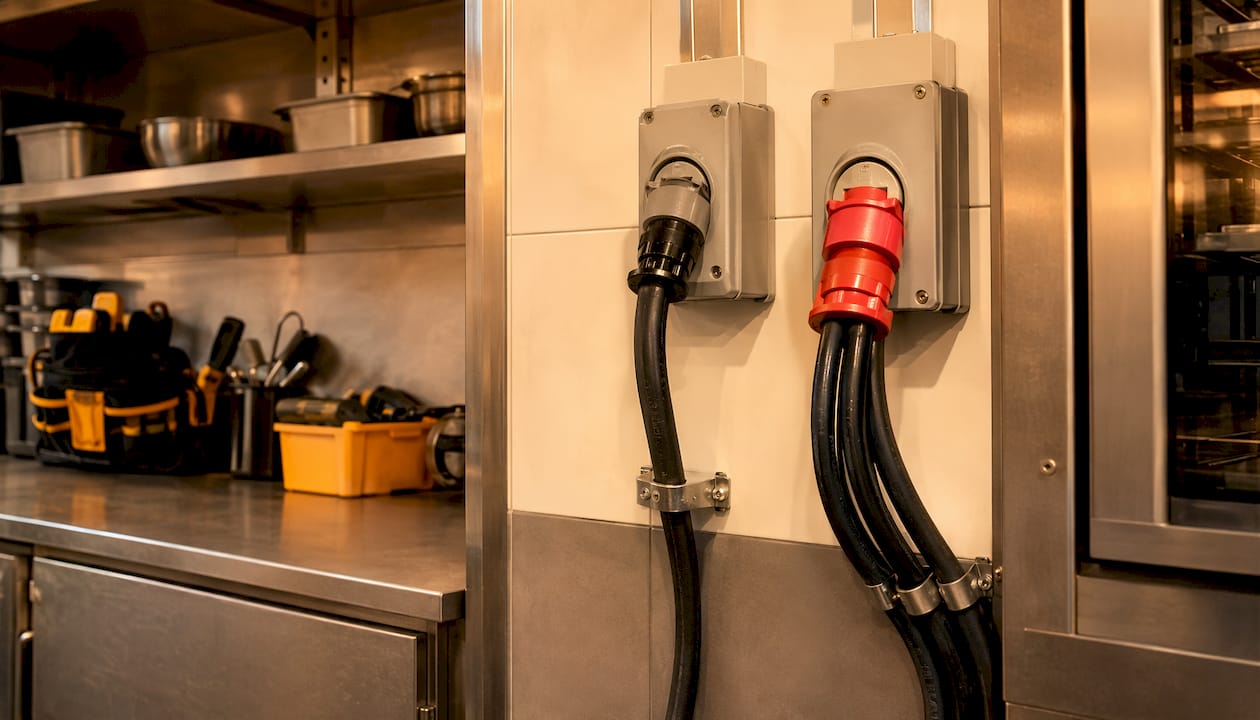
Steady three-phase delivery affects every active component in a modern combi or convection oven. Heating elements recover faster after a door-open event because the available power never dips. Fan motors run at consistent speed without the torque fluctuation that single-phase introduces. Electronic controls, particularly the precision humidity and temperature management systems in Rational iCombi Pro and Unox combi ovens, are sensitive to voltage variation and perform more reliably on a stable supply.
On single-phase, high-load ovens show recognisable symptoms:
- Slower temperature recovery between loads during a busy service
- Dimming lights elsewhere in the kitchen when the oven element cycles on
- Erratic behaviour from electronic controls or touchscreen interfaces
- Nuisance tripping on the circuit breaker during peak demand
Many commercial ovens from Rational, Unox, Blue Seal, and Merrychef are field-configurable for either supply. Ordering the single-phase variant to save on installation cost is a common mistake. It reduces instantaneous available power and slows recovery under sustained throughput. Always check the specification sheet before placing an order.
UK installation checklist: what to plan and who to involve
A proper installation involves more than running a cable to the oven. Work through this checklist before the oven arrives on site:
- Site survey: Commission a qualified electrician (NICEIC or SELECT registered) to assess the existing supply, calculate total connected load, and identify the distribution board capacity.
- Manufacturer wiring diagram: Obtain this before the survey. It specifies supply voltage, phase configuration, cable cross-section, and protective device ratings.
- DNO engagement: If three-phase is not currently available, contact your DNO in writing. Upgrading a UK building supply to three-phase can require a formal application, a site assessment, and possible reinforcement of supply cables. Get a written quote and a realistic lead time before finalising your fit-out schedule.
- Phase balancing: Distribute oven loads across all three phases. Unbalanced single-phase loads on a three-phase supply create excessive neutral currents and cause nuisance tripping even when three-phase is present.
- Cable sizing and protection: Size cables to the manufacturer’s specification, select correctly rated MCBs or fuses, and install RCDs as required by BS 7671.
- Commissioning: Check phase-to-phase voltages, measure neutral current under load, and confirm no single phase is significantly more loaded than the others.
Pro Tip: Where a manufacturer specifies single-phase internal elements within a three-phase oven (common in some Blue Seal and Unox models), split those subcircuits evenly across the three phases at the distribution board. This prevents one phase from carrying the full heating load.
Costs and timelines: wiring now versus upgrading later
The financial case for installing three-phase during fit-out is straightforward. Retrofitting after the kitchen is live costs significantly more in disruption, labour, and potential DNO reinforcement fees.
| Cost factor | What drives the cost | Who provides the quote |
|---|---|---|
| Panel upgrade | New three-phase distribution board, breakers, and labelling | Electrical contractor |
| Incoming service upgrade | DNO application, possible cable reinforcement | DNO / energy supplier |
| Cable runs and containment | Length of run, cable cross-section, trunking or conduit | Electrical contractor |
| Engineer labour | Day rate, access complexity, commissioning time | Electrical contractor |
| Future disruption avoided | Downtime, replastering, re-tiling, lost trading days | Internal estimate |
Key cost drivers to request in writing:
- DNO application fee and estimated reinforcement cost
- Electrician’s day rate and estimated duration
- Cable specification and containment materials
- Commissioning and testing fees
A decision checklist for procurement conversations
Before placing an oven order, work through these questions:
- What is the oven’s rated power input (kW) and which supply voltage does the manufacturer specify?
- Is the model field-configurable for single-phase or three-phase, and what is the performance difference?
- What is the site’s current maximum single-phase capacity, and does the oven rating fit within it?
- What is the total connected load across all kitchen equipment, and is the supply adequate?
- Does the site already have three-phase available at the distribution board?
Red flags to act on immediately:
- The oven’s rated input exceeds your site’s single-phase capacity
- You are experiencing nuisance trips during peak service with existing equipment
- The manufacturer’s wiring diagram is not available or has not been reviewed
- No phase-balancing plan exists for the distribution board
Practical thresholds: single-phase is typically used for loads under roughly 7.5 kW; three-phase becomes the standard for motors above approximately 2.2–3.7 kW and is decisive for total kitchen loads above 10 kW. Bring these figures into your conversation with both your electrician and Thecommercialovenstore sales team.
How to future-proof your kitchen electrical installation
The marginal cost of running additional containment and leaving spare panel capacity at fit-out time is typically far lower than upgrading after the kitchen is live. Practical steps:
- Install conduit and trunking sized for future cable runs, even if those runs are empty at first
- Leave clearly labelled spare phase spaces in the distribution board for additional three-phase circuits
- Document the as-built phase allocation so future installers know exactly what is on each phase
- Design the distribution board with balanced load in mind from day one
Pro Tip: Run three-phase to the kitchen’s central distribution point even if some appliances initially use single-phase tails. The infrastructure cost is small at fit-out; the saving when you add a second combi oven two years later is substantial.
When single-phase supply is acceptable
Single-phase is a workable choice in specific, well-defined situations:
- Total kitchen demand is genuinely below 7.5 kW and no large motors are involved
- The oven is explicitly rated and specified for single-phase operation by the manufacturer
- The site has no realistic prospect of three-phase supply (rural location, listed building)
Where single-phase is the only option, reduce risk with these measures:
- Dedicate a separate circuit to each oven with correctly rated protection
- Check the oven’s inrush current with your electrician and confirm the breaker rating handles it without nuisance tripping
- Use staggered starts where multiple single-phase ovens share a board
- Consider a soft starter if the manufacturer supports it for your model
Where three-phase is genuinely unavailable, rotary or static phase converters can provide a workaround. Both options introduce efficiency losses and additional maintenance points compared with a direct utility supply, so treat them as a last resort rather than a standard solution.
Safety and compliance in commercial kitchen electrical installations
Commercial kitchens are a high-risk environment for electrical installations. Heat, moisture, steam, and cleaning chemicals all accelerate insulation degradation and increase fault risk. BS 7671 sets the baseline for all fixed electrical work in the UK, and commercial kitchens attract additional requirements under its special location provisions.
Key compliance points:
- All fixed wiring must be installed and certified by a qualified electrician; in Scotland, SELECT registration is the recognised standard alongside NICEIC
- RCD protection is mandatory for circuits in zones where water or steam is present
- Cable routes must avoid heat sources; use appropriate cable types rated for the ambient temperature near ovens
- Periodic inspection and testing (EICR) is a legal requirement for commercial premises under the Electricity at Work Regulations 1989
- Oven commissioning must include a check that protective earth continuity is intact and that the supply matches the manufacturer’s rated voltage
Never commission an oven without confirming the supply voltage matches the nameplate rating. A 400 V three-phase oven connected to a 230 V single-phase supply will not simply underperform; it will fail, potentially dangerously.
Maintenance and reliability: what the supply type means long-term
Three-phase ovens generally have a lower maintenance burden under sustained commercial use. The constant torque delivery reduces mechanical stress on fan motors, bearings, and drive components. Electronic control boards are less exposed to voltage fluctuation, which is a common cause of premature failure in single-phase installations running near their capacity limit.
Single-phase ovens running at or near their rated load show higher rates of element failure, motor wear, and control board faults over time. The pulsing power delivery creates thermal cycling stress on components that three-phase avoids. In a high-volume kitchen running two or three services a day, that difference accumulates into measurable maintenance cost within a few years.
Practically, this means:
- Three-phase ovens typically require less frequent element replacement in high-throughput environments
- Control board failures are more common in single-phase ovens operating near capacity
- Phase imbalance on a three-phase supply causes similar degradation to single-phase operation; commissioning checks matter
Energy efficiency and operating costs: single-phase versus three-phase
Three-phase is more efficient at delivering the same power output. The 57.7% reduction in current per conductor means lower resistive losses in the cables, less heat generated in the distribution board, and smaller cable cross-sections that cost less to install. For a high-output kitchen running multiple ovens across a full day, those losses add up.
Single-phase motors also draw more reactive current to compensate for their inherent power factor characteristics, which can increase apparent demand and, in some tariff structures, affect standing charges. Three-phase motors run closer to unity power factor under load.
The operating cost difference between a correctly specified three-phase installation and a single-phase one running near its limit is not trivial over a five-year period. Add the avoided maintenance costs from reduced component stress, and the case for three-phase in any serious commercial kitchen is clear.
Key takeaways
Three-phase power is the correct supply for any professional UK kitchen running high-output commercial ovens; single-phase is only appropriate below roughly 7.5 kW total demand with no large motors.
| Point | Details |
|---|---|
| Choose three-phase for high-output ovens | Any oven above 7.5 kW or with fan motors requires three-phase for reliable performance. |
| Check manufacturer specs before ordering | Field-configurable ovens perform better on three-phase; confirm the wiring diagram before purchase. |
| Engage your DNO early | UK supply upgrades require a formal DNO application; factor lead time into your fit-out schedule. |
| Balance phases at the distribution board | Unbalanced loads cause nuisance tripping even when three-phase is available on site. |
| Thecommercialovenstore for supply and advice | Thecommercialovenstore supplies Rational, Unox, Blue Seal, and Merrychef ovens with expert guidance on electrical specifications. |
The cost of getting the supply wrong
The most common mistake I see is a kitchen manager ordering a high-spec combi oven, then discovering on delivery day that the site has only single-phase available. The oven sits in a corridor for three weeks while a DNO application is processed and an electrician rebooks. It is an expensive, avoidable delay.
The brands we supply at Thecommercialovenstore, Rational, Unox, Blue Seal, and Merrychef, all publish clear electrical specifications. Rational’s iCombi Pro range, for instance, specifies three-phase supply for its larger GN configurations. Unox’s XEFT series includes models configured for both supply types, but the three-phase variant consistently delivers faster recovery under sustained load. Blue Seal convection ovens cover a range of power classes, and the specification sheet tells you exactly what the site needs before you commit.
What I would urge any kitchen manager to do is treat the electrical survey as part of the procurement process, not an afterthought. Thecommercialovenstore can help coordinate installation guidance and point you to the right product specifications before you place an order.
Get the right oven and the right supply from Thecommercialovenstore
Choosing the right oven is straightforward when you have the electrical specification confirmed first. Thecommercialovenstore supplies premium commercial ovens from Rational, Unox, Blue Seal, and Merrychef, with expert pre-sales guidance on power requirements, wiring configurations, and installation coordination. Flexible payment options through iwocaPay mean the capital outlay does not have to land all at once.
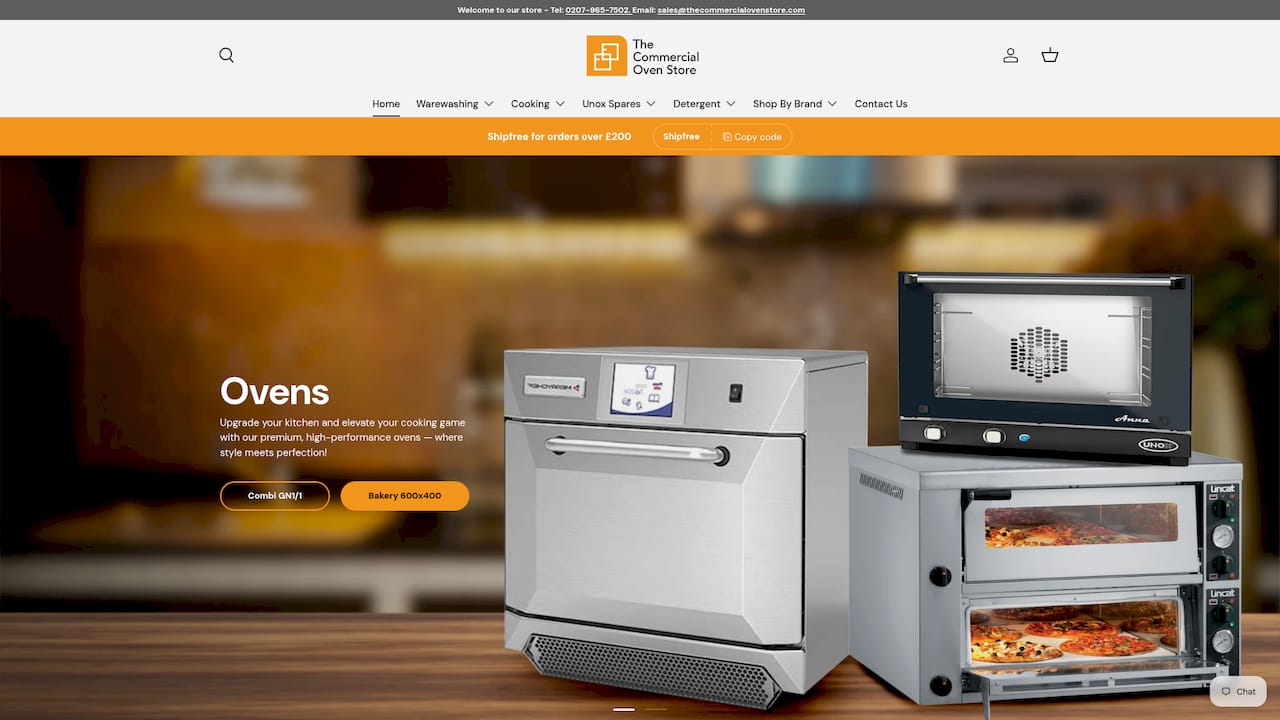
Whether you need a Blue Seal convection oven for a café fit-out or a Rational combi for a high-volume kitchen, the team at Thecommercialovenstore will confirm the electrical specification with you before the order is placed. Browse the full range and request a quote at thecommercialovenstore.com.
Useful references and next steps
- BS 7671 (IET Wiring Regulations): The mandatory standard for all fixed electrical installations in the UK. Your electrician must certify compliance on completion.
- NICEIC / SELECT: Use a registered contractor for all commercial kitchen electrical work. NICEIC covers England, Wales, and Northern Ireland; SELECT covers Scotland.
- Your DNO: Contact your Distribution Network Operator for a written quote on any supply upgrade. Lead times vary; allow several weeks minimum in your fit-out programme.
- Manufacturer wiring diagrams: Request these directly from the manufacturer or from Thecommercialovenstore at the point of enquiry.
Next steps:
- Arrange a site survey with an NICEIC or SELECT registered electrician before placing your oven order
- Obtain a written DNO response if three-phase is not currently available on site
- Review the electrical specification for your shortlisted oven models at thecommercialovenstore.com
- Confirm phase-balancing and commissioning checks are included in your electrician’s scope of work