

Test your feed water before you buy anything else. That single step determines whether you need a compact ion-exchange cartridge system or a full reverse-osmosis unit, and getting it wrong costs far more than the test itself.
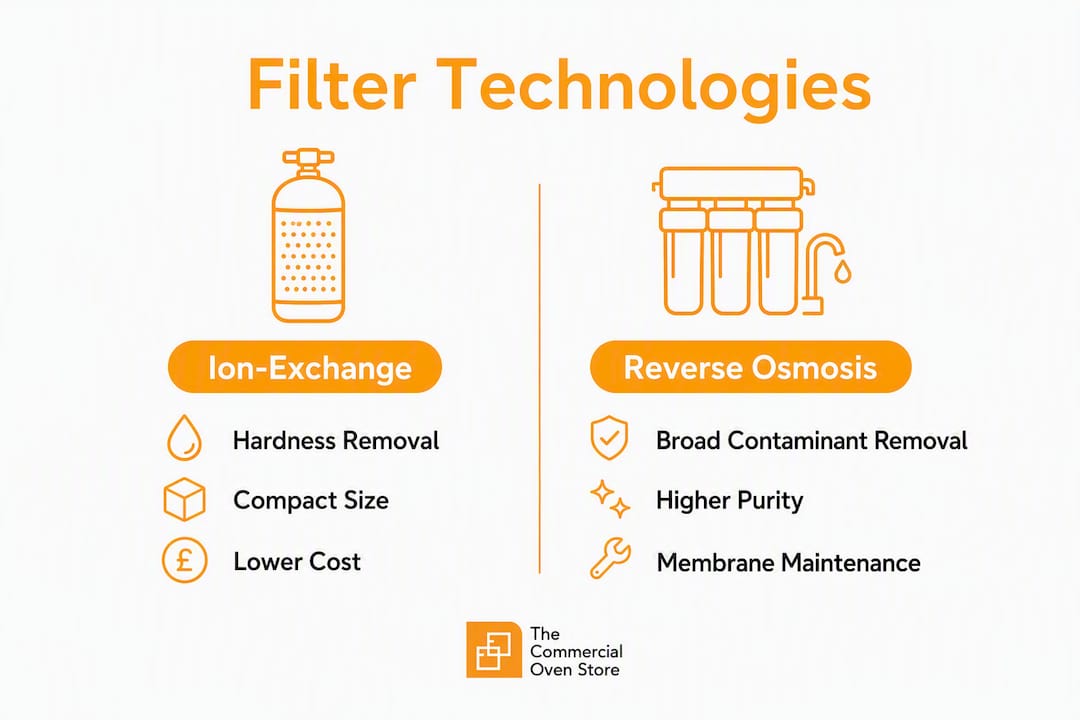
For most small to medium UK commercial kitchens, a specialist ion-exchange or resin cartridge system (such as those in the WaterCare or CTU ranges) will meet OEM water-parameter requirements and protect against limescale. If your site has high chloride levels, high TDS, or runs multiple high-production steam ovens, reverse osmosis is the right technology. Fitting the wrong system, or fitting nothing at all, can void your oven manufacturer’s warranty and leave you paying for boiler repairs that should never have happened.
The three things to do right now:
- Arrange a feed-water analysis covering TDS, total hardness, chlorides, chlorine/chloramine, and pH.
- Compare results against your oven manufacturer’s published water-parameter limits (Blodgett, Rational, and Unox all publish these).
- Contact a UK filtration specialist with those results before specifying any system.
Table of Contents
- Why do combi ovens need a dedicated water filter?
- How do the main filter technologies compare?
- How do you choose the right system for your kitchen?
- What does a combi oven water filter cost in the UK?
- What systems and suppliers will you find in the UK market?
- What are the exact water-parameter targets for combi ovens?
- Your step-by-step action checklist
- Key takeaways
- Water filtration and the ovens you actually buy
- Thecommercialovenstore can help you get this right
- Useful sources
Why do combi ovens need a dedicated water filter?
Mains water in the UK contains dissolved minerals, chlorine, chloramines, and other compounds that cause two distinct types of damage inside combi and steam ovens: scale build-up and corrosion. They are separate problems, and treating one without addressing the other is a common and expensive mistake.
Scale forms when calcium and magnesium carbonates precipitate out of water during heating. Inside a combi oven, this coats steam generators, spray nozzles, and heat-exchange surfaces. The result is reduced heat transfer, higher energy consumption, blocked nozzles, and eventually component failure. A thin layer of limescale acts as an insulator, forcing the heating element to work harder for the same output.
Corrosion is the less obvious threat. Chlorides, chloramines, and sulphates attack stainless-steel components, particularly in the boiler and steam circuit. Blodgett’s water-treatment guidance sets the chlorine and chloramine limit at 0.2 ppm, above which stainless-steel corrosion accelerates. Critically, a water-softening system that removes hardness but leaves chlorides untouched can actually concentrate those chlorides in the treated water, increasing corrosion risk rather than reducing it.
Warranty note: Blodgett states explicitly that boiler maintenance and the use of good-quality feed water are the owner’s responsibility, and that poor-quality feed water will void the warranty. Rational and Unox publish equivalent requirements. Fitting a filter that does not meet OEM parameter ranges offers no warranty protection.
Pro Tip: Polyphosphate-based scale inhibitors, sometimes sold as a low-cost alternative, break down at steam-generation temperatures and are not adequate protection for combi ovens. Avoid them.
The practical stakes are straightforward: an unplanned boiler replacement on a mid-range combi oven typically costs more than several years of filtration consumables. Warranty voidance on top of that removes any manufacturer contribution to repair costs.
How do the main filter technologies compare?
Three core technologies cover the UK market for combi oven water filtration, and most installed systems combine at least two of them.
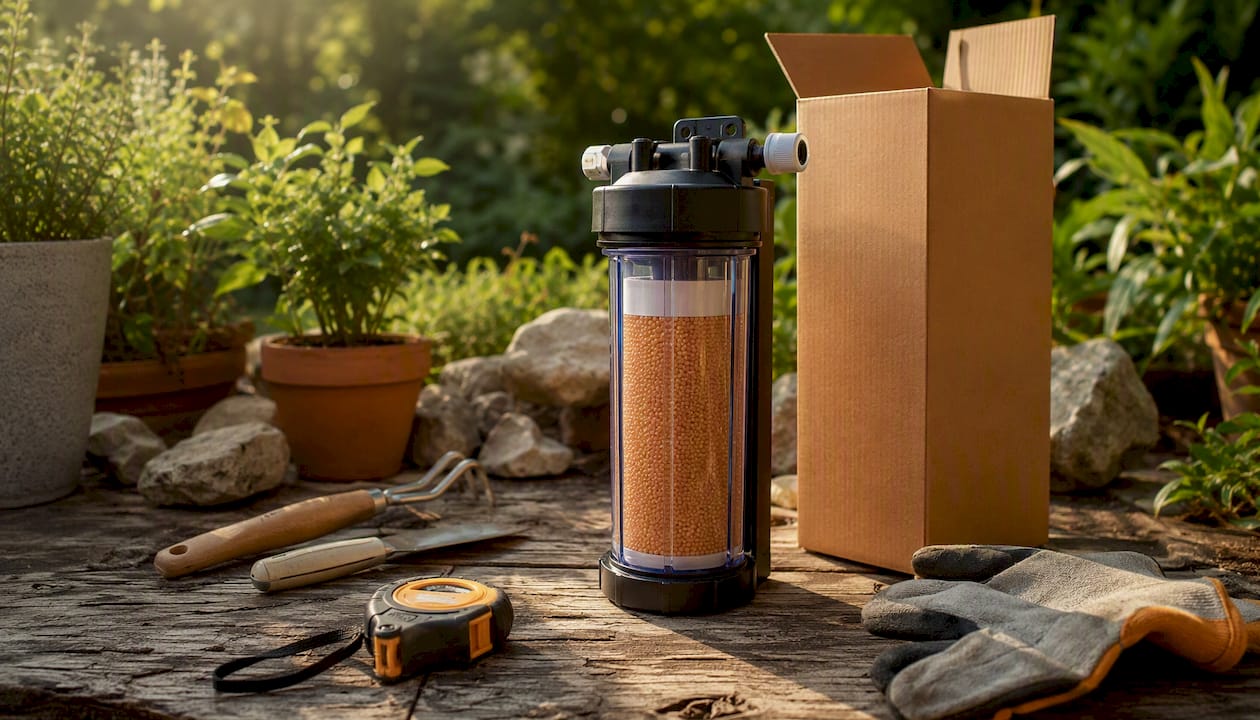
Ion-exchange and resin cartridge systems
Ion-exchange systems swap calcium and magnesium ions for sodium or hydrogen ions, reducing carbonate hardness and preventing limescale. WaterCare’s UK-made filtration systems, including their CTU and IX Eco ranges, are built specifically for this application. They are compact, straightforward to install under a counter or adjacent to the oven, and do not require a drain connection or electricity. Cartridges are either replaced or, with regenerable systems, refilled and returned, which reduces both waste and long-term cost.
The limitation: standard ion-exchange does not remove chlorides, chlorine, or chloramines. In areas with high chloride concentrations or chloraminated mains supply, a softener alone leaves corrosion risk unaddressed.
Reverse osmosis systems
RO systems are the industry standard for high-production steam equipment because they reject the full spectrum of dissolved minerals, including chlorides that ion-exchange misses. Water passes through a semi-permeable membrane under pressure, producing very low-TDS permeate. The trade-offs are real: RO units require a cold-water feed, a drain connection, adequate feed pressure (typically 3.5–5.9 bar), and a storage tank with a re-pressurisation pump to maintain supply during peak demand. Footprint and installation complexity are both higher than cartridge systems.
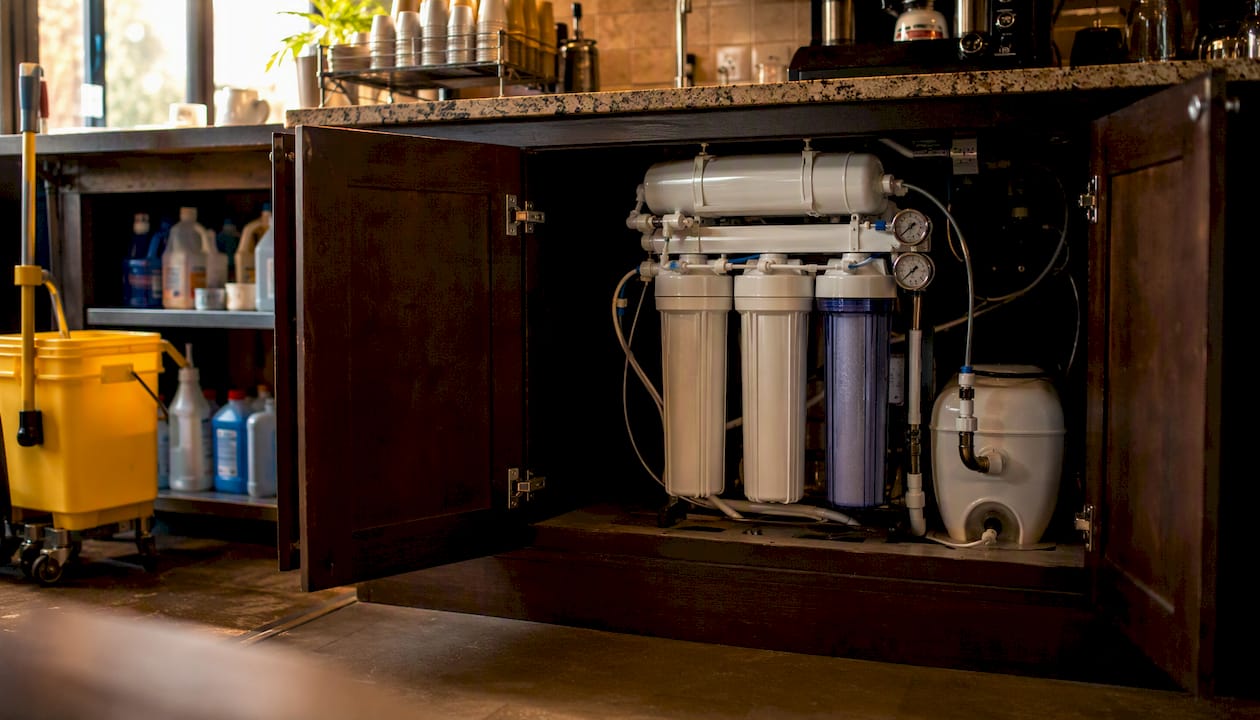
Membrane life varies with feed-water quality. Pentair Everpure’s OPS-series spec sheets recommend pre-filter and mineral-addition cartridge changes every six months, with membrane replacement at around 18 months depending on conditions.
Carbon pre-filters and chloramine reduction stages
Carbon block pre-filters sit upstream of an RO membrane or ion-exchange resin to remove chlorine, chloramines, and sediment. They protect the downstream stage from fouling and extend its service life. In areas with chloraminated mains water (increasingly common across UK water authority zones), a dedicated chloramine-reduction stage is not optional; it is the guard that keeps the rest of the system working.
Combination systems
The most capable systems combine pre-filtration, RO, and a mineral-addition cartridge in a single unit. The mineral-addition stage re-introduces a controlled level of minerals after RO treatment to meet the conductivity requirements of steam-sensor circuits, which need a minimum TDS to function correctly. Pentair Everpure’s OPS70/2 and OPS175/5 systems follow this architecture, as do multi-stage wall-mounted units with integrated storage tanks. A single combination system can also serve coffee machines, dishwashers, and steamers simultaneously, reducing parts inventory and simplifying service calls.
| Dimension | Ion-exchange / resin | Reverse osmosis | Combination system |
|---|---|---|---|
| Best for | Small to medium sites, low chlorides | High-production steam, high chlorides or TDS | Multiple appliances, complex water chemistry |
| Hardness/TDS reduction | Good (carbonate hardness) | Excellent (broad mineral rejection) | Excellent |
| Chloride/corrosion protection | Limited | Strong | Strong |
| Flow rate / capacity | Moderate (cartridge-dependent) | Depends on tank size and pump | High (tank-buffered) |
| Installation complexity | Low | Medium to high | High |
| Maintenance | Cartridge swap or regeneration | Pre-filter, membrane, mineral cartridge | Multiple stages; service contract recommended |
| Typical cost shape | Lower upfront, predictable consumables | Higher upfront, higher ongoing service | Highest upfront, lowest per-appliance OPEX at scale |
How do you choose the right system for your kitchen?
Start with the water test, not the brochure. Feed-water chemistry varies significantly across UK regions: London and the South East have notoriously hard water, while parts of Scotland and Wales run soft. A site in a hard-water zone with chloraminated supply needs a fundamentally different system from one in a soft-water area with low chlorides.
Before contacting any supplier, have these figures to hand:
- TDS (target: 40–125 ppm per Blodgett guidance)
- Total hardness (target: 35–180 ppm)
- Chloride concentration (target: below 25 ppm)
- Chlorine and chloramine levels (target: below 0.2 ppm)
- pH (target: 7.0–8.5)
- Number of ovens and other appliances drawing from the same supply
- Peak simultaneous demand (litres per hour)
With those numbers, the system family usually selects itself. Low TDS, low chlorides, moderate hardness: a well-sized ion-exchange cartridge system is sufficient. High chlorides or chloramines present: add carbon pre-filtration at minimum, or move to RO. High-production central kitchen with multiple steam ovens: RO with a storage tank and mineral-addition stage.
Pro Tip: Check whether your site has adequate feed pressure for an RO unit before specifying one. Most RO systems require 3.5 bar or above at the inlet. If mains pressure is borderline, a booster pump adds cost and complexity.
Questions to ask every supplier before committing:
- Does this system meet the OEM water-parameter requirements for my specific oven model? Can you confirm that in writing?
- What is the cartridge or membrane replacement schedule, and what are the ongoing consumable costs?
- Do you offer a service contract with defined response times?
- Can you provide references from UK catering sites using this system with the same oven brand?
- Is the system UKCA or CE marked, and does it comply with relevant water-fittings regulations?
Red flags to watch for: a supplier who cannot confirm OEM compatibility in writing, a proposal that is clearly undersized for your peak demand, no local service engineer, or a warranty that excludes water-treatment failures. Walk away from any supplier who cannot produce commissioning paperwork.
What does a combi oven water filter cost in the UK?
Cartridge and ion-exchange systems for a single oven typically start from a few hundred pounds for the unit, with installation adding to that depending on site conditions. RO systems with storage tanks and booster pumps sit at a higher price point, and combination systems covering multiple appliances are higher still. Exact pricing varies by supplier, configuration, and site requirements, so treat any figure without a site survey as a rough guide only.
Ongoing costs to budget for:
- Cartridge replacements (ion-exchange) should be scheduled based on capacity or water hardness and throughput rather than strict calendar dates.
- RO pre-filter and mineral-addition cartridges: every six months is a common recommendation from manufacturers such as Pentair Everpure.
- RO membrane replacement varies under normal feed-water conditions and should follow manufacturer recommendations.
- Annual service visit: most UK suppliers offer service contracts covering inspection, consumable swap, and a water test.
The comparison that matters most is not filter cost versus zero: it is filter cost versus the cost of an unplanned boiler repair, a failed warranty claim, or a condemned oven. A single boiler replacement on a commercial combi oven can run to four figures. Regenerable cartridge systems from suppliers such as WaterCare reduce both plastic waste and the unpredictability of consumable spend, which matters for sites managing tight maintenance budgets.
Installation typically requires a cold-water feed connection, drain access for RO systems, and sufficient space under the counter or in a plant room. Sites with low mains pressure may need a booster pump, and some RO configurations require a dedicated feed line rather than a tee off an existing supply.
What systems and suppliers will you find in the UK market?
The UK market for combi oven water filtration splits broadly into three supplier types, and knowing which you are dealing with shapes what you can expect from them.
Filtration specialists design, supply, and service systems specifically for commercial catering equipment. WaterCare is a UK-based example, manufacturing ion-exchange and CTU-range systems domestically and offering regeneration services and service contracts. AquaCure operates in the UK commercial water-treatment space and covers catering applications. These suppliers typically offer on-site water testing, system sizing, commissioning documentation, and ongoing service agreements.
Equipment distributors and OEM-aligned suppliers supply filter kits matched to specific oven brands. Retigo, for instance, references compatible filtration as part of its combi oven commissioning guidance. BWT (available in the UK) produces the PURITY C Steam Advanced range, a cartridge-based system widely specified for combi and steam oven applications and designed to reduce carbonate hardness while maintaining a controlled mineral content. Pentair Everpure’s SC Filtration Systems and OPS-series RO units are available through UK distributors and are specified for steam and combi oven use.
National service providers offer regeneration contracts and multi-site service agreements, which suit hotel groups, contract caterers, and central production kitchens managing large equipment fleets.
Pro Tip: Ask whether your supplier offers a regenerable or refillable cartridge programme. WaterCare’s IX Eco-style systems use refillable cartridges that are collected, regenerated, and returned, cutting plastic waste and giving you a predictable service cost rather than a variable consumable bill.
What a good UK supplier should provide as standard: an on-site or postal water test before system sizing, a written commissioning report with pre- and post-treatment water readings, a service schedule with defined cartridge or membrane change intervals, and spare-part availability for at least five years.
What are the exact water-parameter targets for combi ovens?
Blodgett’s published water-treatment guidance provides some of the most specific OEM parameter ranges available, and they are a useful benchmark even when specifying for Rational, Unox, or other brands.
| Parameter | Blodgett recommended range | Why it matters |
|---|---|---|
| TDS | 40–125 ppm | Too low causes conductivity sensor issues; too high causes scale |
| Total hardness | 35–180 ppm | Carbonate hardness is the primary scale-forming agent |
| Silica | Below 25 ppm | Silica scale is hard to remove and damages heat surfaces |
| Chlorides | Below 25 ppm | Chloride ions cause pitting corrosion in stainless steel |
| Chlorine / chloramine | Below 0.2 ppm | Above this level, stainless-steel corrosion accelerates |
| pH | 7.0–8.5 | Outside this range, both scale and corrosion risk increase |
Rational and Unox publish their own equivalent specifications; always confirm the exact figures for your oven model with the manufacturer or your authorised dealer before finalising a system specification.
The chloride and chloramine parameters deserve particular attention. A site that installs a softener to address hardness but has chloride levels above 25 ppm is still running outside OEM limits, and the warranty exposure remains. Where chloramines are present in the mains supply (check with your local water authority), a carbon or dedicated chloramine-reduction stage is necessary regardless of hardness levels.
Pentair Everpure’s combination systems address this by including a mineral-addition cartridge after the RO membrane, which brings treated water back to a TDS within the sensor-compatible range. Without that stage, very low-TDS RO permeate can fall below the minimum conductivity threshold and cause steam-sensor faults.
Keep commissioning water-test results on file. Blodgett’s guidance is explicit that boiler maintenance and feed-water quality are the owner’s responsibility. If a warranty claim arises, documented proof that water parameters met OEM requirements at installation is your primary defence.
Your step-by-step action checklist
-
Run a feed-water analysis. Test for TDS, total hardness, chlorides, chlorine/chloramine, and pH. Use a postal water-test kit, an on-site aquameter, or ask a filtration supplier to test during a site visit. Compare results against your oven manufacturer’s published limits.
-
Select the system family. Low hardness, low chlorides, soft-water region: ion-exchange cartridge system. Moderate hardness, chloraminated supply: ion-exchange plus carbon pre-filter. High chlorides, high TDS, or multiple high-production steam ovens: RO with mineral-addition stage. Multiple appliances across the site: combination system covering all steam and coffee equipment.
-
Get two written proposals. Each should include system sizing based on your water-test results, confirmation of OEM compatibility for your specific oven model, commissioning scope, service SLA with response times, cartridge or membrane replacement schedule and costs, and spare-part availability.
-
Confirm OEM compatibility in writing before signing anything. Ask the supplier to reference your oven model and the manufacturer’s water-parameter specification in the proposal document.
-
Commission and document. At installation, the engineer should take pre- and post-treatment water readings and provide a commissioning report. File this with your oven purchase documentation and warranty paperwork. Set a calendar reminder for the first service interval.
-
Schedule ongoing service. Agree a service contract that includes periodic water testing, not just cartridge swaps. Parameter drift (a rising TDS or hardness reading) should trigger a service call, not just the calendar date.
Key takeaways
Fitting the right combi oven water filter requires a feed-water test first, then a system matched to OEM parameter limits, covering TDS, hardness, chlorides, and chloramine, to keep warranties valid and prevent both scale and corrosion.
| Point | Details |
|---|---|
| Test before you specify | Run a full feed-water analysis (TDS, hardness, chlorides, chloramine, pH) before contacting any supplier. |
| Match OEM limits | Blodgett sets chlorides below 25 ppm and chloramine below 0.2 ppm; Rational and Unox publish equivalent ranges. |
| Ion-exchange vs RO | Ion-exchange suits small to medium sites with low chlorides; RO is necessary where chlorides are elevated or steam output is high. |
| Factor in lifecycle costs | Budget for cartridge or membrane replacements, annual service visits, and commissioning documentation, not just the upfront unit price. |
| The commercial oven store | Supplies compatible Unox filter kits and installation accessories alongside combi ovens, with flexible payment options to bundle oven and filtration in one purchase. |
Water filtration and the ovens you actually buy
The specification question that most articles skip is this: the oven and the filter are not separate decisions. If you buy a Rational iCombi Pro or a Unox combi and then discover your mains water sits outside OEM limits, you are already in warranty risk territory before you have cooked a single tray.
The operators who handle this well treat filtration as part of the oven purchase, not an afterthought. A small bakery running one or two combi ovens in a hard-water area almost always gets away with a well-sized ion-exchange cartridge system, changed on schedule. A central production kitchen running six steam ovens in London, where Thames Water chloraminates the supply, needs RO with pre-filtration and a mineral-addition stage, and the commissioning paperwork to prove it.
What I see less often, but should be standard practice: operators keeping the original commissioning water-test results alongside the oven invoice. That document is the difference between a successful warranty claim and a four-figure repair bill that sits entirely with the operator.
Thecommercialovenstore can help you get this right
Buying a combi oven and sorting the filtration separately means two suppliers, two service relationships, and the risk that neither confirms OEM compatibility in writing. Thecommercialovenstore stocks compatible Unox Pure filter cartridges and Unox Pure RO filter kits alongside the full range of Rational and Unox combi ovens, so you can specify oven and filtration together and confirm compatibility before anything ships.
Flexible payment through iwocaPay means the filtration kit does not have to compete with the oven budget. Whether you are buying a Rational iCombi Pro for a busy restaurant kitchen or a smaller Unox unit for a café, the team can confirm the OEM water-parameter requirements for your model, point you to the right filter kit, and connect you with a local installation engineer. Get in touch via thecommercialovenstore.com to request a water-test referral or a bundled oven and filtration quotation.
Useful sources
The sources below are worth bookmarking for datasheets, OEM parameter specifications, and UK supplier pages. Always keep copies of water-test results and commissioning paperwork alongside these references.
- Blodgett water-treatment guidance: the most detailed OEM water-parameter specification publicly available, covering TDS, hardness, silica, chlorides, chloramine, and pH with explicit warranty language.
- WaterCare commercial combi oven filtration: UK-based specialist covering CTU, IX Eco regenerable systems, and on-site water testing for catering environments.
- Pentair Everpure combination systems: SC Filtration Systems and OPS-series RO units specified for steam and combi oven applications, with downloadable spec sheets.
- Pentair Everpure SC Filtration Systems: product detail page for the SC range, including flow rates and cartridge specifications.
- AquaCure UK reviews: independent customer reviews for a UK commercial water-treatment supplier active in the catering sector.
Suppliers should provide commissioning paperwork that records pre- and post-treatment water readings matched to your OEM’s parameter requirements. If a supplier cannot or will not provide this documentation, treat that as a reason to look elsewhere.