

For most small UK bakeries, a convection oven is the right starting point: even heat, faster bake times, and a footprint that fits real kitchens. If artisan sourdough is your core product, a deck oven with steam injection is the better call. Running a mixed menu at volume? A combi oven from Rational or Unox gives you the control to do both without compromise.
Quick shortlist by use-case:
- Home hobbyist or cottage baker: A compact convection oven with a small tray capacity handles pastries, cookies and enriched doughs without the cost or complexity of commercial kit.
- Micro-bakery (up to 50 covers or weekly market stall): A mid-range convection oven such as the Bakerlux XB693 gives you consistent results and programmable cycles without a three-phase supply in most configurations.
- Artisan sourdough or bread-focused bakery: A deck oven with self-contained steam injection. Deck ovens produce strong bottom heat and steady temperatures that form crisp crusts and well-set interiors.
- Café or coffee shop with baked goods: A speed oven such as the Merrychef range handles rapid service without sacrificing finish quality.
- Small commercial or wholesale bakery: A combi oven from Rational or Unox, with programmable multi-stage cycles and humidity control, is the standard choice for balancing quality and throughput.
Before you go further, three immediate checks: confirm your available electrical supply (single or three-phase), measure your floor space including door swing and clearance zones, and ask any supplier about warranty response times and UK spare-parts availability before you commit.
Table of Contents
- Which oven type suits your use-case and budget?
- What does each oven type actually do?
- How to choose the right oven for your bakery
- What does a bakery oven actually cost to run in the UK?
- Where to buy, how to install, and what warranty cover to expect
- Recommended models available from Thecommercialovenstore
- Key takeaways
- The oven decision most buyers get wrong
- Ready to find the right oven for your bakery?
- Useful sources and further reading
Which oven type suits your use-case and budget?
The UK commercial baking oven market splits cleanly into four buyer groups. Knowing which one you are saves you from overspending on features you will never use, or underspending on capacity that will throttle your output within six months.
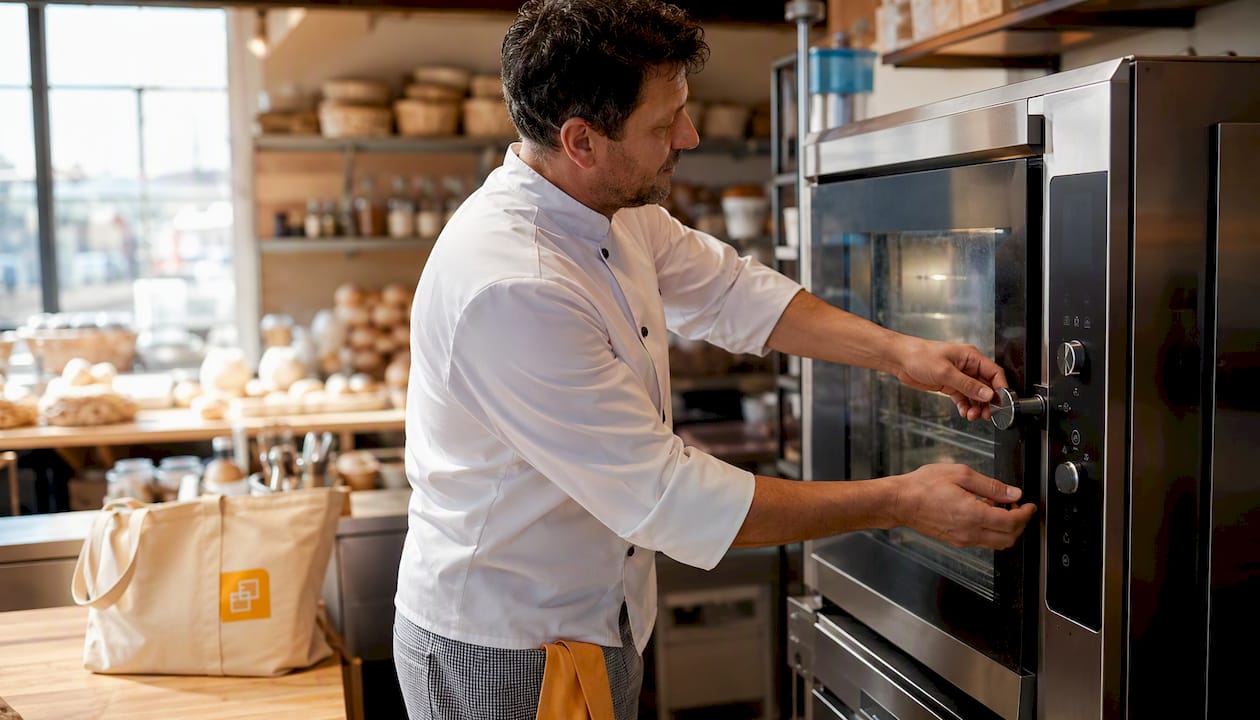
| Use-case | Oven type | Typical UK price band | Common fuel |
|---|---|---|---|
| Home / hobby baker | Compact convection ovens with a small tray capacity | £800–£2,500 | Electric |
| Micro-bakery / market stall | Mid convection or Bakerlux-style | £2,500–£6,000 | Electric |
| Artisan / sourdough bakery | Deck ovens with multiple decks and steam injection | £4,000–£14,000 | Electric or gas |
| Café / coffee shop | Speed oven or compact convection | £3,000–£8,000 | Electric |
| Small commercial / wholesale | Combi ovens with moderate tray capacities | £8,000–£25,000+ | Electric or gas |
Delivery lead times in the UK vary by brand and model. Stock items from dealers such as Thecommercialovenstore typically ship quickly; made-to-order or imported units from Rational, Unox or Blue Seal may take several weeks depending on specification and current demand. Always confirm lead time before signing off on a kitchen fit-out schedule.
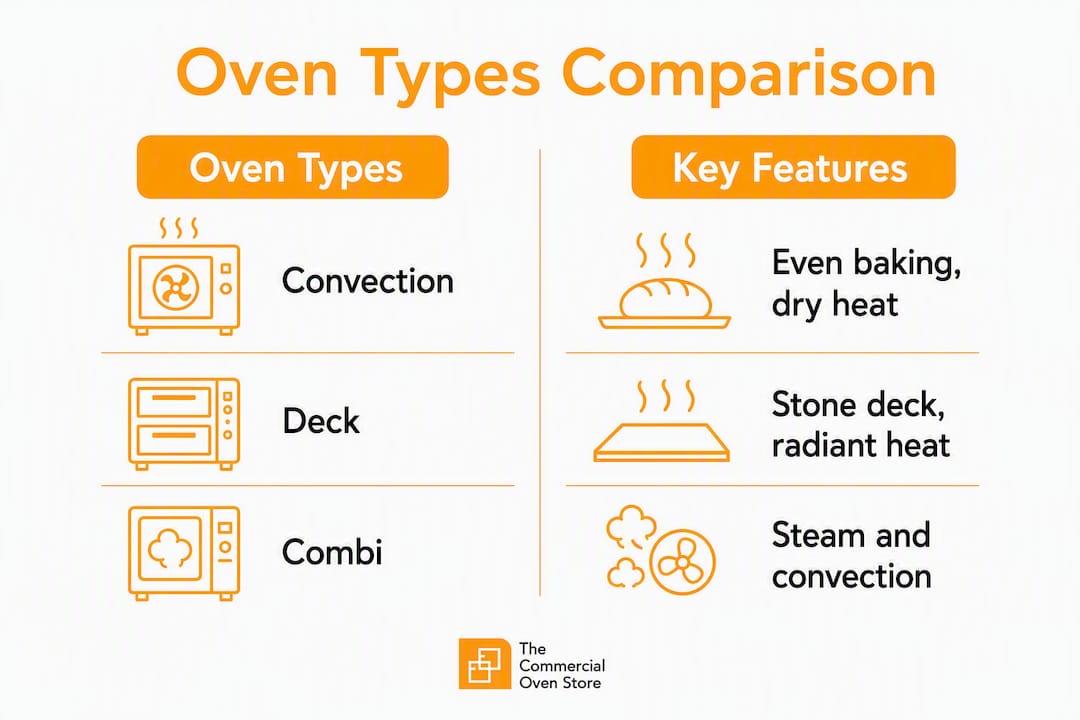
Price bands above reflect typical dealer pricing for new equipment. Ex-demonstration and refurbished units can reduce entry costs by 20–40%, though warranty terms will differ. Commercial oven category pages show the breadth of configurations available across convection, combination, deck and rack formats.
What does each oven type actually do?
Understanding the mechanics behind each oven type is not just academic. The wrong airflow design or heat source will affect your product quality every single day.
Convection ovens
A convection oven uses one or more fans to circulate hot air around the chamber. The result is even browning across multiple trays, faster cook times than a static oven, and consistent results for delicate products. Convection ovens are particularly well suited to pastries, cookies and muffins because the circulating air prevents hot spots and reduces bake time without drying out the product.
The trade-off is moisture. Circulating air strips humidity from the chamber, which can cause surface drying on enriched doughs and makes achieving an artisan crisp crust genuinely difficult without integrated steam injection. Basic convection models lack that feature; commercial-grade units with professional steam management close the gap considerably.
Deck ovens
Deck ovens use thick stone or steel baking surfaces heated from below, with radiant heat from above. There are no fans. The result is a steady, enveloping heat that mimics a traditional stone hearth. Artisan bread bakers favour them because the strong bottom heat drives oven spring and the self-contained steam injection systems produce the burst of humidity needed for crust development in the first minutes of baking.
The limitation is throughput. Loading and unloading individual loaves or trays from each deck is slower than racking a convection oven, and recovery time after the door opens is longer on entry-level units. For a bakery producing 50 or more loaves per session, a two or three-deck unit is the minimum practical configuration.
Combi ovens
Combi ovens combine convection heat with steam injection and let you control both independently. That combination is what makes them the standard choice for bakeries running a mixed menu: you can bake croissants at low humidity, switch to a high-steam cycle for sourdough, and then proof enriched doughs in the same chamber. High-end combi ovens combine steam and convection control to deliver consistent results at scale, which is why they appeal to bakeries that need both artisan quality and speed.
Modern units from Rational and Unox go further. Some store over 70 personalised recipe variants and use sensors to optimise cooking phases by load type, which means less experienced staff can deliver consistent results without supervision. That programmability is worth prioritising for small teams.
Rack ovens
Rack ovens are designed for high-volume production. You load an entire rolling rack of trays directly into the chamber, which rotates during baking for even results. They are the right tool for wholesale bakers producing hundreds of units per session. For a micro-bakery or café, the footprint and cost are rarely justified.
Speed ovens
Speed ovens, such as the Merrychef range, combine microwave energy with convection and sometimes infrared to dramatically cut cook times. They are built for rapid service rather than artisan production: reheating pastries, finishing par-baked goods, or running a café counter where a customer expects a hot item in under two minutes. Output quality is good for that purpose; they are not a substitute for a proper baking oven if you are producing from scratch.
Pro Tip: Do not choose a convection oven and assume you can add steam later. Most entry-level and mid-range convection units have no steam injection capability at all. If your menu includes any bread product where crust development matters, confirm steam injection is built in before you buy, not after.
How to choose the right oven for your bakery
Matching oven type to product type, daily volume, footprint and utility requirements is the single most important step in the buying process. Work through this checklist before you speak to any supplier.
- Define your core menu. List the three or four products you will bake most. Pastries and cookies favour convection; artisan loaves favour deck; a mixed menu with bread and pastry favours combi.
- Estimate daily output. How many units per session, how many sessions per day? A micro-bakery doing two sessions of 60 pastries needs different capacity to a café doing continuous small batches across a full service day.
- Measure your space. Note floor dimensions, ceiling height, and the position of doors and extraction points. Many commercial ovens require clearance zones on all sides for ventilation and servicing, plus space for door swing.
- Confirm your utilities. Check whether your site has single-phase (13A or 32A) or three-phase electrical supply. Many commercial ovens above 6 kW require three-phase. If you are considering gas, confirm a certified gas supply is accessible and budget for a Gas Safe registered installation.
- Set a realistic total budget. Include purchase price, delivery, installation, extraction work, any electrical upgrade, and a commissioning fee. The oven price is rarely the whole cost.
- Ask about warranty and service. Confirm what the warranty covers, whether repairs are on-site or depot-based, and what the typical response time is in your area.
- Request a site survey. Any reputable dealer should offer a pre-sale site survey, or at minimum a technical consultation, before you order.
Worked example: a micro-bakery producing sourdough and pastries
Suppose you are opening a micro-bakery producing 80 sourdough loaves and 120 pastries per day across two sessions. Your kitchen is 18 m², you have a single-phase 32A supply, and your budget is £8,000 all-in including installation.
That profile points to a mid-range convection oven with steam injection for the pastries, plus a single-deck stone oven for the sourdough. The problem is budget: a quality deck oven alone can reach £6,000–£8,000 before installation. The practical answer for this buyer is a combi oven in the 6-tray GN1/1 class, which handles both product types in one unit, and a three-phase supply upgrade if the site allows it. If three-phase is not feasible, a high-quality electric convection oven with integrated steam injection covers most of the menu, with the sourdough crust quality slightly compromised versus a dedicated deck.
Questions to ask suppliers and red flags to watch for:
- What is the warranty period and does it include parts and labour?
- Is servicing on-site or does the unit need to go to a depot?
- What is the typical spare-parts lead time for this brand in the UK?
- Does the quoted price include commissioning and a handover demonstration?
- Is the model UKCA or CE marked, and can you provide the declaration of conformity?
Red flags: a supplier who cannot confirm spare-parts availability in the UK, a quoted price with no mention of installation or extraction, and any dealer who discourages a site survey before purchase.
What does a bakery oven actually cost to run in the UK?
Purchase price is only part of the story. Choosing a professional-grade unit with robust steam management often pays for itself through reduced waste and consistent product quality, but you still need to understand the full cost picture before committing.
Typical UK purchase brackets:
- Entry-level convection (4–6 tray, electric): £800–£3,000
- Mid-range convection ovens or Bakerlux-style ovens with moderate tray capacities: £3,000–£7,000
- Deck oven (1–2 decks, steam): £4,000–£12,000
- Combi oven (6 GN1/1, electric): £8,000–£15,000
- Combi oven (10 GN1/1, electric or gas): £14,000–£25,000+
- Rack oven (full-size, gas): £15,000–£35,000+
Common installation costs to budget for:
- Ventilation and extraction canopy: £500–£2,500 depending on site
- Three-phase electrical upgrade: £800–£3,000+ depending on distance from supply
- Gas hook-up and certified installation: £400–£1,200
- Site modifications (floor reinforcement, wall clearance): variable
- Commissioning and handover: often included by dealer, sometimes charged at £150–£400
| Operating cost factor | Electric convection | Gas deck | Combi (electric) |
|---|---|---|---|
| Typical power draw | 3–6 kW | 10–20 kW equivalent | 6–14 kW |
| Approx. daily energy cost (8-hr use) | £3–£7 | £5–£12 | £6–£14 |
| Recovery time after loading | Fast (fans assist) | Moderate to slow | Fast (sensors assist) |
| Steam capability | Model-dependent | Built-in (stone deck) | Full humidity control |
Energy costs above are illustrative estimates based on typical UK commercial electricity rates and gas tariffs; your actual costs will depend on your tariff, usage pattern and oven efficiency rating. Always request the oven’s energy consumption data from the manufacturer before purchase.
Simple five-year TCO example (mid-range electric combi, 6 GN1/1):
- Purchase price: £10,000
- Installation (three-phase upgrade + extraction + commissioning): £3,500
- Annual energy cost (estimated, two sessions per day, five days per week): £1,800
- Annual maintenance contract: £500
- Five-year total: £10,000 + £3,500 + (£2,300 × 5) = £25,000
That figure puts a £10,000 combi oven in a very different light compared to a £4,000 convection unit with lower installation costs but higher per-batch waste from inconsistent results. Better insulation and intelligent energy management lead to faster recovery and more consistent results, which reduces the hidden cost of rejected batches over time.
Understanding yeast dough proofing and humidity control also affects your running costs: an oven that lets you proof and bake in the same chamber eliminates the need for a separate proofer, which is a meaningful saving on both equipment spend and floor space.
Where to buy, how to install, and what warranty cover to expect
Buying routes in the UK
There are three main routes to buying a commercial bakery oven in the UK. Each has different implications for service and support.
Manufacturer-authorised dealers carry stock, offer pre-sale advice, and typically have service engineers in the field. Brands like Rational and Unox operate through authorised dealer networks, and buying through one means your warranty is registered correctly and service calls are handled by trained engineers.
Direct online specialists such as Thecommercialovenstore offer a curated range of commercial ovens from leading brands, with the convenience of online ordering, transparent pricing, and flexible payment options through iwocaPay. The advantage over a general marketplace is that the team can advise on specification, confirm UK compliance, and connect you with installation support. Spare-parts availability and service lead times vary by dealer and brand, so asking these questions directly before ordering is always worth doing.
General trade marketplaces list a wide range of units but offer limited pre-sale technical support and variable after-sales service. They can be useful for price comparison but are rarely the right route for a first commercial oven purchase.
Installation essentials
Before your oven arrives, confirm the following:
- Site survey: Has a qualified engineer assessed clearance zones, ventilation requirements and door swing?
- Extraction: Does your extraction canopy meet the oven’s airflow requirements? Undersized extraction is one of the most common causes of installation delays.
- Electrical supply: Three-phase supply confirmed and tested? If not, has an electrician quoted for the upgrade?
- Gas supply: If gas-fired, is a Gas Safe registered engineer booked for the connection and commissioning?
- UKCA/CE compliance: Request the declaration of conformity for the model. All commercial ovens sold in the UK must carry UKCA or CE marking; confirm this before purchase.
- Commissioning paperwork: Ensure the commissioning engineer signs off the installation and that you receive a commissioning certificate, which most manufacturers require for the warranty to be valid.
Warranty and service questions
Ask every supplier these questions before you sign:
- What is the warranty period? (Typically one to two years parts and labour for most brands; some extend to three years on specific models.)
- Is warranty service on-site or depot-based? On-site is strongly preferable for a production kitchen.
- What is the typical engineer response time in your postcode area?
- Are spare parts held in the UK, and what is the average lead time for common components?
- Is a maintenance contract available, and what does it cover?
Financing options
UK businesses purchasing commercial ovens can spread the cost through several routes. Thecommercialovenstore offers flexible payment options through iwocaPay, which allows businesses to split the purchase cost without a long-term lease commitment. Traditional equipment finance and hire purchase are also available through most high-street banks and specialist asset finance brokers. For VAT-registered businesses, the VAT element on a purchase is reclaimable on the next return, which effectively reduces the upfront cash requirement.
Recommended models available from Thecommercialovenstore
Thecommercialovenstore stocks a focused range of commercial ovens from Rational, Unox, Blue Seal and Merrychef. The models below map directly to the use-cases covered earlier.
Unox Bakerlux XB693 (micro-bakery and café)
The Bakerlux XB693 is a six-tray manual convection oven built for consistent, high-volume baking in compact spaces. It suits micro-bakeries and cafés that need reliable output without the complexity of programmable combi controls.
- Six 600x400mm tray capacity; GN1/1 compatible
- Manual controls; even heat distribution via reversing fan
- Electric; single or three-phase options depending on configuration
Typical UK price band: mid-range. Available from stock; confirm current lead time with the store. Warranty and UK service support available through Unox’s authorised network.
Unox Bakerlux XB893 (mid-volume bakery)
The Bakerlux XB893 steps up to ten trays and suits a small commercial bakery producing across multiple product lines. The larger chamber handles full-size 600x400mm trays and maintains consistent temperatures across the load.
- Ten 600x400mm tray capacity; GN1/1 compatible
- Manual control panel; reversing fan for even browning
- Electric; three-phase supply required
Typical UK price band: mid to upper-mid. Ask Thecommercialovenstore for current availability and lead time. UK spare parts and service available through Unox’s network.
Unox Bakerlux ShopPro TOUCH Rosella (artisan and mixed menu)
The Bakerlux ShopPro TOUCH Rosella adds programmable TOUCH controls and humidity management to the four-tray Unox convection platform. It is the right step up for a bakery that wants repeatable results across different product types without moving to a full combi.
- Four 600x400mm tray capacity; GN1/1 compatible
- Programmable TOUCH controls; humidity management
- Electric; confirm supply requirements with the store
Ideal for artisan bakers who want programmable cycles but do not need the full steam and convection control of a combi oven.
Rational i-Combi Classic 6 GN1/1 (small commercial, mixed menu)
The Rational i-Combi Classic 6 GN1/1 is the entry point into Rational’s combi range and a serious piece of kit for a small commercial bakery running a mixed menu. Six GN1/1 trays, full steam and convection control, and Rational’s iCooking Suite programming make it one of the most capable ovens at this size.
- Six GN1/1 tray capacity
- Full steam injection and convection control; programmable multi-stage cycles
- Electric; three-phase supply required
Typical UK price band: upper-mid to pro. Rational’s UK service network is one of the most established in the country, with on-site engineers and UK-held spare parts. Warranty terms available on request from Thecommercialovenstore.
Rational i-Combi Pro 10 GN1/1 (high-output small commercial)
The Rational i-Combi Pro 10 GN1/1 is the step up for a bakery that needs ten-tray capacity with the full iCooking Suite feature set, including automated sensing and load-adaptive cooking phases.
- Ten GN1/1 tray capacity
- Automated sensing; stores multiple recipe programmes; full humidity control
- Electric or gas; three-phase supply required for electric
This is the oven for a growing small commercial bakery that wants to reduce reliance on individual operator skill and deliver consistent results across every session.
Blue Seal E33 T5 (compact convection, café or small bakery)
The Blue Seal E33 T5 is a compact, robust electric convection oven suited to cafés and small bakeries where space is tight and the menu is focused on pastries, traybakes and heated goods.
- Compact footprint; five-tray capacity
- Electric; straightforward controls
- Strong build quality; UK service support available
Typical UK price band: entry to mid. A practical, no-fuss option for buyers who want reliable convection performance without programmable complexity.
Key takeaways
The right bakery oven is determined by your menu, your daily output, and your site utilities. Buying on price alone is the most common and most costly mistake in the market.
| Point | Details |
|---|---|
| Match oven type to menu first | Convection for pastries; deck for artisan bread; combi for mixed menus at volume. |
| Budget for total cost of ownership | Installation, extraction and running costs can add 30–50% on top of the purchase price over five years. |
| Confirm utilities before ordering | Three-phase supply and adequate extraction are required for most mid-range and above commercial ovens. |
| Ask about UK service and spare parts | On-site warranty response and UK-held spare parts protect your production schedule; always confirm before purchase. |
| Thecommercialovenstore for UK supply | Stocks Rational, Unox and Blue Seal models with flexible iwocaPay financing and pre-sale technical advice. |
The oven decision most buyers get wrong
The most persistent mistake I see in the UK bakery market is buyers treating the oven purchase as a one-time cost rather than a five-year operational decision. A lower-priced convection oven that produces inconsistent results, requires a maintenance contract, and needs replacing in a few years can cost more over time than a higher-priced combi oven that runs reliably with lower per-batch waste.
The second mistake is underestimating installation. Buyers who have not confirmed their electrical supply before ordering frequently discover that a three-phase upgrade adds £1,500–£3,000 to a purchase they thought was complete. That surprise is avoidable with a ten-minute conversation with a dealer before you commit.
There is also a tendency to over-specify on programmability and under-specify on steam. A bakery producing artisan bread needs steam injection far more than it needs 70 recipe slots. Conversely, a café running a mixed menu of pastries and heated goods benefits enormously from programmable cycles that let less experienced staff deliver consistent results without supervision. The features that matter depend entirely on your specific menu and team, not on what sounds impressive in a brochure.
My honest advice: start with your three most important products, work out the daily volume for each, and let those numbers drive the specification. Everything else, including brand, controls and aesthetics, is secondary.
Ready to find the right oven for your bakery?
Thecommercialovenstore supplies commercial ovens from Rational, Unox, Blue Seal and Merrychef to bakeries, cafés and professional kitchens across the UK. The difference from buying through a general marketplace is straightforward: you get pre-sale technical advice on specification and utilities, UK delivery, installation liaison, and access to flexible payment through iwocaPay so the cost does not have to land in one hit.
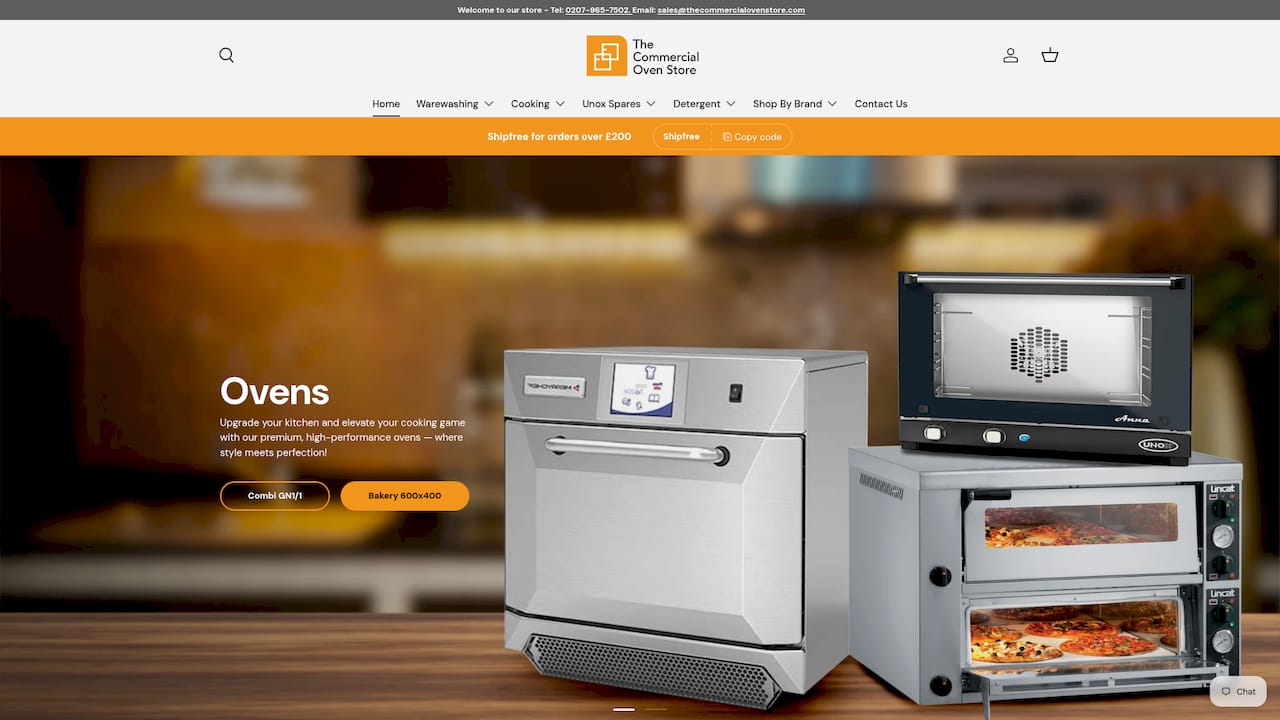
The store’s range covers everything from compact convection ovens for micro-bakeries to full Rational combi systems for small commercial operations. If you are not sure which model fits your site and menu, the team can walk through your requirements and point you to the right specification before you spend a penny.
Browse the full range at Thecommercialovenstore or go straight to the Bakerlux XB893 if you are looking for a proven mid-volume convection oven. For combi capability, the Rational i-Combi Pro 10 GN1/1 is available to order with financing options on request. Contact the store to discuss your site requirements and get a tailored quote.
Useful sources and further reading
Model availability, specifications and lead times change regularly. Always request up-to-date delivery information directly from your supplier before placing an order, and confirm UKCA/CE compliance on the manufacturer’s own product pages for the specific SKU you are buying.
- KaTom Bakery Oven Buyer’s Guide: Practical guidance on matching oven type to product and volume; covers airflow, heat source, capacity and utility requirements. A useful reference before any supplier conversation.
- Empire Bake: What baking oven is right for my bakery?: Covers convection versus combi trade-offs, recovery time and insulation quality; good background reading on throughput and energy management.
- Unox Convection Ovens: Buying Guide and Range Overview: Thecommercialovenstore’s in-depth guide to the Unox convection range, including model comparisons and practical buying advice.
- Unox Combi Ovens: Features and Real-World Use-Cases: Explains combi oven benefits and how they compare to convection-only alternatives in a bakery context.
- WebstaurantStore Commercial Ovens Category: Broad product listing across convection, combination, deck and rack formats; useful for understanding the range of configurations and typical specifications available in the market.
- Electrolux Professional Skyline Combi Oven: Manufacturer specification page for a high-capacity bakery combi oven; useful for understanding advanced features such as automated sensing and recipe storage at the top of the market.