

Most commercial bakeries should choose a bakery-depth convection oven with injected steam or humidity control and programmable recipes. That single specification covers the majority of bread, viennoiserie, and patisserie production without compromise. For a quick shortlist:
- Small batch / café bakery: a compact countertop convection oven with injected humidity (4–6 trays, 600×400mm), such as the Unox Bakerlux ShopPro
- Mid-volume artisan bakery: a single-deck bakery-depth floor oven accepting 600×400mm trays with steam injection, such as the XB893 Bakerlux Oven 10×600×400
- High-volume or mixed production: a double-deck bakery-depth electric convection oven with programmable humidity and HACCP logging, such as the Blue Seal E33 T5
Three reasons these specifications matter above all else: throughput (600×400mm tray format maximises batch size per cycle), crust and crumb quality (injected steam drives oven spring and lamination in croissants and sourdough), and operational control (programmable recipes cut scrap rates and training time across shifts). Bakery-grade convection ovens are engineered specifically for dough products — standard catering convection units consistently fall short on airflow geometry and steam delivery.
Table of Contents
- Which oven size fits your bakery’s throughput?
- What types of convection oven will you actually encounter?
- What features actually matter on a bakery convection oven?
- What should you ask suppliers before buying?
- Recommended convection ovens available from Thecommercialovenstore
- Site checklist: preparing for delivery and installation
- Cleaning, servicing, and keeping your oven in peak condition
- Key takeaways
- What most bakery buyers get wrong
- Thecommercialovenstore: ovens, finance, and installation support
- Useful sources and further reading
Which oven size fits your bakery’s throughput?
The fastest way to narrow your shortlist is to match oven category to daily output and product type. Use this grid as your starting point.
-
Small bakery / café (countertop, 4–6 trays, 600×400mm): best for viennoiserie, morning pastry batches, and bake-off frozen dough. Steam need: injected humidity. Control level: manual or basic digital. Typical buyer: café with an in-house pastry counter or a micro-bakery producing under 200 units per day.
-
Mid-volume artisan bakery (single-deck bakery-depth floor oven, 6–10 trays): best for artisan breads, laminated doughs, and mixed patisserie. Steam need: injected or programmable humidity control. Control level: digital with programmable recipes. Typical buyer: independent bakery running two or three bake cycles per day.
-
High-volume or multi-product (double-deck bakery-depth, 10+ trays per deck): best for bread lines, cakes, and continuous production across shifts. Steam need: full humidity control with HACCP logging. Control level: programmable, Wi-Fi or USB recipe export. Typical buyer: wholesale bakery, hotel kitchen, or multi-site operation.
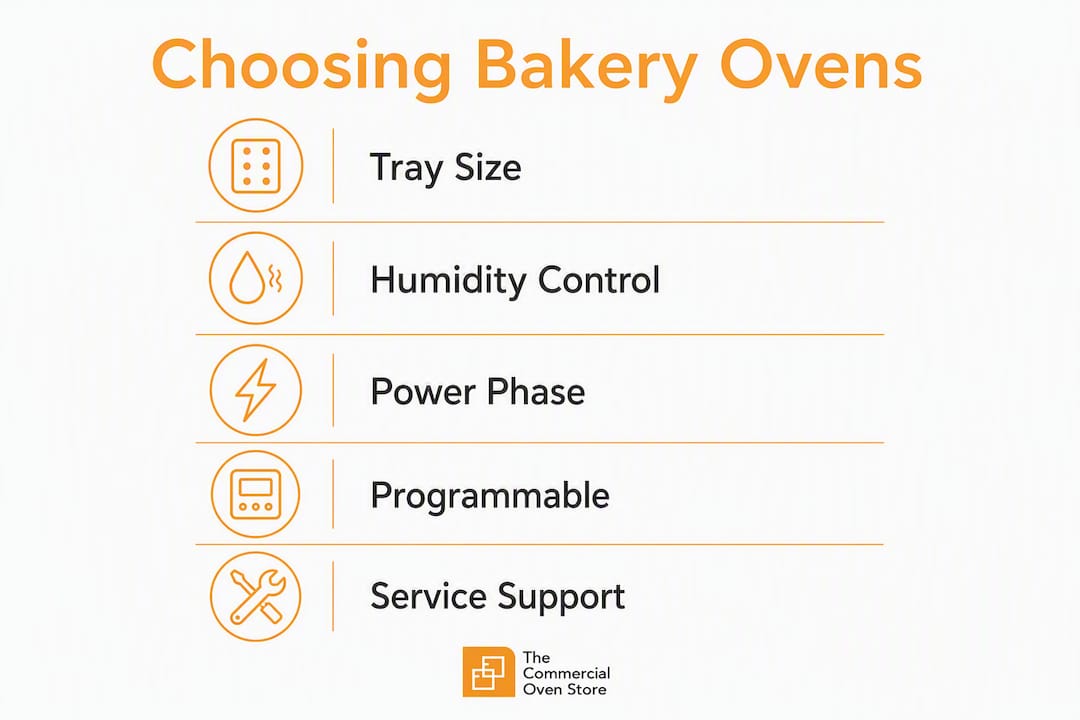
When in doubt, choose a bakery-depth oven that accepts 600×400mm trays and offers programmable humidity. You can always run a smaller batch in a larger oven; you cannot run a full tray in an oven that does not fit it.
What types of convection oven will you actually encounter?
The term “convection oven” covers a wide range of equipment, and the differences between categories are operationally significant for bakers.
Countertop / compact convection ovens
These sit on a worktop and typically hold 4–6 half-size or 600×400mm sheet pans. With injected humidity, they deliver genuine bakery performance in a small footprint — well suited to cafés, hotel breakfast operations, and small-batch artisan producers. Operating temperatures commonly reach 300°C, which handles everything from croissants to choux.
Single-deck and double-deck bakery-depth floor ovens
The workhorse of most independent bakeries. “Bakery depth” means the oven cavity is sized for 600×400mm trays positioned front-to-back, which improves airflow and pan-format flexibility compared with a standard GN 1/1 catering unit. Double-deck versions stack two cavities, effectively doubling throughput without doubling your floor space, and are common in bakeries producing multiple product lines simultaneously.
Combi / convection with humidity control
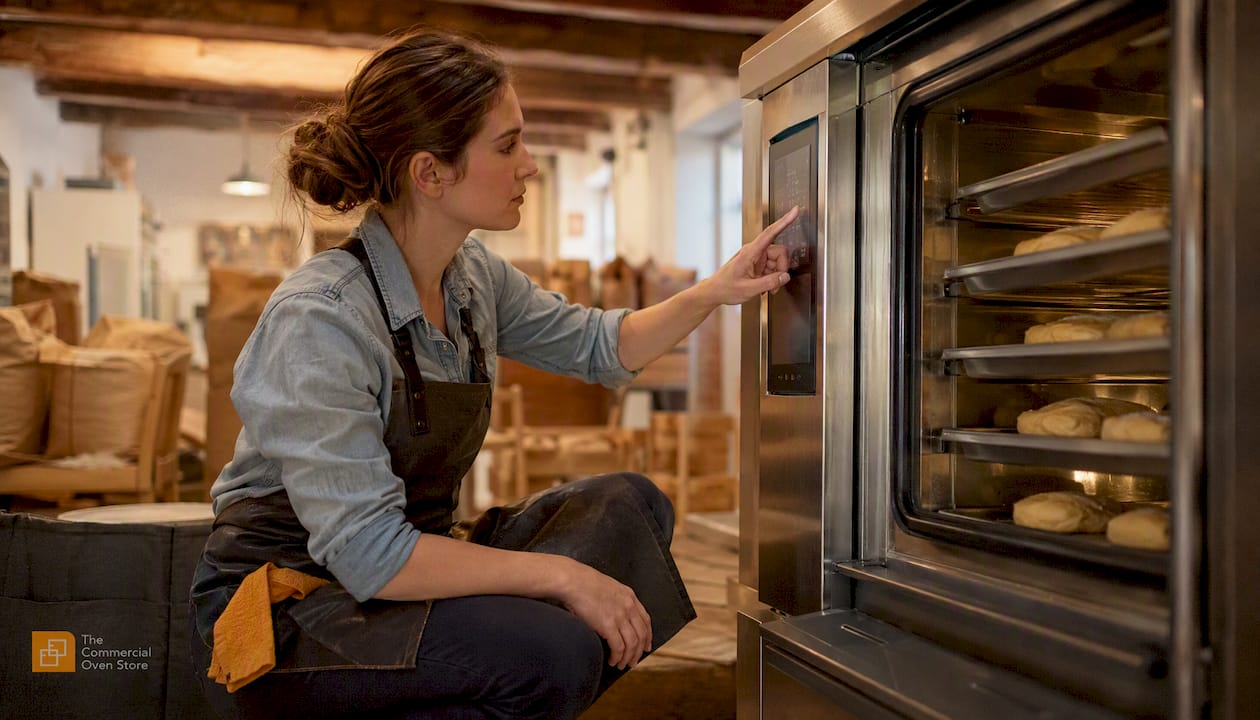
A combi oven combines convection heat with steam injection or full humidity control. For hearth breads and laminated viennoiserie, this is the category that makes the biggest difference to oven spring and crust. Some models allow you to programme a steam phase followed by a dry convection phase in a single recipe step — useful for sourdough where you want a burst of steam in the first ten minutes, then a dry finish.
Speed / high-speed ovens
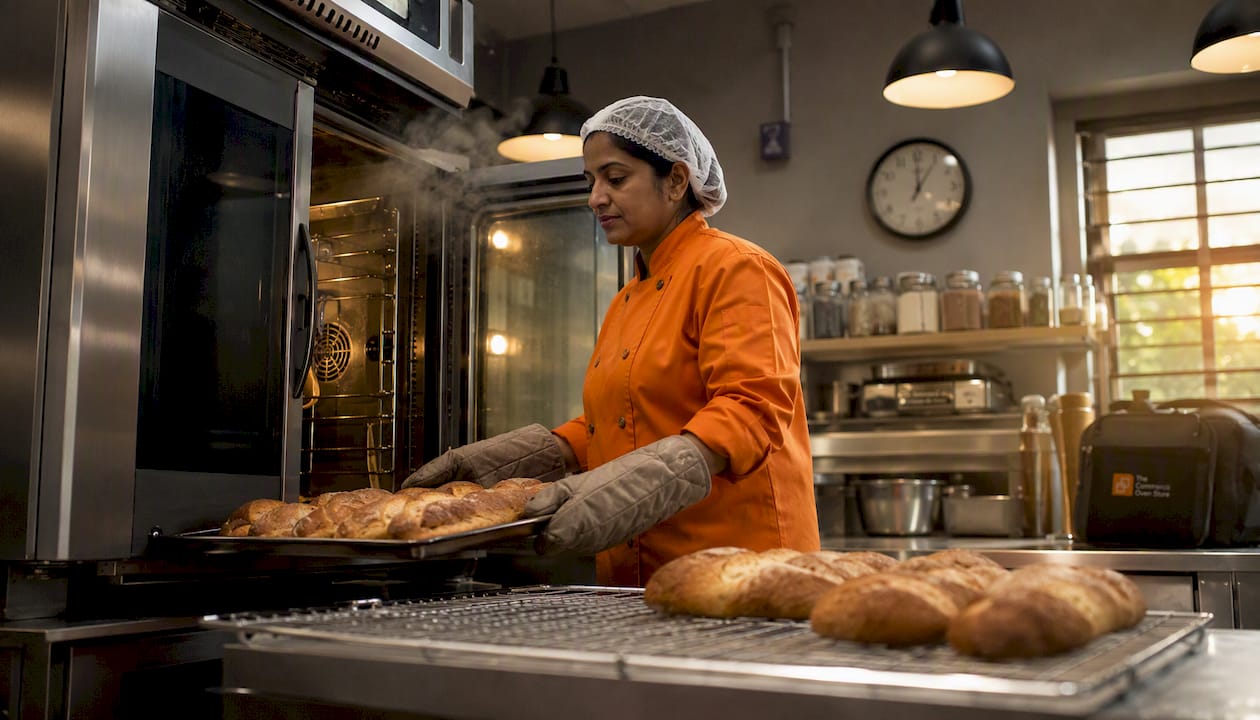
These combine microwave, convection, and sometimes infrared energy to cut cook times dramatically. They suit reheating and finishing more than primary baking, so they are rarely the right answer for a bakery’s main production oven. If your operation involves both baking and rapid reheating, our guide to high-speed ovens for your business covers that category separately.
The distinction between a bakery-grade convection oven and a general catering convection oven is not marketing language. Fan geometry, tray spacing, and steam delivery are physically different, and the results in the baking chamber reflect that.
What features actually matter on a bakery convection oven?
Specification sheets can be overwhelming. These are the items that materially affect baking results and day-to-day operations.
Capacity and tray format
- Tray count and tray size (600×400mm vs GN 1/1) determine your batch size per cycle. Bakery-grade ovens built around 600×400mm capacity typically space racks at 80mm between levels for adequate air circulation — tighter spacing compromises evenness.
- Dual-format capacity (accepting both GN 1/1 and 600×400mm) is operationally valuable for mixed production lines.
Airflow and fan design
- Variable fan speeds and reversible fans are worth paying for. Reversible fans reduce hot spots and produce more even browning across all rack positions — particularly important when baking a full load of croissants where the back tray would otherwise colour faster.
- Single-speed fans are adequate for simple reheating but limiting for artisan production.
Steam and humidity systems
- Injected steam introduces water directly into the baking chamber at a controlled rate. This is what drives oven spring in sourdough and keeps laminated doughs from seizing before they have expanded.
- Humidity control (a percentage setting rather than a simple on/off steam button) gives you precision across different product types.
- Manual steam injection (a button you press) is the entry level. Programmable steam cycles, where the oven manages steam phases automatically within a recipe, are the professional standard for consistent multi-shift production.
Control type and connectivity
Programmable recipe storage, USB or Wi-Fi export, and HACCP data logging are increasingly standard on mid-range and above models. Modern professional ovens with connectivity allow recipe management and HACCP tracking to standardise production across staff and sites — which matters the moment you have more than one baker on shift. Some models ship with recipe libraries of 300 programmes or more and allow USB copying to replicate settings across multiple ovens.
Construction and serviceability
AISI 304 stainless steel internal chambers, rounded internal corners, and removable rack supports are the markers of a bakery-grade build. Rounded corners are not just aesthetic — they are a HACCP compliance feature that eliminates the grease traps that form in square-cornered chambers. Automatic multi-stage cleaning systems save meaningful labour time and, critically, keep fans and sensors free of residue that would otherwise alter bake profiles over weeks of use.
Power and energy
Electric models run on single-phase or three-phase supply depending on kW draw. Most single-deck bakery-depth ovens sit in the 7–11 kW range; double-deck units typically draw more. Gas models require a certified gas engineer for installation and a confirmed flue route. Ask suppliers for consumption figures at a typical bake cycle rather than peak-rated kW, since peak figures overstate real running costs.
Pro Tip: Prioritise models with 600×400mm bakery-depth tray support and cloud or USB recipe export. Those two features alone will reduce scrap rates and training time more than any other specification on the sheet.
What should you ask suppliers before buying?
A structured set of questions separates the right oven from an expensive mistake.
- Calculate your trays-per-hour target first. Divide your daily unit output by average units per tray, then divide by available baking hours. That number tells you the minimum tray count and cycle frequency you need — ask the supplier to show you an example production run that matches it.
- Confirm electrical phase and breaker requirements. Single-phase 13A sockets will not run a bakery-depth floor oven. Know your supply before you order.
- Ask about gas supply and flue routing if you are considering a gas model. Confirm whether the unit ships for natural gas or LPG, and whether conversion kits are available.
- Request HACCP logging options and recipe export details. Ask specifically whether the oven logs temperature and time data in a format your environmental health officer will accept.
- Confirm UK service network and warranty terms. A manufacturer warranty is only as good as the service agent who fulfils it. Ask for the name of the UK service partner and their average response time.
- Ask for kW/h consumption at a representative bake cycle, not the nameplate rating. This is the figure you need for operating cost comparisons.
- Request a demo bake with your own product or a representative equivalent. Any reputable supplier should accommodate this.
Red flags to watch for:
- No bakery-depth tray fitment (the oven accepts GN 1/1 only)
- Vague steam specification (“moisture injection” with no pressure or rate detail)
- No named UK service agent or warranty fulfilment partner
- Unclear spare-parts availability or no published part numbers
- Supplier cannot provide real-world references from bakery customers
Negotiation prompts: discuss finance and leasing options upfront. iwocaPay and manufacturer leasing schemes can spread the cost of a mid-range or high-volume oven across manageable monthly payments — worth raising before you commit to a purchase price.
Recommended convection ovens available from Thecommercialovenstore
These three models cover the main bakery use cases and are available to buy or finance through Thecommercialovenstore.
| Model | Capacity | Best for | Steam capability | Control type | Power / phase | Footprint / stackability | Price band |
|---|---|---|---|---|---|---|---|
| Unox Bakerlux ShopPro | 4×600×400mm | Café bakery, viennoiserie, small-batch pastry | Injected humidity | Digital / programmable | Electric, single-phase | Compact countertop; stackable | Mid |
| Blue Seal E33 T5 | Full-size, multi-rack | High-volume bread, cakes, mixed production | Steam option | Digital controls | Electric, three-phase | Floor-standing; double-deck option | Mid–High |
| XB893 Bakerlux 10×600×400 | 10×600×400mm | Artisan bread, laminated doughs, mid-volume bakery | Manual steam control | Manual | Electric | Bakery-depth floor unit | Mid |
Unox Bakerlux ShopPro: Built specifically for pastry shops and café bakeries. The injected humidity system handles croissants and choux without the guesswork, and the compact footprint means it fits on a worktop without dominating the kitchen. A strong first oven for a growing operation, or a dedicated pastry station alongside a larger deck oven.
Blue Seal E33 T5: The choice for higher-volume sites running continuous production. Digital controls and a robust build make it reliable across long shifts, and the three-phase supply means it recovers temperature quickly between cycles — which matters when you are loading tray after tray during a morning rush. See the full Unox convection oven buying guide for context on how Unox models compare across the range.
XB893 Bakerlux 10×600×400: Ten full-size 600×400mm trays in a single bakery-depth cavity. Manual controls keep operation straightforward for experienced bakers who prefer direct dial control over recipe programmes. The tray capacity makes it the most productive single-cavity option in this shortlist for artisan bread production.
Finance and leasing are available on all three models. Contact Thecommercialovenstore for a bespoke quote.
Site checklist: preparing for delivery and installation
Ordering the right oven is only half the job. Site preparation determines whether installation goes smoothly or costs you an extra week of downtime.
Electrical requirements:
- Confirm single-phase vs three-phase supply with your electrician before ordering. Most bakery-depth floor ovens require three-phase; countertop models often run on single-phase.
- A dedicated breaker sized to the oven’s kW draw is standard practice. Do not share a circuit with other high-draw equipment.
- Have your consumer unit / distribution board details ready when speaking to the installer.
Gas (if applicable):
- Confirm natural gas vs LPG and whether a conversion kit is needed.
- A Gas Safe registered engineer must carry out the connection — this is a legal requirement in the UK.
- Flue routing must be agreed before delivery day.
Ventilation and heat exhaust:
- High-throughput bakery ovens generate significant heat. A canopy extraction system sized to the oven’s output is standard for floor-standing units.
- Check with your local environmental health team if you are installing in a listed building or shared premises.
Clearances and access:
- Measure door widths, corridor widths, and any stair or lift constraints before the delivery date.
- Allow the manufacturer’s recommended clearance on all sides for maintenance access and heat dissipation.
- If you are stacking two units, confirm the combined height against your ceiling clearance and the structural load rating of the floor.
Delivery and lead times:
- Lead times vary by model and manufacturer. Confirm with Thecommercialovenstore at point of order and schedule your electrician or gas engineer to arrive after the oven is on site.
- For imported models, allow additional time for any customs or logistics delays.
Pro Tip: Before booking your installer, photograph your consumer unit, measure every doorway on the delivery route, and confirm the floor load rating if you are stacking double-deck units. Sending those details to your supplier in advance prevents the most common installation delays.
Cleaning, servicing, and keeping your oven in peak condition
A commercial bakery oven running two or three cycles a day accumulates grease, flour dust, and steam residue faster than most operators expect. Staying ahead of that is what keeps bake profiles consistent over years rather than months.
Daily and weekly cleaning:
- Wipe down the internal chamber after each session while still warm (not hot). Rounded internal corners and removable rack supports make this significantly faster than cleaning a square-cornered catering oven.
- Check door gaskets weekly for cracks or compression loss. A failing gasket bleeds heat and steam, which skews bake times and raises energy costs.
- Keep fan guards and sensors clear of flour and grease. Residue on a temperature sensor will cause the oven to read incorrectly and alter your bake profile without any obvious warning.
Automated cleaning systems:
Ovens with automatic multi-stage cleaning (typically three cleaning levels plus a rinse cycle) reduce labour meaningfully and keep sensors and fans free of the residue that would otherwise change bake profiles over time. For a busy bakery running double shifts, the premium for an auto-clean model pays back in labour hours within the first year.
Service schedule:
- Annual professional service is the minimum for a bakery running daily production. Busy operations (three or more cycles per day) benefit from a six-month check.
- Key items at each service: fan motor condition, element integrity, door seal compression, thermostat calibration, and steam injector function.
Spares to keep on hand:
- Door gaskets (the highest-frequency replacement part)
- Thermostat sensors
- Fan motor (confirm part number and UK availability before purchase)
- Steam injector seals
Confirm part numbers and UK stock availability with your supplier before committing to a model. An oven that cannot be serviced within a week is a production risk.
Warranty: manufacturer warranties vary by brand and model. Extended cover and service contracts are available through Thecommercialovenstore — worth discussing at point of purchase rather than after the first breakdown.
Key takeaways
A bakery-depth convection oven with injected steam, programmable recipes, and confirmed UK service support is the right specification for the vast majority of commercial bakeries in the UK.
| Point | Details |
|---|---|
| Bakery-depth tray format | Specify 600×400mm tray compatibility — it determines throughput and airflow quality more than any other single spec. |
| Injected steam is non-optional for artisan products | Sourdough, croissants, and laminated doughs need controlled steam injection; a dry convection oven will not produce the same crust or oven spring. |
| Confirm electrical supply before ordering | Most bakery-depth floor ovens require three-phase supply; check your consumer unit before placing an order. |
| Request a demo bake | Any reputable supplier will run your product through the oven before you commit — insist on it. |
| Thecommercialovenstore for models and finance | The Unox Bakerlux ShopPro, Blue Seal E33 T5, and XB893 Bakerlux are available to buy or lease, with iwocaPay finance options. |
What most bakery buyers get wrong
The most common mistake I see is treating oven selection as a price-per-tray calculation and nothing else. Buyers compare tray counts, pick the cheapest unit that fits the number, and then spend the next two years fighting inconsistent bake results and a service agent who takes three weeks to respond.
The specification that gets overlooked most often is the steam system. “Steam injection” on a spec sheet can mean anything from a water reservoir that produces ambient humidity to a precision injector that delivers a measured burst at a set point in the bake cycle. Those two things produce categorically different results in a croissant or a sourdough loaf. Ask the supplier to describe exactly how the steam is generated and delivered — if they cannot answer that clearly, the oven probably cannot either.
The second overlooked factor is service network. A manufacturer warranty is only as useful as the engineer who fulfils it. Before you sign anything, get the name of the UK service partner, ask how many engineers they have covering your region, and ask for a typical call-out time. A bakery oven that is down for ten days in December is not a minor inconvenience.
My practical advice: shortlist on tray format and steam specification, then filter on service network, and only then compare price. Finance options through iwocaPay mean the upfront cost is rarely the real constraint — the real constraint is finding an oven that bakes consistently and gets fixed quickly when it does not.
Thecommercialovenstore: ovens, finance, and installation support
Buying a commercial convection oven outright is not the only route. Thecommercialovenstore supplies the Unox Bakerlux ShopPro, Blue Seal E33 T5, and XB893 Bakerlux directly, with flexible payment through iwocaPay that lets you spread the cost across monthly instalments rather than absorbing the full amount at once. For higher-volume operations, manufacturer leasing options are also available.
The team can advise on site requirements, arrange delivery and installation through certified partners, and connect you with UK service contracts that cover your oven beyond the standard manufacturer warranty. If you are unsure which model fits your production volume, a demo bake or site survey is the fastest way to find out.
Browse the full range and request a quote at Thecommercialovenstore, or go directly to the Blue Seal E33 T5 product page to check availability and finance options.
Useful sources and further reading
The sources below were used to verify specifications and buying guidance in this article. Where a manufacturer datasheet is listed, request the current version directly from the manufacturer or your supplier, as specifications are updated periodically.
- Thecommercialovenstore — commercial convection oven buying guide: in-depth guide covering convection oven basics, technical considerations, and UK commercial use cases.
- Thecommercialovenstore — Unox convection ovens buying guide: brand-specific notes on Unox models, including the Bakerlux range, with buying and demo guidance.
- XB893 Bakerlux Oven 10×600×400 — product page: full specification and purchase details for the bakery-depth manual-control model.
- Blue Seal E33 T5 — product page: full specification and finance options for the high-volume electric convection oven.
For any model on this list, request the manufacturer’s current technical datasheet and ask Thecommercialovenstore about arranging a demo bake before committing to a purchase.
Recommended
- Commercial Convection Ovens: Complete Buying Guide for Catering Kitchens – thecommercialovenstore.com
- Unox Convection Ovens: Buying Guide & Range Overview | The Commercial Oven Store – thecommercialovenstore.com
- Blue Seal E28 M4 Convection Oven – thecommercialovenstore.com
- Unox XF023-GB Convection Oven – thecommercialovenstore.com