

For cafés, bakeries and restaurants that need browning, crisping and proper finishing, buy a commercial speed oven. If your operation is purely reheating pre-cooked food at volume, a commercial microwave is sufficient and considerably cheaper.
By segment:
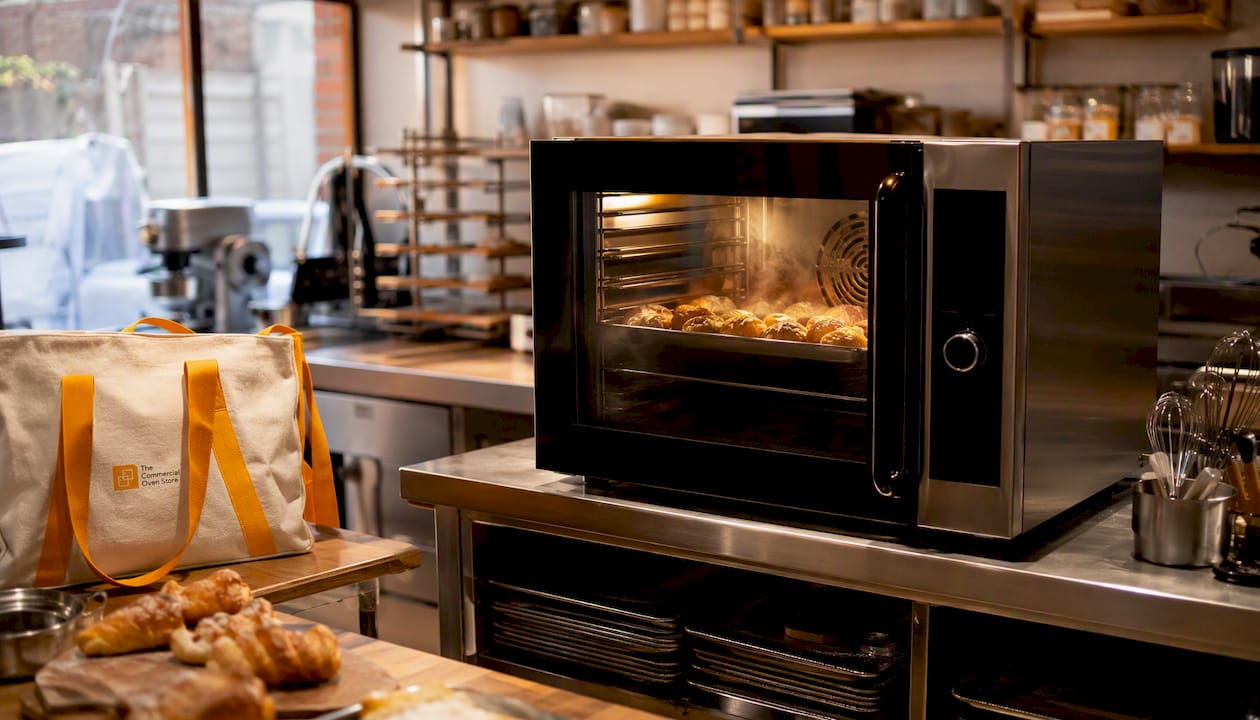
- Bakery: A speed oven finishes laminated pastries, buns and bread rolls with a genuine crust. A microwave cannot brown — full stop.
- Café/coffee shop: Speed ovens handle panini, toasties and pastry finishing in one unit, replacing a toaster and a microwave simultaneously.
- Restaurant (fast-casual and full-service): Speed ovens from brands like Unox and Rational deliver consistent plate finishes at pace; microwaves suit soup and sauce reheating only.
- Large-scale caterer: Commercial microwaves win on bulk reheating throughput and lower capex. Speed ovens are worth adding when the menu includes items that need texture.
Thecommercialovenstore stocks speed ovens from Unox, Rational, Merrychef, and Bakerlux, with flexible payment via iwocaPay. Speed ovens can cook items 5–20× faster than traditional ovens depending on model and method — a meaningful advantage when your lunchtime queue is busy.
Table of Contents
- Speed oven vs microwave: the core comparison
- How does a speed oven actually cook differently?
- Which appliance suits which menu items?
- What does a speed oven cost to run day-to-day?
- Installation, footprint and UK regulatory requirements
- Questions to ask before you sign a purchase order
- Budgeting and financing options for UK buyers
- What operators actually observe in practice
- Key takeaways
- The view from Thecommercialovenstore
- Ready to buy? Here is how Thecommercialovenstore helps
- Sources and further reading
Speed oven vs microwave: the core comparison
| Dimension | Commercial speed oven | Commercial microwave |
|---|---|---|
| Core technology | Microwave + convection + impingement/radiant | Microwave (electromagnetic) only |
| Browning/crisping | Yes — genuine crust and colour | No — food steams internally |
| Cycle time | 5–20× faster than traditional ovens depending on model and item | 30 seconds to 2 minutes for reheating |
| Capacity | 1/3 GN to full GN trays; stackable models available | typical cavity sizes vary; no tray standard |
| Labour & automation | One-touch presets; minimal skill required | Simple controls; no preset programming |
| Capex | £2,000–£10,000+ (mid to premium range) | £300–£1,500 (entry to mid commercial) |
| Financing | iwocaPay and leasing options via Thecommercialovenstore | Standard purchase |
| Energy/maintenance | Higher draw; catalytic converter replacement periodically | Lower draw; minimal maintenance |
| Footprint/venting | Compact; many models ventless with catalytic converter | Compact; no venting required |
| Best for | Finishing, crisping, baking, panini, pizza, pastry | Bulk reheating, soups, sauces, pre-cooked proteins |
How does a speed oven actually cook differently?
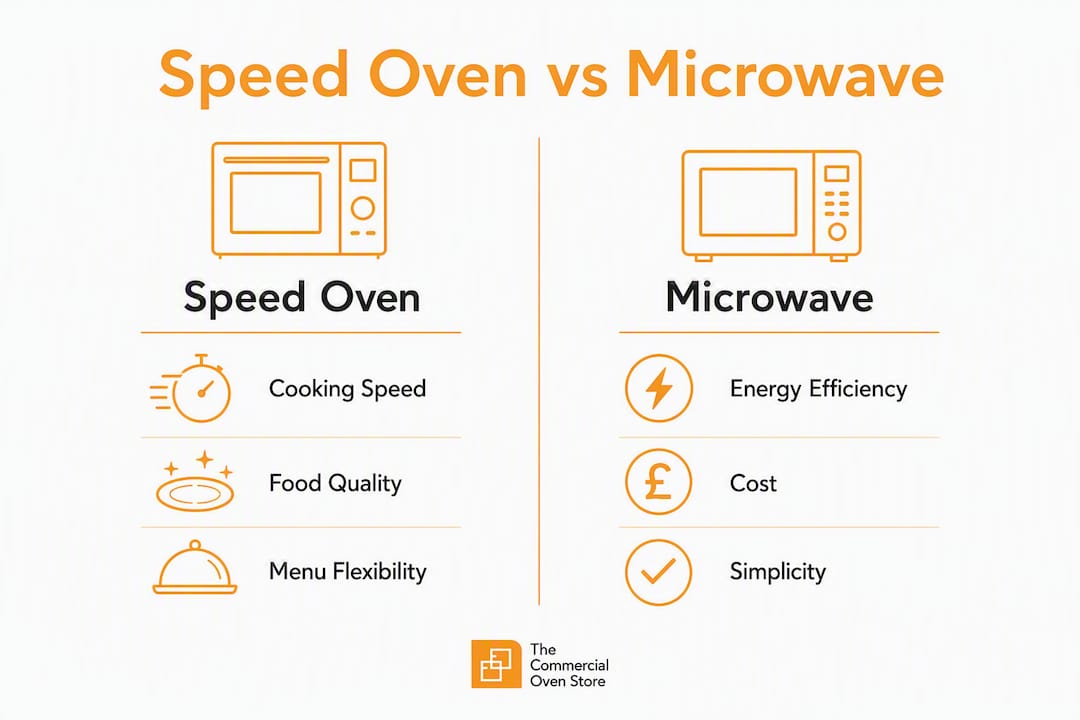
Commercial speed ovens combine microwave, convection and air impingement to deliver rapid cooking with browning and crisping. A commercial microwave uses electromagnetic radiation only and cannot brown the surface of food.
Here is what that means in practice:
- Magnetron/microwave energy penetrates the food and heats it from within, cutting the time needed to reach serving temperature.
- Convection airflow circulates hot air around the food, driving moisture off the surface and creating the conditions for browning.
- Impingement jets direct high-velocity hot air at specific points on the food — the mechanism responsible for the crisp base on a pizza or the colour on a croissant.
- Radiant elements (on some models) add direct surface heat for additional colour and finish.
- Catalytic converters on ventless models neutralise cooking odours and grease vapour, removing the need for a traditional extraction hood.
- Adjustable microwave percentage lets operators dial the ratio of microwave to convection energy, giving precise control over texture and finish.
Pratica Europe notes that speed ovens deliver reproducible results through controlled microwave percentage and impinged air — which is why a panini comes out the same at 7 AM and 7 PM regardless of who is on shift.
A commercial microwave, by contrast, heats food through molecular friction caused by electromagnetic waves. It is fast and reliable for reheating, but the surface stays soft and pale. No convection, no impingement, no browning.
Which appliance suits which menu items?
Menu goals should drive the appliance choice rather than speed alone. Quality-first menus justify speed-oven investment; reheating-focused operations may be fine with microwave-only units.
| Menu item | Recommended appliance | Reason |
|---|---|---|
| Laminated pastries (croissants, pain au chocolat) | Speed oven | Needs dry heat and surface colour |
| Bread rolls / buns (finishing from par-baked) | Speed oven | Crust development requires convection |
| Panini / toasties | Speed oven | Grill marks and crisp exterior |
| Pizza (fresh or par-cooked) | Speed oven | Base crispness and cheese melt |
| Plated protein finishing (chicken, fish) | Speed oven | Texture and colour on the surface |
| Soup / sauce reheating | Commercial microwave | No texture requirement; speed and volume |
| Pre-cooked rice, pasta, sides | Commercial microwave | Bulk throughput; texture not critical |
| Sauced proteins (casseroles, curries) | Commercial microwave | Liquid-based; browning irrelevant |
A speed oven can replace both a microwave and a contact grill or toaster in a café setting — one footprint, one power connection, one cleaning routine. For a caterer running a banqueting line where 200 plates of pre-cooked chicken need to hit 75°C in 90 minutes, a bank of commercial microwaves is the more cost-effective answer.
Pro Tip: If your menu includes even a handful of items that need crisping or colour, a speed oven pays for itself faster than you might expect. The margin on a finished croissant versus a reheated one is not trivial.
What does a speed oven cost to run day-to-day?
Higher capex is the honest starting point for speed ovens. A commercial microwave costs £300–£1,500; a mid-range speed oven from Merrychef or Unox sits in the £2,000–£6,000 range, with premium multi-mode units from Rational reaching £10,000 or more.
Although speed ovens have higher upfront costs, their superior efficiency and faster cycles can lower utility bills over the equipment lifetime. The key OPEX factors:
- Energy: Speed ovens draw more power per cycle but complete cycles faster. Net energy per dish is often comparable to or lower than a traditional oven.
- Labour: One-touch presets reduce training time and improve consistency, meaning that a less experienced team member can produce the same result as a trained chef.
- Maintenance: Catalytic converters need periodic replacement (typically annually, cost varies by model). Convection fans and door seals require routine inspection.
- Servicing: Budget for an annual service contract. Downtime on a speed oven during a lunch service is expensive; a contract with a guaranteed response time is worth the premium.
Pro Tip: A simple payback calculation: if a speed oven saves one hour of labour per day at £12/hour, that is £4,380 per year. A £4,000 unit pays back in under 12 months on labour alone, before any uplift in throughput or menu margin.
Installation, footprint and UK regulatory requirements
Many modern commercial speed ovens feature ventless designs with catalytic converters, permitting front-of-house placement or use in compact kitchens where traditional hooding would be impractical. Check the specific model before assuming ventless — some higher-output units still require extraction.
Installation checklist:
- Confirm power supply: most commercial speed ovens require a 13A or 16A single-phase supply; some larger units need three-phase. Check with your electrician before ordering.
- Verify electrical load against your consumer unit capacity — adding a speed oven to an already-loaded circuit is a common installation problem.
- Check water connections if the model includes steam functions (relevant for combi-speed units).
- Measure clearance: most manufacturers specify a minimum gap at sides and rear for airflow. Confirm stacking compatibility if you plan to run two units.
- Confirm bench or stand requirements — some units ship without a stand; order it at the same time.
- For larger units, check delivery access: door widths, stair access and whether a tail-lift vehicle is needed.
UK safety and regulatory notes:
- All commercial electrical equipment must be installed by a competent person and subject to PAT testing.
- Local authority environmental health officers may inspect extraction and ventilation arrangements — ventless catalytic models generally satisfy this, but confirm with your local authority before installation.
- Gas-fired speed ovens are less common but require Gas Safe registered installation.
- Operators must comply with the Regulatory Reform (Fire Safety) Order 2005 regarding kitchen fire suppression where applicable.
Timeline: Allow 2–4 weeks from order to delivery for most stocked models. Commissioning and test-cook typically takes half a day. Request a site survey from Thecommercialovenstore before ordering if you have any doubt about power supply or clearances.
Questions to ask before you sign a purchase order
Getting the appliance right matters; getting the supplier relationship right matters just as much. Work through this list before committing:
- Warranty: What is the standard warranty period? Is parts and labour included, or parts only?
- Service response: What is the guaranteed response time for a breakdown call-out? Next business day is the minimum acceptable for a primary cooking appliance.
- Training: Does the supplier provide on-site training on preset programming? Who trains new staff if you have turnover?
- Presets: How many recipe presets does the unit support? Can you update them remotely or via USB?
- Spare parts: Are parts held in the UK? What is the typical lead time for a magnetron or convection fan?
- Delivery and installation: Is delivery to the kitchen included, or kerbside only? Who commissions the unit?
- PAT and compliance documentation: Will the installer provide a signed commissioning certificate?
- Catalytic converter policy: What is the replacement interval and cost? Is it covered under the service contract?
At delivery, insist on a test cook of at least two menu items before signing the handover document. A speed oven that cannot reproduce your preset results on day one is a problem to resolve before the engineer leaves, not after.
Budgeting and financing options for UK buyers
Typical price brackets for UK commercial kitchens:
- Entry-level commercial microwave: £300–£800
- Mid-range commercial microwave: £800–£1,500
- Entry-level speed oven (e.g. Merrychef or Bakerlux): £2,000–£4,000
- Mid-range speed oven (e.g. Unox Speed.Pro, Bakerlux range): £4,000–£7,000
- Premium multi-mode unit (e.g. Rational iCombi Pro): £8,000–£15,000+
Thecommercialovenstore offers flexible payment via iwocaPay, allowing buyers to spread the cost of a speed oven purchase rather than taking the full capex hit upfront. Leasing options are also available — ask for a tailored quote when you enquire.
Budgeting bullets:
- Add 20% VAT to all equipment prices unless your business is VAT-registered and reclaiming.
- Budget £200–£600 for installation and electrical work if your supply needs upgrading.
- Allow a 10% contingency for site-specific surprises (cable runs, stand, delivery access).
- A service contract typically adds 8–12% of the unit price annually — factor this into your three-year cost model.
What operators actually observe in practice
The pattern across commercial kitchens that switch from microwave-only to speed ovens is consistent:
- Labour reduction: Preset programming means a barista or counter assistant can produce a finished panini or pastry without chef supervision. High-speed ovens increase service capacity and customer throughput, which operators convert into higher revenue when matched to menu and staffing patterns.
- Quality uplift: The difference between a microwaved croissant (soft, slightly steamed) and a speed-oven-finished one (crisp, coloured, warm through) is visible and affects repeat custom.
- Menu expansion: A speed oven enables menu expansion into higher-margin items such as toasted sandwiches or finished baked goods without purchasing multiple specialist machines. That is a meaningful gross-margin improvement per square metre of kitchen.
- Waste reduction: Consistent presets mean fewer overcooked or undercooked items discarded during a busy service.
For deeper reading on how food quality drives hospitality outcomes, the link is worth a look before finalising your appliance decision.
Key takeaways
Commercial speed ovens are the right buy for any UK kitchen where finished product quality, browning, or crisping matters; commercial microwaves remain the cost-effective choice for pure bulk reheating.
| Point | Details |
|---|---|
| Speed advantage | Speed ovens cook significantly faster than traditional ovens, enabling high-throughput service. |
| Quality difference | Only speed ovens brown and crisp; microwaves reheat without surface colour or texture. |
| Labour and presets | One-touch presets reduce training time and deliver consistent results across all skill levels. |
| Total cost of ownership | Higher speed-oven capex is often offset by energy efficiency, labour savings and menu margin gains over the equipment lifetime. |
| Thecommercialovenstore | Stocks Unox, Rational, Merrychef and Bakerlux speed ovens with iwocaPay financing; request a quote or site survey directly. |
The view from Thecommercialovenstore
The question we hear most often is not “speed oven or microwave?” — it is “can I justify the extra spend?” The honest answer is that it depends entirely on what your menu asks of the appliance.
Kitchens that run a microwave where they need a speed oven are leaving margin on the table. A café selling reheated croissants instead of finished ones is charging less and losing repeat customers who notice the difference. The appliance choice is a menu decision as much as a capital one.
Thecommercialovenstore works with bakeries, cafés, restaurants and catering operations across the UK, stocking speed ovens from Unox, Rational, Merrychef and Bakerlux alongside convection ovens and compatible accessories. The team can advise on model selection, site requirements and financing via iwocaPay — whether you are replacing a single unit or specifying a full kitchen fit-out. Site surveys, product demonstrations and telephone consultations are available on request.
Ready to buy? Here is how Thecommercialovenstore helps
Faster service and better-finished food are available now, not after a lengthy procurement process.
Thecommercialovenstore gives UK kitchen buyers direct access to the best speed ovens from Unox, Rational, Merrychef and Bakerlux, alongside convection ovens, Bakerlux deck ovens and all the accessories needed for a complete installation. Every order comes with expert pre-purchase advice, and iwocaPay financing means you can spread the cost rather than absorbing the full capex in one quarter.
Browse the Unox convection and speed range or visit thecommercialovenstore.com to request a tailored quote, arrange a site survey, or speak to a sales specialist about which model fits your kitchen, your menu and your budget.
Sources and further reading
- What’s the Difference Between a Commercial Microwave and High-Speed Oven — Fridge Freezer Direct
- High-Speed Oven vs Microwave — Electrolux Professional
For site-specific quotes, product demonstration sheets or case studies from kitchens similar to yours, contact Thecommercialovenstore directly via thecommercialovenstore.com.