

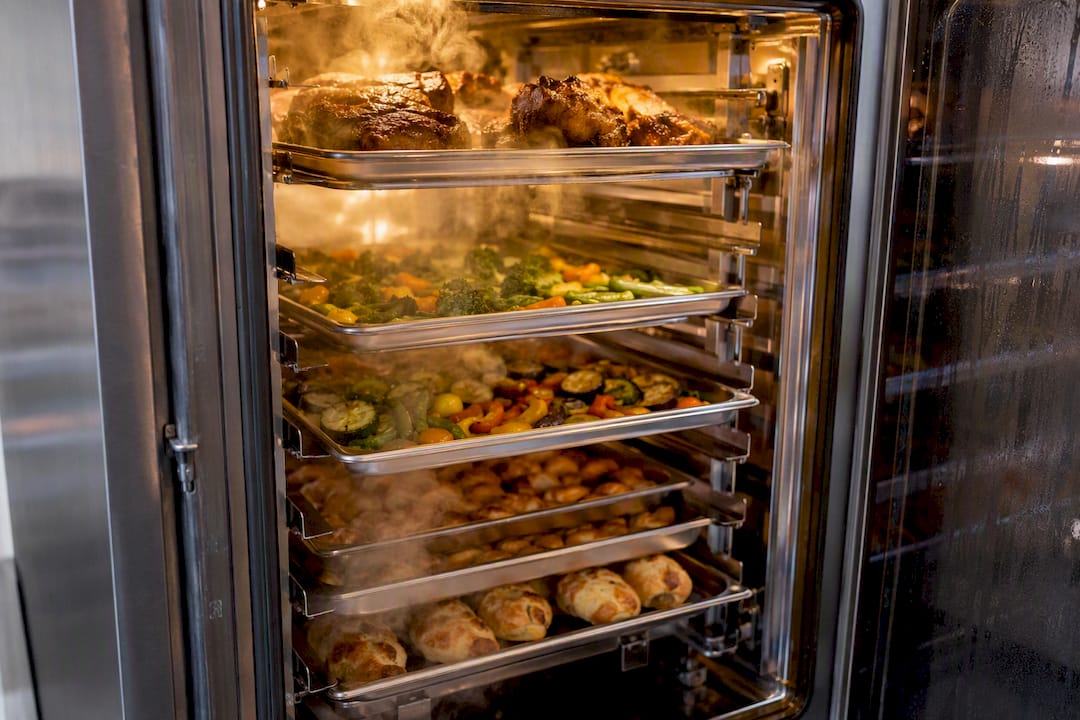
Multi level cooking is the use of combi or multi‑deck ovens to cook different dishes simultaneously across several racks, controlling temperature, humidity and airflow so nothing dries out or tastes of its neighbour. The single most important requirement is climate control: humidity and airflow management matter as much as temperature, sometimes more. Prioritise programmable, probe‑capable ovens with strong climate control and a proper automatic cleaning system.
TL;DR:
- Prioritize ovens with strong climate control features like percent-based humidity and adjustable airflow to ensure consistent results across multiple racks.
- Use multi-step programming and core-probe cycles to achieve precise cooking without relying solely on timers, especially for mixed loads with different cooking profiles.
- Proper loading techniques, staged schedules, and staff training are crucial to prevent uneven cooking, flavor transfer, and patchy browning during multi-rack cooking.
- Regular maintenance, correct ventilation, and compliance with safety standards are essential to operate multi-level ovens safely and hygienically.
- Selecting the right platform depends on load variability, automation needs, and budget, with industry leaders like Rational, Unox, and Electrolux offering different strengths.
Table of Contents
- Why multi level cooking matters for high-volume kitchens
- What features actually make multi level cooking reliable?
- How do you programme and schedule mixed loads?
- Why do multi-rack loads cook unevenly?
- How do you choose an oven for multi level cooking?
- Comparing the major multi-level oven platforms
- What safety and compliance rules apply to multi-level ovens?
- What the industry gets wrong about multi level cooking
- Get expert help choosing your multi level cooking oven
- Sources
Why multi level cooking matters for high-volume kitchens
A single combi oven running mixed loads does the work of a convection oven, a steamer and often a griddle. That’s not a marketing line, it’s how Electrolux Professional describes the combi format: one chamber, multiple modes, cooking different foods at once. For a bakery‑café pushing out pastries at 7am and roasting joints for lunch service by 11, that consolidation changes the shape of the whole kitchen.
The throughput gain is obvious on paper, but the labour saving is where it actually pays for itself. Programmed recipes and core probes mean a junior chef can run a six‑rack load to the same standard as your head chef, every time, without babysitting each shelf.
- Higher throughput per square metre of kitchen floor, since one oven replaces several single‑function units
- Repeatable results shift to shift because programmes remove guesswork from timing and temperature
- Lower energy spend from running one efficient appliance instead of three or four older ones
- Flexibility to switch between roast, steam, bake and regenerate modes within the same service
Mixed loads work best when the dishes share a rough cooking profile. Roasting chicken thighs above a tray of root vegetables makes sense. Steaming delicate fish next to a high‑heat bake usually doesn’t, unless the oven’s climate control is genuinely capable of holding separate zones steady, which the better combi platforms increasingly are.
What features actually make multi level cooking reliable?
Buyers get sold on touchscreens and app connectivity. The features that actually decide whether six racks come out right are less flashy: humidity generation, airflow distribution and probe accuracy.
Fresh steam generation with percent‑based humidity control is the feature to interrogate first. RATIONAL’s own technical explanation of the combi oven makes the point plainly: precise climate control is what stops a mixed load drying out on one shelf while stewing in its own moisture on another, and it’s what stops a tray of fish tainting the bread proving two shelves below it.
Airflow matters just as much. Electrolux notes that combi ovens manage airflow, temperature stability and humidity together to keep cooking even whether the chamber is half full or stacked to capacity. An oven with a single fixed fan speed will always favour the middle racks over the top and bottom ones.
Beyond climate and airflow, look for:
- Multi‑step programming that runs different phases automatically, so a load can roast, then rest, then finish under grill without manual intervention.
- Core‑probe cycles that cook to a target internal temperature rather than a fixed timer, the method RATIONAL’s technology handbook treats as central to repeatable cooking.
- Recipe libraries with remote management, allowing a head office or head chef to push a standardised programme across every site.
- Automatic cleaning systems that keep chamber performance consistent between services, not just presentable.
- Electrification options, including retrofit and ventless models suited to sites without heavy extraction, a shift the FCSI white paper on advanced ovens flags as increasingly viable without sacrificing gas‑level performance.
Named technologies worth asking about by name include iDensityControl style climate regulation and iCookingSuite style intelligent cooking, both built around the same principle: let the oven manage humidity and fan speed so the chef manages the menu.
Pro Tip: Ask any supplier to demonstrate a genuinely mixed load, not a single tray of chicken breasts. If they hesitate, that tells you more about the oven’s real‑world climate control than any spec sheet will.
How do you programme and schedule mixed loads?
Running six different items across six racks and expecting them all to finish together is the single most common planning mistake in busy kitchens. The fix isn’t a better oven, it’s a better programme.
- Programme by finish time, not by identical timers. Work backwards from the moment everything needs to hit the pass and stagger the start of each tray accordingly.
- Use a core probe on every protein. Set a target internal temperature rather than trusting a clock, particularly on joints and thicker cuts where residual carryover cooking varies by size.
- Load in stages where the oven supports just‑in‑time or multi‑rack modes. Products like the Lainox Naboo build this staggered loading directly into the touchscreen, so racks added later automatically adjust their cycle to finish alongside the rest.
- Leave a genuine gap between trays. Blocked airflow is the fastest way to turn an even bake into a patchy one, so resist the urge to cram in one more tray during a rush.
- Pair the oven with proper holding equipment. A hot cookline base unit smooths the gap between an oven finishing and a dish reaching the pass, particularly during a lunch peak when six racks land within minutes of each other.
Staff training deserves its own five minutes on every induction, not a one‑off session in month one:
- Confirm every chef knows how to load a probe correctly, not just how to press start.
- Check nobody is overriding programmed humidity settings out of habit from an older oven.
- Walk through what a blocked vent or overcrowded tray does to the rest of the load.
Pro Tip: Print the finish‑time backwards schedule for your busiest service and stick it inside the oven door. It takes five minutes to build and saves a lot of guesswork at 1pm on a Saturday.
Why do multi-rack loads cook unevenly?
Uneven browning on the top rack, a dry chicken breast on the bottom one, bread that’s picked up a whiff of yesterday’s fish. These aren’t random faults, they’re symptoms with identifiable causes.
- Dry or tough results usually mean humidity has been set too low, or the load is too dense for the fan speed selected.
- Patchy browning between racks almost always traces back to blocked airflow, either from overloading or from mismatched tray types stacked too close together.
- Flavour transfer happens when strongly flavoured items share a cycle with delicate ones at a humidity level that lets moisture and aroma move between shelves.
- Slower cooking on outer racks points to fan distribution issues, worth flagging to a service engineer if it persists across multiple loads.
If a load is genuinely incompatible, split it. Two shorter, well‑matched cycles beat one compromised six‑rack attempt every time, especially on nights when the menu has more variety than usual.
Routine maintenance prevents most of this from recurring: descale the steam generator on schedule, check door seals for wear, and have fans inspected if you notice performance drifting between services rather than waiting for a full breakdown.
How do you choose an oven for multi level cooking?
Procurement conversations go better when you arrive with specifics rather than vague requirements. Ask suppliers to quote against the same criteria every time, so offers are genuinely comparable.
- Capacity and spacing — confirm GN tray count, usable deck spacing and whether the unit supports modular stacking as your volume grows.
- Climate control specification — insist on percent‑based humidity control and adjustable fan speed, not a single fixed setting described as “steam mode”.
- Probe and programme compatibility — confirm core‑probe support and how many programmes the memory holds.
- Cleaning system — automatic cleaning cuts downtime and protects the consistency you’re paying for.
- Site logistics — check power requirements, hood or ventless options, warranty terms and what training is included at installation.
- Total cost of ownership — weigh energy efficiency and servicing costs alongside the purchase price, and ask what finance options are available; iwocaPay is one route that lets a kitchen spread the cost rather than tie up capital in one purchase.
Industry commentary from the FCSI white paper notes that operators frequently underuse the ovens they already own simply because staff were never trained on programmed cycles and remote recipe distribution. Buying the right oven only pays off if the team actually uses its programming features, so ask any supplier what training comes bundled with installation before you sign.
Comparing the major multi-level oven platforms
Three names dominate serious multi‑level oven conversations: Rational’s iCombi Pro, Unox’s CHEFTOP MIND/Maps, and Electrolux Professional’s combi range under the SkyLine platform. Each takes a slightly different route to the same goal.
The Rational iCombi Pro leans heavily on automated intelligence, using sensors to adjust cooking parameters mid‑cycle. Its strength is consistency across mixed loads with minimal manual adjustment, supported by features like iDensityControl and iCookingSuite that manage climate and cooking logic automatically. The trade‑off is a premium price point that smaller operations need to weigh against usage volume.
Unox’s CHEFTOP MIND/Maps range focuses on adaptive cooking software that tracks load size and adjusts cycles accordingly, a strong fit for kitchens running highly variable menus night to night. Its recipe management tools suit multi‑site operators who want centralised control over programmes.
Electrolux Professional’s SkyLine combi ovens emphasise straightforward humidity and airflow management with a simpler interface, which some kitchens prefer for faster staff onboarding, at some cost to the deeper automation the other two platforms offer.
None of these is universally “best”. A bakery running repetitive, high‑volume bakes has different priorities to a restaurant kitchen juggling a varied à la carte menu across six racks. Match the platform’s strengths to your actual load patterns rather than the longest feature list, and for compact sites, a dedicated countertop fast oven alongside your combi can absorb overflow during peak service.
What safety and compliance rules apply to multi-level ovens?
Multi‑rack ovens concentrate more heat, steam and moving parts into one unit than a single‑function appliance, which raises the stakes on installation and daily operation getting it right.
Ventilation is the first compliance question. A combi oven producing steam at volume needs extraction sized for the load, or a genuinely ventless model rated for the site, not a hood borrowed from an old convection unit. Electrical and gas installation should always go through a qualified engineer who signs off against current building and food safety regulations for the premises, since requirements vary by kitchen size and fuel type.
Daily operational safety matters as much as installation. Door seals need regular checking, since a failing seal lets steam escape at door height where staff reach in and out constantly during service. Staff should be trained never to open a chamber mid‑cycle without understanding the residual steam risk, and probe cables need checking for wear given how often they’re handled during a shift.
Food safety compliance runs alongside physical safety. Core‑probe cooking isn’t just about quality, it’s how many kitchens demonstrate that proteins hit safe internal temperatures consistently, which matters for environmental health inspections. Keeping programme logs where the oven supports them gives you a record of what temperature and time each batch actually ran, useful evidence if a compliance question ever comes up.
Automatic cleaning cycles also play a compliance role beyond convenience, keeping the chamber free of the residue build‑up that can harbour bacteria between services.
What the industry gets wrong about multi level cooking
Most kitchens buy a combi oven for its versatility, then run it like a slightly fancier convection oven. That’s the real gap. The oven capable of six perfectly balanced racks sits underused because nobody trained the evening shift on the probe settings, so they default to guesswork timers out of habit.
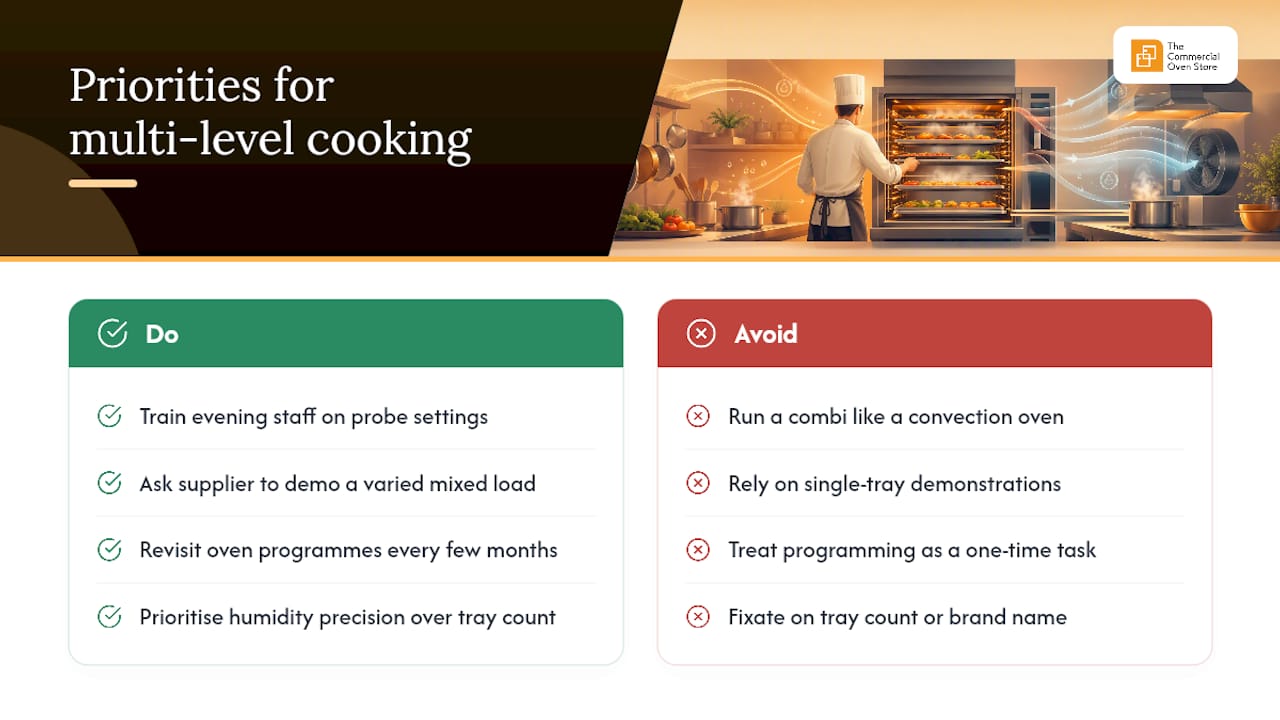
The obsession with headline specs doesn’t help either. Buyers fixate on tray count and brand name, when the feature that actually determines whether mixed loads succeed is humidity precision, something you can only really judge by asking a supplier to demonstrate a genuinely varied load, not a single tray of identical items. A six‑deck oven with weak climate control will disappoint a kitchen far more than a smaller oven with tight humidity management ever will.
There’s also a tendency to treat programming as a one‑time setup task rather than a living part of kitchen operations. Menus change, suppliers change cut sizes, and a programme built for last year’s chicken supplier might quietly be overcooking this year’s leaner bird. Revisiting programmes every few months costs almost nothing and prevents the slow drift into inconsistent results that nobody notices until a regular customer complains.
— Simon
Get expert help choosing your multi level cooking oven
Thecommercialovenstore is the alternative to guessing your way through a spec sheet: our team matches kitchens to ovens from Rational, Unox and Merrychef based on actual load patterns, not just tray counts, and iwocaPay lets you spread the cost instead of draining working capital on day one.
We help with the parts that actually decide whether multi‑level cooking works for you: choosing the right humidity and airflow specification for your menu, sizing capacity correctly, and arranging installation and training so your team uses the programming features you’re paying for. If a single combi oven doesn’t cover everything, we can pair it with complementary equipment such as the Merrychef CONNEX 16 for high‑speed finishing during peak service.
Browse the current range at Thecommercialovenstore, or go straight to a specific model like the XB893 Bakerlux oven if you already know you need higher tray capacity. Request a site visit or a quote and we’ll talk through what your actual mixed loads need before you commit to anything.
Sources
- What Is a Combi Oven? Uses and benefits | Electrolux Professional
- What is a combi oven? | RATIONAL
- FCSI UNOX white paper (2026) — industry perspective on combi and advanced ovens