

For artisan bakeries, a deck oven or small combi wins on crust control; for mixed menus with pastries and sheet bakes, convection or combi ovens make more sense; for high-volume bread production, a rotary rack oven earns its footprint. The right bakery oven choice always comes down to three things: your product mix, your daily throughput, and what your site can actually support in terms of power, gas, and access.
TL;DR:
- Oven capacity should be based on cycle time and throughput, not just tray count, with a typical 16-tray rack oven producing around 1,400 to 1,500 loaves per day.
- Site utilities, especially electrical and gas supply, must be thoroughly checked and specified before purchase to prevent installation delays.
- Insulating the oven and using standby modes can significantly reduce energy costs over its lifetime, especially with poorly insulated models.
- For consistent bake quality, prioritize features like true steam injection, programmable recipes, and independent zone controls over marketing declarations.
- Buyers should always test ovens with their actual dough and consider entire workflow logistics, including proofing and transport, to ensure real-world capacity matches expectations.
Table of Contents
- Oven types explained: which one bakes what
- How much can one oven actually bake per day?
- What utilities does your bakery need before installation?
- Gas or electric: which costs less to run?
- Which features actually improve bake quality?
- Ergonomics and everyday workshop flow
- How do you test a bakery oven before buying it?
- Expert advice from The Commercial Oven Store
- Where most bakery owners get their oven choice wrong
- Ready to choose the right oven for your bakery?
- Sources
Oven types explained: which one bakes what
Every oven heats dough differently, and that difference shows up in the crust, the crumb, and how many trays you can push through in a shift. Getting this wrong is the single most common mistake we see at Thecommercialovenstore: a bakery buys the oven that looks impressive on a spec sheet rather than the one suited to what’s actually going in it.
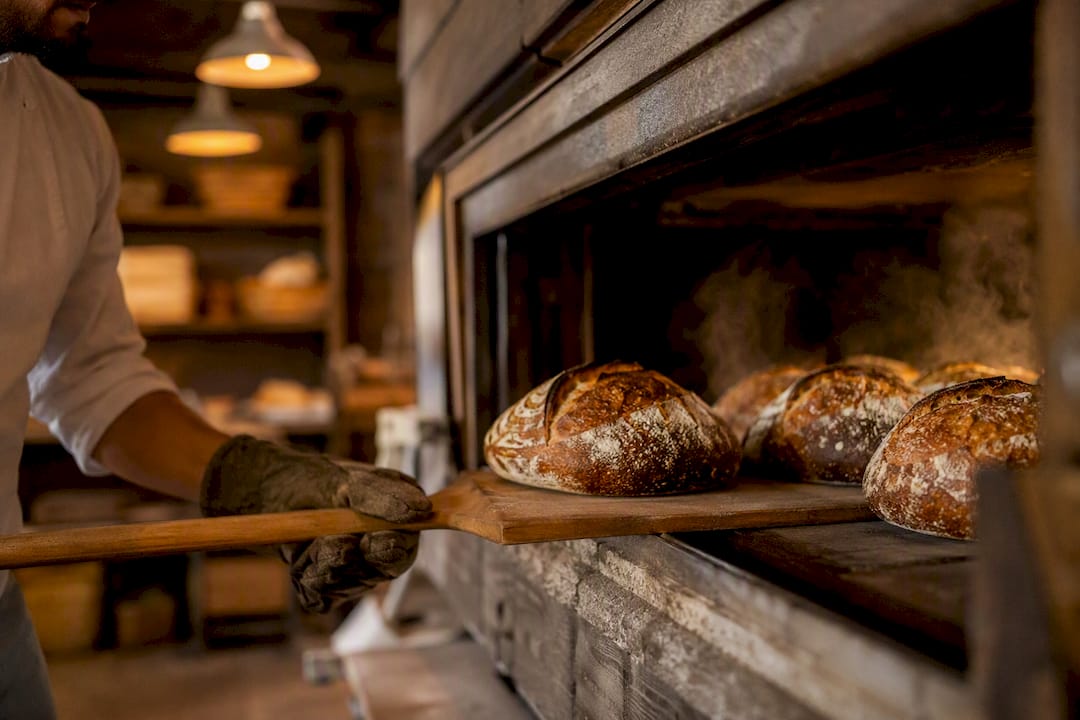
Deck ovens heat mainly from below, through a stone or heated hearth deck. That bottom heat drives the strong oven spring and blistered crust that sourdough and artisan loaves need, which is why deck ovens remain the standard for bakeries chasing crust quality and crumb structure. The heat transfer is largely conductive, similar to how a hot stone transfers energy directly into dough sitting on its surface, which is a different mechanism to the air movement inside a fan oven.
Convection ovens work by circulating hot air with a fan, evening out temperature across every shelf and cutting cook times compared with a static oven. This makes convection genuinely well suited to pastries, cookies, and any mixed-menu operation) where consistency across multiple trays matters more than an aggressive bottom crust. If your counter sells croissants, muffins, and traybakes alongside a handful of bread lines, this is usually where you land, and our convection oven guide for UK bakeries covers the sizing detail in more depth.
Rotary rack ovens rotate a full trolley of trays through the heat zone continuously, which is what makes them the workhorse of wholesale bread production. Uniformity across dozens of trays at once is the entire point.
Combi ovens blend convection heat with steam and, in some cases, microwave or grill functions, giving smaller operations one machine that handles bread, pastry finishing, and reheating without three separate appliances taking up floor space.
Tunnel ovens move product on a conveyor through a long heating chamber, built for continuous, high-volume production lines rather than batch baking. Most independent and mid-size bakeries never need one; they belong in industrial settings baking the same product by the tens of thousands.
Here’s how the trade-offs stack up:
- Deck ovens: excellent crust and oven spring, low running cost, but limited tray capacity per footprint and slower turnaround between bakes.
- Convection ovens: even bakes, shorter cycle times, flexible across a varied menu, but weaker bottom heat for serious artisan bread.
- Rotary rack ovens: high throughput and consistent results at scale, but a larger footprint, higher upfront cost, and mechanical parts that need servicing.
- Combi ovens: strong versatility for smaller kitchens, useful beyond baking, but a jack-of-all-trades compromise if bread is your main product.
- Tunnel ovens: unmatched continuous output, but only viable at industrial volumes and with a much larger capital outlay.
How much can one oven actually bake per day?
Buyers routinely guess capacity from an oven’s tray count alone, and it’s the second-biggest mistake we see after picking the wrong oven family entirely. Tray count tells you what fits inside the chamber at one moment. It tells you nothing about cycle time, and cycle time is what actually determines your daily output.
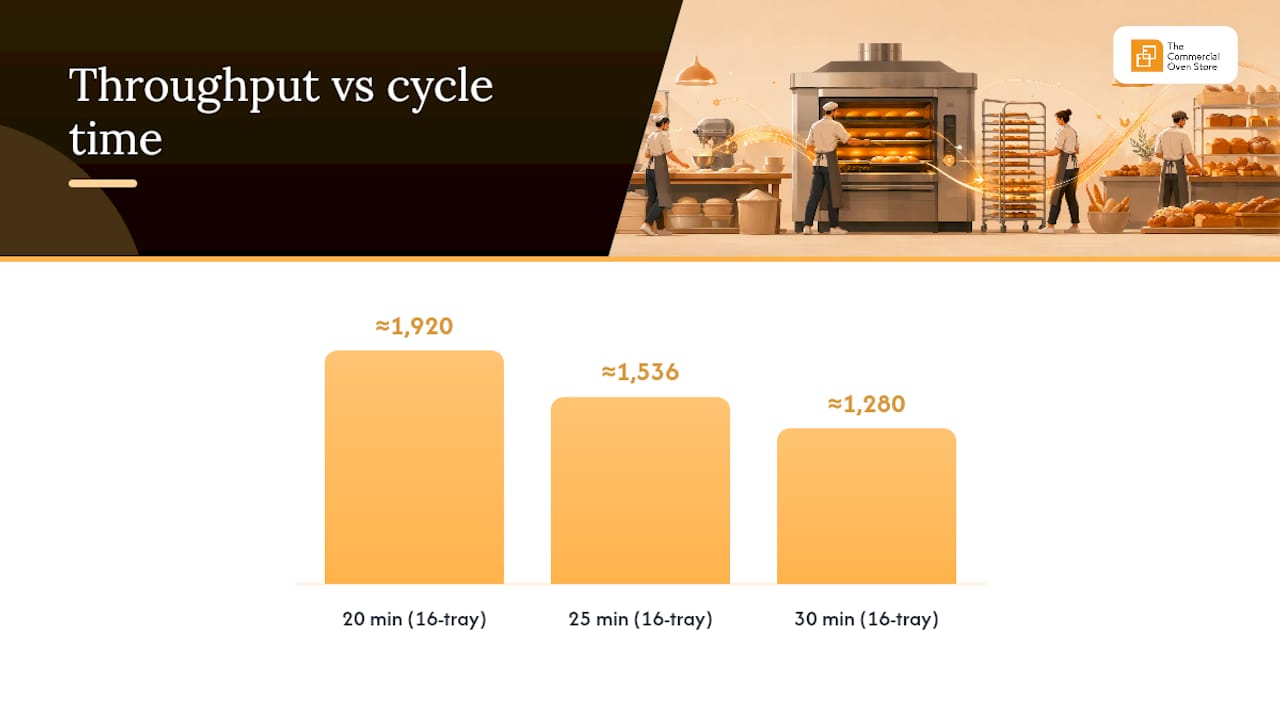
A useful anchor point: a 16-tray rotary rack oven can turn out around 80 loaves per 25-minute cycle, scaling to roughly 1,400 to 1,500 loaves across an 8-hour shift when proofing capacity keeps pace. That last condition matters more than most buyers assume.
Work through the maths for your own bakery like this:
- Count your trays per cycle. A small deck oven might hold 8 to 12 trays; a rack oven typically holds 16 to 20.
- Time one full cycle, from loading to unloading, including any recovery period between bakes. Bread cycles usually run 20 to 30 minutes; pastry cycles are often shorter.
- Divide your shift length by cycle time to get the number of cycles you can realistically run.
- Multiply cycles by tray count and units per tray to reach your daily ceiling, then subtract 15 to 20% for loading time, cleaning, and staff breaks.
Rough bands worth knowing when you’re scoping an oven:
- Lower daily production volumes: a single deck oven or a compact combi oven often covers these comfortably, typical for many café bakeries and small independents.
- Moderate daily volumes: a second deck, a larger convection oven, or an entry-level rack oven may become financially sensible, especially when running bread and pastry lines side by side.
- High daily volumes: at larger scales, a rotary rack oven is usually the practical choice, as deck configurations struggle to scale efficiently without excessive footprint and labour.
Proofing capacity is the part almost nobody budgets for properly. An oven that can bake 1,500 loaves a shift is worthless if your proofer only holds enough dough for 500. The rule of thumb suppliers use is a 2 to 3 times proofer-to-oven capacity ratio, so dough is always ready to load the moment a cycle finishes. Undersized proofing is the single most common bottleneck in bakeries that upgraded their oven but kept the old proofer, and it quietly caps output well below what the new equipment is capable of.
Pro Tip: Size for 1.5 times your current daily demand, not your five-year fantasy volume. An oven bought for growth you haven’t reached yet ties up capital, eats more energy standing half-empty, and often sits in a footprint you could have used better today. Buy for the business you have plus a realistic step up, then upgrade again when the numbers justify it.
What utilities does your bakery need before installation?
The oven itself is often the easy part. Site readiness is where projects stall, and it’s worth checking every item below before you commit to a purchase, not after the oven arrives at your loading bay.
Electrical supply trips up more buyers than any other factor. Larger convection and rack ovens usually need a three-phase supply, and the kW rating on the nameplate isn’t always the number that matters. For gas-fired ovens specifically, the electrical figure quoted often only covers fans and controls, while thermal input in kW or BTU is the real number for combustion capacity. Confusing the two leads to underspecified gas connections that get flagged during installation, sometimes weeks after the oven has already been delivered.
Gas supply needs checking against both pressure and volume, not just presence. Mains gas suits most fixed-site bakeries, but LPG becomes the practical answer for units without a mains connection, or where the existing meter can’t support the additional thermal load a new oven adds.
Ventilation and flue routing are non-negotiable for gas ovens and matter for high-output electric ones too. Combustion products need a properly sized flue, and even electric ovens generate significant heat and moisture that extraction needs to handle, particularly with steam-injection models running multiple shots per hour.
Physical access catches out more buyers than any spec sheet ever will:
- Measure every doorway, corridor, and turn on the delivery route, not just the kitchen entrance.
- Confirm lift dimensions and weight limits if the oven is going anywhere above ground floor.
- Check floor loading capacity, particularly for rack ovens, which are considerably heavier than a deck unit of similar footprint.
- Plan the exact route from delivery vehicle to final position before the oven leaves the supplier’s warehouse.
If your installation involves moving existing equipment out first, planning the logistics properly avoids the kind of delay that turns a two-day changeover into a two-week one.
Gas or electric: which costs less to run?
This is rarely a straightforward answer, because the honest answer is that lifecycle running cost usually matters more than which fuel powers the oven. Gas ovens tend to have lower running costs per unit of heat in areas with competitive gas pricing, but they need flue and ventilation infrastructure that adds to installation cost. Electric ovens are simpler to install and easier to control precisely, but they can be more expensive to run depending on local electricity pricing and how efficiently the unit is insulated.
Energy costs and insulation choices often outweigh the purchase price over an oven’s working life, and good insulation combined with sleep modes measurably reduces total cost of ownership compared with an equivalent oven left running at full temperature between bakes.
A poorly insulated oven bleeds heat constantly, forcing the burner or elements to work harder just to hold temperature, which shows up as a bigger bill every quarter rather than a one-off cost. Practical ways to cut running costs without touching your menu:
- Use sleep or standby modes during genuine downtime rather than leaving the oven at full temperature overnight.
- Buy the oven size that matches your actual throughput; an oversized chamber heating empty space wastes energy on every single cycle.
- Check door seal condition regularly, since a failing seal lets heat escape and forces longer, hotter cycles to compensate.
Which features actually improve bake quality?
Some features are marketing polish. Others determine whether your bread is consistent on a Tuesday morning as it was on Saturday. Steam injection sits firmly in the second category. A proper steam system injects moisture during the first minutes of the bake, preserving the dough’s skin elasticity long enough to develop a proper crust, and it does this far more reliably than a tray of water sitting in the base of the chamber, which produces inconsistent, weak steam that dissipates unevenly.
Prioritise these when comparing models:
- True steam injection with a generator sized to recover fully between shots, particularly important in multi-deck ovens where each deck draws on shared steam capacity.
- Programmable recipe memory, so a junior baker can select a stored cycle rather than guessing time and temperature from experience alone.
- Independent deck or zone control, letting you run bread at one temperature while finishing pastry at another simultaneously.
- Probe baking, which ends a cycle based on internal temperature rather than a fixed timer, useful for anything with variable size or density.
- Accessible door seals and heating elements, since replacement parts and straightforward access keep an oven earning money instead of sitting idle waiting for a technician.
Pro Tip: Ask your supplier for the steam generator’s recovery time between shots, not just its presence on the spec sheet. A weak generator that can’t recharge fast enough between bakes will leave your third and fourth loads under-steamed, even though the oven technically “has steam injection”.
Ergonomics and everyday workshop flow
Loading height sounds like a minor detail until someone’s lifting a hot tray above shoulder height forty times a shift. The widely used guideline is that top decks above roughly 1.6 metres create genuine loading difficulty, often forcing bakeries to add loaders or rework their layout entirely. If your oven configuration stacks taller than that, plan for a platform or loader from the outset rather than retrofitting one later.
Trolley and tray compatibility is another detail that catches experienced buyers out. Confirm tray pitch, trolley wheelbase, and door aperture before ordering, because an incompatible trolley can leave an otherwise excellent oven unusable with your existing racking. Our gastronorm sizing guide breaks down the standard measurements to check against your current equipment. On maintenance, check that door seals are replaceable without a full technician callout, that heating elements are accessible for cleaning and repair, and that spare parts are actually stocked locally rather than shipped from overseas on a multi-week lead time.
How do you test a bakery oven before buying it?
Never buy on a spec sheet alone. Specialist suppliers and buying guides consistently recommend running a demo bake with your own dough before signing anything, because your recipe will behave differently to whatever the showroom uses to demonstrate a machine.
- Bring your actual dough or batter, not a generic recipe, and bake your real product across a full tray load, not a single test loaf.
- Check colour and rise consistency across every position in the chamber, front to back and top to bottom, not just the centre tray.
- Time the recovery period between consecutive bakes, since a slow recovery quietly caps your real-world daily throughput regardless of the rated capacity.
- Test the steam shot directly, listening for consistent pressure and checking crust results on multiple consecutive bakes rather than just the first one.
- Run the same programme twice to confirm repeatability, since a machine that bakes brilliantly once but drifts on the second run isn’t ready for daily service.
- Ask about service response times, local parts stock, and a realistic installation lead time, since a fast oven backed by a slow service network still costs you downtime.
Expert advice from The Commercial Oven Store
We spend a good part of every week talking bakery owners through exactly this decision, and the pattern is consistent: the businesses that get it right are the ones who let us see the site before they pick a model. Our site survey checks electrical capacity, gas supply, ventilation, floor loading, and delivery access, then matches oven type and size to your actual menu and throughput rather than a generic recommendation.
Thecommercialovenstore works with established manufacturers including Rational and Unox, covering convection, combi, and rack ovens across the full range this article has walked through. We also offer flexible payment through iwocaPay, which spreads the cost of equipment without tying up working capital your bakery needs for stock, staff, and everyday running costs.
Where most bakery owners get their oven choice wrong
The mistakes are rarely about product quality. They’re about sequencing. Buyers oversize “for someday” and pay years of energy costs heating empty capacity they never fill. They upgrade the oven but leave the proofer as it was, so the bottleneck just moves one station down the line. Or they measure the kitchen door but forget the corridor, the lift, and the turn halfway down the delivery route.
Fix the order instead: size for 1.5 times current demand, match proofer capacity to oven output at a 2 to 3 times ratio, and walk the entire delivery route with a tape measure before you order anything.
— Simon
Ready to choose the right oven for your bakery?
Once you know which oven family fits your menu, the next decision is fit and finance, not just which brand looks best on paper. Thecommercialovenstore stocks convection, combi, and rack ovens from Rational, Unox, and other established manufacturers, alongside the accessories that actually determine whether an oven works in your kitchen: installation kits, stands, grids, and trays sized to match.
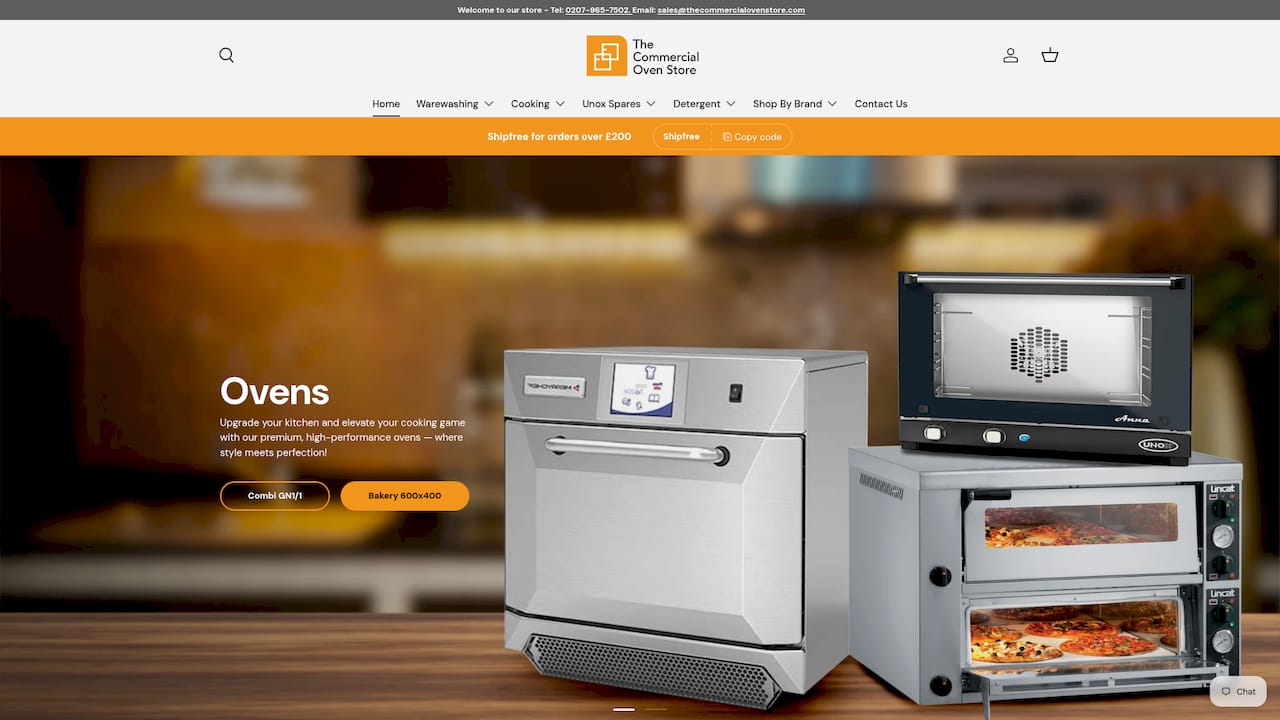
If your menu leans toward bread and pastry finishing, the Blue Seal E28 M4 convection oven is a solid mid-size entry point, and for compact counter service, models like the Unox Bakerlux ShopPro pack real capability into a small footprint. Every purchase can be spread through iwocaPay, so you’re not committing your entire cash reserve to one piece of equipment.
Book a site survey with our team through Thecommercialovenstore, and we’ll check your utilities, measure your delivery route, and size an oven to your actual throughput before you spend a penny.
Sources
- Commercial bakery oven buying guide 2026 — Grace Kitchen Equipment
- Bakery oven buyers guide — KaTom learning centre
- Commercial oven types explained for bakers — Chef’s Icon
- How to choose a commercial bakery oven — BRESSO