

Most commercial ovens cost between moderate amounts per hour to run, depending on fuel type, size and usage intensity, translating to several thousand pounds per year for a typical medium-use kitchen; understanding these costs is essential when considering commercial kitchen rental cost and shared kitchen models. The most effective way to manage running costs is to calculate your actual usage and improve scheduling and maintenance accordingly.
TL;DR:
- Gas ovens may have lower hourly running costs than electric models in the UK, but they require higher upfront installation expenses if gas lines are not available.
- A typical mid-size electric convection oven consumes 2 to 5kW, with running costs highly dependent on actual use hours, energy rates, and maintenance.
- Regular descaling, better insulation, and shifting baking to off-peak times can significantly reduce ongoing costs without major investments.
- Hidden expenses, like repairs and downtime, often surpass energy costs, especially if preventive maintenance and water treatment are neglected.
- Running an oven efficiently relies on precise calculation of usage patterns, proper scheduling, and routine upkeep, preventing costly repairs and replacements.
Table of Contents
- How to calculate your commercial oven running costs
- What actually changes your running costs
- Proven ways to cut oven running costs without a big spend
- Maintenance and hidden costs most budgets miss
- Three worked examples you can adapt
- Simon’s practical checklist for operators
- Where to go for oven finance and running-cost advice
- Sources
How to calculate your commercial oven running costs
Forget the guesswork. The formula is the same whether you’re running a countertop speed oven or a 20-tray rack unit.
- Find the rated power. Check the nameplate or manual for kW (electric) or BTU/therm rating (gas). A typical mid-size electric convection oven sits at 2 to 5kW.
- Multiply by hours of active use. Not hours the oven is switched on, but hours it’s actually heating or holding temperature.
- Multiply by your unit rate. Electric: kW × hours × pence per kWh. Gas: convert therms to kWh using your supplier’s conversion factor, then apply the same maths.
- Add the extras. Auto-clean cycles pull extra electricity and water, consumables (detergent, descaler) cost money, and you should build in a maintenance allowance per hour of use.
Here’s a worked example: a 3kW electric oven running 8 hours a day at 28p/kWh costs 3 × 8 × 0.28 = £6.72 a day, or roughly £2,400 a year across a six-day week. Swap in your own kW rating, hours and tariff, and you’ve got a figure that means something to your budget, not a generic average.
What actually changes your running costs
The formula above gives you a baseline. These variables are what push the real number up or down:
- Fuel source. Gas ovens often have lower running costs per hour than electric equivalents at typical UK tariffs, but electric units heat up and recover faster, which matters if you’re running back-to-back batches. Gas also carries higher installation costs where no gas supply already exists.
- Size and load factor. An oven running half-empty for most of its cycle wastes energy per portion cooked. Undersized ovens forced to run flat out all service also waste money through inefficient cycling.
- Insulation, door openings and recovery time. Every door opening bleeds heat, and a tired door seal or worn insulation forces the oven to work harder to recover, extending duty cycle and pushing up hourly cost.
- Auto-clean and water quality. Hard water accelerates limescale build-up inside boilers and heat exchangers, which increases both energy draw and the risk of expensive component failure.
Proven ways to cut oven running costs without a big spend
Some of these cost nothing beyond a change in habit. Others need capital, but pay back inside a couple of years.
- Stagger startups and batch loads. Don’t fire every oven at once for opening. Sequence starts around your actual service pattern and load ovens to capacity rather than running half-empty cycles.
- Cut idle time. Ovens left hot between uses waste energy holding temperature nobody needs yet. Use timers or programmable controls to bring units up only when a batch is imminent.
- Descale and service on schedule. Regular descaling and correct cleaning agents keep heat exchangers working as designed, rather than fighting scale build-up.
- Fit a water softener in hard-water areas. Softened water protects combi boilers from the limescale that shortens element life and pushes up energy draw.
- Invest in insulation and door seals. A worn door seal is cheap to replace and stops heat loss that otherwise shows up as a longer recovery time on every single cycle.
- Shift bakes to cheaper tariff windows. Where your supplier offers time-of-use pricing, moving batch cooking to off-peak hours reduces cost without touching the oven itself.
Pro Tip: Before spending on any capital upgrade, run your oven’s actual hours through the calculation method above for a full month. Most operators are surprised by which shift or product line is actually driving the bill.
Maintenance and hidden costs most budgets miss
Energy is the cost you see on the utility bill. The one that catches operators out is everything else.
Budget for five distinct items: consumables (detergent, descaling agents), preventive maintenance visits, corrective repairs when something fails, water treatment, and downtime. Downtime is often the single largest hidden cost, because a broken oven during service doesn’t just cost the repair bill, it costs the covers you can’t serve.
- A rough rule of thumb worth applying: if a repair quote runs close to half the cost of a comparable new or refurbished unit, and the oven is already past its expected service life, replacement usually makes more financial sense than another round of patching.
- Preventive maintenance contracts typically cost a fraction of what corrective repairs run to once a boiler element or control board actually fails.
- Set an annual allowance scaled to oven class: a countertop unit needs far less than a high-duty 20-tray combi running multiple services a day.
Preventive maintenance contracts and correct water treatment consistently come up as the cheapest insurance against the kind of failure that takes a kitchen offline for days, not hours.
Three worked examples you can adapt
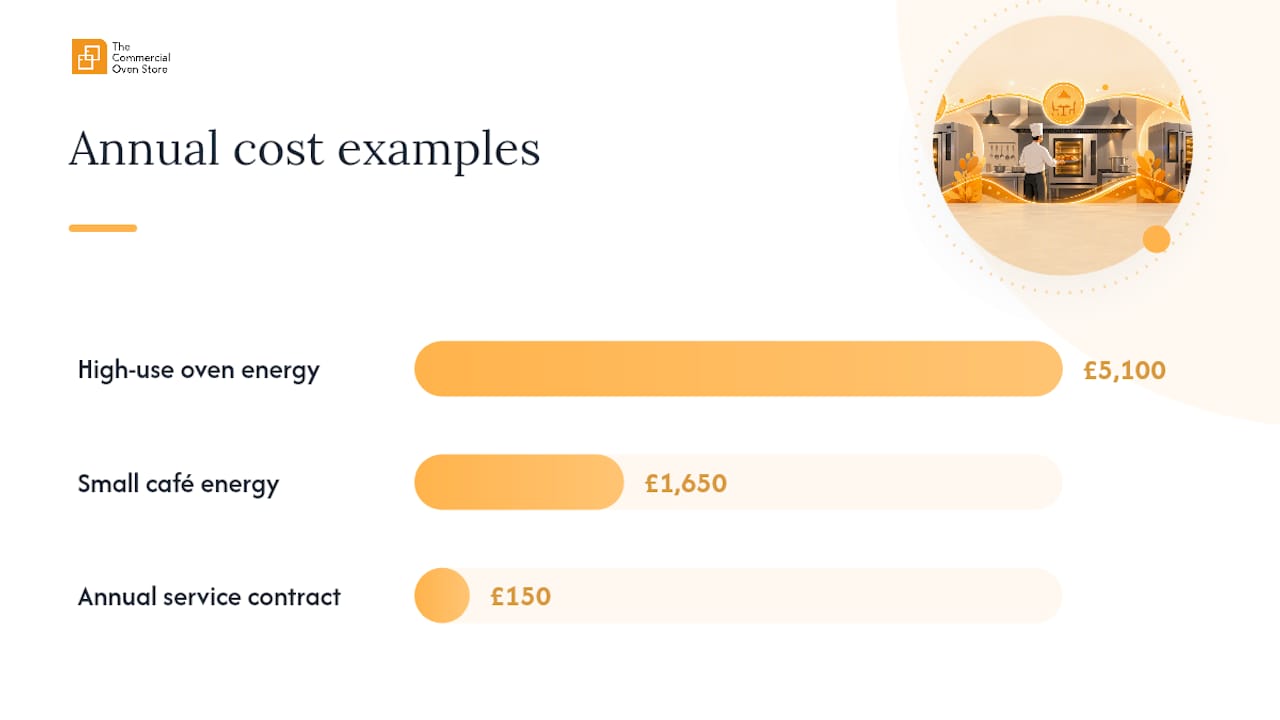
High-use combi oven, city restaurant. Running 10 hours a day at 5kW and 28p/kWh: 5 × 10 × 0.28 = £14 a day, around £5,100 a year across a seven-day operation. Add annual maintenance and consumables costs, bringing total cost of ownership to a higher amount.
Small café countertop oven. A 2.7kW unit running 6 hours a day at 28p/kWh costs 2.7 × 6 × 0.28 = £4.54 a day, roughly £1,650 a year. Maintenance is lighter here, typically a few hundred pounds annually if descaling stays on schedule.
Maintenance-impact case. A kitchen skipping descaling for 18 months saw energy draw creep up as scale built inside the heat exchanger, then faced a four-figure element replacement that a £150 annual service contract would likely have prevented.
- If your electricity tariff moves 20% either way, these annual figures shift by roughly the same percentage, so it’s worth rerunning the sums whenever you renew a supply contract.
- Scheduling changes such as staggered startups and batch loading are commonly cited as delivering meaningful cuts to idle-energy spend, though the exact percentage depends heavily on your existing habits.
In numbers: Fitting basic exhaust heat recovery on a high-duty oven can reclaim 8 to 15% of its total energy consumption, a saving worth modelling if your kitchen also has a hot water demand nearby.
Simon’s practical checklist for operators
Most kitchens I see get the energy sums roughly right and then blow the budget on downtime nobody planned for. That’s the mistake worth fixing first.
This week: calculate your own per-hour figure using the method above, review your batch schedule for idle gaps, check whether your water needs softening, and book a preventive maintenance visit if it’s been over a year. The two habits that trip people up most are treating maintenance as optional until something breaks, and skipping descaling because the oven “seems fine”. By the time it isn’t fine, you’re looking at a replacement bill, not a service invoice.
— Simon
Where to go for oven finance and running-cost advice
Getting the running-cost sums right matters more once you’re choosing between oven types, and that’s exactly where Thecommercialovenstore earns its keep: efficient combi and speed ovens from Rational and Unox, specced to your actual duty cycle rather than sold on brochure numbers.
Thecommercialovenstore stocks combi and speed ovens built for faster recovery and lower idle losses, which is where a lot of the running-cost savings above actually come from. If cash flow is the barrier to switching from an ageing, inefficient unit, iwocaPay spreads the purchase without tying you into a long-term contract, and the team can talk you through maintenance support options alongside the sale. For readers weighing capacity against power draw, the CIBO/S countertop fast oven is a useful reference point at 2.7kW for smaller sites. Get in touch for a running-cost review tailored to your kitchen’s actual hours and tariff, and a finance option that fits.
Sources
- What does professional combi oven maintenance cost per year? | JMGT Commercial Kitchen Technology
- How Much To Run A Commercial Convection Oven Per Hour: Cost, Energy Use & Efficiency | OvenCookGuy