

Programmable commercial ovens pay for themselves through three levers: energy, labour and consistency. RATIONAL’s own bakery case studies put the numbers at around 18% less energy, up to 15% lower cost of goods, and more than 40% less working time once a kitchen moves from manual convection ovens to programmed combi cooking. Recipe memory and sensor control mean a junior baker can run a laminated pastry programme that used to need a head baker’s eye. HACCP logging happens automatically in the background, which matters at audit time as much as it does at 6am on a Saturday.
The next move is small. Pick two or three of your best-selling menu items, build a trial programme for them, and ask Thecommercialovenstore for a commissioning visit to set it up properly.
Where the gains actually come from:
- Energy: steam and combination modes typically use 15 to 20% less energy than dry convection for suitable dishes.
- Labour: system-dependent execution replaces constant chef supervision.
- Consistency: sensor-driven programmes remove operator-to-operator variation.
- Compliance: automated HACCP recording cuts manual paperwork.
Key Takeaways
Programmable ovens cut energy use, labour hours and product waste simultaneously because sensor-driven cycles replace manual monitoring with repeatable, product-led cooking.
| Point | Details |
|---|---|
| Energy and labour gains are real | RATIONAL bakery case studies show around 18% less energy and over 40% less working time on combi ovens. |
| Steam mode cuts shrinkage | Steam injection during roasting reduces protein shrinkage by 15 to 25%, protecting yield on high-value items. |
| Map your menu before programming | Group dishes into three or four climate categories, then build one base programme per group. |
| Never mix incompatible loads | Steam-heavy and dry-only products in the same chamber run damage one or both results. |
| Thecommercialovenstore supports setup | Beyond selling Unox, Rational and Blue Seal ovens, the store commissions, transfers programmes and trains staff on site. |
Table of Contents
- What operational and financial benefits do programmable ovens deliver?
- Which programmable features actually create these benefits?
- How do you set up a programmable oven for bakery production?
- How do you measure ROI on a programmable oven?
- What mistakes derail programmable oven adoption?
- What should you ask a commercial oven supplier?
- Supplier note: getting real value from a programmable oven
- Get the right oven and the setup that makes it work
- Frequently asked questions
- Sources
What operational and financial benefits do programmable ovens deliver?
Four things change the moment a bakery or catering kitchen switches from manual ovens to programmed combi, convection or speed ovens: consistency, throughput, labour cost and energy spend. Each one shows up on a different line of the P&L, which is why suppliers and buyers alike keep coming back to the same shortlist of numbers.
Consistency comes from programme memory paired with sensor feedback. A combi oven blends steam and convection with sensor-driven adjustments that standardise output regardless of who loaded the trolley. That matters more at a second or third site than a single-site bakery, where “how Dave bakes it” has always been the unwritten recipe.
Throughput rises because multi-timer and multi-level cooking let one oven run several products on different clocks at once, rather than queuing trays for a single-temperature bake.
Statistic callout: Bakeries switching appropriate dishes into steam or combination mode report 15 to 20% energy savings on those specific dishes, while steam injection during roasting cuts protein shrinkage by 15 to 25% on high-value proteins.
Labour savings follow a similar logic. A commercial combi can replace several standalone appliances, a steamer, a proofer, sometimes a second convection oven, freeing both floor space and the staff hours that used to babysit them. Fewer appliances also means fewer things breaking down during service.
Put together, the benefits stack like this:
- Less shrinkage on proteins and baked goods thanks to humidity control.
- Fewer standalone units to clean, service and insure.
- Predictable bake colour and crumb structure across every shift.
- Lower overtime because junior staff can run programmed cycles unsupervised.
Which programmable features actually create these benefits?
A programmable oven is only as good as the features a manager actually uses, and most kitchens use a fraction of what they’ve paid for. Mapping specific features to the outcomes above shows why.
Multi-stage recipes run a laminated pastry through separate stages automatically: a hot, low-humidity stage for initial lift, a moderate transition stage to set the crumb, and a final dry stage to crisp the crust. Programmed correctly, that sequence delivers the same oven spring on tray four as it does on tray one.
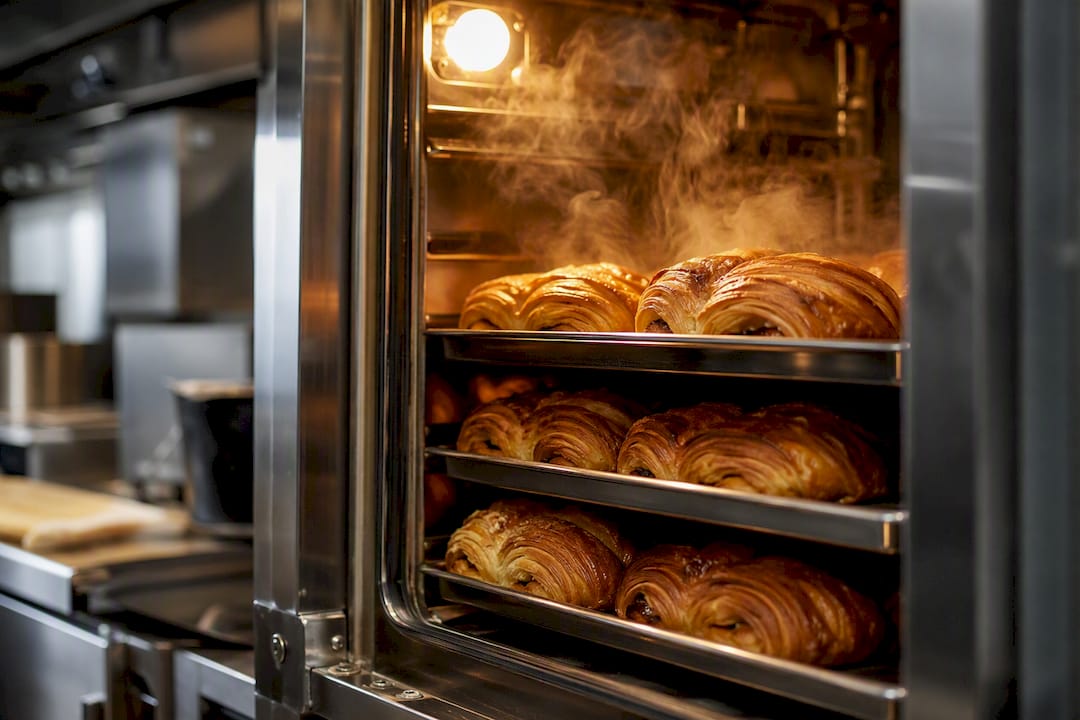
Humidity control and steam injection slow surface moisture loss during the bake, which is the mechanism behind the reduced shrinkage figures above. Less moisture lost means more saleable weight on every batch of croissants or roast joints.
Core-temperature probes with delta-T cooking pull the product out the moment it hits target internal temperature rather than after a fixed clock time, which cuts overcooking and lets the next load go in sooner.
Recipe memory and cloud connectivity mean a programme built at one site transfers to another site’s oven in minutes. Systems such as RATIONAL’s iCookingSuite and iProductionManager manage humidity and airflow automatically and export data for HACCP records without a manager touching a clipboard.
Automated cleaning and scheduling shrink the labour cost of compliance, since the oven runs its own clean cycle overnight rather than needing someone to scrub it by hand.
Pro Tip: Build your first three programmes around your highest-volume items, not your most complicated ones. A programme that’s used fifty times a week earns its setup time far faster than a fiddly showpiece bake used once a month.
How do you set up a programmable oven for bakery production?
Getting real value out of a combi or convection oven takes a short setup process, not a manual rewrite. Four steps cover most of it.
- Map your menu into climate categories. Most bakeries need only three or four groups: steam-heavy (bread, laminated pastry), dry-heat (biscuits, tarts), combination (roasted meats, casseroles) and delicate/low-temperature (meringues, custards). Programme a base recipe for each category before you worry about individual dishes.
- Build multi-stage recipes for your climate groups. For a laminated pastry, a workable starting block looks like: Stage 1, 220°C with high humidity for 8 minutes to drive oven spring; Stage 2, 190°C with reduced humidity for 10 minutes to set structure; Stage 3, 170°C dry for 5 minutes to crisp and colour.
- Set peak-hour loading rules. The golden rule: never mix a steam-heavy load with a dry-only load in the same chamber run, since one will finish soggy and the other will scorch. Use the multi-level timer to stagger different products cooking at the same temperature and humidity, not different climates.
- Fix a maintenance routine before problems start, not after. This protects the steam generator and keeps warranty terms intact.
A sample setting block worth copying straight into your oven’s interface:
- Bread base programme: 230°C, 80% humidity, 12 minutes, then 200°C, 20% humidity, 8 minutes.
- Roasted protein programme: 160°C, 40% humidity, delta-T finish at 68°C core.
- Daily clean: automated chemical cycle after final service, gasket wipe by hand.
Managers following this kind of structured approach, dividing the menu into climate categories and running strict multi-stage programmes, echo the practical operator guidance published for bakery combi setups, which treats the water-management timetable as inseparable from the cooking programme itself.
How do you measure ROI on a programmable oven?
Five figures tell you whether a programmable oven is paying for itself: monthly kWh, labour hours saved (FTE reduction multiplied by hourly rate), food waste as a percentage weight loss, throughput in dishes per hour, and ongoing maintenance cost.
A simple payback calculation:
- Record baseline kWh and labour hours for one month on the old equipment.
- Record the same figures for one month once the new oven is running its programmes.
- Multiply the energy difference by your unit electricity cost, add the labour hours saved multiplied by average wage, and add any reduction in wasted product.
- Divide the oven’s purchase and installation cost by that monthly saving to get a payback period in months.
| Metric | What to track |
|---|---|
| Energy use | Monthly kWh before and after switching cooking mode |
| Labour hours | FTE hours saved on monitoring and manual checks |
| Food waste | Percentage weight loss on proteins and baked goods |
| Throughput | Dishes or trays completed per hour at peak |
Local energy-efficiency grants and equipment finance schemes are worth checking with your supplier or local authority, since availability and terms vary by region and change year to year.
What mistakes derail programmable oven adoption?
The single biggest mistake is running a combi as if it were only a convection oven, ignoring steam entirely and losing most of the yield and consistency benefits you paid for. The second is mixing incompatible loads, putting a steam-heavy bread bake next to a dry biscuit tray and getting a poor result on both. The third, and the most expensive long-term, is neglecting water management, which lets scale build up in the steam generator and can void your warranty.
A basic maintenance timetable, drawn from manufacturer and operator guidance, looks like this:
- Daily: run the automated chemical clean cycle, wipe door gaskets, empty and clean drain filters.
- Weekly: check water-softener salt levels and test water hardness.
- Monthly: inspect steam generator for scale, verify door seal integrity, review HACCP logs for irregular cycles.
Pro Tip: Log your water hardness readings alongside your cleaning records. If scale problems appear later, that log is what proves you followed the maintenance schedule, and it is often what a warranty claim actually hinges on.
What should you ask a commercial oven supplier?
Before signing off on any programmable oven, get straight answers on warranty terms, on-site commissioning and training, spare parts availability, recommended water treatment, and service response times. A supplier who can’t answer these clearly is not one you want servicing a steam generator two years from now.
What a proper supplier should hand over as standard:
- A written programme transfer, by USB or cloud, so your base recipes are documented and portable.
- HACCP data export set up and tested before you go live.
- A documented daily, weekly and monthly maintenance schedule specific to your water hardness.
- A commissioning report including sample programmes built for your actual menu.
The trust signals worth checking are manufacturer specifications and warranty documents, published energy and labour case-study figures like the ones cited above, a genuine local service network, and finance options such as iwocaPay that let you spread the cost rather than draining working capital in one go.
Supplier note: getting real value from a programmable oven
We supply, install, commission and train on every oven we sell, because a programmable oven only delivers its promised savings once someone has transferred the right base recipes onto it. We arrange on-site trials, commissioning visits and staff training sessions to get your climate-category programmes running from day one.
Get the right oven and the setup that makes it work
Choosing between a Unox, Rational or Blue Seal oven is only half the job. The harder part is getting the programmes right, the water treatment sorted, and your team trained before service starts, and that’s the part most suppliers skip once the invoice is paid. Thecommercialovenstore handles both halves: we help you pick the right model for your menu, then commission it, transfer working programmes onto it, and train your staff to run it without a head chef standing over every tray.
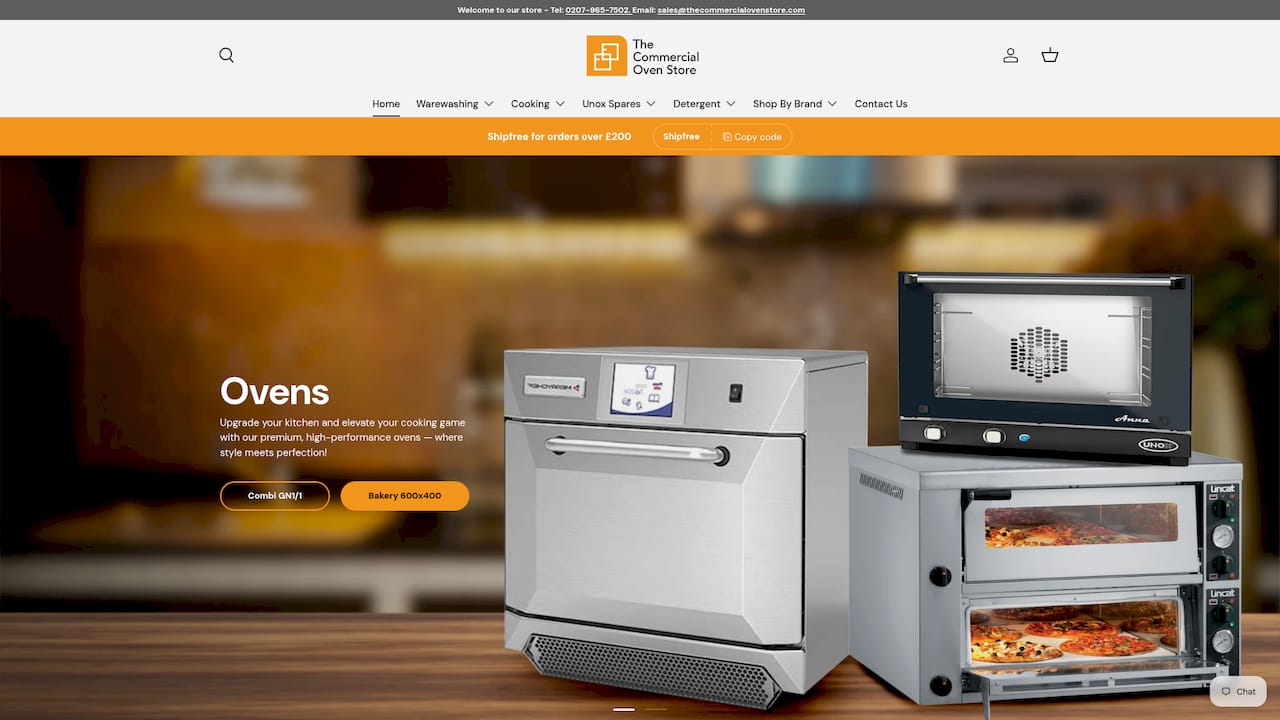
If you’re weighing up a combi against your current convection ovens, our range covers everything from compact countertop units like the CIBO/S fast oven for smaller cafés through to bakery-focused programmable ovens such as the Unox Bakerlux ShopPro. Flexible payment through iwocaPay means you don’t need the full cost upfront. Kitchens juggling event catering alongside daily service often find it useful to plan around structured peak-hour workflows as well, so your oven programmes and your service schedule pull in the same direction.
Request a site visit or an equipment quote through Thecommercialovenstore and we’ll come back to you with a setup built around your actual menu, not a generic spec sheet.
Frequently asked questions
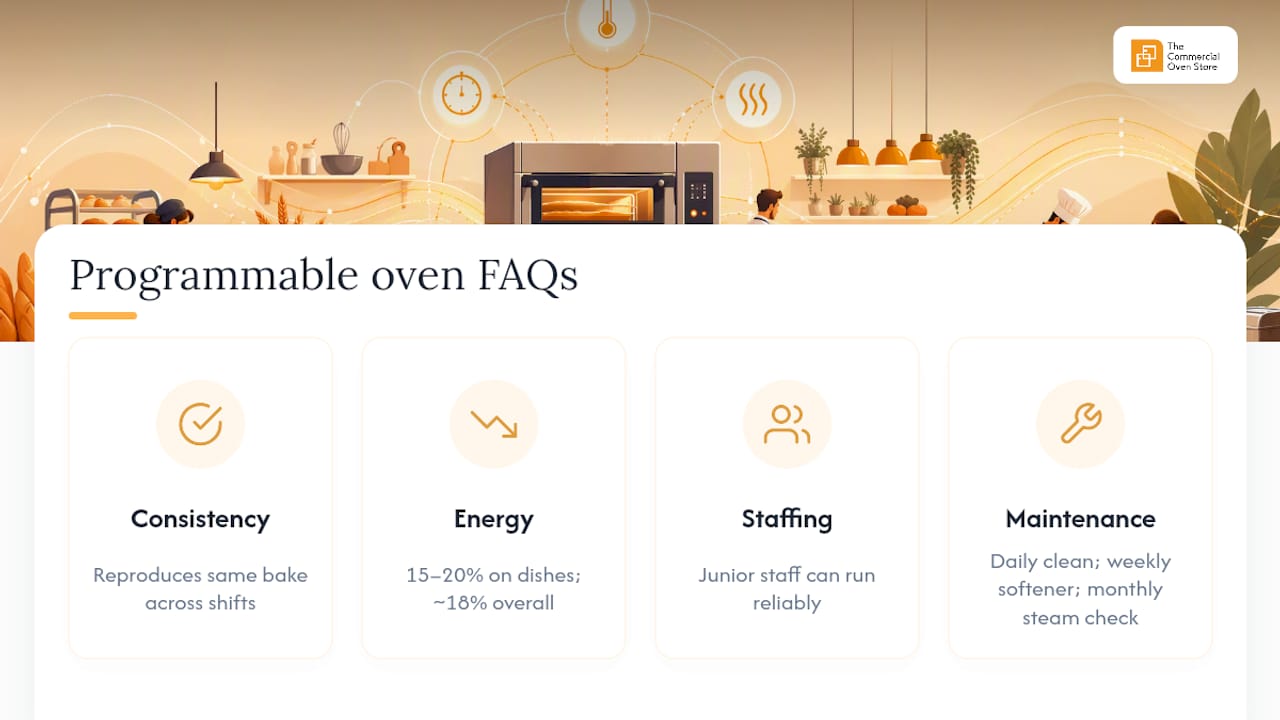
What is the main benefit of a programmable oven for a bakery? The clearest benefit is consistency at scale: sensor-driven multi-stage programmes reproduce the same bake colour, crumb and yield across every shift, without needing a head baker present for every batch.
Do programmable ovens really reduce energy costs? Yes, when dishes are shifted to steam or combination mode where suitable, operators report 15 to 20% energy savings on those dishes, and RATIONAL’s bakery data shows roughly 18% overall.
Can junior staff operate a programmable oven safely? Yes. That’s one of the main points of programme memory: once base recipes are built and tested, execution shifts from chef-dependent judgement to system-dependent cycles that a trained junior member of staff can run reliably.
How often does a programmable oven need maintenance? Daily automated cleaning cycles and gasket checks, weekly water-softener testing, and monthly inspection of the steam generator for scale build-up are the minimum to protect performance and warranty terms.
Is a programmable oven worth it for a small café? It depends on menu volume and variety. A compact programmable countertop oven can suit a smaller café’s service pattern, while a full combi suits higher-volume bakery or catering production where consistency across many batches matters most.
Sources
- The iCombi Pro rises to the occasion for bakers | RATIONAL
- Commercial Combi Ovens: The Complete Australian Buyer’s Guide (2026) - Mattys
- What Is a Combi Oven? Uses and benefits | Electrolux Professional
- How to maximise your combi oven — NTSmart (practical bakery guide)
- DS-iCP-11-EG-en-INT-00-ST (Rational iCombi Pro spec sheet) — Caterkwik