

Aim for incoming water hardness below 6 °dH (roughly 107 ppm CaCO3) for any boiler-equipped combi oven. Above that threshold, scale accumulates on heating elements, clogs sensors and, in most manufacturer specifications, voids the warranty. Boiler combi ovens commonly require ≤6 °dH, while injection-style models often tolerate up to 7–10 °dH before treatment becomes necessary.
Three things to do right now:
- Test your supply. Use a titration drop test or send a sample to a lab. Test strips give a rough steer but are not precise enough to match against manufacturer limits.
- Check your oven manual for inlet limits. Alto-Shaam, for example, publishes an untreated inlet limit of less than 3 gpg (≈52 ppm) for some models. Your manual’s water-quality page is the contractual reference for warranty claims.
- Contact a treatment supplier or installer if you are over the limit. The comparison in Section 5 covers UK-available options from ion-exchange softeners to reverse osmosis and scale-reduction units.
Warranty sensitivity is real: fitting the wrong treatment, or no treatment at all, is the single most common reason manufacturers decline service claims on combi ovens.
Key takeaways
Correct water treatment is the single most cost-effective step a commercial kitchen operator can take to protect a combi oven investment and keep warranty cover intact.
| Point | Details |
|---|---|
| Target hardness for boiler combi ovens | Keep inlet water at or below 6 °dH (≈107 ppm) to meet most manufacturer limits. |
| Test before you specify | Use a titration kit or lab report; test strips alone are not accurate enough for treatment specification. |
| Match treatment to your water profile | Ion-exchange softening suits most kitchens; add RO when chlorides or TDS are also elevated. |
| Warranty depends on documentation | A post-install hardness certificate is your evidence if a manufacturer warranty claim arises. |
| CTU/scale reducers have limits | Non-softening units delay scale but do not satisfy strict boiler combi hardness limits; confirm manufacturer acceptance in writing. |
| The Commercial Oven Store | Supplies matched softeners, installation, commissioning and post-install certificates alongside its combi oven range. |
Table of Contents
- How water hardness damages combi and steam ovens
- How to measure water hardness on site
- Treatment options: softeners, reverse osmosis, scale reducers and filtration
- Comparing UK-available water treatment options
- How to choose and size the right water treatment
- Example setups from The Commercial Oven Store
- The Commercial Oven Store: ovens, softeners and installation in one place
- Sources
How water hardness damages combi and steam ovens
Scale and certain dissolved salts cause three distinct problems: efficiency loss, sensor error and corrosion. They do not announce themselves until a component fails, which is why reactive repairs cost far more than prevention.
Component-level impacts to watch for:
- Heating elements: Limescale is an effective insulator. An eighth of an inch of scale can raise energy consumption of steam equipment by a significant margin, meaning the oven works harder for the same output.
- Temperature and humidity sensors: Scale deposits on probe tips cause false readings, leading to inconsistent cooking results that are difficult to diagnose without stripping the oven.
- Door gaskets and seals: Mineral-laden steam accelerates rubber degradation, shortening gasket life and allowing heat and moisture to escape.
- Solenoid valves and water injectors: Hard water deposits narrow the bore of valves and injectors, reducing flow and triggering pressure faults.
- Condensate drains: Scale and iron deposits block drain channels, causing water to back up into the cooking cavity.
- Oven glass: Calcium deposits etch glass over time, reducing visibility and requiring abrasive cleaning that risks scratching.
Boiler-based vs boilerless combi ovens. Boiler systems are significantly more sensitive to hardness because they heat a reservoir of water continuously, concentrating minerals with every cycle. Boiler combination ovens can use more than 20 gallons (≈76 litres) per cooking cycle in steam mode, meaning scale accumulates far faster than in a boilerless model that injects water directly. Boilerless (injection) ovens are more forgiving, but they are not immune: injectors and sensors still scale up in hard-water areas.
Pro Tip: If you run a boiler combi in an area with hardness above 10 °dH, check the element visually every six months. A white crust forming on the element sheath is a reliable early warning that your treatment is undersized or overdue for regeneration.
How to measure water hardness on site
Three reliable options exist: test strips, titration drop tests and laboratory analysis. Use test strips for a quick initial screen, a titration kit when you need a result accurate enough to compare against manufacturer limits, and a lab report when you are specifying treatment or need a certificate for warranty purposes.
Unit conversions at a glance
Most UK water suppliers publish annual water-quality reports by postcode. These give a starting point, but building pipework and any existing treatment can shift the figure significantly by the time water reaches the oven inlet.
Practical testing options:
- Test strips: Dip in a cup of water drawn from the oven’s supply line. Results in seconds, accurate to within roughly ±2 °dH. Useful for a first check, not for specification.
- Titration/drop test kits: Count the drops of reagent until the colour changes. Accurate to ±0.5 °dH and sufficient for most supplier conversations.
- Laboratory analysis: Send a 500 ml sample in a clean, sealed bottle. A full water analysis returns hardness, TDS, chloride, iron and pH, all the parameters treatment suppliers need to specify correctly.
Pro Tip: Take the sample from the cold-water feed directly behind the oven, not from a tap elsewhere in the building. A building-level softener or filter may have already altered the water, and you need the reading at the point of use.
Treatment options: softeners, reverse osmosis, scale reducers and filtration
The right treatment depends on your hardness level, TDS, chloride content and how many hours a day the oven runs. Here is the short version: ion-exchange softening is the standard first choice for most commercial kitchens; RO is necessary when TDS or chlorides are also elevated; scale-reduction units suit sites where softening is impractical; carbon prefiltration protects flavour and elastomers regardless of which primary treatment you choose.
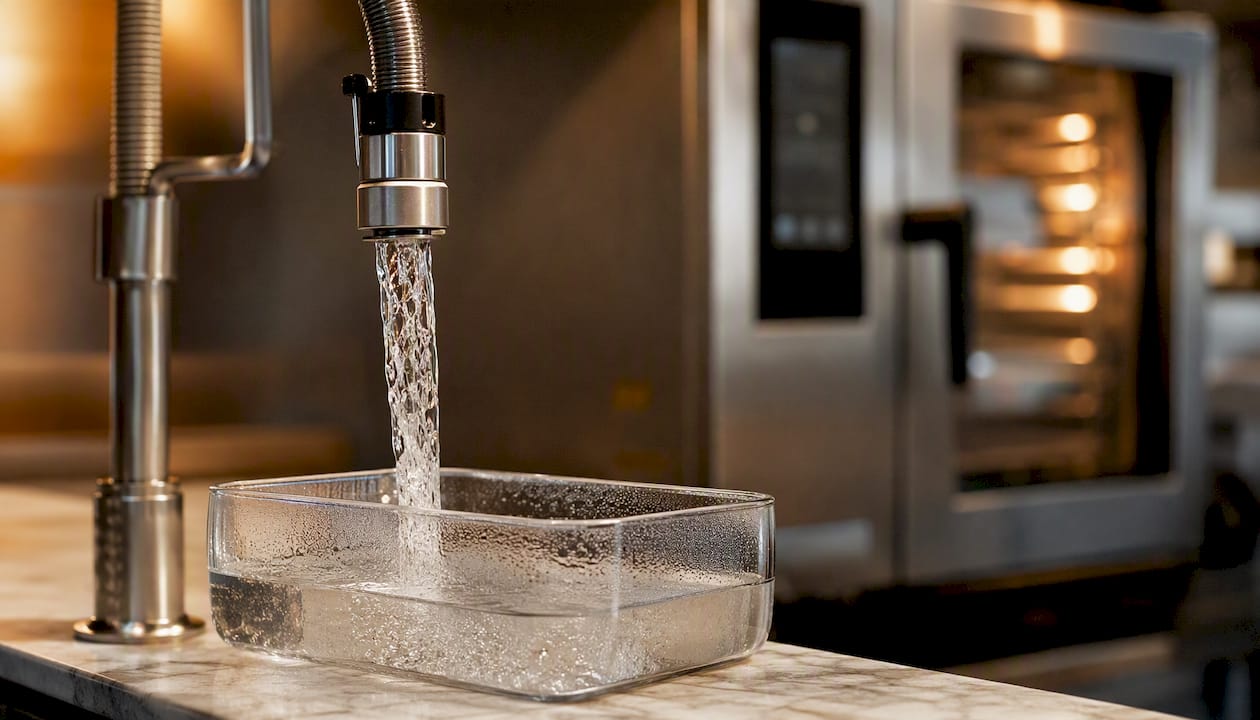
Ion-exchange water softeners
The most widely specified treatment for combi ovens. Resin beads swap calcium and magnesium ions for sodium, reducing hardness to near zero before blending back to a target level.
- Reduces hardness reliably to manufacturer-specified limits
- Requires a salt supply and periodic regeneration (typically every 3–7 days in a busy kitchen)
- Adds sodium to the water, which can affect TDS; check manufacturer limits on TDS as well as hardness
- Needs a drain connection for regeneration backwash
- Manual units are lower cost; automatic metered units regenerate on demand and waste less salt
Reverse osmosis (RO)
RO forces water through a semi-permeable membrane, removing virtually all dissolved solids including hardness, chlorides and heavy metals. The result is very pure water that must usually be blended back with untreated water to reach the target hardness band.
- Necessary when chlorides are high (above roughly 50 mg/l) because softening alone does not remove chloride
- Produces a waste-water stream (typically 2–4 litres rejected per litre produced) requiring a drain
- Higher capital and running cost than softening
- Requires pre-filtration to protect the membrane
- Mis-specifying RO introduces new issues unless matched to the model and local water quality
Cartridge prefiltration and carbon filtration
Carbon block or activated-carbon cartridges remove chlorine and chloramine, protecting gaskets and food flavour. Trace chlorine or chloramine affects delicate flavours and targeted filtration protects steam quality. Carbon filtration does not reduce hardness, so it is almost always used alongside a softener or RO unit rather than instead of one.
- Low cost and simple to install
- Cartridges need replacing every 3–6 months depending on flow and chloramine levels
- Protects elastomers from chloramine degradation
CTU/scale-reduction units
Chemical treatment units (CTUs) and template-assisted crystallisation (TAC) devices delay scale formation by altering the crystal structure of calcium carbonate without removing it. IX Eco and similar CTU-style scale reducers are used where softening is undesirable, where TDS rules out RO, or where a drain connection is not available.
- No salt, no drain, no regeneration
- Does not reduce TDS or chloride
- Scale formation is delayed, not eliminated; not suitable for boiler ovens with strict hardness limits
- Appropriate for injection-style ovens in moderately hard areas
Chemical scale inhibitors
Phosphate-dosing systems add a small quantity of scale inhibitor to the water. They are common in dishwashers but less frequently specified for combi ovens because some manufacturers prohibit additives in the water supply. Always check the manual before fitting a dosing system.
Comparing UK-available water treatment options
| Provider / System | Best for | Treatment type | Post-treatment hardness target | Maintenance frequency | Warranty compatibility |
|---|---|---|---|---|---|
| The Commercial Oven Store | Operators buying ovens and needing a matched softener and installation package | Ion-exchange softener (manual or automatic) | ≤6 °dH (≈107 ppm) | Salt top-up weekly; regeneration every 3–7 days | High — post-install certificate provided |
| Vivreau | Sites needing carbon filtration for chloramine and taste protection alongside scale control | Cartridge filtration + carbon | Hardness unchanged; chloramine/chlorine removed | Cartridge change every 3–6 months | Supports warranty where chloramine is the primary concern |
| Watercare | Sites seeking end-to-end service contracts and on-call maintenance | Ion-exchange softener + service contract | ≤6 °dH | Managed service schedule | High when matched to manufacturer limits |
| IX Eco / CTU | Installations where softening is impractical and strict hardness reduction is not required | Scale-reduction unit (CTU/TAC) | Hardness unchanged; crystal structure modified | Annual inspection | Moderate — check manufacturer acceptance of CTU treatment |
| KineticoPRO | High duty-cycle sites needing reliable regeneration and full treatment packages | Softener, RO or combined system | ≤6 °dH or near-zero (RO) | Managed regeneration; membrane service annually | High when specification matches oven inlet limits |
A note on warranty compatibility. Ion-exchange softening and RO, when correctly sized and commissioned, typically satisfy manufacturer inlet limits and preserve warranty cover. CTU and scale-inhibitor approaches sit in a grey area: some manufacturers accept them, others do not. Always obtain written confirmation from the oven manufacturer before fitting a non-softening treatment. Chemical dosing systems are the highest risk and are prohibited by several major brands including some Rational and Unox models.
How to choose and size the right water treatment
Start with four numbers before you speak to any supplier: your tested hardness result (in °dH or ppm), your peak flow rate at the oven inlet (litres per hour), your oven’s pan capacity and daily cycle count, and your TDS and chloride readings from a lab report.
A rough sizing reference: a 10-pan combi running 40 cycles per day in a 15 °dH supply area will exhaust a small domestic-grade softener within hours. Commercial kitchens need a unit rated for continuous duty, with a resin volume matched to daily water throughput and a regeneration schedule that does not interrupt service.
Ten questions to put to every treatment supplier
- What is the rated softening capacity in litres at my hardness level before regeneration?
- How long does regeneration take, and can it be scheduled outside service hours?
- What is the waste-water ratio if you are quoting RO?
- What salt type and quantity does the unit consume per regeneration cycle?
- Can you provide an emergency swap-out unit if the system fails during service?
- Does this treatment satisfy the inlet-water requirements in my oven’s installation manual?
- Will fitting this unit affect my oven’s manufacturer warranty, and can you confirm that in writing?
- What is the maintenance SLA, and how quickly can an engineer attend?
- Will you provide a post-installation water sample certificate showing treated hardness and conductivity?
- Is the unit compatible with my drain connection and available space?
Red flags to reject a quote: any supplier who cannot answer questions 6, 7 and 9 in writing; any quote that specifies a unit by brand alone without a capacity calculation based on your actual hardness and flow data; any proposal that omits a commissioning test.
Pro Tip: Insist on a post-install certificate showing treated hardness and, where the manufacturer requires it, conductivity. Keep this document with the oven’s service records. If a warranty claim arises, it is your primary evidence that the inlet water met specification on day one.
Example setups from The Commercial Oven Store
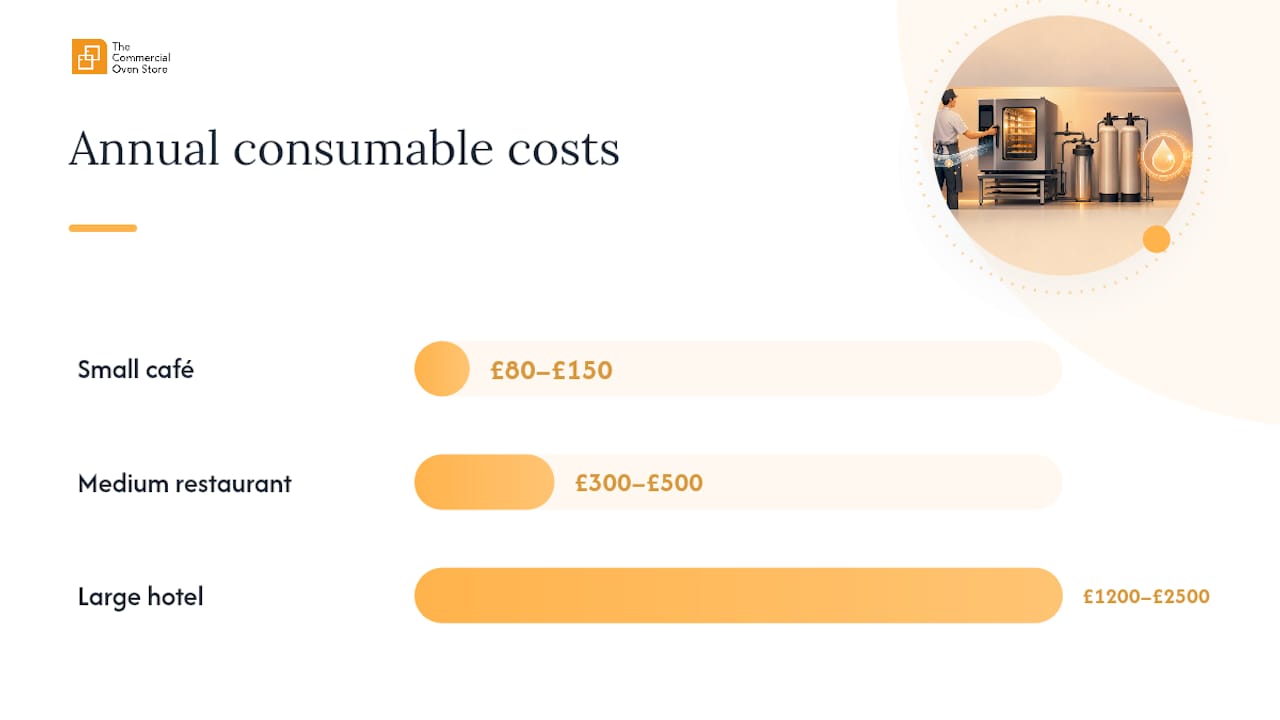
These configurations illustrate what a correctly specified installation looks like across three common kitchen sizes. Consumable costs are indicative and will vary by supplier and local water hardness.
Small café (1–2 combi ovens, up to 6 GN1/1 pans, moderate duty)
- Treatment: Manual ion-exchange softener, 10–15 litre resin volume
- Target hardness: ≤6 °dH at the oven inlet
- Peak flow handled: 100–150 litres per hour
- Maintenance: Salt top-up every 1–2 weeks; regeneration manually initiated; annual service visit
- Typical consumable cost: £80–£150 per year in salt
- Descaling cadence: Annual, per Rational service guidance for hardness up to 18 °dH
- A Rational i-Combi Pro 6 GN1/1 paired with a correctly sized manual softener and a post-install certificate satisfies most manufacturer inlet limits at this scale
Medium restaurant (2–4 combi ovens, 10 GN1/1 pans, high daily cycle count)
- Treatment: Automatic metered ion-exchange softener with carbon prefiltration
- Target hardness: ≤6 °dH; chloramine removed by carbon stage
- Peak flow handled: 250–400 litres per hour
- Maintenance: Automatic regeneration overnight; salt delivery every 4–6 weeks; bi-annual service
- Typical consumable cost: £300–£500 per year in salt and cartridges
- A Rational i Combi Pro 10 GN1/1 benefits from the carbon stage where chloramine is present, protecting gaskets and preserving steam flavour quality
Large hotel or banqueting kitchen (multiple combi ovens, continuous operation)
- Treatment: Twin-vessel automatic softener (one vessel in service, one regenerating) plus RO for high-TDS or high-chloride supplies, with carbon prefiltration
- Target hardness: ≤3 °dH at the oven inlet; TDS within manufacturer band after blending
- Peak flow handled: 600+ litres per hour
- Maintenance: Managed service contract; monthly salt delivery; quarterly membrane check; annual full service
- Typical consumable cost: £1,200–£2,500 per year depending on RO membrane replacement cycle
- Descaling cadence: At minimum twice annually for hardness in the 18–24 °dH range, per Rational descaling interval guidance
The Commercial Oven Store supplies and installs manual and automatic softeners alongside its oven range, with commissioning and a post-install hardness certificate included. Finance through iwocaPay is available, spreading the cost of equipment and installation together.
The case for treating water before you need to
The operators who call for emergency combi oven repairs in the middle of a Saturday service share one thing: they knew the water was hard and assumed the oven would cope. It does cope, for a while. Scale builds slowly, efficiency drops gradually, and then a sensor fails or an element burns out at the worst possible moment.
What most guides understate is that the cost of correct treatment is almost never the barrier. A properly sized softener for a medium restaurant kitchen costs less than a single emergency call-out and element replacement, and it pays back within a year in energy savings alone. The real barrier is specification: an undersized softener that exhausts its resin before the end of a lunch service is worse than no softener, because it gives false confidence. Getting the capacity calculation right, based on actual hardness and actual daily water throughput, is where most operators cut corners.
TDS is the other variable that gets ignored. Softening reduces hardness but raises sodium, which can push TDS above the manufacturer’s upper limit. Some Rational and Unox models specify a TDS band, not just a hardness ceiling. If your softened water is outside that band, you are still at risk of a declined warranty claim. A lab report before specification costs very little and removes that uncertainty entirely.
The Commercial Oven Store: ovens, softeners and installation in one place
Buying a combi oven and specifying water treatment separately is where most operators lose time and money. The Commercial Oven Store supplies commercial combi ovens from Rational and Unox alongside matched water softener options, handling installation and commissioning as a single package. Every installation includes a post-install hardness certificate, giving you the documented evidence that the inlet water met specification from day one.
Finance through iwocaPay means the cost of the oven, softener and installation can be spread rather than paid upfront, which matters when you are equipping a new kitchen or replacing ageing equipment at short notice. If your supply hardness is borderline or you are unsure which treatment suits your oven model, the team can advise on the right unit before you commit. Request a quote or site survey at The Commercial Oven Store and get the water question resolved before the oven arrives.
Sources
- U.S. EPA: Combination ovens — WaterSense at Work (section 4.3)
- Combi oven water quality: expert Q&A — Vivreau
- KineticoPRO: The impact of water on steamers & combi‑ovens (application note)
- Commercial kitchen water treatment guide 2026 — Grace Kitchen Equipment
This article provides general guidance on water treatment for commercial combi ovens. Confirm inlet-water requirements with your oven manufacturer and consult a qualified water treatment engineer before specifying or installing any treatment system.