

Humidity control sets the percentage of moisture in the cooking cavity, and that percentage decides how fast heat reaches the food and what its surface does when it gets there. Three modes cover almost every task: steam at 100%, combi mode variable between a low and high humidity percentage, and convection at close to 0%. Get the staging right and you get juicier proteins, better bake lift and a crust that behaves the way you want it to, not the way the oven happened to leave it.
TL;DR:
- Humidity significantly affects heat transfer in combi ovens, with condensation allowing faster, more even cooking and reducing weight loss in meats and baked goods.
- The ideal humidity ranges for different tasks are 100% for delicate steaming, 60-80% for roasting and baking, and near 0% for crisping and browning.
- Proper vent management alongside humidity settings is crucial, with closed vents trapping moisture for steaming, and open vents promoting dryness for finishing touches.
- Staged humidity programming during cooking, decreasing humidity in phases, yields better texture and doneness, especially for roasting and baking.
- Regular maintenance of sensors, descaling, and ensuring water quality are key to reliable humidity control and consistent results.
Table of Contents
- How humidity control actually changes the cooking physics
- Which humidity percentage suits which job?
- Setting humidity on the control panel and understanding the vents
- Staged humidity programmes that actually work
- Fixing humidity problems before they hit the pass
- Why this guidance holds up in a working kitchen
- Comparing humidity control across combi oven models
- Energy use and humidity settings
- What the conventional advice on humidity gets wrong
- Ready to upgrade your kitchen’s humidity control?
- Sources
How humidity control actually changes the cooking physics
Dry hot air cooks food by convection alone, and convection is a comparatively slow way to move energy into a piece of meat or a tray of bread rolls. Steam changes the equation. When moist air meets a cooler surface, it condenses, and that phase change releases energy far faster than air moving past the food ever could. The RATIONAL Culinary School handbook sets out exactly why combi ovens were built around this principle: condensation heat transfer gets food to temperature quicker and more evenly than dry heat alone.
That speed matters commercially, not just scientifically. Faster core heating means less time for moisture to evaporate out of the product, so joints of meat lose less weight during roasting and bread doesn’t dry out before the crumb sets. It also flattens the hot and cold spots that plague dry ovens, because humid air carries heat more consistently around a fully loaded cavity than dry air does.
The oven manages all this through a feedback loop rather than a fixed setting:
- A humidity sensor reads the moisture level inside the cavity in real time.
- The controller compares that reading against the percentage you’ve set.
- If humidity is low, the boiler or injector adds steam; if it’s too high, the vent opens to let excess moisture escape.
- The cycle repeats continuously, holding the set point through temperature swings, door openings and different pan loads.
The humid batch typically comes out heavier off the same raw weight, because less moisture has boiled away during the initial heat penetration. That’s the phase-change advantage working in your favour, not a fluke of the batch.
Which humidity percentage suits which job?
Steam mode holds the cavity at 100% humidity, and it’s the setting for anything that needs to cook through gently without drying out or browning: blanched vegetables, delicate fish, poached eggs, and regenerating plated meals without turning the edges leathery. Operator guidance from Cooking with Steam treats 100% as the default whenever a recipe simply says “steam,” which removes a lot of the guesswork chefs report when facing an unfamiliar control panel.
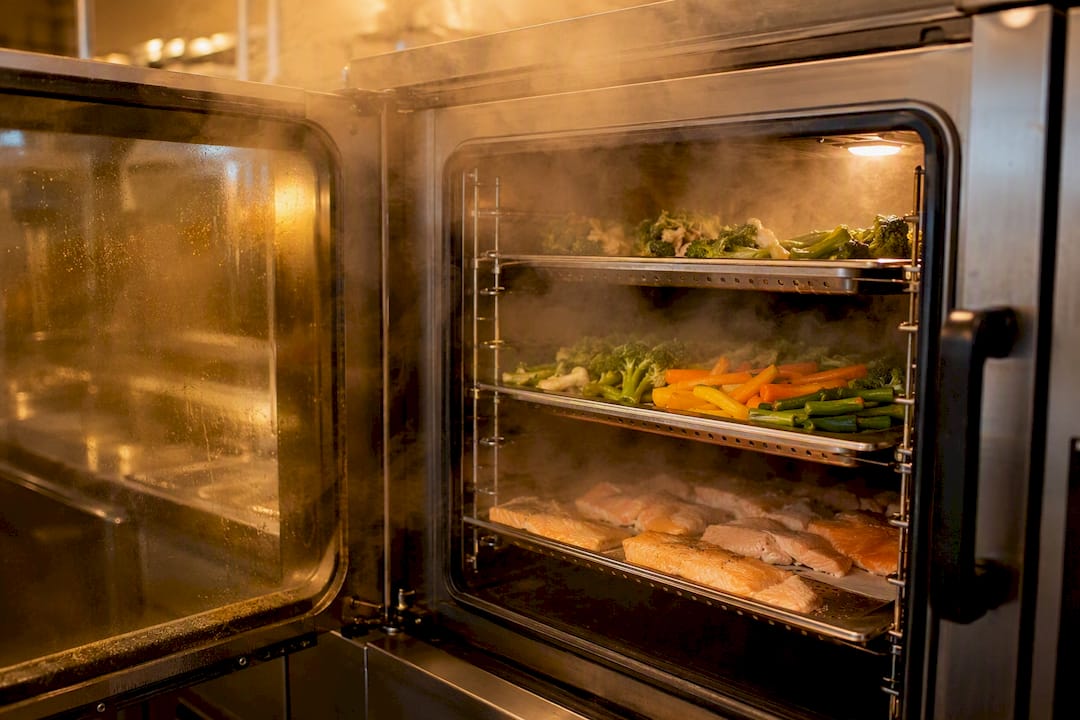
Combi mode is where most of the daily work happens, and the useful range sits around 60% to 80% humidity for the bulk of roasting and baking tasks. That same guidance from Cooking with Steam suggests defaulting to 60% to 80% whenever a combi recipe doesn’t specify a figure, which is a sound rule of thumb rather than a precise science.
Practical percentage bands to work from:
- 100% (steam): vegetables, fish, poaching, gentle regeneration of plated dishes.
- 60% to 80% (combi): roasting joints, pastry with a lift requirement, rethermalising bulk-cooked proteins.
- 30%: finer crumb control on certain bakes, according to Gaggenau’s baking guidance.
- 0% (convection): final crisping, browning, and anything that needs to shed surface moisture fast, such as crackling or pastry that’s already set.
The mistake most kitchens make is picking one setting for the whole cook.
Setting humidity on the control panel and understanding the vents
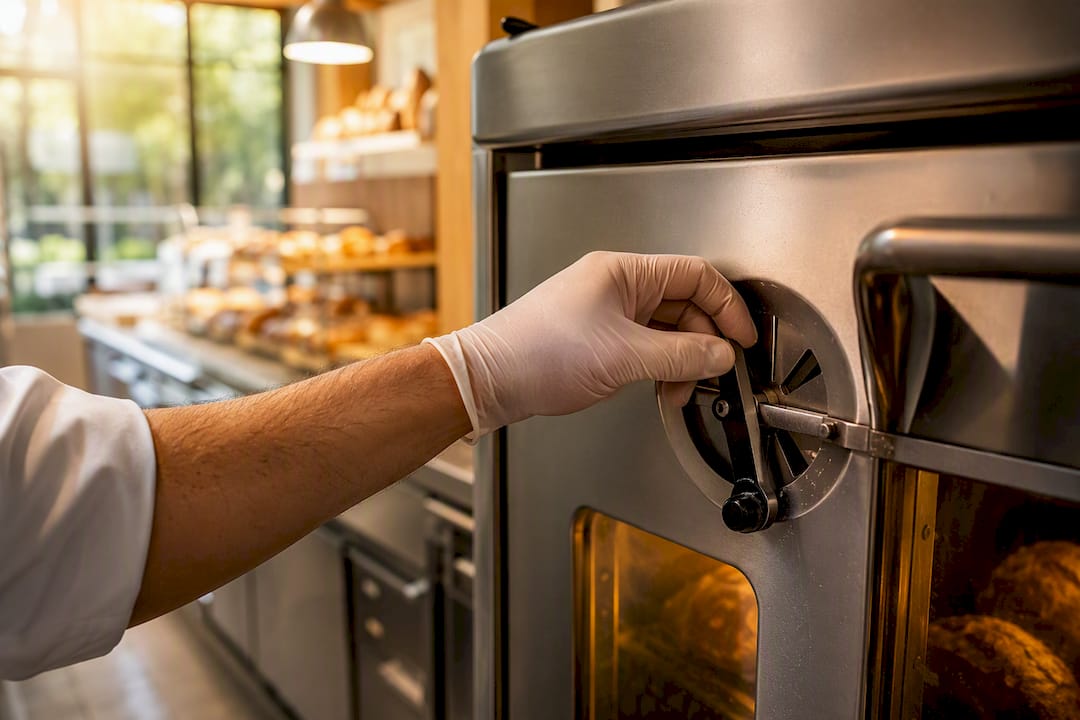
Most combi ovens let you enter a humidity value directly through a dedicated humidity row on the touch panel or keypad, often covering a broad adjustable range. The Electrolux Combi TOUCH manual shows the standard sequence: select the humidity function, key in the target percentage, and the oven holds that figure for the duration of the programmed step, adjusting steam injection or venting automatically to compensate.
The vent valve is the part operators overlook, and it changes the outcome almost as much as the percentage itself:
- Closed vent retains humidity fully inside the cavity, useful for steam-heavy stages where you want every bit of moisture staying put.
- Adjustable vent opens automatically once humidity exceeds your set point, bleeding off the excess without you touching the controls.
- Open vent forces a dry environment regardless of what percentage you’ve dialled in, which is what you want for a genuine crisping finish.
Fan speed works alongside the vent, not instead of it. A closed vent with a low fan speed can leave a stagnant, saturated layer of air right against the food, which is often the real cause of soggy surfaces that chefs blame on “too much humidity” when the percentage setting was correct all along.
Pro Tip: If a bake keeps coming out damp on top despite a sensible humidity percentage, check the vent state before you touch the moisture setting. A closed vent on a long bake traps condensation exactly where you don’t want it.
Staged humidity programmes that actually work
Manufacturer training material consistently recommends staging humidity through a cook rather than fixing it, and the logic holds for three very different kitchen tasks.
Roasting a joint:
- Preheat the cavity to your target temperature with the vent closed.
- Run the first third of the cook at 100% humidity to drive fast, even heat into the core and cut down moisture loss.
- Drop to around 60% for the middle stage, maintaining gentle surface browning while the interior finishes cooking through.
- Finish at 0% humidity with the vent open to crisp skin or crackling in the final few minutes.
This 100% to 60% to 0% sequence is a documented approach in the RATIONAL handbook’s example programmes, and it works because each stage does a different job rather than compromising on all three at once.
Bakery work follows a similar logic in reverse order of intensity:
- Preheat with high humidity present so the oven doesn’t lose moisture the moment the door opens.
- Bake puff pastry at convection plus 60% humidity for the early lift, per Gaggenau’s guidance, which supports the oven spring before the structure sets.
- Drop to 30% once the crumb has formed, to firm the structure without stalling browning.
- Finish dry for the final few minutes if a crisper crust is wanted.
Longer holds call for lower humidity than a quick blast regeneration, because moisture keeps accumulating the longer the door stays shut.
Fixing humidity problems before they hit the pass
Most humidity complaints trace back to one of three symptoms, and each has a fairly predictable cause.
- Soggy or underbaked results usually mean the vent stayed closed too long, or the humidity percentage was left too high into a stage that needed drying out.
- Dry, tough, or cracked product points the other way: too little humidity during the early cook, or a vent left open when it should have been holding moisture in.
- Uneven cooking across a full load often comes down to poor steam distribution rather than the percentage setting itself, particularly in older units without a well-calibrated fan.
A short maintenance routine keeps the humidity system honest rather than guessing:
- Descale according to the manufacturer’s schedule, since limescale on the steam generator throws off both steam output and temperature accuracy.
- Check incoming water quality, as hard water accelerates scale build up on injectors and boiler elements.
- Clean vent channels and drain lines regularly, because blocked drainage causes water to pool in the cavity and skews humidity readings.
- Test the humidity sensor periodically against a known reference, since a drifting sensor will hold the wrong percentage confidently.
Patchy condensation usually means an injector or sensor needs attention before it costs you a bad service.*
Why this guidance holds up in a working kitchen
The commercial oven store specialises in premium commercial ovens for bakeries, cafés and professional kitchens, working with manufacturers including Rational and Unox whose control systems and manuals underpin the staged humidity approach covered here. The XV393, XV593 and XV893 humidity convection ovens, alongside the Rational iCombi range, all give operators direct percentage control and adjustable vent behaviour rather than fixed presets. Buyers get expert advice on matching an oven to their menu and flexible payment options through iwocaPay, which matters when the right combi oven is a five figure decision rather than a small purchase.
Comparing humidity control across combi oven models
Not every combi oven manages humidity the same way, and the differences show up most clearly in how precisely you can set a percentage and how the vent responds once you have.
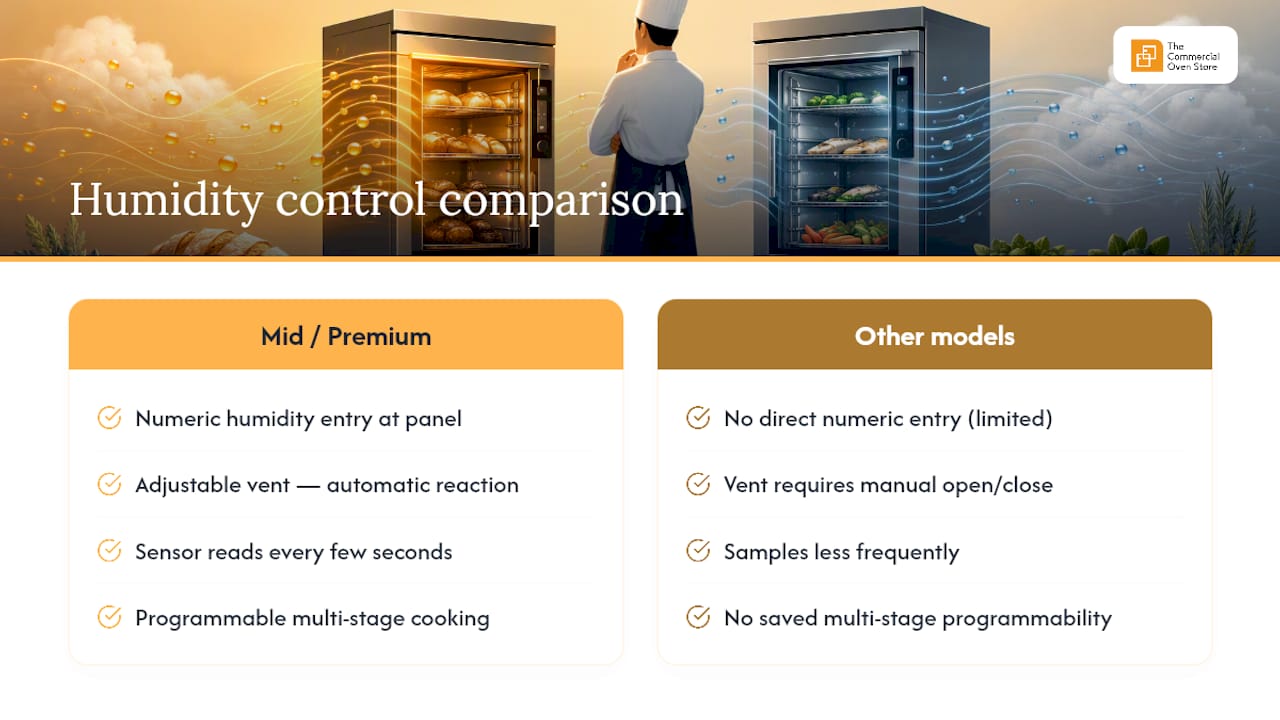
Mid-range and premium models, including the humidity convection ovens Thecommercialovenstore supplies, allow direct numeric entry at the panel and pair it with an adjustable vent that reacts automatically once the cavity exceeds the set point, rather than requiring the operator to open and close it manually.
The other meaningful difference is sensor responsiveness. A humidity sensor that reads and corrects every few seconds holds a set point far more tightly through door openings and cold loading than a system that samples less frequently, and that shows up directly in batch consistency across a busy service. Higher-specification ovens also tend to combine humidity control with programmable multi-stage cooking, so a roast or bake sequence like the ones above can be saved and repeated exactly rather than adjusted by hand at each stage. For kitchens running the same core menu daily, that programmability often matters more than the raw humidity range on the spec sheet.
Energy use and humidity settings
Steam generation costs energy, and running high humidity for longer than a dish needs is one of the more avoidable sources of waste in a busy kitchen.
Vent behaviour affects efficiency just as much as the percentage setting does. An open vent forces the boiler to keep replacing moisture that’s escaping, which burns more energy than a closed or adjustable vent achieving the same humidity target. Getting vent settings right, as covered in the controls section above, is as much an efficiency question as a quality one.
Recovery time after door openings also draws on the humidity system, since a cavity that’s lost its steam has to regenerate it before the next stage can proceed accurately. Kitchens that batch similar humidity-stage dishes together, rather than switching between high and low humidity tasks throughout service, reduce how often the boiler has to work from a cold start. It’s a scheduling change rather than an equipment change, and it costs nothing to implement.
What the conventional advice on humidity gets wrong
Most guidance on combi oven humidity treats it as a single number you pick and forget, and that’s the mistake worth unlearning first. The oven’s real value isn’t the percentage on the display, it’s the ability to change that percentage mid-cook without opening the door or losing your place in the programme.
I’d also push back on the idea that higher humidity is always the safer choice for yield. It isn’t, once you factor in surface texture. It isn’t an extra step, it’s the step that makes the staged approach worth using at all.
If you take one thing from this guide, prioritise learning your oven’s vent behaviour before you fine-tune percentages. A correct humidity setting fighting a badly timed vent will still give you inconsistent results, and that’s the fault operators blame on the oven most often when it’s actually a sequencing issue.
— Simon
Ready to upgrade your kitchen’s humidity control?
Thecommercialovenstore gets you a combi oven with genuine percentage precision and adjustable vent control, not a handful of vague presets, and you can spread the cost through iwocaPay instead of paying the full amount upfront.
The team gives straightforward advice on matching oven capacity and humidity range to your actual menu, whether that’s a bakery running staged bread programmes or a kitchen batch-cooking proteins through service. Browse the XV393 humidity convection oven or the larger XV593 if you’re planning for higher throughput, and get in touch through Thecommercialovenstore to talk through installation and finance options before you commit to a model.
Sources
Recommended
- XV393 CHEFLUX HUMIDITY CONVECTION OVEN 5 GN/1 – thecommercialovenstore.com
- XV593 CHEFLUX HUMIDITY CONVECTION OVEN 7 GN/1 – thecommercialovenstore.com
- XV893 CHEFLUX HUMIDITY CONVECTION OVEN 12GN1/1 – thecommercialovenstore.com
- Combi oven installation: the UK site-readiness guide – thecommercialovenstore.com