

Choose a 6-pan countertop or floor combi for small cafés and low-volume kitchens, a 10-pan model for most full-service restaurants, and a 20-pan roll-in for higher-volume central production kitchens and banquet catering. Pan count refers to GN 1/1 equivalents, the standard tray footprint used across professional kitchen equipment.
- 6-pan: coffee shops, small bakeries, low-cover cafés
- 10-pan: full-service restaurants running 100 to 150 covers per session
- 20-pan roll-in: hotels, hospitals, contract catering, banquet kitchens
Once you know your rough class, the next move is practical: measure your site clearances and electrical supply, then get a tailored spec from Thecommercialovenstore. Sizing on paper and sizing on your kitchen floor are two different exercises.
Pro Tip: Measure your doorway and delivery route before you fall in love with a model. A 10-pan combi that won’t fit through the kitchen door is a very expensive lesson.
TL;DR:
- Confirm the oven pan count based on your expected covers, typically 8 to 15 for each GN 1/1 pan used in service.
- Check the oven’s runner spacing, usually 65 mm, to ensure compatible pan depths and avoid reducing usable rack capacity.
- Verify your electrical power supply requirements, as larger units often need three-phase at 40 to 100 amps, before placing an order.
- Size your oven based on typical daily volume rather than peak capacity to prevent energy waste and maximize efficiency.
- Conduct site assessments early, including clearances, door swing, and delivery routes, to avoid costly installation errors and delays.
Table of Contents
- Combi oven sizes compared: footprint, covers and power
- What is the Gastronorm standard for combi ovens?
- How many covers does one GN pan serve?
- Site planning: clearances, power and ventilation
- Building the right pan mix for your menu
- How Thecommercialovenstore supports your sizing decision
- Weight and load capacity by oven size
- Height and stacking: making the most of vertical space
- External dimensions versus internal capacity: what actually matters
- Does oven size affect cooking time and running costs?
- Why most sizing advice skips the site visit
- Ready to size your next oven correctly?
- Key Takeaways
- Sources
Combi oven sizes compared: footprint, covers and power
Manufacturers rarely agree on exact dimensions, so treat the figures below as planning ranges rather than a spec sheet. Confirm exact numbers against the datasheet before you order.
Countertop and small floor units, sold as 6-pan configurations, suit cafés, small bakeries and shared kitchens and satellite kitchens. They generally run on a single-phase or lighter supply and handle roughly 40 to 80 covers per service, depending on menu complexity. A 10-pan combi is the workhorse size for most independent restaurants, typically drawing a three-phase supply and covering 100 to 150 covers per service. Roll-in 20-pan systems load via wheeled racks rather than individual trays and are built for institutional and banquet volumes, often 150 to 300 covers or more.
| Pan Class | Typical Footprint | Covers Per Service | Power Tier |
|---|---|---|---|
| 6-pan countertop/floor | Compact, fits under standard extraction canopy | 40 to 80 | Single-phase or light three-phase |
| 10-pan floor | Medium floor footprint, needs rear service clearance | 100 to 150 | Three-phase, 40 to 60 amps |
| 20-pan roll-in | Large footprint plus trolley bay | 150 to 300+ | Three-phase, 60 to 100+ amps |
Footprints and power draw vary by manufacturer and model; use planning figures as approximations and confirm specifications with suppliers
What is the Gastronorm standard for combi ovens?
Every combi oven size ultimately traces back to one measurement: the GN 1/1 pan, which measures 530 × 325 mm. Fractional sizes derive from that base module, so a GN 1/2 is half the tray area, a GN 1/3 a third, and so on down to the small GN 1/9 inserts used for garnishes and sauces. This system was formalised across European kitchen equipment under EN 631, which is precisely why a pan bought from one manufacturer slots neatly into an oven, blast chiller or fridge from another.
Depth matters just as much as footprint. Standard depths run 20, 40, 65, 100, 150 and 200 mm, and most combi ovens are built around 65 mm runner spacing. Order a 100 mm or 150 mm pan without checking runner spacing first and you can end up skipping slots or removing runners entirely, which quietly halves your usable rack positions.
- 20 to 40 mm: garnishes, sauces, thin proteins
- 65 mm: the workhorse depth for most bakery and à la carte production
- 100 mm: braises, stocks, batch vegetables
- 150 to 200 mm: deep casseroles, large-format catering dishes
A sensible starter mix for a new kitchen is GN 1/1 at 65 mm and 100 mm, plus a handful of GN 1/2 and 1/3 pans at 65 mm for smaller batches and mise en place.
One overlooked figure: buying deeper pans without checking your oven’s runner spacing is one of the most common ordering mistakes in new kitchen fit-outs, and it can quietly cut your effective rack capacity in half before you’ve cooked a single service.
How many covers does one GN pan serve?
A workable rule of thumb is 8 to 15 covers per GN 1/1 pan per service, though where you land in that range depends on portion size, menu complexity and how many items you’re batch-cooking versus cooking to order.
- A 60-cover café running simple batch bakes and one or two hot options can usually work comfortably on a 6-pan oven, since most of the pans are in near-constant rotation through a single peak period.
- A 150-cover restaurant with a varied à la carte menu typically needs the full 10 pans, because different dishes tie up different pans simultaneously rather than cycling through the same one repeatedly.
- When your covers push past what a single 10-pan unit can realistically cycle through in your service window, you face a choice: step up to a 20-pan roll-in, or run two 10-pan ovens side by side for redundancy and flexibility.
That last option is worth taking seriously. Two mid-size ovens give you a working backup if one fails mid-service, something a single large unit can’t offer.
Site planning: clearances, power and ventilation
Before you order anything, walk your kitchen with a tape measure. The most expensive sizing mistakes happen at installation, not at the checkout.
- Leave clearance behind and to the sides of the oven for ventilation and service access, not just the door swing at the front.
- Confirm door swing radius against your kitchen layout. Wall-mounted or wheeled equipment nearby can block a fully open door without anyone noticing until delivery day.
- Match your electrical supply to the oven class early: countertop units often run on single-phase, standard 6- to 10-pan units typically need three-phase at 40 to 60 amps, and roll-in systems can demand 60 to 100+ amps.
- Check extraction capacity, floor loading for heavier roll-in units, and heat spill from adjacent equipment such as fryers or griddles.
- Confirm gas supply pressure and pipe sizing if you’re specifying a gas-fired model rather than electric.
Two mistakes come up repeatedly with new installs: ordering pans deeper than the oven’s runner spacing allows, and underestimating the electrical phase or breaker capacity needed for a 10-pan or larger unit. Both are avoidable with one phone call to an electrician before you place an order, not after the oven arrives.
Pro Tip: Book your electrician’s site visit at the same time you request your oven spec sheet. Running these in parallel, rather than sequentially, is the single biggest time-saver in a kitchen fit-out.
Our installation guide covers the full site-readiness checklist in more depth if you’re planning a fit-out from scratch.
Building the right pan mix for your menu
Getting your combi oven capacity right on paper means nothing if you’ve specified the wrong pan mix to go with it. A practical starter kit for most kitchens looks like this:
- GN 1/1 at 65 mm (your everyday workhorse)
- GN 1/1 at 100 mm (braises, stocks, batch veg)
- GN 1/2 at 65 mm (smaller batches, side dishes)
- GN 1/3 at 65 mm (garnishes, sauces)
- A handful of GN 1/6 inserts for condiments and small mise en place
Perforated pans earn their place once you’re steaming vegetables or holding fried items, since they let moisture and excess oil drain away rather than pooling. Steamable lids are worth adding if you’re batch-cooking rice, grains or delicate proteins that dry out under open combi steam. If you’ve gone with a 20-pan roll-in, budget for trolleys and rolling racks from day one. Roll-in speed only pays off if your prep area is set up to load and swap racks quickly during service.
How Thecommercialovenstore supports your sizing decision
Getting combi oven sizes right on paper is one thing. Getting the right unit installed, wired correctly and running by opening day is another, and that’s where in-market expertise pays for itself.
- Direct partnerships with Rational and Unox mean advice grounded in real specification sheets, not guesswork from a brochure.
- Site survey support helps you confirm clearances, door swing and electrical supply before you commit to an order.
- Flexible payment through iwocaPay lets you spread the cost of a 10-pan or roll-in unit rather than tying up working capital in one purchase.
- Installation checklists cover the practical details, extraction, floor loading, phase requirements, that catch out first-time buyers.
| What You Need | How We Help |
|---|---|
| Confirming pan count vs covers | Expert advice matched to your menu and service pattern |
| Site clearance checks | Installation guidance before you order |
| Managing cash flow | Flexible finance via iwocaPay |
| Brand-specific specs | Direct access to Rational and Unox documentation |
Weight and load capacity by oven size
Combi oven weight scales sharply with pan count, and that has real consequences for your floor and any staff moving equipment during a fit-out. A 6-pan countertop unit typically weighs in a range light enough for two people to manoeuvre into position with a trolley, and most commercial kitchen floors handle that load without reinforcement.
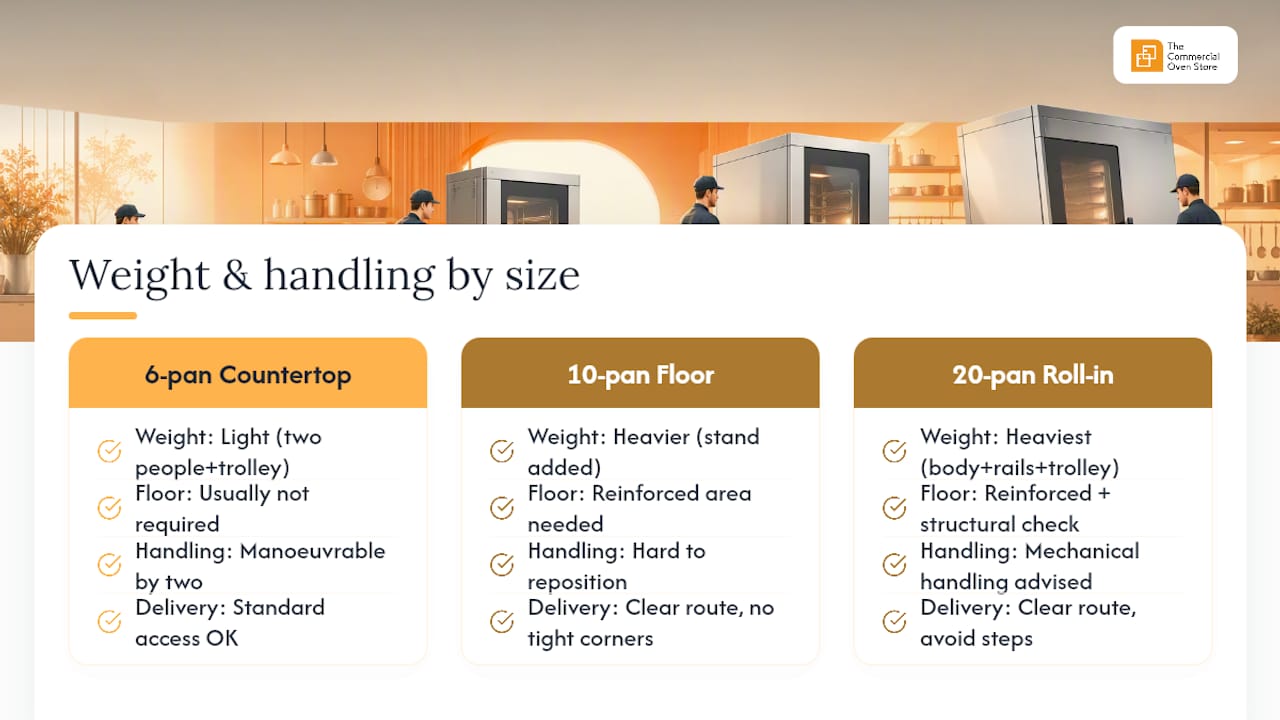
A 10-pan floor model is considerably heavier once you add the stand, and it’s designed to sit permanently on a reinforced floor area rather than be repositioned casually. This is where floor loading calculations matter, particularly in upper-floor kitchens, converted units or older buildings where the original floor wasn’t specified for heavy catering equipment.
Roll-in 20-pan systems are the heaviest class by a wide margin once you include the oven body, the internal rack rail system and a loaded trolley of full pans. Loaded trolleys carrying multiple GN 1/1 pans at 100 mm or deeper depth add substantial weight on wheels that concentrate load onto small contact points with the floor. If you’re installing at ground level on a solid slab, this is rarely an issue. If you’re on a suspended floor or upper level, it’s worth having a structural conversation before delivery day rather than after.
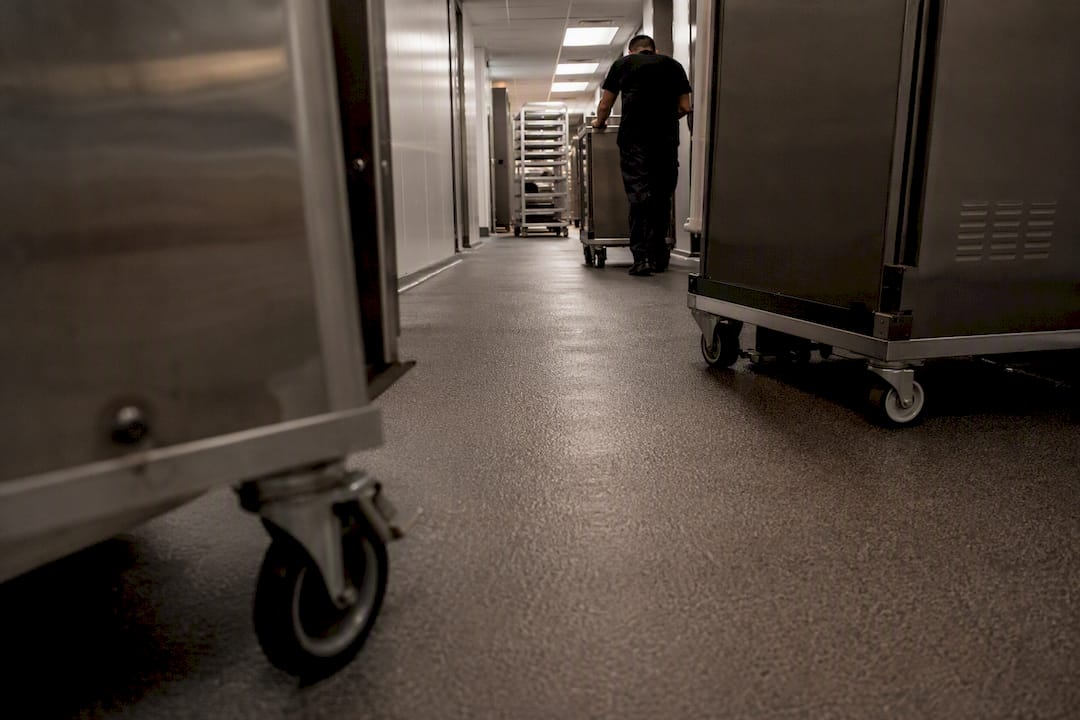
Delivery access matters as much as final position. A heavier 10-pan or roll-in unit needs a clear, obstruction-free route from the delivery vehicle to its final position, ideally without tight corners or steps that require lifting equipment mid-transit.
Height and stacking: making the most of vertical space
Kitchen floor space is almost always the tightest constraint in a fit-out, and stacking is one of the most underused ways to solve it. Countertop combi units are specifically built to sit on top of a stand, a base cabinet or even another piece of equipment, which means your floor footprint for a small kitchen can be far smaller than the oven’s rated capacity would suggest.
Floor-standing 6-pan and 10-pan units are typically too tall and too heavy to stack on top of each other directly, but many can be specified with a matching stand that includes proving or holding drawers underneath. This turns dead space beneath the oven into genuinely useful storage or proving capacity rather than wasted floor area.
Roll-in 20-pan ovens are the exception to the stacking conversation. Their height is dictated by the internal rack rail system needed to accommodate a full-size trolley, so they’re rarely stacked and instead need generous overhead clearance for the door to open fully without catching on canopy or ductwork above.
If your kitchen has a low ceiling or a ventilation canopy positioned lower than standard, check the fully-open door height of any 10-pan or 20-pan model against your site measurements before ordering. This is a detail that trips up more fit-outs than most people expect, particularly in converted retail units or older buildings with lower ceiling heights than purpose-built kitchens.
External dimensions versus internal capacity: what actually matters
Two ovens with near-identical external dimensions can have meaningfully different internal capacity, and this is where buyers relying purely on a footprint spec sheet get caught out. Wall thickness, insulation depth and internal fan housing all eat into the usable chamber space, so the external width and depth quoted in a brochure rarely translates directly to how many pans actually fit.
The number that matters for production planning is pan count, not cabinet dimensions. A 10-pan combi from one manufacturer might have a slightly larger external footprint than a 10-pan unit from another, purely because of differences in insulation or door mechanism, without any difference in actual cooking capacity. This is why comparing external dimensions across manufacturers without checking rated pan count is close to meaningless for planning purposes.
When you’re measuring your kitchen for a new oven, work backwards from the space you have to the largest external footprint that fits, then check which pan count that footprint actually delivers across the models you’re considering. Two units with the same footprint have sometimes been engineered with meaningfully different internal chamber volumes, so it pays to ask the specific pan count rating rather than assuming size correlates directly with capacity.
Does oven size affect cooking time and running costs?
Larger combi ovens don’t necessarily cook individual items faster. A single portion of chicken cooks at broadly the same rate in a 6-pan or a 20-pan combi, because cycle time is driven by temperature, humidity setting and food thickness rather than chamber size. What size changes is throughput, how many portions you can cook in one cycle, not the speed of any single cycle.
This matters for energy planning. A 6-pan oven running at capacity uses energy efficiently because you’re heating a smaller chamber to cook a smaller batch. A 20-pan roll-in running half-empty wastes a considerable amount of energy heating unused chamber volume, which is one of the most common efficiency mistakes kitchens make after upsizing without adjusting their batch planning.
The practical lesson is to size for your typical service, not your busiest possible night. Running a 10-pan oven consistently near capacity is more energy-efficient than running a 20-pan oven at half-load most nights and full-load occasionally. If your volume genuinely varies that much, two mid-size ovens running independently often make more sense than one oversized unit, since you can run just one during quieter periods and both during peak service.
Why most sizing advice skips the site visit
Most combi oven guidance treats sizing as a spreadsheet exercise: count your covers, pick a pan number, done. That’s a reasonable starting point, but it misses the part that actually causes problems, the physical reality of your kitchen.
The conventional advice underweights two things repeatedly. First, pan depth and runner spacing get treated as an afterthought when they should be decided alongside pan count, because a mismatch here can quietly halve your usable capacity regardless of how well you sized the oven itself. Second, electrical supply gets assumed rather than confirmed, and that assumption is exactly what causes installation delays.
If there’s one thing worth prioritising above all else, it’s sequencing. Don’t finalise your oven order before you’ve had an electrician look at your supply and measured your delivery route. The pan count decision is genuinely the easy part. The site-readiness work is where kitchens lose weeks, and it’s entirely avoidable with the right checks done early rather than as an afterthought once the oven is already on order.
— Simon
Ready to size your next oven correctly?
You’ve now got the framework: pan count for capacity, GN depth for runner compatibility, and site clearances for the reality check. The part most guides leave you to figure out alone is matching that framework to an actual oven you can order, wired the right way, on a floor that can take it.
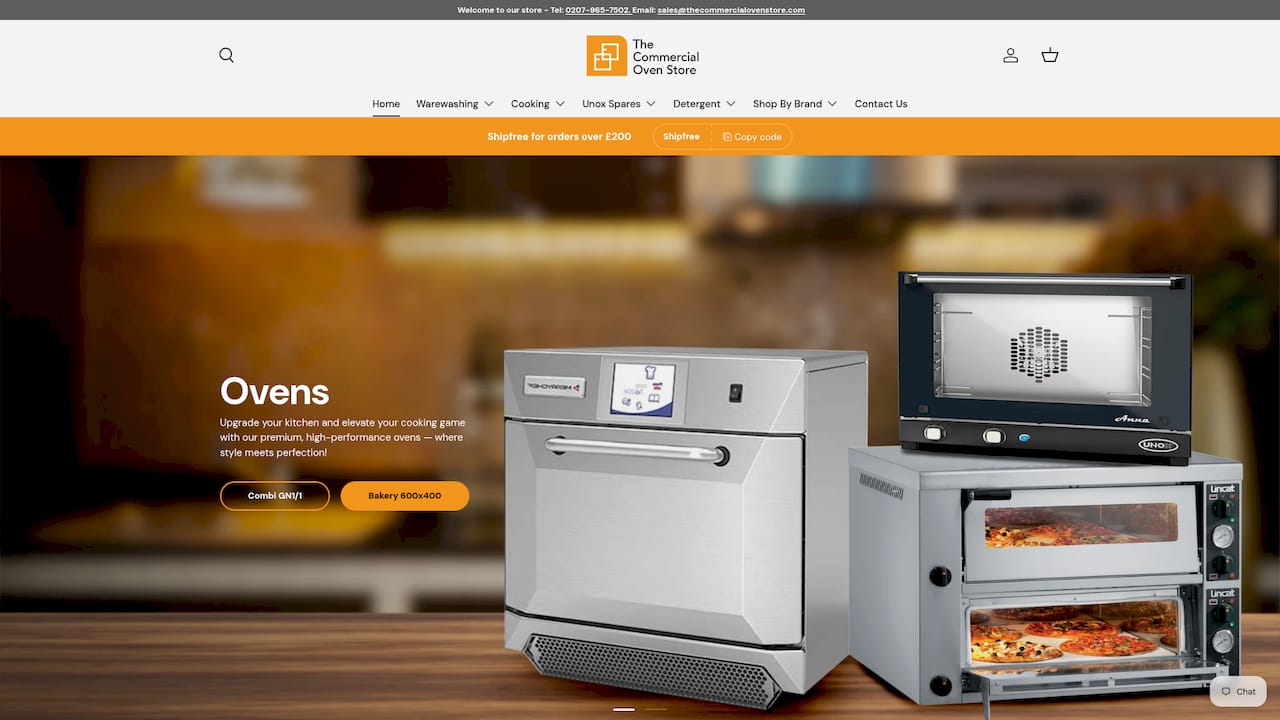
Thecommercialovenstore works through that final step with you directly. If you’re weighing up a 6-pan against a 10-pan, our team can talk through your covers and menu before you commit to anything, and if a 10-pan floor model looks like your fit, the XB893 is a solid example of what that class delivers. Running a smaller café or satellite kitchen instead? The CIBO/S countertop fast oven is built for exactly that footprint. Whichever size fits, iwocaPay means you don’t have to pay for it in one hit. Request a site survey or a full spec sheet through Thecommercialovenstore and get a tailored recommendation before you order.
Key Takeaways
Matching combi oven size to production means starting with GN 1/1 pan counts, then confirming depth, power and clearances before you order.
| Point | Details |
|---|---|
| Match pan count to covers | Use 8 to 15 covers per GN 1/1 pan per service as your starting rule of thumb. |
| Check depth against runners | Most ovens run 65 mm runner spacing; deeper pans can cost you usable rack slots. |
| Confirm power before ordering | 10-pan and roll-in ovens typically need three-phase supply at 40 amps or higher. |
| Size for typical service, not peak | An oversized oven running half-empty wastes more energy than a well-matched one at capacity. |
| Get a tailored spec | Thecommercialovenstore offers site survey support and iwocaPay financing to match oven size to your kitchen. |
Sources
- Gastronorm
- Gastronorm GN System Standard Sizes Containers and Complete Guide
- Commercial Combi Oven Buying Guide 2026: Types, Sizes, Prices & How to Choose - Grace Kitchen Equipment