

Connected commercial ovens combine traditional cooking functions with cloud-based controls that let you monitor performance, push recipes and get diagnostics remotely. That’s the whole idea in one sentence, but the detail that actually decides whether the investment pays off is what happens after the first year.
Three benefits show up in daily operation: consistent recipes, remote monitoring of oven status, and automatic capture of consumption and HACCP data improve kitchen management.
The caveat that catches operators out: most manufacturers bundle a free subscription window into the purchase price, then start billing. Budget for that renewal before you sign the order, not after the invoice arrives.
Key Takeaways
Connected commercial ovens deliver consistency, remote oversight and usable data, but only when buyers plan for subscription renewal and service logistics from day one.
| Point | Details |
|---|---|
| Define “connected” precisely | Confirm Wi-Fi/Ethernet hardware, cloud features, and data export format before comparing prices. |
| Match oven type to need | Combi ovens suit multi-site consistency; high-speed countertop units suit front-of-house speed and ventless installs. |
| Budget past the free trial | Most platforms offer a free window (commonly 12 months) before charging renewal fees per unit. |
| Check service and data terms | Confirm spare-parts turnaround, SLAs, and who retains recipe and HACCP data before signing. |
| Choose a supplier who explains the trade-offs | Thecommercialovenstore stocks Rational, Unox and CIBO connected ovens with iwocaPay financing and installation support. |
Table of Contents
- What does “connected” actually mean in a commercial oven?
- Which type of connected oven suits your kitchen?
- How much does connectivity actually improve kitchen performance?
- What does it really cost to run a connected oven?
- How do you choose the right connected oven for your kitchen?
- What installation and power requirements should you check first?
- How does connectivity change maintenance and uptime?
- Why choose The Commercial Oven Store for connected ovens
- How connected ovens fit into your wider kitchen systems
- What I’d tell a kitchen manager before they buy
- Ready to add a connected oven to your kitchen?
- Frequently asked questions
- Sources
What does “connected” actually mean in a commercial oven?
“Connected” is a broad word, so it helps to know exactly what you’re paying for. In practice it breaks down into a small set of features that behave consistently across most manufacturers.
- Network hardware. Most connected ovens ship with Wi-Fi and Ethernet as standard, and some offer optional cellular connectivity for sites with unreliable networks. A USB port is usually included as a local fallback for firmware updates or recipe loading when there’s no signal.
- Cloud platform access. This is where the real value sits: remote start and stop, recipe and menu push to multiple units at once, live telemetry, and automated fault alerts sent to a manager’s phone or a head office dashboard.
- Data export. Decent platforms let you pull consumption and performance data into a spreadsheet or connect via API, and increasingly they generate exportable HACCP-ready logs, which matters enormously come audit time.
- What happens when the subscription lapses. The oven keeps cooking. What disappears is the remote layer: no more push updates, no more phone alerts, no more centralised dashboard. You’re back to a standalone oven with a screen nobody but the site can see.
SkyLine combi ovens run this model through their OnE Connected platform, offering 24/7 remote monitoring and consumption tracking as the core of the offer, while Alto-Shaam’s Prodigi range uses its ChefLinc platform for recipe push and remote diagnostics in a broadly similar way.
Which type of connected oven suits your kitchen?
Not every oven class gets equal value from connectivity. The technology adds the most where variability, speed or multi-site oversight are already business problems, and it’s mostly wasted where a kitchen runs one static menu on one machine.
- Combi ovens benefit most from recipe libraries and remote push, because multi-mode cooking (steam, convection, combination) is exactly where operator technique varies most between shifts. A connected platform locks that variation down site by site.
- Convection ovens gain from scheduling and energy tracking rather than recipe complexity. Batch bakers and high-volume roasters care more about knowing when a unit is running inefficiently than about pushing new dishes.
- High-speed and countertop ovens earn their connectivity in front-of-house settings, where speed and footprint matter more than depth of menu. The Merrychef conneX®12 is built for exactly this: ventless installation, significantly faster cook times compared to conventional methods, and remote menu management suited to delivery-first or grab-and-go formats.
- Steam ovens tend to sit lower on the connectivity priority list unless they’re part of a larger combi-format unit, since their use case is usually narrower and less variable.
The decision guide is fairly blunt in practice: if you run multiple sites, multiple shifts, or a menu that changes seasonally, connectivity earns its keep. If you’re a single-site kitchen with one fixed menu and an experienced head chef who’s been running the same routine for years, a standalone oven without the cloud layer might genuinely be the better spend. For a deeper look at capacity and format trade-offs, our complete guide to commercial convection ovens covers the ground in more detail.
How much does connectivity actually improve kitchen performance?
The operational case for connected ovens rests on three measurable levers: consistency, throughput, and waste reduction through data.
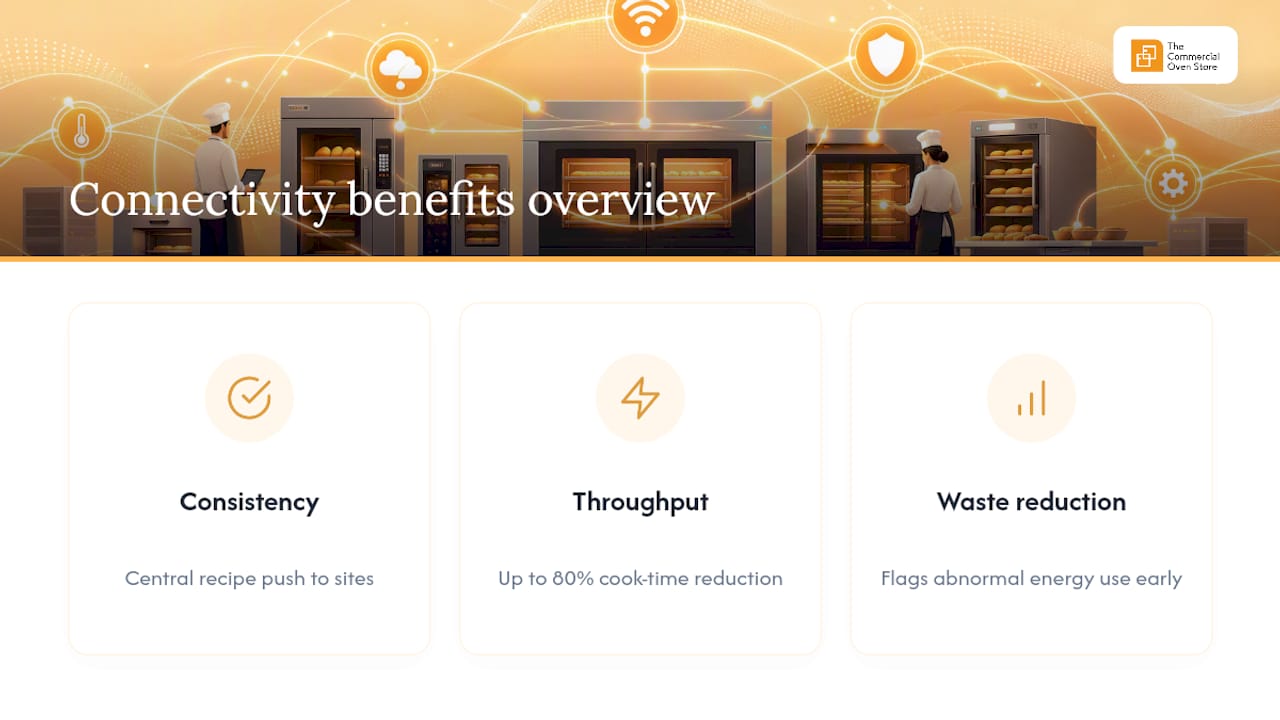
Central recipe control is the most direct one. When a head office pushes an approved recipe to every unit across five sites simultaneously, the variation that comes from different chefs interpreting the same written method disappears. SkyLine’s platform and similar systems from other manufacturers are built specifically around this: recipe management and consumption tracking exist to keep quality identical whether the oven sits in a flagship restaurant or a franchise outpost.
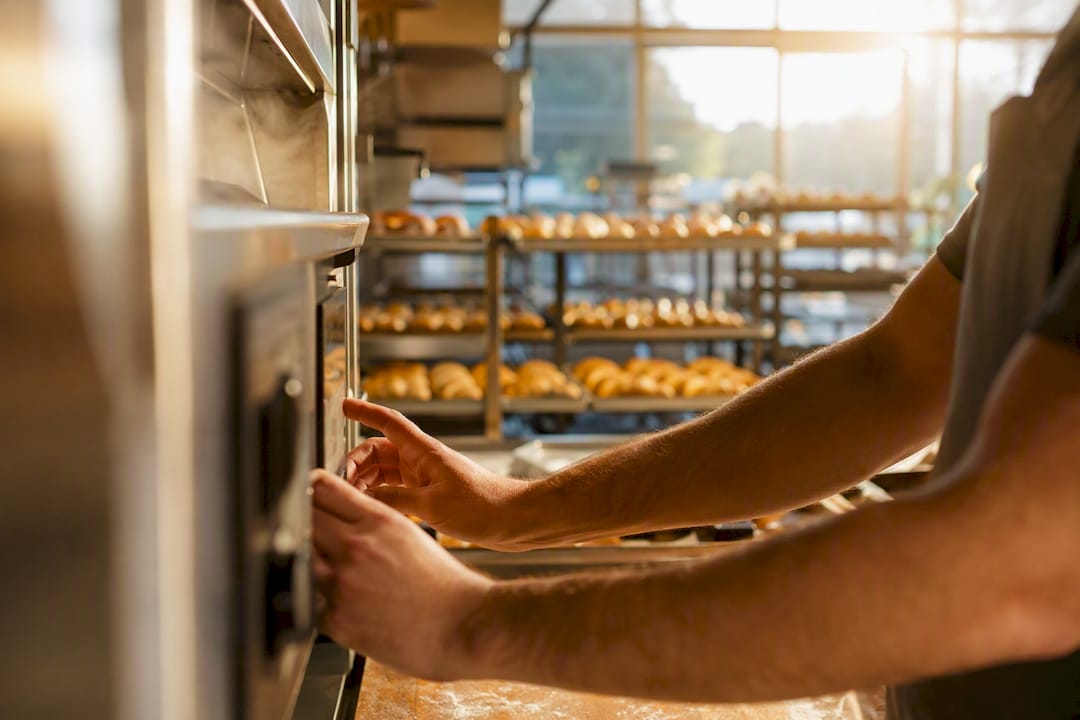
Throughput gains show up most clearly in high-speed and countertop units. The Merrychef conneX®12’s claimed cook-time reduction of up to 80% against conventional methods isn’t just a speed statistic, it’s a queue-length statistic during a lunch rush, which is where most front-of-house bottlenecks actually happen.
Telemetry does something less obvious but arguably more valuable over time: it flags abnormal energy use before it becomes a wasted-stock problem. An oven running longer cycles than usual, or cycling on and off erratically, is often the first sign of a door seal failing or a sensor drifting out of calibration, long before anyone notices burnt batches or a spike in the electricity bill.
Pro Tip: Pull a baseline energy report in the first month of ownership. Without it, you’ve got nothing to compare against when the platform flags an anomaly six months later.
What does it really cost to run a connected oven?
Purchase price still varies by oven class and capacity the way it always has: countertop high-speed units sit at the lower end, full-size combi ovens with larger GN capacity sit considerably higher, and convection ranges land somewhere in between depending on cavity count and build quality. The connectivity layer changes the shape of the cost, not just the number.
The subscription model is fairly consistent across manufacturers now. Merrychef’s conneX range, for example, comes with Wi-Fi and Ethernet built in and a free 12-month subscription to its KitchenConnect platform, after which operators renew monthly or annually to keep the remote features active. That’s a genuinely common structure across the category, not a one-off promotion, and it’s worth treating the free year as exactly what it is: a trial.
When you’re calculating total cost of ownership, three components tend to get underestimated:
- Energy consumption — connected telemetry can help you monitor this, but you still need a baseline before the data means anything.
- Spare parts and consumables — door seals, filters and probes wear regardless of how smart the control panel is.
- Service agreements — a subscription covers software, not a technician’s callout fee.
Pro Tip: Multiply the per-unit subscription fee by every oven you’re planning to connect before you commit to a multi-site rollout. A fee that looks trivial on one unit adds up fast across twelve sites, and renewal terms rarely improve at scale unless you negotiate them upfront.
How do you choose the right connected oven for your kitchen?
Buying decisions on connected ovens go wrong in fairly predictable ways, usually because someone falls in love with a feature list before checking whether the basics fit. A short framework keeps procurement grounded in what actually matters.
- Match capacity to real throughput, not aspiration. Check GN pan compatibility against your actual menu volume, not the volume you hope to hit next year. Our guide to convection ovens for bakeries walks through GN sizing in more depth if capacity planning is the sticking point.
- Check how open the connectivity actually is. Ask specifically whether the platform supports CSV export or an open API, and whether it handles multi-site dashboards if you operate more than one location. A closed system that only talks to its own app is a limitation you’ll feel later, not now.
- Confirm the service network before you confirm the order. A brilliant oven with a three-week wait for a spare part is a bad oven in practice. Ask about SLAs and escalation routes explicitly, not vaguely.
- Settle data ownership in writing. Recipe files and telemetry logs are commercially sensitive, and you want it clear in the contract who retains that data if you switch suppliers or close a site.
Pro Tip: Ask suppliers directly what happens to your exported HACCP logs and recipe data if you cancel the subscription. Some platforms lock historical data behind the paywall retroactively, which is a nasty surprise during an audit.
What installation and power requirements should you check first?
The oven itself is rarely the part that delays a project. Power supply, extraction and floor space usually are, and connectivity doesn’t remove any of that groundwork.
- Electrical supply and phase. Confirm single-phase versus three-phase requirements with your electrician before you order, not after delivery. A larger combi oven drawing more current than your existing supply can handle turns a straightforward install into a rewiring job.
- Extraction and ventilation. Full-size combi and convection ovens typically need proper extraction. High-speed countertop units are the exception: models like the Merrychef conneX®12 are designed for ventless operation, which is precisely why they turn up in front-of-house and delivery-kitchen setups where installing ductwork isn’t practical.
- Bench and footprint. Check load limits on existing benches for countertop units, and confirm floor space and clearance for full-size ranges, including door swing.
- HACCP data requirements. If your local food-safety regime expects retained temperature logs, confirm the platform’s export format and retention period matches what your auditors actually ask for, not just what the brochure claims.
How does connectivity change maintenance and uptime?
Remote diagnostics change the shape of a service call rather than replacing it. An alert that flags a faulty heating element or a failed sensor gets a technician to the right part on the first visit instead of a diagnostic visit followed by a second trip with the correct spare.
- First-line fixes speed up, but a diagnostic alert still can’t tighten a loose connection or replace a worn door seal itself. Hardware faults still need hands.
- Usage telemetry beats fixed-interval servicing. Tracking door openings, cycle counts and run hours gives a far more accurate maintenance schedule than “service every six months regardless of load,” and it tends to catch wear before it causes an emergency callout.
- SLAs and spare-parts turnaround need to be pinned down before purchase, not discovered the first time something breaks during a Friday dinner service.
Pro Tip: Ask your supplier how spare-parts logistics work specifically for your postcode, not the national average. A two-day turnaround in a major city can mean a two-week wait somewhere more remote.
Why choose The Commercial Oven Store for connected ovens
Thecommercialovenstore specialises in premium commercial ovens, stocking category-leading ranges from Rational and Unox alongside connected countertop and combi options, which means the advice on offer is grounded in equipment the team actually sells and installs.
- Flexible payment through iwocaPay, so a larger connected oven doesn’t have to be paid for in one lump sum.
- Installation support that catches power and extraction issues before they become delays.
- Guidance on subscription terms and connectivity requirements before you commit, not after.
How connected ovens fit into your wider kitchen systems
A connected oven that only talks to itself is only half useful. The real operational gain comes when telemetry and recipe data feed into the systems you already run, rather than sitting in a separate app nobody checks.
Point-of-sale integration is the most valuable link for high-volume operators. When menu items sold at the till correspond to specific oven programmes, some platforms allow that data to inform cook-count reporting, which matters when you’re trying to work out which dishes are actually profitable once cook time and energy use are factored in. Not every manufacturer’s platform supports this natively, so it’s worth asking specifically at the sales stage rather than assuming.
Inventory and stock management benefit from consumption tracking, particularly in bakery and combi operations where ingredient use scales predictably with cook cycles. A platform that logs cycle counts gives you a rough proxy for ingredient drawdown, which helps flag reordering points before a shelf runs empty mid-service.
Staff scheduling systems are the least commonly integrated, but usage data still has a role: if telemetry shows peak oven activity consistently landing at certain hours, that’s a genuinely useful input for rota planning, even without a formal software link between the two systems. A guide to kitchen workflow efficiency covers how these operational layers typically connect in practice.
The honest caveat here: full integration between oven platforms and third-party kitchen management software is still patchy across the industry. Ask any supplier for a straight answer on what genuinely talks to what, rather than a slide showing a diagram of possibilities.
What I’d tell a kitchen manager before they buy
Most procurement mistakes I see come from the same root cause: buying features nobody on the floor will actually use, then being surprised by the renewal invoice a year later. Check the subscription cost against your real usage pattern before you fall for a feature list.
The second mistake is treating service coverage as an afterthought. A connected oven with poor spare-parts logistics is worse than a basic one, because you’ve paid more for downtime you still can’t avoid.
Ready to add a connected oven to your kitchen?
If you’ve read this far, you already know the two things that decide whether a connected oven pays for itself: matching the connectivity to a real operational need, and knowing exactly what the subscription renewal will cost before you sign anything. That’s where Thecommercialovenstore earns its place. The team stocks Rational and Unox alongside the CIBO range of connected countertop ovens, and every recommendation comes with a straight answer on subscription terms, not a feature list dressed up as a sales pitch.
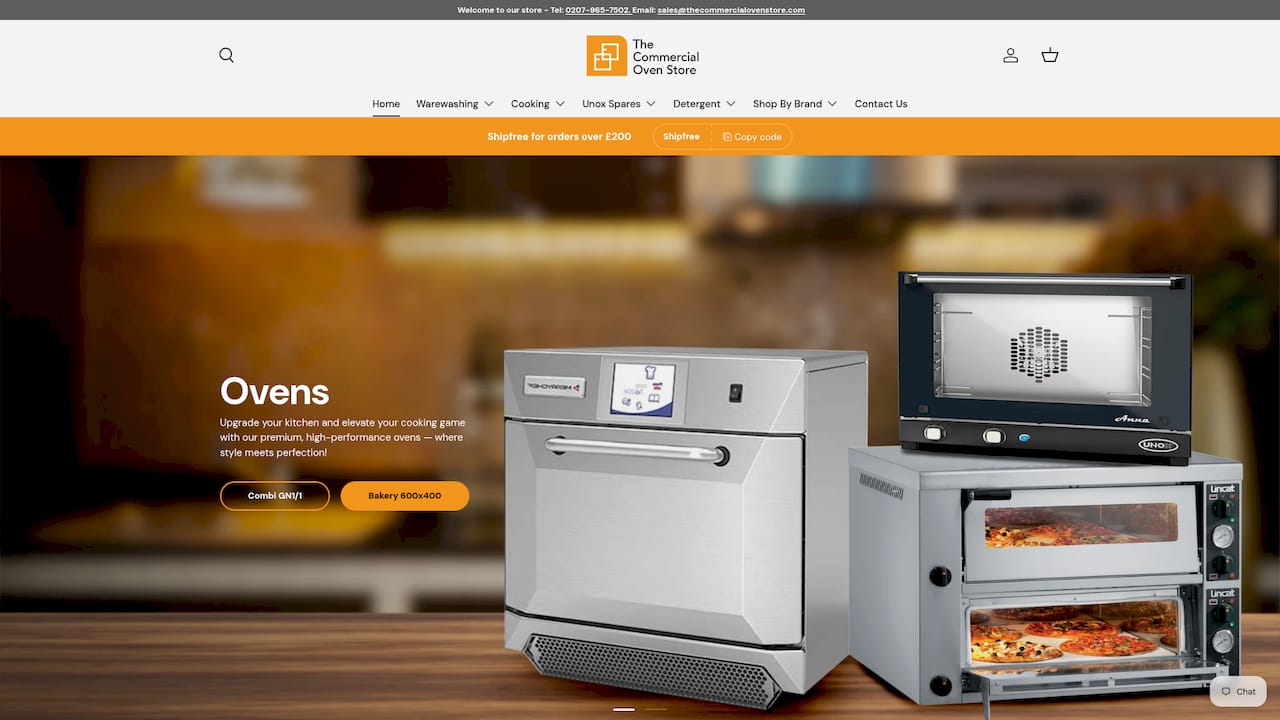
If a ventless, high-speed unit fits your front-of-house or delivery setup, the CIBO/S countertop fast oven is a solid starting point to look at, with a compact footprint and 2.7kw draw that suits most existing electrical supplies without major rewiring. Flexible payment through iwocaPay means the purchase doesn’t have to sit as one upfront cost, and the team can talk through installation requirements, power supply, and connectivity setup before you commit. Get in touch through Thecommercialovenstore to request a quote or arrange a site survey.
Frequently asked questions
Are connected commercial ovens worth the extra cost over standard models? For multi-site operators or anyone running variable menus, yes, largely because central recipe control and remote diagnostics reduce the staff time spent fixing inconsistency. For a single-site kitchen with one fixed menu, the case is weaker.
What happens if I stop paying the oven’s subscription fee? The oven keeps cooking normally, but remote monitoring, recipe push and phone alerts stop working. You’re left with a standalone unit until you renew.
Do connected ovens need a permanent internet connection to work? No. Most units cook fine offline and fall back to local USB for updates, but you lose the live telemetry, remote alerts and recipe push until connectivity is restored.
Can a connected oven integrate with my existing POS or inventory system? Some platforms support this through CSV export or an API, but it varies significantly by manufacturer. Ask specifically what integrates before you buy rather than assuming from a brochure.
Do high-speed countertop ovens need ventilation ductwork? Many are designed for ventless operation, which is why they’re common in front-of-house and delivery kitchens where installing extraction isn’t practical.
Sources
- Merrychef conneX brochure (Welbilt/FKI) 2024
- Merrychef conneX®12 product page — Welbilt
- SkyLine combi oven — Electrolux Professional