

Prioritise Gastronorm tray count paired with maximum food load in kilograms, not internal litres. As a rule of thumb, a 4 to 6 tray countertop unit suits a café doing fewer meals, an 8 to 12 tray oven covers most restaurants with moderate covers, and 16 to 20 tray models are built for production kitchens serving many meals. Sizing guidance and product teams can help confirm the right class once you know your peak covers.
TL;DR:
- Capacity is better assessed by tray count and maximum food load in kilograms rather than internal volume in liters, as litres do not reliably indicate usable space.
- Mid-size ovens with 8 to 12 trays are suitable for most independent restaurants serving 50 to 150 covers, with a maximum load of around 45kg for a 10-tray model.
- External footprint and utility requirements, such as electrical supply and water connections, are critical to ensure the oven fits in your kitchen before considering capacity figures.
- Always size your oven based on your peak service period, not the daily average, to avoid service delays during busy times.
- Planning for 10 to 20% extra capacity allows accommodating seasonal growth and menu changes without immediate replacement.
Table of Contents
- How manufacturers report combi oven capacity
- Combi oven size classes and what they’re built for
- Matching capacity to your menu and peak covers
- Footprint, access and utilities that limit which ovens fit
- A selection checklist and the questions to put to your supplier
- Three sizing tips from Thecommercialovenstore
- Building in room to grow
- Get help sizing your next combi oven
- Spec sheets worth checking before you buy
- Sources
- FAQ
How manufacturers report combi oven capacity
Spec sheets throw a lot of numbers at you, and not all of them tell you what you actually need to know. Gastronorm sizing, written as GN 1/1, GN 2/1 or GN 2/3, describes the standard tray footprint an oven accepts. A GN 1/1 tray measures roughly 530mm by 325mm, and it’s the reference size most café and restaurant ovens are built around. GN 2/1 trays are double width and turn up on high-capacity and banqueting models.
Tray count is the figure worth anchoring your decision to, because it tells you directly how many trays you can cook simultaneously. Internal litres get quoted almost everywhere, but they’re a weak proxy for usable space. A sample specification sheet from GBS America makes the point clearly: internal litres and tray counts appear side by side, but litres alone don’t reliably predict what actually fits, because shelf pitch, or the gap between runners, is what really governs it.
When comparing models, check these fields side by side:
- GN format supported (1/1, 2/1, or 2/3) and how many trays fit
- Runner or shelf pitch in millimetres, which determines clearance for taller dishes
- Maximum food load in kilograms, both per tray and for the whole oven
- Internal cavity dimensions, since two ovens with identical tray counts can still differ in usable height
Maximum food load matters more than most buyers realise. A tray rated to hold a joint of meat or a deep pan of lasagne behaves very differently from one loaded with delicate pastry, and heavy, dense items will hit the oven’s overall kilogram ceiling long before you run out of trays.
Combi oven size classes and what they’re built for
Combi ovens split fairly cleanly into three practical bands, and matching your operation to the right one avoids the two most common mistakes: buying too small and choking service, or buying too big and paying for capacity you’ll never load.
-
Countertop and small format (4 to 6 x GN 1/1). These sit on a worktop or stand, typically with tighter runner pitch suited to compact menus. They’re the natural fit for cafés, small bakeries and low-volume kitchens doing batch cooking rather than continuous service. The Lincat CombiSlim 1.10 illustrates this class well, built to fit a standard worktop footprint while still handling a working breakfast or lunch service.
-
Mid-size (8 to 12 x GN 1/1, or 6 x GN 2/1). This is the band most independent restaurants land in. A 10-tray model, according to Lincat’s own spec sheet, typically runs 70mm runner spacing and a maximum oven load around 45kg, working out to roughly 4.5kg per tray. That’s enough for most à la carte and set-menu operations doing 50 to 150 covers a day, assuming reasonable turnaround between batches.
-
High-capacity (16 to 20 x GN 1/1, or 11 x GN 2/1). Production kitchens, central commissaries and banqueting venues sit here. Electrolux Professional’s SkyLine 20-tray combi carries a maximum load capacity of around 200kg across its 20 x GN 2/1 trays, a figure that reflects both the tray count and the reinforced build needed to support that much weight simultaneously. Expect a bigger external footprint and correspondingly heavier services requirements at this end.
It’s also worth knowing that capacity isn’t always quoted in GN trays at all. The Blodgett Invoq combi lists capacity in full-size sheet pans (up to seven) or hotel pans (up to ten) on certain configurations, which is a reminder to always check what unit a spec sheet is actually using before comparing two ovens side by side.
Matching capacity to your menu and peak covers
The calculation isn’t complicated once you break it down: portion size, multiplied by portions per tray, multiplied by batches you can realistically run per service, gives you the meals a given tray count can produce. Manufacturer guidance, including Rational’s published meals-per-day bands, gives a starting range for each model class, but those figures assume a fairly simple menu and need adjusting for your own mix.
Three worked scenarios show how this plays out in practice:
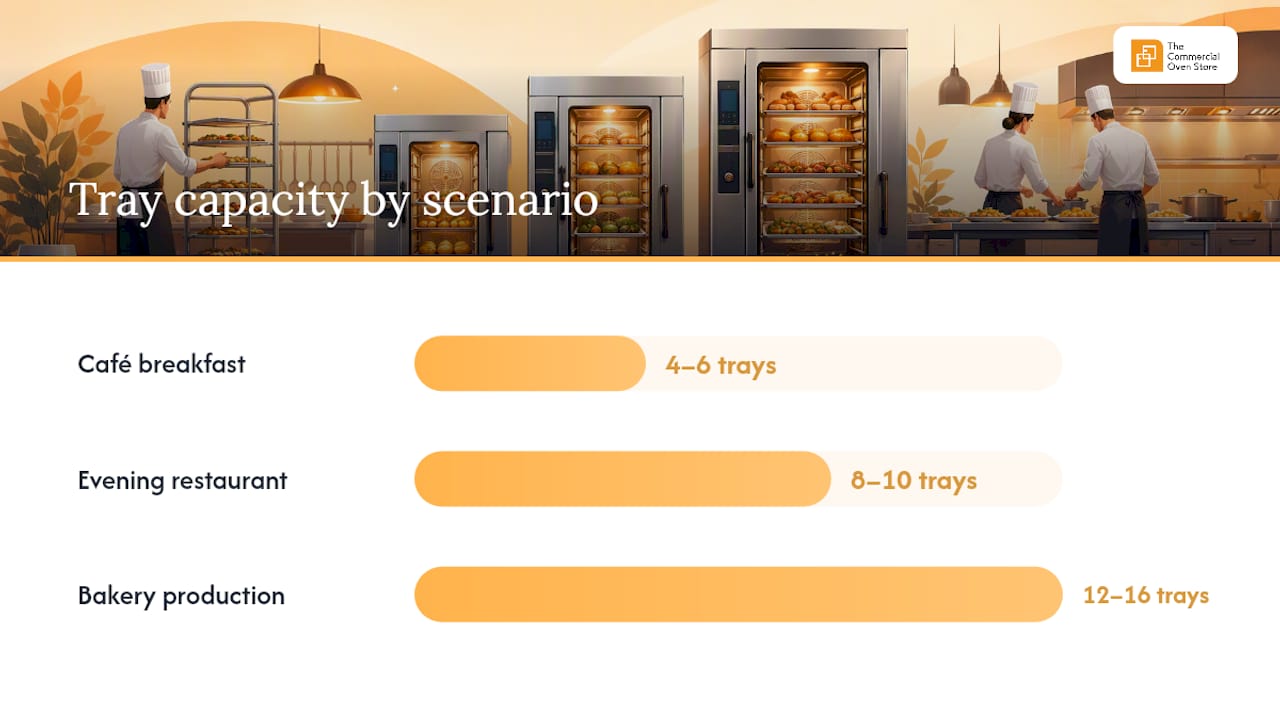
- Café breakfast service. A short, sharp peak of 40 to 60 covers over two hours suits a 4 to 6 tray countertop oven, since you’re rarely running more than two or three batches back to back.
- 80-cover evening restaurant service. With a mixed à la carte menu, an 8 to 10 tray oven gives enough headroom to run mains, sides and regeneration simultaneously without queuing dishes.
- Bakery batch production. High-volume proving and baking cycles favour 12 to 16 trays, because batch consistency matters more than speed of turnaround.
Regeneration and holding programmes eat into your usable throughput in ways that raw tray count doesn’t show. If half your trays are tied up holding food at temperature during service, your effective capacity for fresh cooking drops accordingly, and multi-step programmes with drying or resting stages take longer per cycle than a single-shot bake.
Pro Tip: Always size for your busiest 90 minutes, not your daily average. A combi oven sized to your service peak rather than your average cover count is the difference between smooth service and a queue of tickets at 8pm on a Saturday.
Footprint, access and utilities that limit which ovens fit
Tray count only matters if the oven physically fits in your kitchen and your building can power it. External footprint and door clearance need checking before anything else, since a 20-tray oven often needs a wider service corridor for delivery and future maintenance access, not just floor space.
Cavity geometry and runner spacing decide which pans and trays actually slide in, and this catches out buyers who assume all GN 1/1 ovens are interchangeable. A tighter runner pitch on a countertop unit won’t accommodate the same gastronorm trolley or deep roasting tray that a mid-size model handles comfortably.
Utilities are the other half of the equation:
- Electrical supply: confirm whether the model needs single-phase or three-phase power, and check the ampage against your existing board
- Water and drainage: most combi ovens need a mains water connection and a drain for condensate and cleaning cycles
- Ventilation: extraction and hood requirements scale with oven size and can affect what’s viable in an existing kitchen layout
It’s worth checking any high-powered model against current electrical safety guidance through a resource like the ETL energy and security portal before committing, and confirming compliance with a qualified electrician rather than relying on the spec sheet alone.
A selection checklist and the questions to put to your supplier
Getting sizing right is mostly about asking the right questions before you sign anything, not after.
- Map your menu first. List every dish that goes through the oven, its typical batch size, and how often you run it during peak service.
- Confirm your peak covers, not your average day. Sizing to a quiet Tuesday leaves you short on a busy Friday.
- Check batch sizes against tray count. If your busiest dish needs six trays per batch, a 6-tray oven leaves zero headroom for anything else cooking alongside it.
- Build in headroom for cleaning cycles, holding programmes and the odd equipment fault day.
- Ask your supplier directly: What is the GN tray count with standard runner pitch? What is the maximum food load in kilograms per oven? What throughput, in meals per day, is this model realistically built for? Do you offer installation and testing as part of the purchase?
Watch for spec sheets that omit maximum food load entirely, describe tray capacity ambiguously without stating the GN format, or give no detail on installation and servicing support. Those gaps tend to surface as problems after delivery, not before. Buyer feedback on dealer sites, including patterns visible in Trustpilot reviews for equipment suppliers, consistently points to installation quality and accurate specification as the two things that separate an oven that performs as advertised from one that disappoints.
Three sizing tips from Thecommercialovenstore
Buyers consistently underestimate three things: mixed loads need extra runner pitch, not just extra trays; maximum food load in kilograms caps you before tray count does on heavy menus; and cleaning and holding time has to be factored into your throughput estimate, not treated as free time.
Sizing a combi oven isn’t just counting trays. It’s checking whether your busiest single batch, at its heaviest, still fits within the oven’s stated kilogram limit and runner spacing.
Thecommercialovenstore’s combi oven dimensions sizing guide maps menu types to capacity class, and expert advice plus flexible finance through iwocaPay are both available factually as part of the buying process.
Building in room to grow
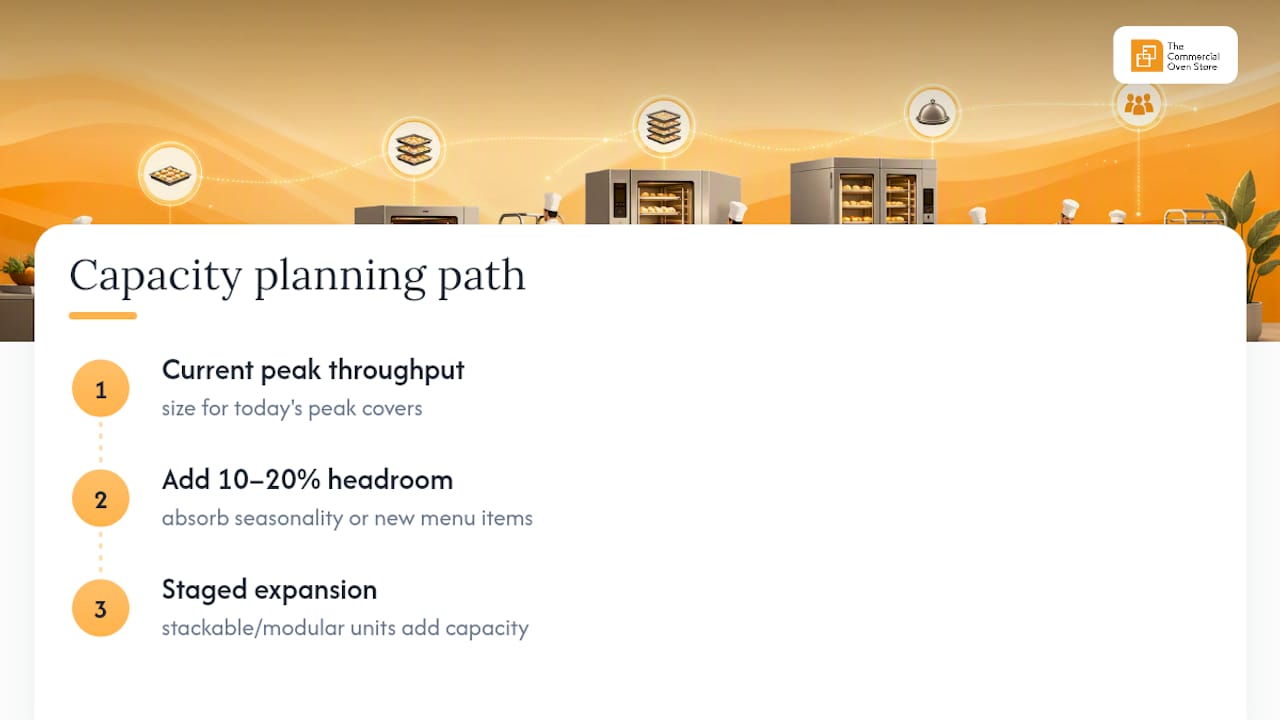
Sizing for exactly today’s covers is a common false economy. I’d generally recommend planning 10 to 20% headroom above current peak throughput, enough to absorb a seasonal spike or a new menu item without forcing a replacement purchase within two years. Where growth is uncertain, stackable or modular combi setups let you add capacity in stages rather than committing to the largest model upfront. If you’re unsure which way to go, a tailored site assessment against the sizing guide settles it faster than guesswork.
Get help sizing your next combi oven
Some suppliers offer direct access to genuine ovens from multiple leading manufacturers in one place, rather than requiring you to contact separate dealers for each brand.
Beyond the range itself, some suppliers back purchases with expert advice on matching capacity to your actual service pattern, professional installation, and flexible payment options so a larger-capacity oven doesn’t have to mean a lump sum upfront. Menu planning tools such as MyLTC’s cafeteria and dining management software can help you firm up your batch sizes and service periods before you even start comparing ovens, which makes the capacity conversation with a supplier far more precise. Browse the full commercial ovens collection, check the combi oven dimensions guide against your own menu, and request a site assessment or quote through Thecommercialovenstore when you’re ready to move from research to a shortlist.
Spec sheets worth checking before you buy
Verify tray type, runner spacing, maximum food load and internal dimensions directly on the manufacturer’s own product page rather than relying on a summary. The Electrolux SkyLine spec sheet, Lincat’s 10-tray Invoq PDF and the Blodgett Invoq listing are useful references for seeing how tray count, kilogram limits and pan format are actually presented across different manufacturers.
Sources
- SkyLine PremiumS electric boiler combi oven — Electrolux Professional
- Lincat Invoq Combi spec sheet (10‑tray model) — PDF
- Blodgett 101BLE Invoq electric combi oven product page
- Sample combi oven specification sheet — GBS America PDF
FAQ
What are the downsides of a combi oven?
Combi ovens cost more upfront than a standard convection oven and need both an electrical and water connection, which can mean additional installation work. They also require more involved cleaning cycles and staff training to use the steam and combination programmes effectively.
How big is a combi oven?
Size ranges from compact countertop units around 4 to 6 GN 1/1 trays up to large 16 to 20 tray floor-standing models. External footprint scales with tray count, so a high-capacity oven needs considerably more floor space and clearance than a countertop unit.
What is a standard oven capacity?
There’s no single standard, since commercial combi ovens are built in classes rather than one fixed size. A widely used mid-size reference point is a 10-tray model, which Lincat’s spec sheet lists at a maximum food load of 45kg.
Is a 60 litre oven big enough?
It depends entirely on tray count and runner spacing rather than the litre figure alone, since internal litres don’t reliably predict how many trays actually fit. Check the GN tray count and maximum food load against your peak covers instead of comparing litres between models.