

Hot spots are uneven temperature or airflow zones inside a commercial oven, whether that’s a conveyor, combi, deck or speed model, and they’re the reason two trays baked side by side come out looking nothing alike. The moment you spot a pattern, whether it’s scorched edges on one lane or pale centres on another, your priority is not to diagnose the cause. It’s to isolate the affected zone, pull any suspect product before it reaches a customer, and run a quick temperature check before you commit another batch.
Do this now if you suspect a hot spot mid-shift:
- Flag the affected lane, tray position or zone and stop loading it.
- Pull a calibrated probe and check actual temperature against setpoint at two or three points.
- Hold the batch if the reading is out of tolerance rather than guessing it’ll even out.
- Log what you saw (position, time, product) so the pattern is traceable later.
Reading Thermal’s work on industrial baking ovens confirms what most production managers already suspect: hot spots don’t just cause the odd burnt edge. They bake some product too fast and some too slow in the same cycle, and that inconsistency compounds into waste, rework and, eventually, complaints. A gas-fired oven with a suspected hot spot is also worth a quick check against NFPA 54 fuel-gas safety guidance before anyone starts poking around the burner assembly.
Table of Contents
- How do you detect hot spots in commercial ovens?
- What should a thermal profile of an oven measure?
- How do you fix hot spots once you’ve found them?
- How often should you profile a commercial oven?
- What’s the right troubleshooting sequence for a hot spot?
- When should you repair, replace or upgrade the oven?
- Get expert help fixing hot spots in your oven
- Sources
How do you detect hot spots in commercial ovens?
You don’t need a lab to find a hot spot. You need a plan for where to look and a probe you trust more than the controller display.
Start with multiple-probe spot checks across the belt or deck rather than a single reading in the middle of the chamber. Sample at the operator side, the centre and the offside, at both the front and back of the cavity, and write down setpoint versus actual for each. A surface colour check on a test bake can flag an obvious pattern quickly, but treat it as an early indicator only, not proof, since browning depends on more than cavity temperature alone.
A door-seal check matters more than most operators realise. Run a strip of paper in the closed door and pull gently; if it slides out with no resistance at any point along the seal, heat is escaping there and that side of the cavity will run cooler than the rest.
Escalate to a full profile when you see:
- Visible colour variance across a single tray, not just between trays.
- A deviation greater than roughly ±15°F (±8°C) from setpoint between zones.
- The same defect repeating across two consecutive production runs.
Pro Tip: Don’t trust the built-in controller readout on its own. A single calibrated, loggable probe moved to five or six points in the cavity will tell you more about real variation in ten minutes than the display panel will tell you all shift.
What should a thermal profile of an oven measure?
A proper thermal profile goes well beyond a temperature reading. According to Reading Thermal, a complete profile captures temperature, energy transfer (heat flux), humidity and air velocity together, because two zones can show identical temperatures on a gauge and still bake completely differently if airflow or heat transfer varies between them. Heat moves through conduction, radiation and convection, and it’s the convective component, driven by airflow and steam behaviour, that swings the most in a poorly maintained oven, according to Mashhad Baking Industries.
A practical profiling protocol looks like this:
- Place a data logger array across the width and length of the belt or deck, covering every lane and both edges.
- Add an air-velocity probe near the fan discharge and at the far end of the chamber, and a heat-flux sensor (or a reliable proxy) at two or three representative points.
- Run the profile after preheat has fully stabilised, not during warm-up.
- Log data at consistent intervals, ideally every few seconds, across at least two to three full passes so you can average out noise.
- Repeat with the oven at typical production load and recipe settings, including normal conveyor speed and steam injection.
Pro Tip: Always run one empty-belt stabilised pass alongside a loaded-production pass. Comparing the two tells you whether the oven itself is drifting or whether the product load is what’s shifting the heat pattern.
How do you fix hot spots once you’ve found them?
Reading a thermal profile is really about pattern matching. The shape of the imbalance usually points straight to the cause.
- Hotter centre, cooler edges — usually an airflow distribution issue. Check dampers and baffles for misalignment before assuming an element fault.
- Hotter edges, cooler centre — often a fan or blower problem restricting central air movement, or a heating element running weak near the centre.
- Top-to-bottom imbalance — check for uneven element wear between top and bottom banks, or a steam distribution fault if the oven injects from one side.
- A zone that lags after every changeover — points to controller or thermocouple drift, or a recovery-time issue after door openings.
- A cool band near a specific spot every time — check door gaskets and seals first; a worn gasket bleeds heat consistently in the same place.
Loading density and steam injection instability are worth ruling out early too. According to iFactory’s analysis of bakery oven zones, shifts in thermal mass from batch to batch, and unstable steam delivery, can alter zone performance mid-run even when nothing mechanical has failed. That’s a loading or process fix, not a repair job.
Once you’ve made a change, whether it’s a damper adjustment, a fan swap or a recalibration, re-run the same profiling protocol you used to find the fault. Compare the new mean and max-min delta values against your tolerance (commonly a maximum delta of roughly ±15°F/±8°C across the width). If the numbers hold within tolerance across two separate runs, the fix has worked.
Pro Tip: In conveyor or tunnel ovens, fix airflow before you touch anything else. Two zones can read the same temperature and still bake unevenly if air velocity or heat flux differs between them, so an airflow fix often resolves problems that look, on paper, like a heating element issue.
How often should you profile a commercial oven?
Profiling only works as prevention if it happens on a schedule, not just when something’s already gone wrong. Reading Thermal is direct about this: uniformity is an ongoing process, and any major maintenance, whether that’s burner tuning, a fan replacement or a conveyor change, needs a fresh profile afterwards to confirm the oven actually returned to a known-good state rather than assuming it.
A realistic cadence for most bakery and foodservice operations:
- Every shift start — a brief spot check: three or four probe positions plus a visual colour check on the first tray out.
- Weekly — a quick review of any logged deviations from the week, looking for creeping drift rather than one-off blips.
- Monthly — a full thermal profile for high-volume tunnel or conveyor ovens; quarterly is usually sufficient for smaller deck ovens with lighter use.
- After any maintenance — burner tuning, fan or motor replacement, conveyor or belt changes, and any deep clean that involved removing panels or baffles near the airflow path.
Keep the logs. Trending mean and delta values over months, not just weeks, is how you catch a gasket wearing out or a fan bearing degrading before it becomes a full-blown hot spot.
What’s the right troubleshooting sequence for a hot spot?
When a hot spot shows up mid-production, work through it in order rather than guessing at a fix.
- Confirm it. Check calibrated cavity probes against the controller readout. If they disagree, you may have a sensor problem, not a heat problem.
- Isolate load versus equipment. Does the pattern persist with an empty belt? If yes, it’s mechanical. If it only appears under load, look at loading density or steam settings first.
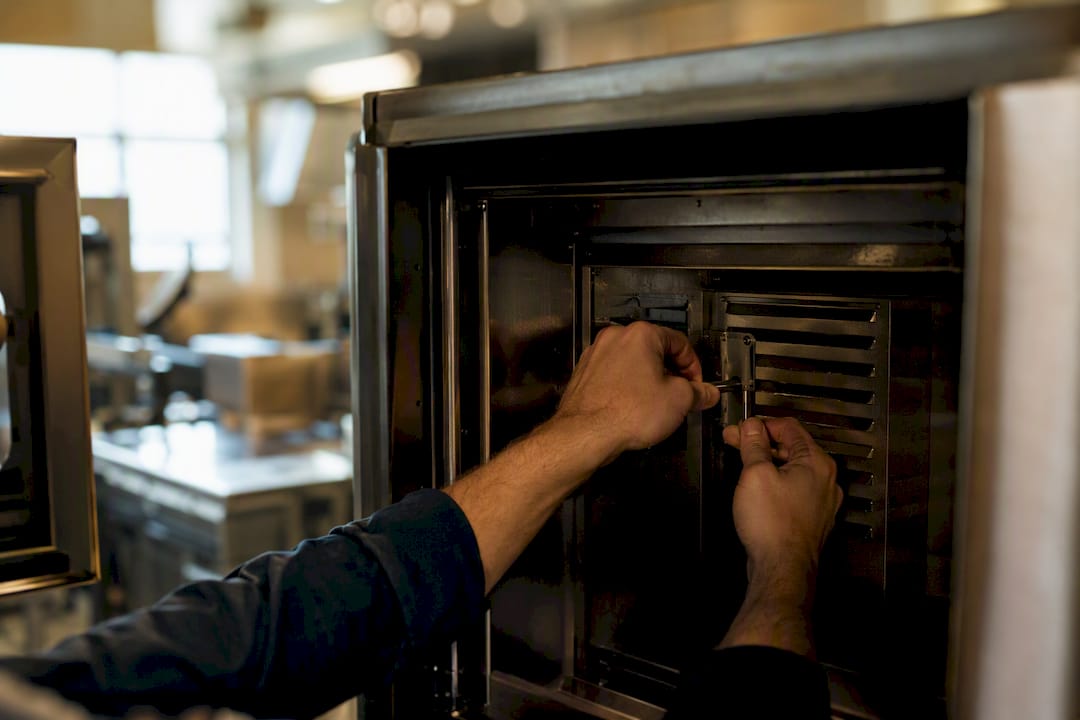
- Work the airflow path. Inspect dampers and baffles, then check the blower or fan motor for reduced RPM, a common and testable fault according to Berne.
- Test the elements. An ohm test on heating elements will quickly reveal a failing or unevenly performing element.
- Check seals and calibration. Inspect door gaskets for gaps and verify thermocouple or controller calibration against a known reference.
- Fix, then verify. Make the targeted repair, re-run the full profile, and confirm with a loaded-production check before returning to normal output.
If two rounds of repair fail to bring the delta back within tolerance, stop repeating the same fix. Call manufacturer service, or start planning for a component or full oven replacement instead.
When should you repair, replace or upgrade the oven?
Some hot spots are worth fixing. Others are telling you the oven is done.
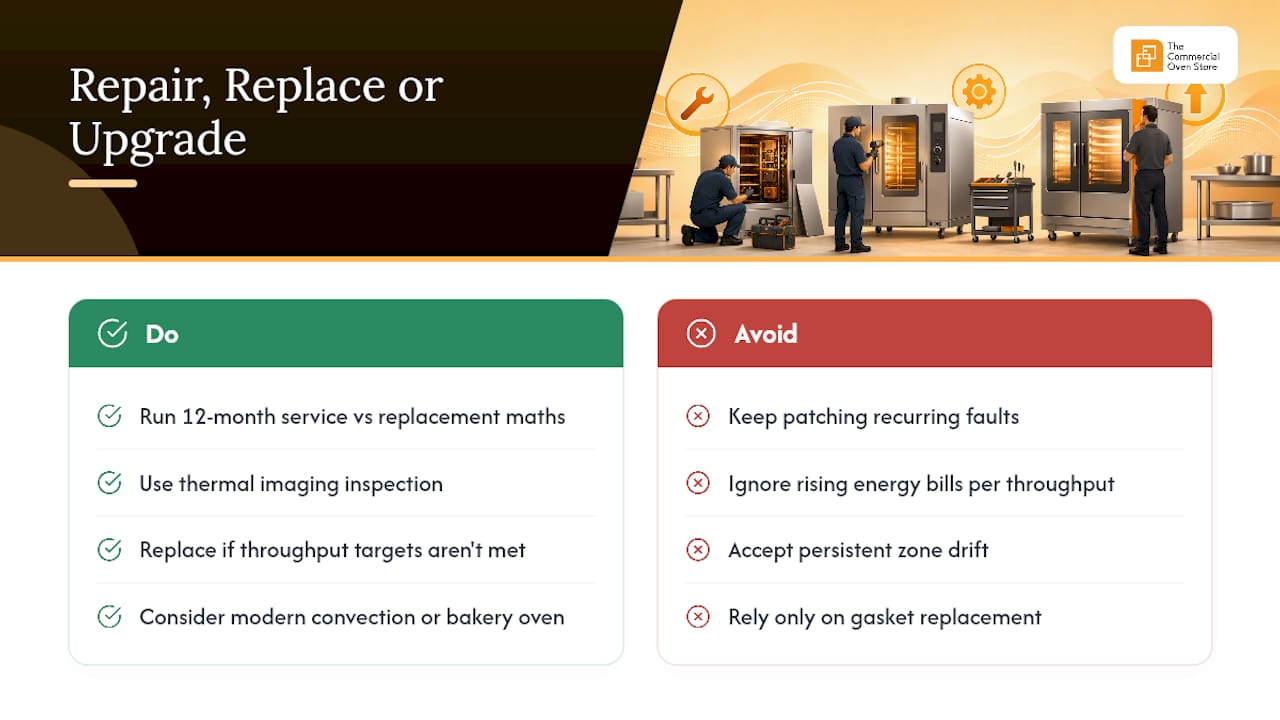
Watch for zone drift that returns within weeks of a repair, elements or fans that fail repeatedly rather than once, energy bills climbing without a throughput increase to explain it, or product rejects that won’t drop below an acceptable rate no matter what you adjust. Thermal imaging and a case inspection can also reveal degraded insulation, a fault that no amount of gasket replacement will fix, according to Mashhad Baking Industries.
Run the maths before committing to another repair. If recurring service costs over twelve months start approaching a meaningful fraction of replacement cost, and the oven still can’t hold your throughput targets, a modern convection or bakery oven with better airflow control and integrated monitoring usually pays for itself faster than another round of patch repairs.
Get expert help fixing hot spots in your oven
Persistent hot spots rarely fix themselves, and chasing the same fault through three repair cycles costs more in wasted product than most operators realise. Thecommercialovenstore works directly with bakery, café and catering teams to figure out whether a hot spot needs a targeted repair, a recalibration, or a straight swap to something built for consistent high-volume output.
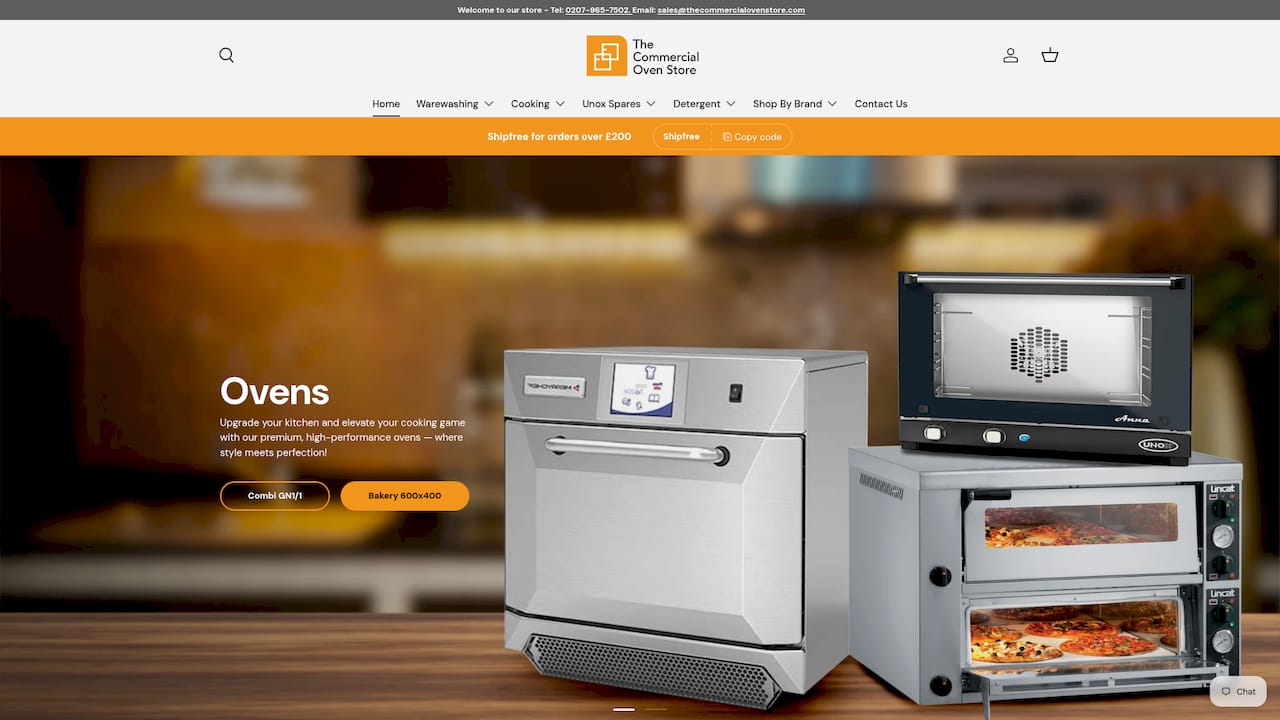
If you’re weighing up a repair against a replacement, browse the convection oven range built for even airflow across every lane, or look at a compact high-throughput option like the CIBO/S countertop fast oven if space and speed are the constraint. For businesses running a pretzel or specialty bread line, Smittie’s Pretzels has useful notes on how bake consistency shows up in a finished product, which is a good sanity check for what your oven should be delivering. Get in touch through Thecommercialovenstore to arrange a site survey or talk through which oven category fits your production line.
A note from an equipment specialist
. Most hot spot calls I see follow the same pattern: an operator assumes it’s the element, and half the time it’s a damper or a tired fan motor instead. Profile first. Guessing costs more trays than testing ever does.
Hot spots in commercial ovens are a data problem before they’re a repair problem, and consistent output depends on catching drift early through regular thermal profiling rather than reacting after product is already wasted.
| Point | Details |
|---|---|
| Act fast on suspected zones | Isolate the lane, hold the batch, and check with a calibrated probe before continuing production. |
| Profile with four metrics | Measure temperature, air velocity, heat flux and humidity together, not temperature alone. |
| Match pattern to cause | Centre, edge, top-to-bottom and lagging-zone patterns each point to a different likely fault. |
| Profile after every major change | Re-profile after burner tuning, fan replacement, conveyor changes or a deep clean. |
| Know when to stop repairing | Repeated failures and climbing energy costs signal it’s time to consider a replacement. |
| Get specialist input | Thecommercialovenstore offers equipment advice and site surveys to help diagnose and resolve persistent hot spots. |
Sources
- Thermal Profiling Systems for Industrial Ovens in Bakeries | Reading Thermal - Reading Thermal
- Bakery Oven Zone Temperature Uniformity and Browning Control
- Commercial Convection Oven Even Bake Failure — Fan Motor or Element? · Berne