

Most speed ovens in UK commercial kitchens can run without ducted extraction, provided the model is genuinely designed for recirculating (ventless) use and the room has adequate general ventilation. There is no blanket exemption in law: HSE CAIS10 requires “adequate ventilation” in every catering establishment, gas-fired units fall under the Gas Safety (Installation and Use) Regulations 1998, and Approved Document F sets the benchmark for supply and extract air.
- Verdict: filtered speed ovens are often acceptable, but only with manufacturer evidence and local sign-off.
- Never assume: “ventless” branding overrides your legal duty to ventilate the space.
- First move: speak to your local Environmental Health Officer before you commit to a recirculating install.
Pro Tip: Get your EHO’s acceptance of a filtered speed oven in writing before installation. A verbal nod at a site visit is worth nothing if an inspector later disagrees.
Key Takeaways
Compliant speed oven ventilation in the UK rests on matching appliance type to genuine extraction evidence, written EHO acceptance, and properly commissioned, maintained systems.
| Point | Details |
|---|---|
| No blanket ventless exemption | HSE CAIS10 requires adequate ventilation for every catering establishment, regardless of oven branding. |
| Get written EHO acceptance | Filtered speed ovens need manufacturer performance data plus documented sign-off before installation. |
| Balance supply and extract air | Industry guidance recommends replacing 75 to 95% of extracted air to avoid negative pressure problems. |
| Use qualified installers only | Gas Safe engineers for gas appliances, competent ventilation contractors for extraction and balancing. |
| Consider Thecommercialovenstore for specification support | Thecommercialovenstore supplies ducted and recirculating-compatible speed ovens with the technical data your EHO and installer need. |
This article is general information, not a substitute for advice from a qualified lawyer. Consult a qualified legal professional about your own circumstances before acting on anything here.
Table of Contents
- Which UK laws govern speed oven ventilation UK requirements?
- Do vented or ventless speed ovens need extraction?
- Ventilation design checklist for speed oven installs
- Who installs and certifies speed oven ventilation?
- Maintenance schedules and the mistakes that trigger enforcement
- Does demand-controlled ventilation cut running costs?
- Specific airflow rates and performance standards for speed ovens
- How do speed oven emissions affect indoor air quality?
- What noise and vibration limits apply to kitchen ventilation?
- Can ventilation controls integrate with speed oven operation?
- What does compliant ventilation typically cost?
- How long does installation and certification take?
- Ventilating a speed oven in a small kitchen
- What should you ask before buying a speed oven?
- Get the right oven and ventilation advice from the outset
- Sources
Which UK laws govern speed oven ventilation UK requirements?
Four sources of authority matter, and inspectors will reference all of them.
- HSE CAIS10 sets the baseline: catering establishments must provide adequate ventilation to control heat, steam, grease and combustion by-products, and it explicitly rejects any blanket “ventless” exemption.
- Building Regulations Approved Document F defines what “adequate” ventilation performance actually looks like in terms of supply and extract air.
- The Health and Safety at Work etc. Act 1974 underpins all of the above with a general employer duty to keep the working environment safe.
Local Environmental Health Officers interpret these documents for your specific kitchen, and their judgement is what actually determines whether your setup passes muster. “Adequate ventilation” isn’t a fixed number. It shifts depending on appliance type: a gas convection oven needs different provision than an electric speed oven, and a solid-fuel pizza deck needs a different approach again. Engage a Gas Safe engineer early for anything gas-fired, and put your ventilation plan in front of the EHO before, not after, you order equipment.
Do vented or ventless speed ovens need extraction?
A vented speed oven is ducted directly to the outside, carrying grease-laden air, steam and heat away from the kitchen. A ventless (filtered) speed oven recirculates air through a series of grease and odour filters and releases it back into the room. Both types are legal in principle. The difference is the evidence you need to justify each one.
Filtered systems are generally accepted only when three things line up: the manufacturer’s own performance data shows the filtration copes with your menu and volume, the EHO has confirmed acceptance in writing, and the room itself has sufficient background ventilation and clearance around the unit. Even genuinely ventless ovens need manufacturer-specified clearance and ambient airflow, since heat build-up can trigger thermal cut-outs and shorten equipment lifespan.
- Vented: higher install cost, but the safest route for high-volume or greasy menus.
- Filtered: lower disruption, cheaper to fit, but carries compliance risk if filtration data or EHO sign-off is missing.
Pro Tip: Keep the manufacturer’s test certificate and your EHO’s written acceptance in the same folder as your fire risk assessment. It’s the first thing an inspector will ask for.
Ventilation design checklist for speed oven installs
Good extraction design starts with balance, not just extraction rate. Industry guidance recommends replacing roughly 75 to 95% of extracted air with make-up air where practicable, because pulling more air out than you put back in creates negative pressure that drags cold draughts through doors, hampers gas appliance combustion, and can even pull fumes back into the room.
Canopies and ducting need grease containment baffles, materials rated for grease and heat, and access panels positioned so a cleaning contractor can actually reach every section. Fire dampers belong wherever ductwork passes through a fire compartment wall, and clearances around the speed oven itself must match the manufacturer’s installation manual, not a generic rule of thumb.
Before you book an installer, walk the kitchen and check:
- Where make-up air will physically enter, and whether it will short-circuit straight into the extract hood.
- Duct route length and number of bends, since every bend adds resistance and cuts fan efficiency.
- Access for cleaning contractors along the full duct run, not just at the canopy.
- Proximity to noise-sensitive neighbours or shared walls.
- Electrical capacity for fan motors, particularly if you’re adding demand-controlled ventilation later.
Get this checklist done before the installer arrives, and the quote you receive will be far more accurate.
Who installs and certifies speed oven ventilation?
Gas-fired appliances must be installed and commissioned by a Gas Safe registered engineer, full stop. Extraction and ductwork work needs a competent ventilation contractor, ideally one who can demonstrate airflow testing experience and holds relevant industry qualifications.
On handover, you should receive:
- A commissioning certificate confirming design airflow rates were achieved.
- Fan performance curves matched to your specific system.
- Airflow test results for both extract and make-up air.
- Electrical certification for any new circuits or motor installations.
- Gas safety certification where applicable.
Pro Tip: Store commissioning paperwork digitally as well as on paper. EHOs increasingly ask for records by email, and a lost folder is not an excuse an inspector will accept.
Maintenance schedules and the mistakes that trigger enforcement
Filters need daily or weekly attention depending on volume, canopies and ductwork need scheduled degreasing, and fans and fire dampers need annual inspection at minimum. Local authorities expect maintenance and commissioning records to be produced on demand, not reconstructed after the fact.
The mistakes that repeatedly cause trouble: relying on filtration alone without EHO sign-off, skipping the balancing step during commissioning, boxing ductwork in so nobody can clean it, and choosing a system purely on upfront price. A poorly maintained system isn’t just an EHO risk. A recent London restaurant fire traced back to grease build-up in extraction ductwork.
Pro Tip: Weigh through-life running and cleaning costs against the purchase price. The cheapest canopy on the quote is often the most expensive one to own.
Does demand-controlled ventilation cut running costs?
Demand-controlled ventilation (DCV) adjusts fan speed to actual cooking load rather than running extraction flat out all day. Variable-speed controls paired with sensors reduce energy waste while keeping indoor air quality where it needs to be, and industry experts increasingly recommend these as standard on new installs rather than an optional extra.
- Capital cost: higher upfront than a fixed-speed system.
- Running cost: lower energy use once tuned to your actual service pattern.
- Risk: poor sensor placement or badly configured fan control undermines the savings and can weaken capture at peak service.
Pro Tip: Ask any DCV supplier for written performance guarantees, not just projected savings figures. If they won’t put numbers on paper, treat the estimate with caution.
Specific airflow rates and performance standards for speed ovens
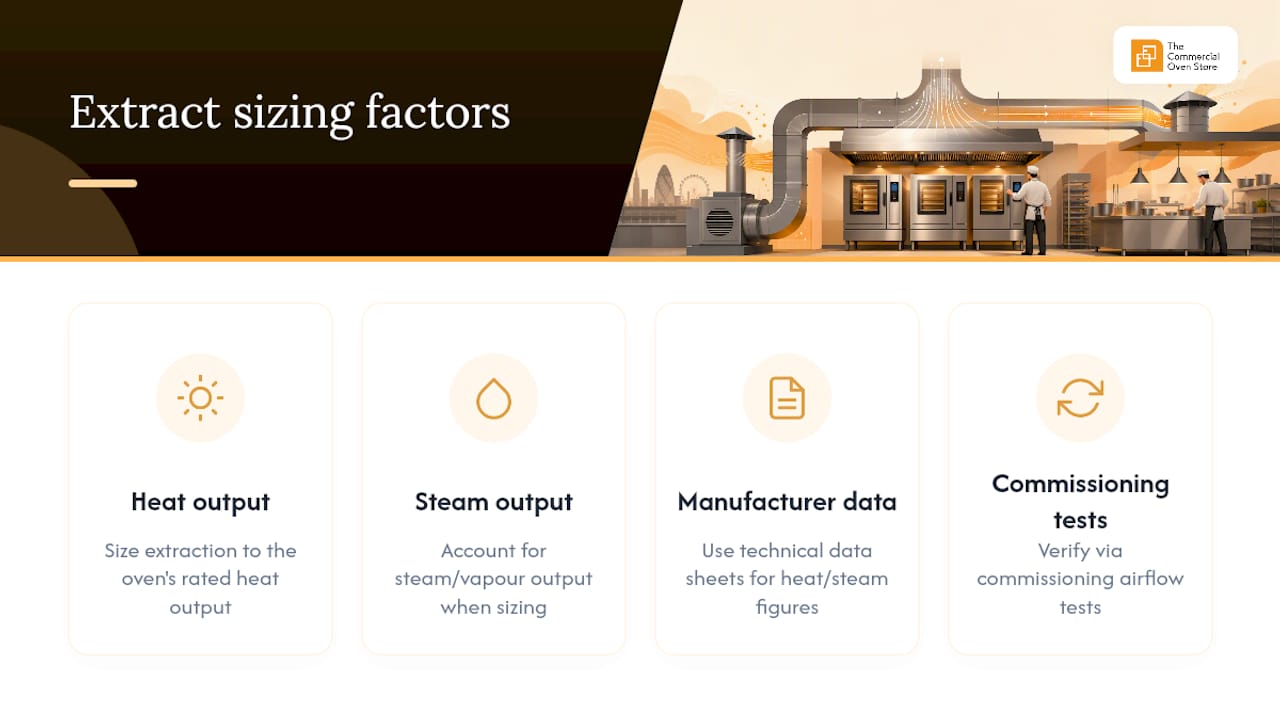
Speed ovens don’t carry a single universal airflow figure the way a solid fuel grill or deep fat fryer might, because heat and vapour output vary hugely between an electric high-speed impingement oven and a combi-style unit doing volume service. What Approved Document F gives you instead is a framework: extraction must be sized to the actual heat and moisture load of the appliance, verified through commissioning airflow tests rather than a generic industry number pulled from a brochure.
In practice, this means your ventilation contractor should size the system to the specific oven’s rated heat output and steam generation, not a blanket per-metre canopy calculation borrowed from a different appliance category. A countertop speed oven producing occasional steam bursts for a coffee shop menu has a completely different extraction demand to a bank of units running continuous high-volume service in a hotel kitchen. Manufacturer technical data sheets, which specify heat rejection and any steam or vapour output, are the starting point your installer should work from when calculating extract volumes and duct sizing. Ask your oven supplier for these figures before your ventilation contractor produces a design, since retrofitting extraction to match an underspecified system is far costlier than getting it right first time.
How do speed oven emissions affect indoor air quality?
Speed ovens generate heat, moisture and, depending on the appliance and menu, grease-laden vapour and fine particulates from cooking oils. Left unmanaged, this raises humidity, degrades air quality for staff working close to the appliance, and leaves a sticky grease film across surfaces, extraction components and eventually the building fabric.
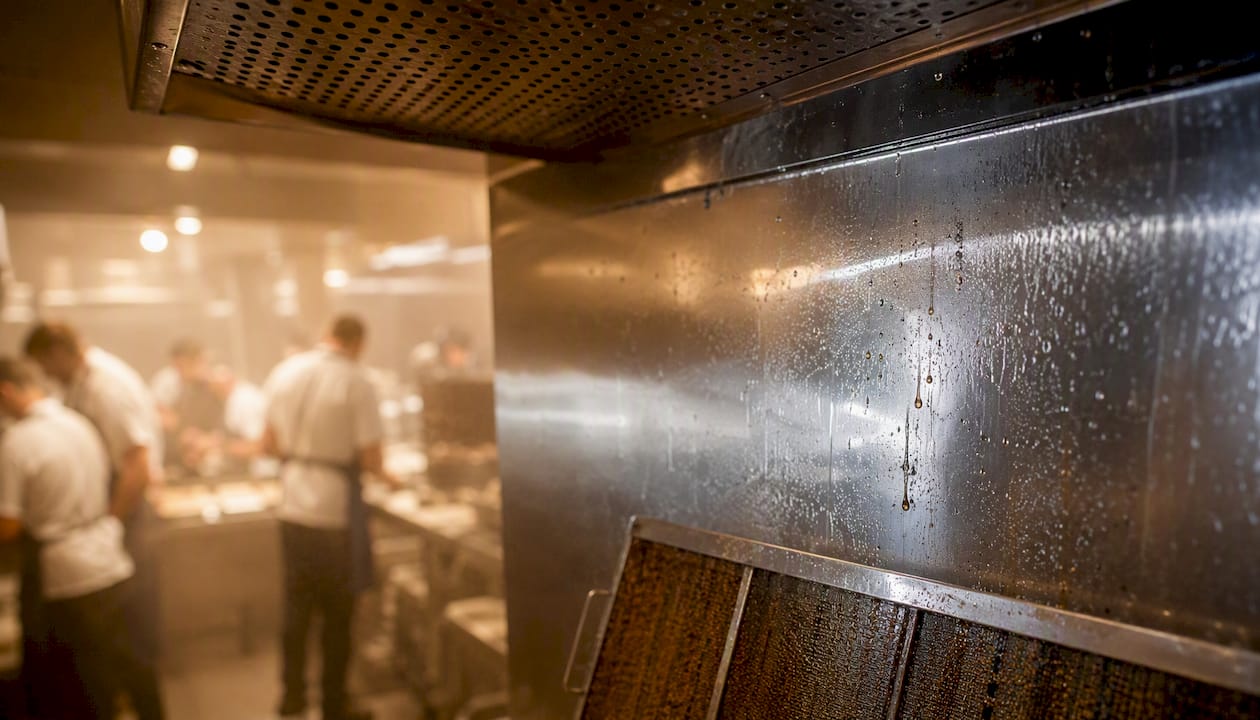
Filtration in a recirculating system typically works in stages: a grease filter to trap airborne fat particles, followed by an odour or carbon filter to manage cooking smells before the air returns to the room. The effectiveness of that filtration is entirely dependent on filter grade, replacement frequency and the volume of cooking passing through the unit, which is precisely why manufacturer performance data matters so much when an EHO is deciding whether to accept a filtered install.
Ducted systems avoid the indoor air quality question by removing contaminated air from the building entirely, which is one reason external extraction remains the default assumption for higher-volume kitchens. Where recirculation is used, more frequent filter changes and closer monitoring of grease accumulation become the trade-off for avoiding ductwork. Either way, adequate make-up air matters just as much as extraction, since stale, humid air recirculating through a poorly ventilated kitchen affects staff comfort and food safety alike.
What noise and vibration limits apply to kitchen ventilation?
There’s no single statutory decibel limit written specifically for kitchen extraction fans, but noise still falls under general workplace and planning obligations, particularly where a kitchen shares a wall with residential neighbours or sits in a mixed-use building. Planning conditions attached to a change of use or new installation frequently specify a maximum noise level measured at the nearest residential boundary, and this is a common source of complaints and enforcement action against catering premises.
Fan selection matters more than most operators expect. A correctly sized fan running at a lower speed is quieter than an undersized fan working flat out, which is another argument for demand-controlled ventilation rather than a fixed-speed unit that runs at maximum regardless of actual cooking load. Vibration isolation mounts on fan units, properly supported ductwork that doesn’t rattle against building structure, and acoustic silencers on the extract and intake ducts all reduce noise transmission without compromising airflow.
If your kitchen sits below flats or next to a residential neighbour, get an acoustic assessment as part of your ventilation design rather than discovering a problem after a noise complaint lands. Retrofitting acoustic treatment to an already-installed system costs considerably more than specifying it correctly from the outset.
Can ventilation controls integrate with speed oven operation?
Modern speed ovens increasingly offer digital controls and connectivity, and pairing that with demand-controlled ventilation is where the real efficiency gains sit. Rather than running extraction at a fixed rate throughout service, a DCV system reads temperature and optical or infrared sensors above the cooking line to ramp fan speed up during heavy use and down during quiet periods.
The safety case matters as much as the efficiency case. Integrated controls can also link to gas interlock systems, automatically shutting off gas supply if extraction fails or drops below a safe threshold, which directly supports the ventilation duties set out in the Gas Safety (Installation and Use) Regulations 1998. For electric speed ovens without a gas interlock requirement, integration still pays off through simple scheduling, extraction ramping up automatically when the oven powers on rather than relying on staff to switch fans on manually.
Getting this right requires the ventilation contractor and oven supplier to work from the same specification data early in the project, not bolt systems together after both have already been installed. A countertop speed oven with clear published heat output figures makes that integration considerably easier to design correctly.
What does compliant ventilation typically cost?
Costs vary enormously by kitchen size, appliance mix and whether you’re retrofitting into an existing building or fitting out from scratch, so treat any fixed figure quoted online with suspicion. What’s consistent across projects is the shape of the spend: canopy and ductwork represent the largest single line item, followed by fan units, make-up air provision, fire dampers, and commissioning and testing fees.
Choosing the cheapest system on quoted price alone is a documented false economy. Lower-specification fans and undersized ductwork cost more to run and maintain over their lifetime, through higher energy consumption, more frequent breakdowns and shorter service life. A demand-controlled system with variable-speed fans costs more upfront than a fixed-speed equivalent, but the running cost reduction over several years of service typically closes that gap.
Budget for ongoing costs alongside the capital spend: filter replacement, canopy and ductwork degreasing, annual fan servicing and periodic fire damper inspection all recur every year for the life of the system. Ask any ventilation contractor to itemise both capital and estimated annual running costs in their quote, so you’re comparing like with like rather than just the headline installation figure.
How long does installation and certification take?
Timelines depend heavily on whether ventilation already exists or needs installing from scratch, and whether the work needs planning permission or building control sign-off alongside the ventilation itself. A realistic sequence looks like: site survey and design, typically one to two weeks; procurement and lead time on canopy, ductwork and fan equipment, which can run four to eight weeks depending on specification; installation itself, usually a few days to a week for a single kitchen; then commissioning, airflow testing and certification, another few days once installation is physically complete.
Gas-fired appliances add a step, since Gas Safe registration requires the engineer to test and certify the gas connection and ventilation adequacy together, and this can’t happen until the extraction system is fully operational. Building work that alters the building’s structure or external appearance, such as a new duct penetrating an external wall, may also need building control notification, which adds its own timeline separate from the ventilation contractor’s schedule.
Plan for a minimum of six to ten weeks from initial site survey to full certification for a standard installation, longer if bespoke ductwork, planning consent or structural work is involved. Ordering your speed oven and booking your ventilation contractor at the same time, rather than sequentially, is the single biggest time saving most operators overlook.
Ventilating a speed oven in a small kitchen
Compact kitchens, the kind found in coffee shops, delis and small casual dining sites, face a genuine tension between space and compliance. There often isn’t room for a full ducted canopy and run of ductwork to an external wall, which is precisely the scenario where a genuinely ventless, filtered speed oven earns its keep, provided the EHO conversation happens before the equipment arrives.
Even in a tight footprint, manufacturer clearance requirements around the oven still apply in full. Skimping on side or rear clearance to fit a unit into a small alcove risks overheating and voids warranty cover, regardless of how little space is available. A compact under-counter unit positioned nearby can also affect airflow around a speed oven, so plan the whole equipment run together rather than each appliance in isolation.
Where ducting genuinely isn’t feasible, a shorter, more direct duct run with a smaller footprint canopy sometimes achieves compliance without the extensive routing a larger kitchen might use. Vertical duct runs through a roof rather than long horizontal runs to a distant external wall often solve the space problem while still delivering genuine external extraction. Get a ventilation contractor experienced with small commercial kitchens to survey the site before assuming ducting is impossible. Often the constraint is the assumed duct route, not the physical space itself.
What should you ask before buying a speed oven?
When kitchens come to us for advice, the questions we ask first are about the appliance, not the ductwork: rated heat output, exhaust or steam rate, manufacturer clearance requirements, and where the duct route would realistically run if extraction is needed. Those four answers determine almost everything else.
Pro Tip: Request the oven’s specific extraction curve from the manufacturer, and don’t proceed with a filtered install until you have written EHO acceptance in hand.
Get the right oven and ventilation advice from the outset
Getting a speed oven that suits your ventilation setup, rather than fighting your ductwork to accommodate the wrong appliance, saves you money and compliance headaches down the line. Thecommercialovenstore stocks models suited to both ducted and genuinely certified recirculating installs, and we provide the manufacturer specification sheets your ventilation contractor and EHO will actually ask for.
Our range includes compact countertop fast ovens for smaller sites, higher-capacity combi ovens for volume kitchens, and units like the XB893 Bakerlux that integrate straightforwardly into an existing ducted extraction system. If you’re weighing appliance types against your ventilation constraints, our guide comparing a speed oven against a microwave is a useful starting point, and broader thinking on energy efficiency in hospitality kitchens is covered well in Wild Foodz’s hospitality guide.
Whichever oven you’re considering, confirm your local EHO’s expectations and your Gas Safe engineer’s sign-off requirements before you finalise a purchase. Get in touch with our team for a specification sheet, a site survey referral, or help matching an oven to your kitchen’s extraction capabilities.
Sources
Recommended
- Speed oven vs microwave: which should your kitchen buy? – thecommercialovenstore.com
- Convection oven for bakery: the UK buyer’s guide – thecommercialovenstore.com
- Combi oven installation: the UK site-readiness guide – thecommercialovenstore.com
- Best bakery ovens for small UK bakeries: how to choose – thecommercialovenstore.com