

For most small-to-medium UK commercial kitchens, a single-phase combi oven running on 240 V with integrated steam and intelligent cooking controls delivers the best balance of output, installation simplicity, and total cost of ownership. You do not need three-phase power to run a professional combi oven. Modern single-phase models from Rational and Unox carry the same components, the same intelligent programmes, and the same build quality as their three-phase counterparts.
Quick feasibility check before you buy:
- Site electrics: confirm you have a 240 V single-phase supply with sufficient amperage for the model you want (sufficient amperage for the model you want)
- Water supply: decide whether you need direct plumbing or a tank-fill option, and check drain access
- Service plan: verify the supplier offers NICEIC-qualified installation and a post-sale service contract with a named response time
If all three boxes are ticked, you are ready to proceed. The commercial oven store stocks Rational and Unox single-phase models with installation support and flexible finance. Browse stocked models or read on for the full selection framework.
Table of Contents
- How do you choose the right single-phase combi oven for your kitchen?
- What are the UK electrical, plumbing and installation requirements?
- What does a single-phase combi oven cost, and what finance options exist?
- How do you keep a combi oven running reliably?
- What are the real advantages and disadvantages of single-phase?
- Thecommercialovenstore: stocked models, installation and finance
- Key takeaways
- Why single-phase deserves more credit than it gets
- Useful sources for further reading
How do you choose the right single-phase combi oven for your kitchen?
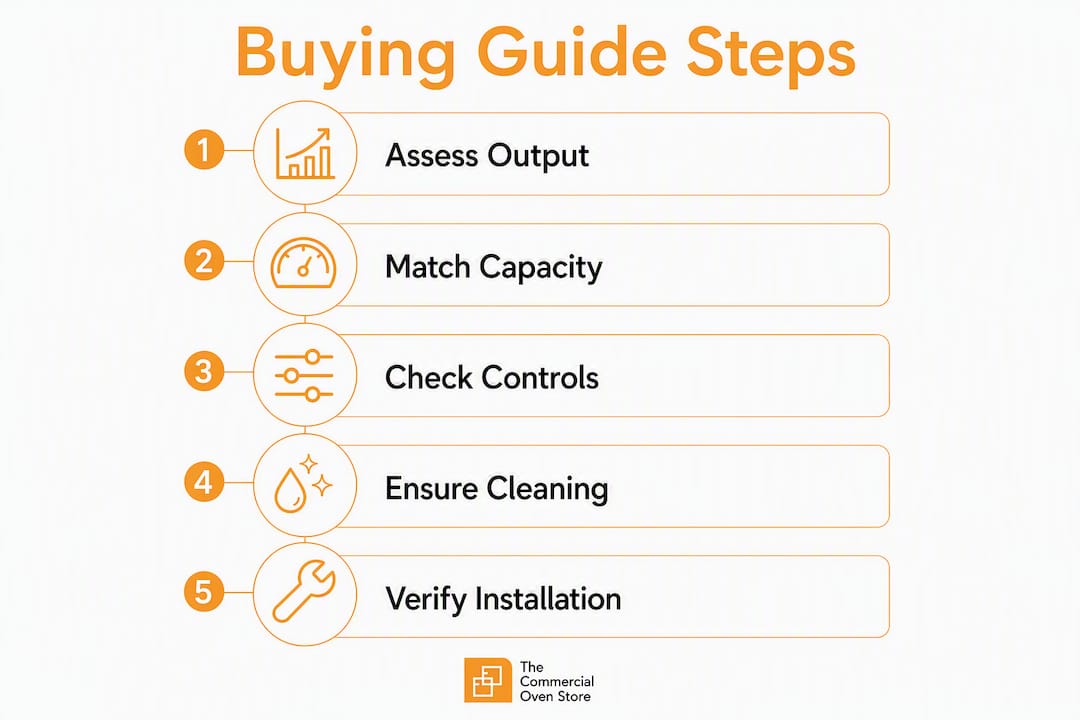
Start with output, not brand. The most common sizing mistake is buying on footprint and discovering the oven cannot keep pace during a Friday service.
Match capacity to your daily covers
A 6 x GN 1/1 single-phase oven handles a moderate number of covers per service comfortably, depending on menu complexity. A 6 x 2/3 GN half-size unit suits tighter menus or lower volumes, say a café running 30–40 covers. If you are regularly pushing beyond typical mid-range volumes, look at a larger model before assuming you need three-phase. The Rational iCombi Pro 10 GN1/1 is available in single-phase configurations and gives you that extra headroom without a supply upgrade.
Controls and usability
Self-cooking programmes matter more than most buyers expect. A chef who can load a tray, press one button, and walk away is a chef who is not standing over the oven during a rush. Rational’s iCookingSuite automates cooking sequences and adjusts humidity and fan speed in real time, which removes the guesswork from multi-batch cooking. Probe points are equally important: a single-probe oven is fine for batch roasting, but a dual-probe model lets you run two different products simultaneously at different core temperatures.

Cleaning and hygiene
Integrated automatic cleaning cycles are worth paying for. Manual cleaning on a busy combi oven takes 20–30 minutes and is frequently skipped under pressure, which accelerates scale build-up and shortens component life. Look for a system that doses its own cleaning tablets and rinses without staff involvement. Check that the cleaning programme is compatible with your local water hardness, and ask the supplier whether a water softener or scale inhibitor is included or recommended.
Footprint and ventilation
A standard 6-grid combi oven typically occupies a 600 mm wide footprint. Most models require 50–100 mm clearance on each side for ventilation. If you are fitting into a tight run, measure the route from the delivery point to the final position before you order. Canopy extraction or a ventless condensation hood is required in most UK commercial kitchens; confirm with your local environmental health officer if you are unsure which applies to your premises.
Red flags when evaluating suppliers
Walk away from any quote that does not specify the model’s kW draw and amp rating, does not include a site-prep checklist, or cannot name a certified installer. Vague service SLAs (“we aim to respond within a few days”) are a warning sign. A reputable supplier will state a maximum response time in writing and confirm whether parts are held in the UK.
What are the UK electrical, plumbing and installation requirements?
What ‘single phase’ actually means here
In UK commercial settings, single-phase power runs at 240 V nominal. Three-phase supplies deliver higher continuous power across three conductors and are common in larger kitchens, but they require a more expensive supply upgrade if your premises do not already have them. A single-phase combi oven draws its full rated power from one phase, which keeps installation straightforward and costs lower.
Typical single-phase combi ovens in the 6-grid class draw power levels requiring amperage appropriate for their kW ratings at 240 V. Half-size or countertop models sit lower, often 3–6 kW. Rational’s iCombi Pro XS, for example, is specified at 208/240 V, 1 Phase, which confirms the voltage range common to both UK and North American single-phase supplies.
Electrical installation options
Most commercial combi ovens above 3 kW require a dedicated circuit. A standard 13 A plug socket is not suitable for a 6-grid unit. Your options are:
- Dedicated circuit with commando socket: common for 16–32 A single-phase ovens; allows the oven to be disconnected without tools
- Hardwired installation: required by some manufacturers for higher-draw models; an NICEIC-qualified electrician must carry out the work and issue a certificate of compliance
- RCD protection: required on all new commercial circuits under BS 7671; confirm your consumer unit has a suitable RCD or RCBO fitted
Never assume a plug-in option is available for a commercial combi oven without checking the manufacturer’s installation manual first.
Plumbing and water supply
Direct-plumbed combi ovens connect to the building’s mains water supply and drain continuously during steam cycles. This is the preferred option for high-frequency use. Tank-fill models exist for sites where running a water line is impractical, but they require manual refilling and are better suited to lower-volume operations.
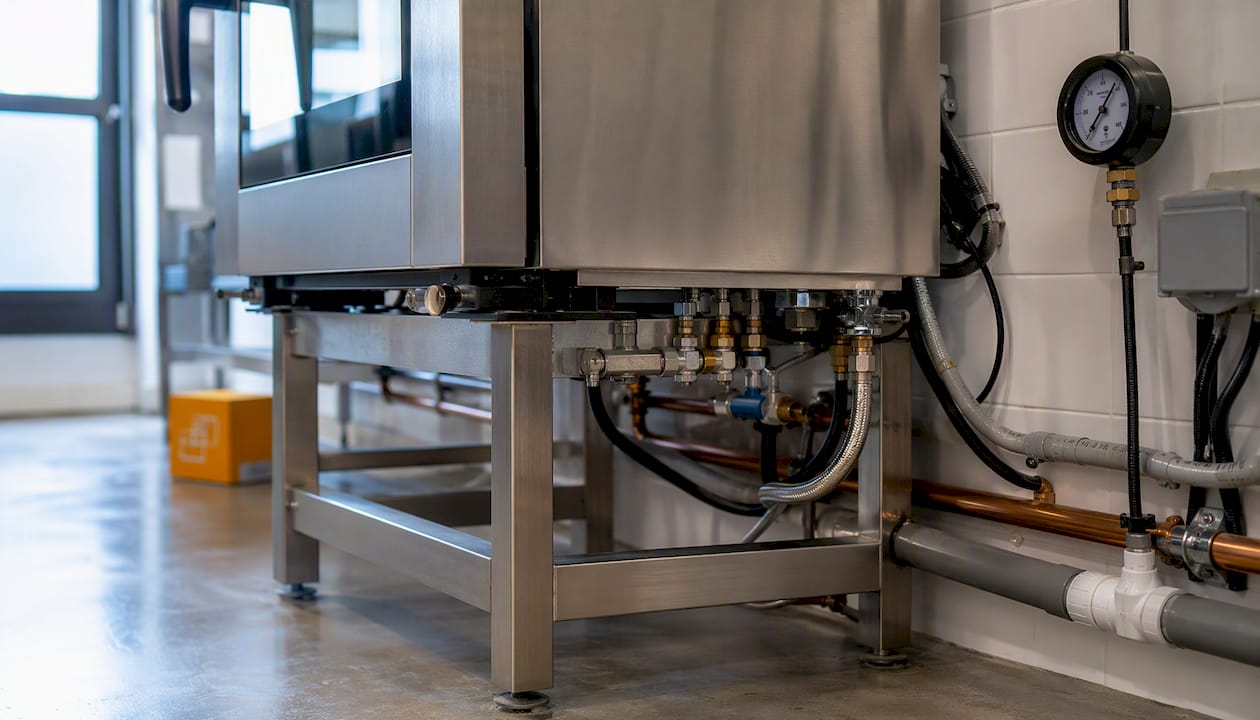
Drainage is non-negotiable. The drain outlet on most 6-grid ovens is 40 mm diameter; it must run to a trapped floor drain or a suitable waste connection. Steam condensate is hot, so the drain run must be heat-resistant.
Site-preparation checklist
Before the installation team arrives, confirm:
- 240 V single-phase supply with correct amperage at the oven position
- Maximum feeder cable length from consumer unit to oven position (ask your electrician to calculate volt drop)
- Isolation switch within sight of the oven
- RCD or RCBO protection on the dedicated circuit
- Cold water inlet (15 mm minimum) with isolation valve within 1 metre of the oven
- 40 mm waste outlet with trap and heat-resistant pipework to drain
- Floor load capacity (most 6-grid ovens weigh 70–120 kg plus stand)
- Minimum 2 m clearance above the oven for canopy or ventless hood
Pro Tip: On installation day, photograph your consumer unit before the electrician starts, note the water pressure at the inlet (aim for 1.5–3 bar), and measure the exact route from the delivery point to the oven position. These three steps alone prevent the most common causes of same-day delays.
| Requirement | Typical specification |
|---|---|
| Supply voltage | 240 V single-phase |
| Amperage (6-grid) | 32–46 A depending on model kW |
| Water inlet | 15 mm cold supply, 1.5–3 bar |
| Drain outlet | 40 mm, heat-resistant, trapped |
| Floor clearance above oven | Minimum 2 m for extraction |
| Electrician certification | NICEIC-qualified, BS 7671 compliant |
What does a single-phase combi oven cost, and what finance options exist?
Price varies significantly by brand, grid count, and feature set. The table below gives a realistic picture of the UK market.
| Price band | Typical range (ex VAT) | What you typically get |
|---|---|---|
| Entry | — | 6-grid, manual or semi-auto controls, basic cleaning |
| Mid | — | 6-grid, auto programmes, integrated cleaning, probe |
| Premium | — | Rational iCombi Pro or Unox full-combination, intelligent controls, connectivity |
The Rational iCombi Pro 6 GN1/1 sits in the premium band and represents the benchmark for single-phase performance at this grid size.
Finance and leasing options
Paying outright is not the only route, and for many operators it is not the smartest one:
- Supplier leasing: fixed monthly payments over 24–60 months; the oven is operational from day one without a large capital outlay
- iwocaPay: Thecommercialovenstore offers iwocaPay, which lets you split the purchase cost into manageable instalments at checkout
- Hire purchase: you own the asset at the end of the term; interest costs vary by provider
Delivery and lead times
Stock models typically ship within 3–7 working days. Made-to-order or imported configurations can take 4–8 weeks. Factor in a further 1–3 days for installation once the unit arrives, particularly if site prep work is needed. Order early if you have a kitchen opening date.
Total cost of ownership
The purchase price is only part of the budget. Plan for:
- Installation cost varies depending on site complexity
- Water treatment requires a scale inhibitor or softener unit plus periodic cartridge replacement
- Annual service contract costs vary for full-coverage plans
- Energy use of a 6-grid single-phase oven depends on operating power and duration; advanced controls like the Rational iCombi Pro’s iDensityControl and iCookingSuite can reduce cooking time by up to 10% and lower energy use by up to 50% compared with earlier models.
How do you keep a combi oven running reliably?
Daily and weekly cleaning
Run the automatic cleaning cycle at the end of every service. Most modern combi ovens offer a short rinse cycle (15–20 minutes) for light soiling and a full clean cycle (45–60 minutes) for heavy use. The difference between kitchens that get five years from a combi oven and those that get ten is almost always cleaning discipline.
Weekly, wipe down door seals, check the drain for blockages, and inspect the water inlet filter. These take five minutes and prevent the majority of call-outs.
Servicing cadence
An annual service by a manufacturer-trained engineer covers safety checks, calibration, and descaling. In hard-water areas, a descale every six months is more realistic. Components that typically need attention over a five-year period include door gaskets, probe cables, and the cleaning pump. None of these are expensive individually; the cost comes from unplanned downtime if they fail mid-service.
What to insist on in a service contract
Pro Tip: Before signing any service agreement, confirm in writing: (1) response time in working hours, not calendar days; (2) that engineers carry genuine manufacturer spare parts; (3) that labour is included, not billed separately per visit. A contract that excludes parts or labour is not a service contract — it is a call-out arrangement at a fixed annual fee.
Rational’s iCareSystem provides automated self-cleaning and maintenance reminders, which reduces the burden on kitchen staff and gives service engineers a diagnostic head start.
What are the real advantages and disadvantages of single-phase?
Advantages
- No supply upgrade required for most UK commercial premises already on single-phase
- Lower installation cost: a dedicated single-phase circuit is cheaper to install than a three-phase supply upgrade, which can run to several thousand pounds
- Identical cooking performance to three-phase at equivalent grid sizes; the myth that single-phase means lower quality is not supported by modern specifications
- Simpler compliance: a single-phase installation involves fewer certification steps than a new three-phase supply
- Compact models available: half-size and countertop single-phase units suit tight kitchens where a full-size oven is impractical
Disadvantages
- Power ceiling: single-phase limits the maximum continuous kW draw, which means very high-output kitchens (100+ covers per service, multiple simultaneous loads) may find a three-phase model recovers temperature faster
- Amperage routing: pulling 32–46 A across a long cable run requires careful volt-drop calculation; a poorly specified circuit causes nuisance tripping
- Not every model is available in single-phase: some larger combi ovens are three-phase only, so your choice of model narrows slightly
When to choose single-phase, and when to go three-phase
Choose single-phase if your premises already have a 240 V supply with adequate amperage, your output is up to roughly 80–100 covers per service, and you want the lowest installation cost. Opt for three-phase if you are fitting out a new build with a three-phase supply already in place, your output regularly exceeds 100 covers, or you are buying a 10-grid or larger unit where three-phase models dominate the available range. For a detailed breakdown of the electrical trade-offs, the single phase vs three phase guide on Thecommercialovenstore covers the UK context thoroughly.
Thecommercialovenstore: stocked models, installation and finance
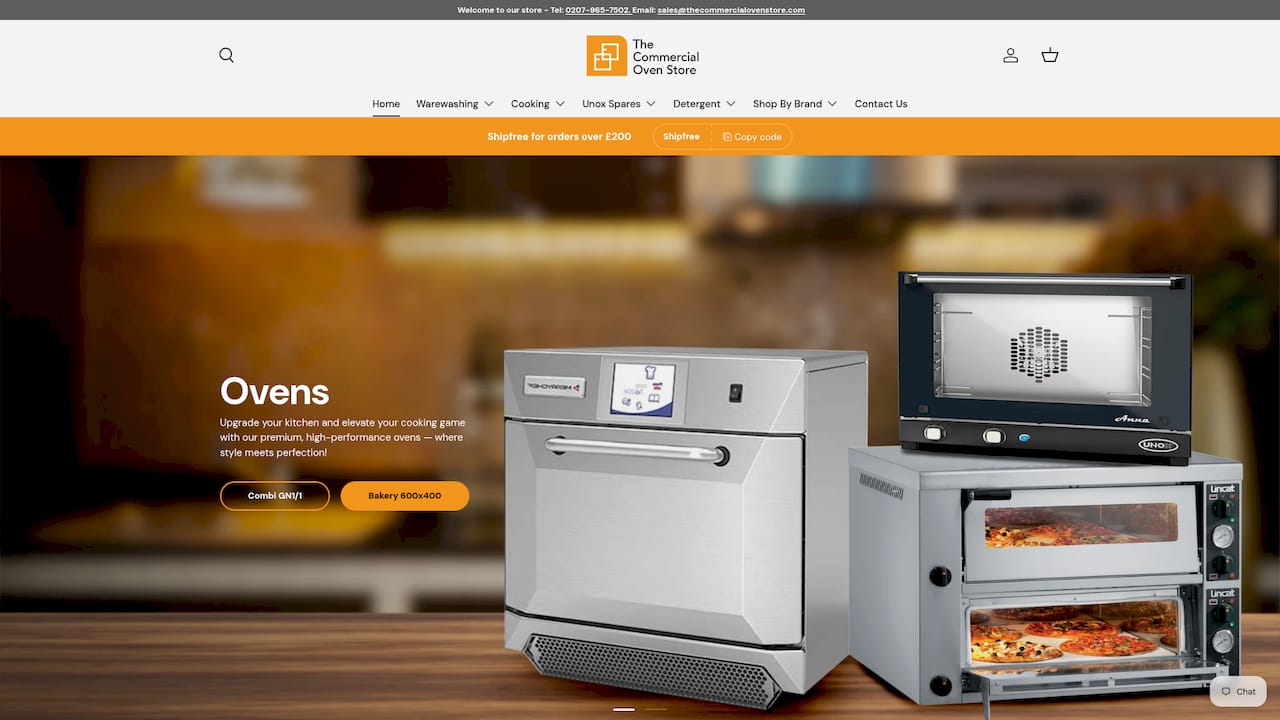
Skip the wait for a quote that never arrives. Thecommercialovenstore stocks single-phase combi ovens from the brands that matter in UK professional kitchens, with installation support and finance built in from the start.
Stocked single-phase brands and model families:
- Rational iCombi Pro (6 GN1/1 and 10 GN1/1 single-phase) — intelligent controls, iCareSystem cleaning, iProductionManager connectivity
- Rational iCombi Classic (6 GN1/1) — proven reliability at a lower price point, full single-phase specification
- Unox Full Combination Range — single-phase models with automatic programmes and integrated cleaning, well suited to bakeries and cafés
- Blue Seal — robust single-phase convection and combi options for operators who prioritise durability and straightforward servicing
Services included with every purchase:
- Site survey and pre-installation assessment
- NICEIC-approved electrician referrals for dedicated circuit installation
- Plumbing and water-treatment installation coordination
- Commissioning and staff training on delivery day
Finance options include iwocaPay at checkout and supplier leasing over 24–60 months. You can also check supplier reputation through independent resources such as The Canary Shed’s recommended suppliers list before committing.
Request a site survey or browse single-phase models at Thecommercialovenstore and get a written quotation with installation costs included.
Key takeaways
A 6-grid single-phase combi oven on a 240 V dedicated circuit is the right starting point for most UK commercial kitchens running up to 80–100 covers per service, with installation costs well below a three-phase supply upgrade.
| Point | Details |
|---|---|
| Single-phase suits most UK kitchens | A 240 V supply with 27–46 A capacity covers the majority of 6-grid single-phase models without a supply upgrade. |
| Installation requires a qualified electrician | An NICEIC-certified electrician must install the dedicated circuit and issue a BS 7671 compliance certificate. |
| Budget beyond the purchase price | Factor in £300–£800 installation, water treatment, and an annual service contract of £300–£600. |
| Single-phase is not lower quality | Modern models like the Rational iCombi Pro use identical components to three-phase versions and can reduce energy use by up to 50% compared with earlier models. |
| Thecommercialovenstore | Stocks Rational, Unox, and Blue Seal single-phase models with site surveys, NICEIC installer referrals, and iwocaPay finance. |
Why single-phase deserves more credit than it gets
The catering industry has a habit of treating three-phase as the default mark of a serious kitchen. Walk into most equipment showrooms and the assumption is baked in: if you are buying a combi oven, you will need three-phase. That assumption costs operators money and time they do not need to spend.
The reality is that the vast majority of UK commercial premises already have a perfectly adequate single-phase supply. The electrical upgrade to three-phase, when it is not already present, can run to several thousand pounds and involve DNO applications that add weeks to a project timeline. For a kitchen running 60 covers a service, that cost buys nothing in cooking performance.
What actually matters is whether the oven’s kW rating fits within your available amperage, whether the circuit is correctly specified, and whether the cleaning and service regime is followed. A Rational iCombi Pro on single-phase, properly installed and maintained, will outperform a neglected three-phase unit every time. The phase count is an electrical supply question, not a quality question.
The one genuine caveat is very high-output sites. If you are running 120 covers across multiple simultaneous loads and your kitchen already has three-phase, use it. But for the majority of operators reading this, the single-phase route is faster, cheaper, and just as capable.
Useful sources for further reading
- Rational iCombi Pro product page — full UK specifications, iCookingSuite and iCareSystem feature details
- Single phase vs three phase for commercial ovens — Thecommercialovenstore — UK-specific electrical guidance and myth-busting
- Rational iCombi Pro 6 GN1/1 product page — Thecommercialovenstore — current pricing, specifications and purchase options for a stocked single-phase model
- Can I plug my oven into a normal socket? — MyAppliances — practical UK guidance on dedicated circuits and hardwiring requirements
Recommended
- Combi oven installation: the UK site-readiness guide – thecommercialovenstore.com
- Convection oven for bakery: the UK buyer’s guide – thecommercialovenstore.com
- Single phase vs three phase for commercial ovens – thecommercialovenstore.com
- Best bakery ovens for small UK bakeries: how to choose – thecommercialovenstore.com