

A standard 13 A plug will run most home appliances and light commercial kit without any trouble, but it caps out at roughly 3 kW. Once your combined load creeps past 15 to 20 kW, or you’re running motors, large ovens, or fast EV charging, three phase becomes the sensible choice rather than an optional upgrade.
TL;DR:
- Loads exceeding 15 to 20 kW or equipment with motors, heavy ovens, or rapid EV chargers usually require a three phase supply instead of single phase.
- Most domestic appliances under 3 kW, such as kettles and small ovens, are suitable for standard 13 A single phase outlets, but larger commercial devices often need three phase connections.
- Upgrading from single phase to three phase involves site surveys, potential network reinforcement, and can cost from around £3,000 to over £20,000, depending on complexity.
- When selecting commercial ovens, small models like countertop speed ovens can run on 13 A single phase, while larger, multi-deck units typically require three phase and professional installation.
- A 13 A plug at 230 V delivers just under 3 kW, so any appliance drawing more than that or running continuously at high power likely needs a three phase supply to operate safely and reliably.
Table of Contents
- 13 amp vs 3 phase: what’s actually different
- How many kW can a 13 amp plug actually handle?
- Deciding between single phase and three phase for your setup
- What upgrading to three phase actually involves
- Choosing the right supply for commercial ovens and kitchen equipment
- Safety rules you shouldn’t bend on
- Why the standard advice on this undersells the planning stage
- Get the right oven for your supply, first time
- Sources
13 amp vs 3 phase: what’s actually different
Single phase and three phase describe how electricity travels down the cable, not just how much of it you get. UK homes run on single phase at 230 V line to neutral, which is the standard 13 A socket you plug a kettle or a toaster into. Three phase runs at roughly 400 V line to line, using three live conductors instead of one, each carrying power that overlaps in a way single phase can’t match.
That overlap is the whole point. With three phase, power delivery stays smoother because the three waveforms peak at staggered intervals rather than all dropping to zero together. It also means each conductor in a three-phase system carries only about 57.7% (1/√3) of the current that an equivalent single-phase circuit would need for the same power output. That’s why motors start more smoothly and run cooler on three phase, and why it’s the default choice for anything with a compressor or a heavy motor load.
You can usually spot which supply a building has without opening a single wire:
- Single phase properties typically have one fuse at the service head or cut-out.
- Three phase properties usually show three fuses side by side, one per live conductor.
- A UK Power Networks engineer or a qualified electrician can confirm this in minutes if you’re not sure.
- Plugs and sockets differ too: 13 A plugs are the familiar three-pin type, while three phase kit uses industrial round-pin or commando connectors that simply won’t fit a domestic socket.
How many kW can a 13 amp plug actually handle?
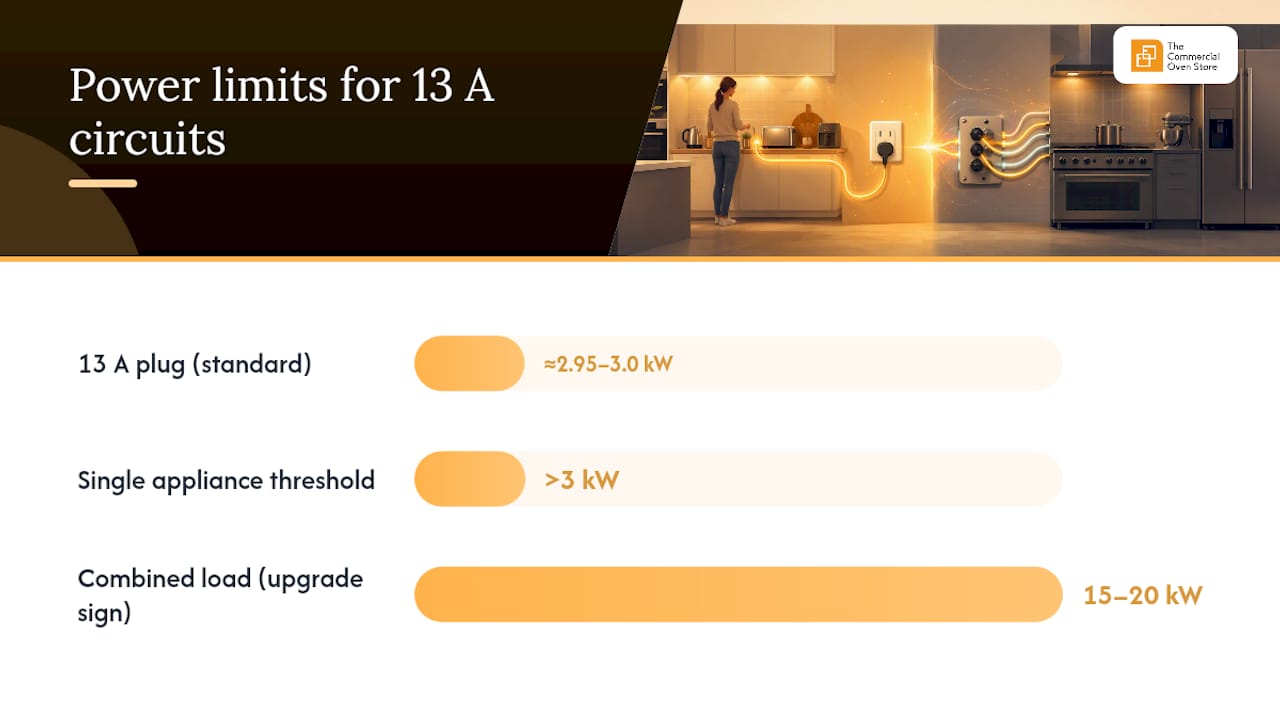
The maths is simple: kilowatts equal volts times amps, divided by 1,000. At 230 V and 13 A, that’s 230 × 13 ÷ 1,000, which comes out at just under 3 kW.
A 13 A plug at 230 V delivers approximately 2.95 to 3.0 kW — enough for a kettle, a microwave, a countertop grill, or a small speed oven, but nowhere near enough for heavy commercial equipment running continuously.
Plenty of kit sits comfortably under that ceiling: toasters, small fridges, most domestic ovens, and compact countertop catering equipment. Anything drawing more than about 3 kW continuously, or anything with a motor that draws a heavy starting surge, starts pushing past what a single 13 A circuit can safely and reliably supply.
Three phase uses a different formula because power splits across three conductors: P = √3 × V(line to line) × I × power factor. Run the numbers at 400 V and even modest current values produce far higher continuous output than single phase can offer, which is why commercial ovens, large compressors, and rapid EV chargers are usually specified in three phase rather than single.
To work out whether your own setup needs an upgrade:
- List every appliance’s rated kW or amp draw, including startup surge for anything with a motor.
- Add up the total, not just what runs at any one moment, since some equipment runs simultaneously.
- Compare that total against roughly 3 kW per standard 13 A circuit, and against your property’s overall supply rating.
- If any single item exceeds 3 kW, or the combined load nears 15 to 20 kW, treat three phase as the likely answer rather than the alternative.
Deciding between single phase and three phase for your setup
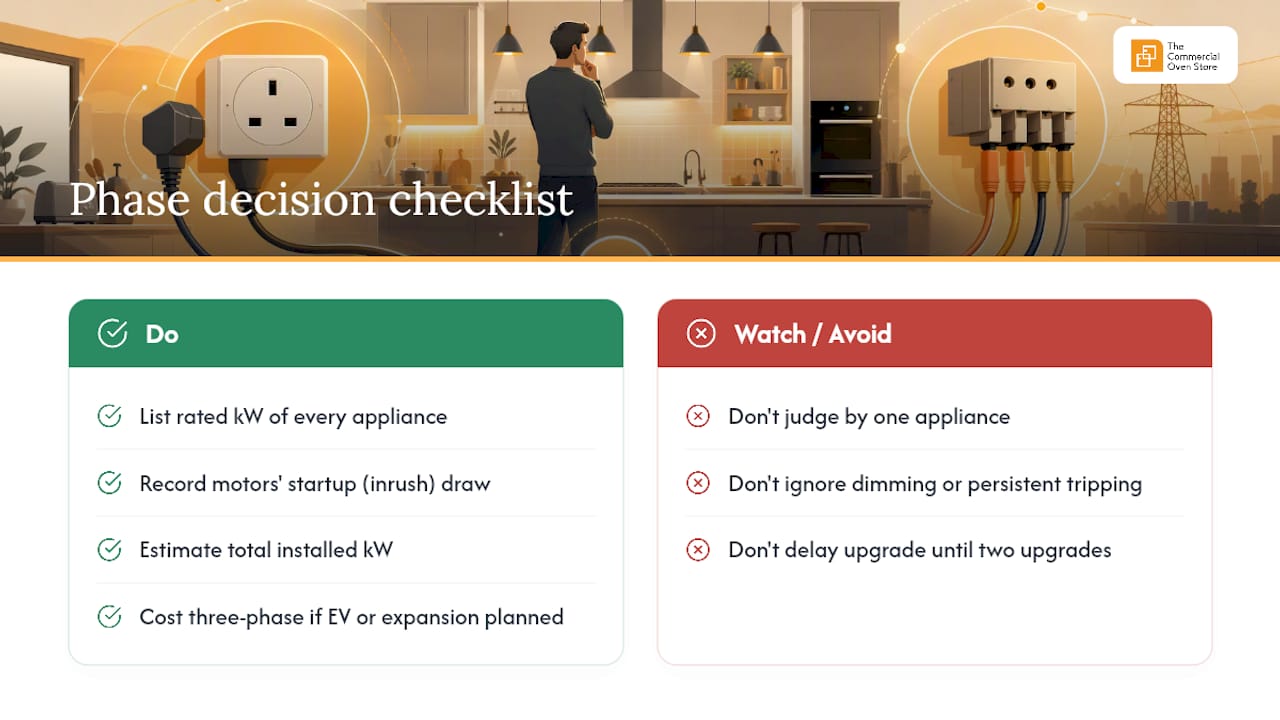
Run through a short checklist before assuming either option is right. Total installed kW across every appliance matters more than any single item, since several 2 kW units running together can outstrip a single phase supply just as easily as one large machine. The presence of motors, whether in compressors, pumps, or ovens with heavy fans, pushes the case towards three phase because of the smoother starting current it offers.
Future plans count too. If EV charging, kitchen expansion, or new equipment are on the horizon, it’s worth costing three phase now rather than paying for two separate upgrades later. Persistent tripping, dimming lights under load, or voltage sag when equipment starts are all signs your current supply is already struggling.
As a rough guide, loads approaching 15 to 20 kW usually make three phase the more sensible option, both technically and financially. Below that, staying single phase with a dedicated circuit is often simpler and cheaper.
Pro Tip: Before calling an electrician, write down the rated kW of every appliance you own or plan to buy, including startup draw for anything with a motor. It turns a vague “do I need three phase” question into a five-minute assessment.
When a professional does visit, expect them to check your meter and fuse type, inspect the service head or cut-out, and run a proper load calculation rather than guessing from your appliance list alone. That survey is what determines whether your existing single phase supply has headroom or whether the DNO (Distribution Network Operator) needs to get involved.
What upgrading to three phase actually involves
Moving from single phase to three phase isn’t a same-day job, and it isn’t cheap in every case, but the steps are predictable. A site survey comes first, followed by contact with your DNO to check whether three phase is already available at the boundary or needs network reinforcement. If reinforcement is needed, a new meter and cut-out, a bigger distribution board, and new protective devices usually follow, along with cable work and earthing checks to match the new load.
Costs vary widely depending on what’s already on site:
- Internal works alone, such as a new distribution board and circuits, often come in under £1,000.
- A straightforward new three phase connection or modest upgrade typically runs £3,000 to £10,000.
- Complex jobs needing substantial network reinforcement can exceed £20,000.
Those figures move with location, and rural sites often face steeper costs than urban ones simply because urban areas tend to have three phase distribution running nearby already. Timescales stretch too: some DNOs only carry out reinforcement work when it’s already scheduled for the wider network, which can mean waiting months rather than weeks. It’s worth asking whether funding the reinforcement privately speeds things up.
Before committing, get formal quotes from at least one qualified electrician and check whether a wayleave agreement is needed if cabling crosses land you don’t own.
Choosing the right supply for commercial ovens and kitchen equipment
Most of the “do I need three phase” questions Thecommercialovenstore hears come from people buying ovens, and the answer genuinely depends on the model. Countertop speed ovens and compact combi units are usually built to run from a standard 13 A socket, making them the easier option for small kitchens without existing three phase.
| Oven type | Typical supply | Installation note |
|---|---|---|
| Countertop speed oven | 13 A single phase | Plugs into a standard socket, no electrician needed for the plug itself |
| Compact combi oven | 13 A single phase | Check rated kW before buying, some sit near the 3 kW ceiling |
| Large combi or multi-deck oven | Three phase | Usually hardwired or fitted with a commando connector by an electrician |
Larger combi ovens and multi-deck units typically need three phase, and they’re usually hardwired rather than plugged in, using an IEC or commando-style connector fitted by a qualified electrician.
Before ordering any oven, give your electrician the exact rated kW from the spec sheet, whether it needs a plug or a hardwired connection, the recommended breaker size, and the planned cable route. Thecommercialovenstore’s guide to commercial oven power requirements covers this in more detail, and the Merrychef Oven Connex 12 SP is a useful example of a genuine 13 A single phase model if you want to see the numbers in practice.
Safety rules you shouldn’t bend on
A 13 A plug fuse exists to protect the appliance’s cable, not the wall circuit behind it. Ring mains run on a much larger breaker, typically 32 A, so the plug fuse is the only thing standing between an overloaded lead and a fire. Swapping a plug or fitting a higher-rated fuse to force a high-power appliance to run from a 13 A socket doesn’t solve the underlying problem; it just removes the safeguard that was catching it.
Watch for these warning signs and call a qualified electrician rather than working around them:
- Sockets or plugs that feel warm or hot during normal use.
- Breakers or fuses that trip repeatedly with the same appliance.
- Lights dimming noticeably when equipment starts up.
Why the standard advice on this undersells the planning stage
Most guides on this topic stop at “three phase is for big loads,” which is true but not especially useful when you’re staring at a spec sheet trying to decide. The more useful judgement, based on everything above, is this: the decision almost never comes down to one appliance. It comes down to what else is running on the same circuit, and what you’re likely to add in the next two or three years.
Conventional advice also underplays how much a DNO’s own schedule affects your timeline. You can have the budget and the electrician lined up, and still wait months if reinforcement work isn’t already planned for your area. That’s worth checking early, not after you’ve bought equipment that needs it.
If there’s one thing to prioritise first, it’s getting an accurate combined kW figure for everything you run or plan to run, motors included, before you talk to anyone about wiring. That single number decides almost everything else in this article.
— Simon
Get the right oven for your supply, first time
Thecommercialovenstore exists so you don’t have to guess your way through this decision alongside choosing an oven. Every product listing states its rated power clearly, so you can match equipment to your existing 13 A supply or plan a three phase upgrade with confidence, rather than discovering a mismatch after delivery.
If your kitchen already runs on a standard 13 A supply, models like the CIBO/S Countertop Fast Oven at 2.7kW sit comfortably within it. Planning something larger, such as the XB893 Bakerlux Oven, and expecting an EV charger too? It’s worth reading a specialist’s EV charger installation cost guide alongside your oven spec, since both often push the same conversation towards three phase. Flexible payment options can help you choose the right oven without compromising due to electrical upgrade concerns. Browse the full range at Thecommercialovenstore and get the rated power confirmed before you order.
Sources
- Single-Phase vs 3-Phase Electricity Supplies Guide | Crown Energy
- Single Phase vs Three Phase: 7 Key Differences Explained
- Single-Phase vs Three-Phase Power: A UK Business Guide
- What’s the difference between a single phase and three phase electricity supply? | UK Power Networks