

Most commercial ovens in the UK need a dedicated hardwired circuit. The exact supply depends on the oven’s nameplate rating, but the quick rules of thumb are straightforward: anything under 3 kW can typically run from a standard 13 A socket; ovens between 3 kW and roughly 15 kW need a dedicated single-phase circuit (usually 32 A with 6 mm² cable); and anything above 15–20 kW almost certainly requires a three-phase supply, 10 mm² cable, and a check with your Distribution Network Operator (DNO). Ovens over 3,000 W normally require hardwiring to a dedicated circuit rather than a standard socket.
Quick rules of thumb:
- ≤3 kW: standard 13 A plug or dedicated 16 A socket outlet (countertop speed ovens, small warming ovens)
- 3–15 kW: dedicated single-phase hardwired circuit, typically 32 A MCB/RCBO with 6 mm² cable
- 15–20 kW+: three-phase supply strongly recommended; 10 mm² cable, 40 A+ protection, and likely a DNO notification
- Any hardwired oven: a cooker control unit (double-pole isolator) is mandatory, and installation must be carried out by a qualified, Part P/NICEIC-registered electrician
For a rough conversion: a 10 kW oven on a 230 V single-phase supply draws a substantial current at full load; on a 400 V three-phase supply, the current per phase is correspondingly lower. Always read the nameplate and the manufacturer’s installation manual before briefing your electrician.
Key takeaways
Matching your oven’s nameplate rating to the correct dedicated circuit, cable size, and protection device is the single most important step in a safe, compliant commercial oven installation in the UK.
| Point | Details |
|---|---|
| Hardwiring threshold | Ovens over 3 kW require a dedicated hardwired circuit, not a standard 13 A socket. |
| Cable and protection | Most single-phase commercial ovens need 6 mm² cable with a 32 A Type B RCBO; large ranges need 10 mm² and 40 A+. |
| Three-phase trigger | Loads approaching 15–20 kW make three-phase more practical; a DNO notification is likely required for new three-phase supplies. |
| Idle draw matters | An oven’s idle energy rate can cost hundreds of pounds per year; ENERGY STAR certified models are substantially more efficient than standard units. |
| Thecommercialovenstore | Stocks ovens from Rational, Unox, Lincat, Blue Seal, Zanolli, and Buffalo with electrical specs listed and installation advice available before you order. |
Table of Contents
- How do you convert oven kW to amps for UK supplies?
- What power does each type of commercial oven actually need?
- What cable sizes and protection devices does a commercial oven need?
- Single-phase or three-phase: which supply does your oven need?
- Site installation checklist and compliance steps
- Worked wiring examples using IET diversity
- How idle draw and efficiency features affect your running costs
- What does commercial oven installation typically cost in the UK?
- Questions to ask before you buy or install
- Keeping your installation compliant after commissioning
- What a commercial oven specialist recommends
- Thecommercialovenstore makes specification straightforward
- Sources
How do you convert oven kW to amps for UK supplies?
Understanding the maths behind nameplate ratings saves you from undersized circuits and expensive retrofits.
The formulas
For a single-phase 230 V supply:
For a balanced three-phase 400 V supply (line-to-line voltage):
These give you the full-load current at unity power factor. In practice, commercial ovens have a power factor close to 1.0 (they are largely resistive loads), so the formula is reliable for initial sizing. Where a fan motor or steam generator is included, the manufacturer’s nameplate will state the total connected load, which already accounts for those components.
Nameplate current vs design current
The nameplate full-load current is the worst-case figure: every element on simultaneously. The design current used for circuit sizing under the IET On-Site Guide / BS 7671 applies a diversity factor, which recognises that not every element runs at 100% simultaneously. This often reduces the design current meaningfully and allows a smaller protective device than the raw nameplate figure would suggest.
Harmonics and power quality
Modern ovens with electronic controls and variable-speed fan motors can introduce harmonic currents. These do not change the fundamental power draw, but they can cause neutral conductors to carry higher-than-expected currents in three-phase installations. An experienced electrical designer will allow headroom in the neutral conductor sizing and may specify a four-core cable for three-phase runs.
Worked conversion table
| Nameplate rating | Single-phase 230 V full-load (A) | Three-phase 400 V full-load per phase (A) |
|---|---|---|
| 1 kW | typical low current | typical low current |
| 3 kW | typical moderate current | typical moderate current |
| 10 kW | higher current draw | correspondingly lower per-phase current |
| 20 kW | very high current | substantial current per phase |
These are full-load figures before diversity. Your electrician will apply IET diversity rules to arrive at the design current used for cable and protective device selection.
What power does each type of commercial oven actually need?
The oven category tells you a lot about the likely electrical brief before you even see the nameplate.
- Countertop speed ovens (1–3 kW): Models such as the Merrychef Connex 12 at 13 A single-phase sit comfortably on a dedicated socket outlet. Electrical Safety First’s appliance ratings list a single domestic oven at around 3.0 kW / 13 A, which gives a useful baseline for small commercial countertop units.
- Half-size convection ovens (3–8 kW): These almost always require hardwiring. A dedicated 16–32 A single-phase circuit with 6 mm² cable is typical. Models from Lincat and Buffalo in this range are common in cafés and small bakeries.
- Full-size convection ovens (8–15 kW): A 32 A single-phase circuit with 6 mm² cable handles many of these, though you should confirm with the nameplate. The Blue Seal E28 M4 convection oven is a good example of a full-size unit where nameplate checking is essential before briefing an installer.
- Combi ovens (8–20+ kW): Rational and Unox combi ovens span a wide range. A 6-tray Unox combi typically sits in the 8–11 kW band and can run on a dedicated 32 A single-phase circuit; a 10-tray or 20-tray Rational will often exceed 15 kW and require three-phase. Always download the manufacturer’s installation manual before specifying the circuit.
- Rack ovens and large range ovens (20–50+ kW): Three-phase is standard here. Zanolli rack ovens and large Rational or Unox rack models draw 20–50 kW depending on configuration. These require 10 mm² cable, 40 A+ protection per phase, and almost certainly a DNO notification. Bakeries specifying a Bakerlux rack oven should factor this into their site survey.
- Induction range ovens (10–30+ kW): The Lincat Phoenix induction oven range illustrates how induction technology concentrates high power into a compact footprint, often pushing the installation firmly into three-phase territory.
Finding the nameplate
The data badge is usually on the inside of the door frame, the back panel, or the underside of the unit. It states the rated voltage, frequency, total connected load in kW or W, and the full-load current in amps. That figure, not a catalogue description, is what your electrician needs.
Pro Tip: Download the manufacturer’s installation manual before you order, not after. Rational, Unox, and Lincat all publish installation manuals online. Checking the electrical data sheet at the specification stage prevents last-minute circuit upgrades.
What cable sizes and protection devices does a commercial oven need?
Getting the cable and protection device right is where theory meets the real installation. UK wiring practice for cookers establishes that a dedicated circuit is required, with 6 mm² twin and earth cable and a 32 A protective device covering the majority of single-phase cookers; 10 mm² cable is used for very large ranges or where the run is long enough to cause derating.
Recommended cable and protection pairings
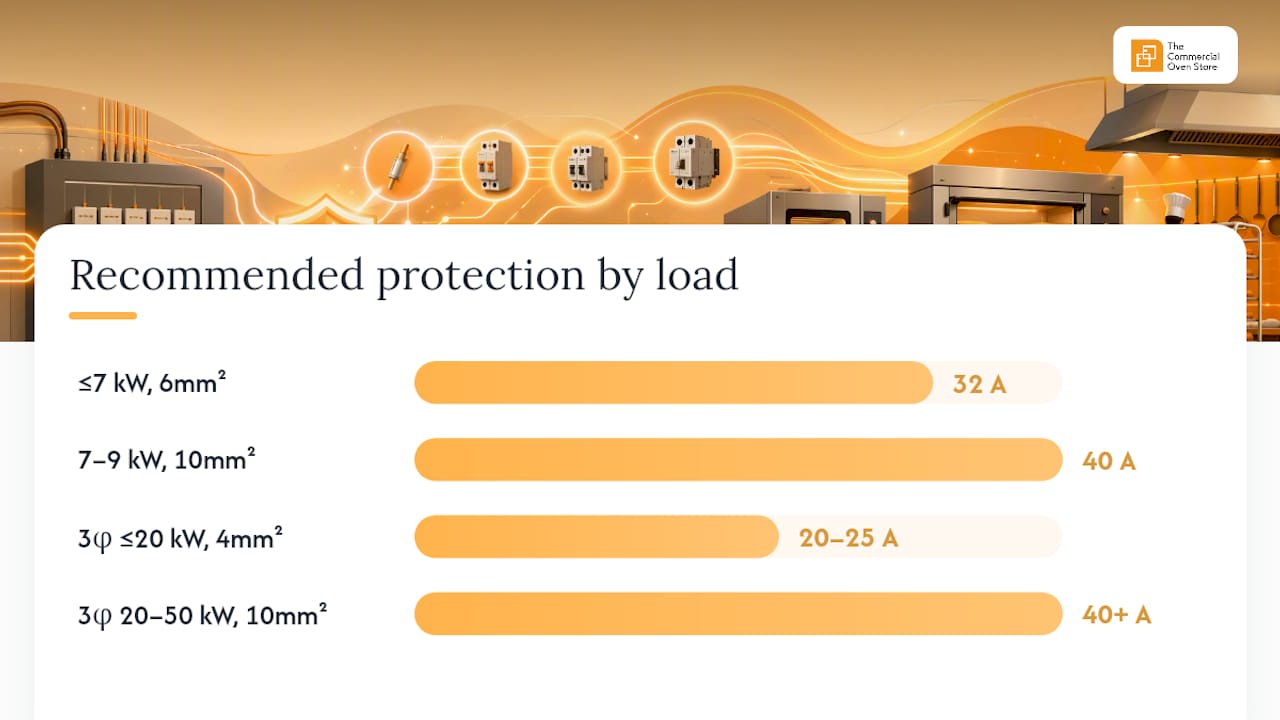
| Oven load | Recommended cable | MCB/RCBO rating | Notes |
|---|---|---|---|
| Up to 7 kW (32 A FL) | 6 mm² twin and earth | 32 A Type B RCBO | Standard for most single-phase convection ovens |
| 7–9 kW (40 A FL) | 10 mm² twin and earth | 40 A Type B RCBO | Larger single-phase ranges, long cable runs |
| Three-phase up to 20 kW | 4 × 4 mm² or 5-core 4 mm² | 20–25 A Type B per phase | Balanced load; check neutral sizing for harmonics |
| Three-phase 20–50 kW | 5-core 10 mm² | 40 A+ Type B per phase | Rack ovens; DNO notification likely required |
When to upsize the cable
Cable current-carrying capacity is derated when the cable runs through thermal insulation, is clipped to a surface in a hot kitchen, or runs in a conduit with other cables. In either case, moving up one cable size is the practical solution.
Type B RCBOs and RCD protection
A Type B RCBO (30 mA) combining overcurrent and residual current protection in a single device is the preferred choice for commercial oven circuits. Where a Type B RCBO is not available, a Type B MCB behind a 30 mA RCD on the distribution board achieves the same protection. Type B trip characteristics handle the inrush currents from heating elements without nuisance tripping.
Cooker control unit (double-pole isolation)
Every hardwired oven requires a cooker control unit, a double-pole switch that isolates both line and neutral simultaneously. It must be mounted to the side of the oven, never directly above it, so the person operating the switch is not reaching over a hot appliance. The switch must be within sight of the oven and accessible without moving the unit. This requirement is referenced in the IET On-Site Guide and is non-negotiable for commissioning sign-off.
Pro Tip: Specify a cooker control unit with a neon indicator. In a busy kitchen, a glance confirms whether the circuit is live without opening the distribution board.
Single-phase or three-phase: which supply does your oven need?
The short answer: if the total connected load of your oven (or ovens) approaches 15–20 kW, three-phase becomes the more practical and economical choice. Running a 20 kW oven on single-phase would require an 87 A circuit, which means very large cable, a high-rated protective device, and significant volt-drop risk over any meaningful cable run. Three-phase spreads that load across three conductors, reducing per-phase current to around 29 A.
Practical advantages of three-phase for commercial kitchens
- Smaller conductor cross-sections for the same total power, reducing material and installation cost
- Balanced loading across phases reduces neutral current and improves supply quality
- Easier to add further heavy appliances (dishwashers, induction hobs) without overloading a single phase
- Many high-end combi and rack ovens from Rational and Unox are designed and optimised for three-phase supplies
When single-phase is sufficient
A single full-size convection oven rated at 8–12 kW on a dedicated 32–40 A circuit is entirely manageable on single-phase. Many cafés and small bakeries operate successfully with a single-phase supply. The trade-offs between single-phase and three-phase are worth reading before you commit to a supply upgrade.
DNO notification and supply upgrades
If you are adding a three-phase supply to a premises that currently has single-phase only, or if the new connected load exceeds your existing supply capacity, you must contact your DNO. In the UK, DNO notification is typically required when a new load exceeds 16 A single-phase or when a three-phase supply is being installed for the first time. Supply upgrades can take several weeks and carry a cost that varies by region and network operator, so factor this into your project timeline.
Site installation checklist and compliance steps
A missed step here means a failed commissioning, a voided warranty, or a prohibition notice. Work through this list before the electrician arrives on site.
- Confirm the nameplate rating. Obtain the full-load current, voltage, and phase requirements from the data badge or installation manual before any circuit is designed.
- Specify a dedicated circuit. No other appliances should share the oven’s protective device or cable run. Many electric cookers require a 32 A circuit, though the correct rating always depends on the unit’s power rating.
- Plan ventilation and extraction. Commercial ovens generating steam, smoke, or grease-laden vapour require a canopy extraction system. Check whether your local authority requires a planning application for external ductwork. The canopy must be sized to the oven’s heat output, not just its footprint.
- Integrate fire suppression. If a fire suppression system is fitted above the cooking line, the oven’s electrical supply must be interlocked with the suppression system so that power is cut automatically on activation. This interlock must be tested and documented at commissioning.
- Install the cooker control unit. Double-pole isolation, mounted to the side of the oven, within sight and accessible without moving the appliance.
- Fit RCD/RCBO protection. A 30 mA RCBO (Type B preferred) on the oven’s dedicated circuit.
- Use a qualified, registered electrician. Installation of a new circuit in a commercial kitchen is notifiable work under Part P of the Building Regulations in England and Wales. The installer must be registered with a competent person scheme such as NICEIC, NAPIT, or equivalent. They will issue an Electrical Installation Certificate (EIC) on completion.
- Commission and document. Obtain the manufacturer’s commissioning certificate (required by most commercial oven warranties), the EIC from the electrician, and as-fitted photographs of the consumer unit and cable routing.
- Notify the DNO if required. If the new load exceeds your existing supply capacity or requires a three-phase upgrade, contact the DNO before installation begins.
Pro Tip: Book a pre-installation site survey with your electrician and oven supplier together. A load-profile check, photographs of the consumer unit, and a measured cable route reduce surprises on installation day and typically shorten commissioning time.
Worked wiring examples using IET diversity
These examples show how the IET diversity method translates a nameplate rating into a practical circuit specification.
Example 1: 12 kW single-phase convection oven
- Full-load current: 12,000 ÷ 230 = 52.2 A
- Apply IET diversity (single cooker): First 10 A at 100% = 10 A; remaining 42.2 A at 30% = 12.7 A; design current = 22.7 A
- Select protective device: Round up to the next standard size: 32 A Type B RCBO
- Select cable: 6 mm² twin and earth is rated at 32 A clipped direct; confirm derating for installation method and ambient temperature
- Volt-drop check: At 22.7 A design current over a 15-metre run in 6 mm² cable, volt-drop is well within the 5% BS 7671 limit
Recommended circuit: 6 mm² twin and earth, 32 A Type B RCBO, cooker control unit
Example 2: 30 kW three-phase rack oven
- Full-load current per phase: 30,000 ÷ (1.732 × 400) = 43.3 A per phase
- Apply diversity (large commercial cooker, IET guidance): First 10 A at 100% = 10 A; remaining 33.3 A at 30% = 10 A; design current per phase = 20 A (note: for large commercial installations, the designer may apply a less aggressive diversity factor; always confirm with the manufacturer’s recommended minimum circuit rating)
- Select protective device: 40 A Type B RCBO per phase (manufacturer minimum circuit rating often overrides the diversity-reduced figure for large rack ovens)
- Select cable: 10 mm² five-core SWA or LSZH, rated for the installation method
- DNO notification: At 30 kW three-phase, a DNO notification is almost certainly required
Recommended circuit: 10 mm² five-core cable, 40 A Type B RCBO per phase, cooker control unit, DNO notification
Summary table
| Oven | Nameplate (kW) | Full-load (A) | Design current (A) | Cable | Protective device |
|---|---|---|---|---|---|
| Single-phase convection | 12 kW | 52.2 A (1-ph) | 22.7 A | 6 mm² T&E | 32 A Type B RCBO |
| Three-phase rack oven | 30 kW | 43.3 A/phase | 20 A/phase (min 40 A per mfr) | 10 mm² 5-core | 40 A Type B RCBO/phase |
Pro Tip: Always check the manufacturer’s minimum circuit rating in the installation manual. For ovens with steam generators or high-powered fan motors, the manufacturer’s minimum often exceeds the IET diversity-reduced figure. Use whichever is higher.
How idle draw and efficiency features affect your running costs
The nameplate rating tells you the peak draw. What it does not tell you is how much energy the oven consumes during the hours it sits at temperature between service periods. That idle draw is where the real cost difference between models shows up.
A simple estimate: an oven with a 1.5 kW idle draw running for 10 hours a day consumes 15 kWh daily. At a commercial electricity rate of around 25p per kWh, that is £3.75 per day, or roughly £1,370 per year, just to keep the oven warm. A better-insulated model with a 0.8 kW idle draw cuts that to around £730 per year. Over a five-year lifespan, the difference is worth more than the price gap between a budget and a premium oven.
ENERGY STAR certified commercial ovens must meet minimum cooking energy efficiency and idle energy rate limits. Certified electric convection ovens are, on average, substantially more energy efficient than standard models. The US Department of Energy’s guidance on purchasing energy-efficient commercial ovens outlines the key metrics: cooking energy efficiency (the proportion of energy that actually goes into the food) and idle energy rate (watts consumed at steady-state temperature). Both figures are worth requesting from your supplier before committing to a model.
Higher-end Rational and Unox models include energy-saving modes that reduce element cycling during idle periods, and their door and cavity insulation is measurably better than entry-level alternatives. That is not marketing copy; it shows up in the idle energy rate figures.
Practical steps to reduce idle energy costs:
- Schedule oven start and stop times to match service periods rather than leaving ovens on all day
- Use the manufacturer’s energy-saving or standby mode during quiet periods
- Batch cooking reduces the number of heat-up cycles per day
- Specify a model with a well-insulated door; heat loss through the door is one of the largest idle-draw contributors
- For bakeries running multiple ovens, consider whether a single larger oven with better insulation beats two smaller ones running simultaneously
What does commercial oven installation typically cost in the UK?
Budget planning for electrical installation is easier when you know what drives the cost. The figures below are indicative ranges based on typical UK commercial electrical work; your actual quote will depend on site conditions, cable route length, and whether a supply upgrade is needed.
- Simple plug-in countertop oven (≤3 kW): Minimal electrical cost; a dedicated socket outlet added to an existing circuit may cost £150–£300 including materials and labour
- Dedicated single-phase hardwired circuit (6 mm² cable, 32 A RCBO, cooker control unit): Typically £400–£800 for a straightforward run from the distribution board to the oven position, including the EIC
- Three-phase circuit from an existing three-phase board: £600–£1,200 depending on cable run length and containment requirements
- New three-phase supply from the DNO: DNO charges vary significantly by region and network operator; a new three-phase service connection can range from a few hundred pounds to several thousand, and lead times of 4–12 weeks are common
- Extraction canopy and fire suppression integration: These are separate trades; budget £1,500–£5,000+ for a commercial canopy installation depending on ductwork complexity
What adds cost
Long cable runs through false ceilings or under floors, containment in conduit or trunking, derating through thermal insulation, and integration with existing fire suppression systems all push the installation cost upward. A pre-installation site survey identifies these issues before work starts, which is far cheaper than discovering them mid-installation.
Timelines
A single-phase hardwired installation in a kitchen with an accessible distribution board typically takes one to three days including testing and certification. A three-phase supply upgrade involving the DNO can take several weeks from application to energisation. Commission the electrical work in parallel with oven delivery lead times to avoid kitchen downtime.
Questions to ask before you buy or install
Arriving at a supplier or electrician conversation with the right questions saves time and prevents specification errors.
- What is the nameplate full-load current and voltage requirement? Get this from the data badge or installation manual, not the catalogue.
- Is the supply single-phase or three-phase? Confirm which the oven is designed for and whether your site has the required supply.
- What cable size and MCB/RCBO rating does the manufacturer specify? The installation manual states a minimum; your electrician may upsize for the actual run.
- Is a cooker control unit included, or do I need to source one separately? Some installation kits include the isolator; many do not.
- Does this installation require DNO notification? Ask both the electrician and the oven supplier; the answer depends on your existing supply capacity.
- Who provides the Electrical Installation Certificate? The registered electrician issues this; confirm it is included in the quote.
- Who arranges extraction and fire suppression integration? This is often a separate contractor; confirm responsibility before work starts.
- What commissioning documentation does the manufacturer require for the warranty? Most commercial oven warranties require a manufacturer commissioning certificate completed by a qualified engineer.
Pro Tip: Ask your electrician for a written summary and a single-line diagram of the proposed circuit before work starts. This document becomes part of the as-fitted record and is invaluable if the installation is ever inspected or the oven is replaced.
Keeping your installation compliant after commissioning
Installation is not the end of the compliance story. Commercial kitchen electrical systems require ongoing inspection and maintenance to remain safe and legally compliant.
The IET Wiring Regulations (BS 7671) recommend periodic inspection and testing of electrical installations. For commercial kitchens, the recommended interval is typically every one to three years, reflecting the demanding environment: heat, steam, grease, and frequent cleaning all accelerate cable and connection degradation. Your insurer may specify a maximum interval; check your policy.
What a periodic inspection covers
A qualified electrician will check the condition of cables, connections, protective devices, and the cooker control unit. They will test RCD/RCBO operation, verify earth continuity, and confirm that the installation still matches the as-fitted record. Any deterioration in cable insulation, loose connections at terminal blocks, or signs of overheating at the cooker control unit are flagged for immediate remediation.
Oven-side maintenance
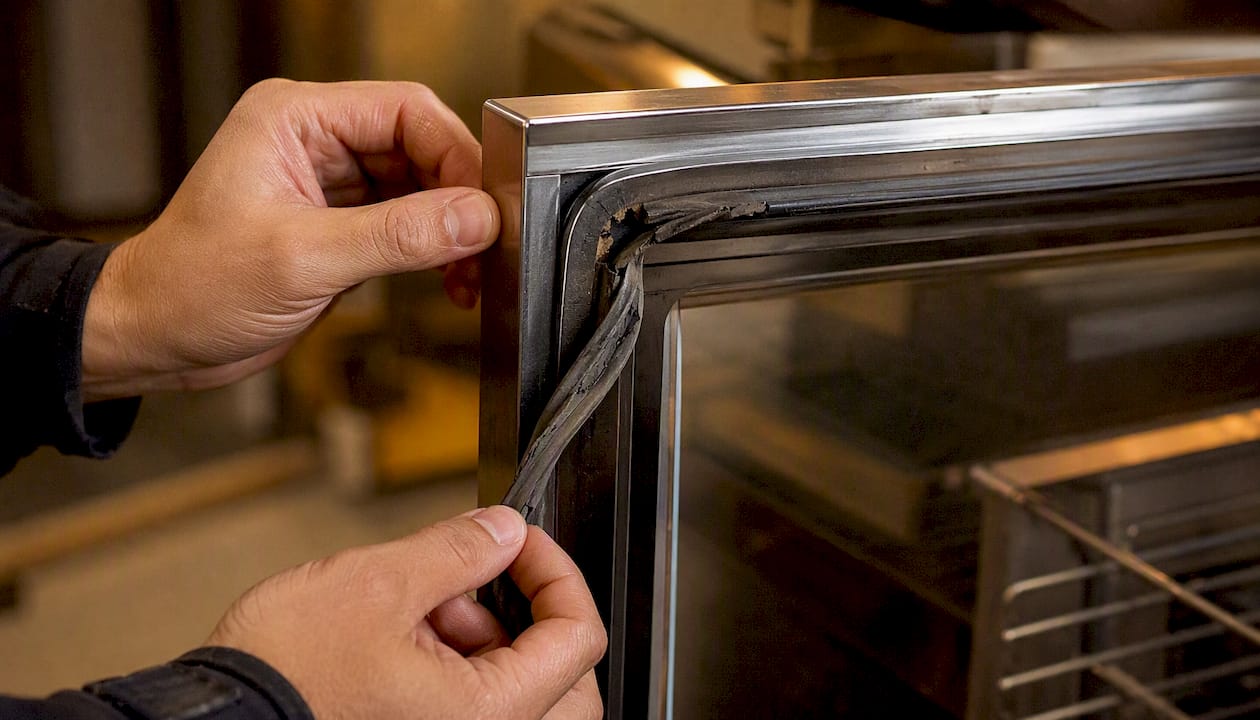
The oven manufacturer’s service schedule typically requires annual inspection of heating elements, door seals, and fan motors by a qualified service engineer. Damaged door seals increase idle draw and reduce cooking efficiency. A failed element that causes an imbalanced load on a three-phase oven can stress the neutral conductor. Neither issue is visible without opening the oven.
Documentation
Keep the original EIC, the manufacturer’s commissioning certificate, and all subsequent periodic inspection reports together. If you sell the business or the premises, these documents demonstrate that the installation has been maintained correctly. A gap in the inspection record is a liability, both for insurance purposes and under the Electricity at Work Regulations 1989, which place a duty on employers to maintain electrical systems in a safe condition.
Fire suppression system interlocks should be tested annually by the suppression system contractor, with the oven electrically isolated during the test to confirm the interlock operates correctly.
What a commercial oven specialist recommends
The most common specification error we see at Thecommercialovenstore is not choosing the wrong oven. It is ordering the right oven and then discovering the site’s electrical supply cannot support it. A café owner orders a 10-tray Rational combi, the oven arrives, and the electrician finds a single-phase 60 A supply that is already carrying a dishwasher, refrigeration, and lighting. The oven goes back into the box while a DNO application is submitted.
The second most common error is forgetting that a combi oven with a steam generator draws more current than the basic oven rating suggests. The steam boiler is an additional load, and some models also include a separate fan motor circuit. The nameplate total connected load covers all of this, but buyers who rely on a catalogue kW figure rather than the installation manual sometimes underrate the circuit.
Getting the electrician involved at the point of specification, not after delivery, is the single change that prevents both problems. Share the installation manual with your electrician before you place the order. If you are unsure which supply your site has or whether it can support the oven you want, ask for a site survey first. The cost of a survey is negligible compared to the cost of a supply upgrade discovered after the oven is on the loading bay.
Thecommercialovenstore makes specification straightforward
Knowing the electrical requirements is only half the job. Finding the right oven from a supplier who understands both the cooking performance and the installation brief is where the real time-saving happens.
Thecommercialovenstore stocks commercial ovens from Rational, Unox, Lincat, Blue Seal, Zanolli, and Buffalo, covering everything from plug-in 2.7 kW countertop models to full-size three-phase rack ovens. Every product listing includes the electrical specification, and the team can advise on installation requirements before you order.
Flexible payment through iwocaPay means you can spread the cost of a premium Rational or Unox model without tying up working capital, which matters when you are also budgeting for electrical installation and extraction work. Browse the full range or request a site survey at Thecommercialovenstore.
Sources
The following resources are worth bookmarking before you brief your electrician or place an order.
- Ratings of electrical appliances
- Can I plug my oven into a normal socket?
- Expert guide to electric cooker and oven installation