

Every commercial oven you buy needs a dedicated circuit sized from its kW rating, installed to BS 7671 by a registered electrician. That is the non-negotiable starting point. Get it wrong and you face nuisance trips at the worst possible moment, cable damage, and a potential insurance or compliance problem.
The single most important step: before your oven arrives on site, send its electrical data sheet to a qualified electrician and ask for a load calculation and circuit design. Everything else follows from that.
Commercial ovens are not light loads. A countertop speed oven may draw 2–3 kW on a standard 230V single-phase circuit, but a combi oven typically pulls 12–25 kW and requires a dedicated three-phase 400V supply. The gap between those two scenarios is enormous in terms of wiring, switchgear, and potentially your site’s incoming supply capacity.
Key takeaways
Correct electrical supply specification is the single step that most determines whether a commercial oven installation runs smoothly or becomes an expensive problem.
| Point | Details |
|---|---|
| Size circuits from kW rating | Use the manufacturer’s maximum demand figure and have a registered electrician calculate current, cable CSA, and breaker size. |
| Three-phase is the norm | Most combi ovens draw 12–25 kW and require a dedicated 400V three-phase hard-wired circuit, not a socket. |
| BS 7671 compliance is mandatory | All fixed installation work must meet BS 7671 (18th edition, A4:2026); the electrician issues an Electrical Installation Certificate on completion. |
| Contact the DNO early | Supply upgrades can take 4–12 weeks; notify your network operator as soon as a capacity shortfall is identified. |
| Thecommercialovenstore | Provides electrical data sheets for every oven stocked and offers installation packages to connect buyers with qualified installers. |
Table of Contents
- What information does your electrician need from you?
- How do you read an oven’s power rating and work out the circuit size?
- Single-phase or three-phase: which supply do commercial ovens need?
- Circuit design: cable sizing, protective devices, and voltage drop
- How to arrange the electrical connection: a step-by-step sequence
- Generators, UPS, and battery backup for commercial ovens
- Common mistakes when specifying oven power
- What do supply upgrades and installation actually cost?
- Why getting the electrical supply right upfront saves you money
- Thecommercialovenstore makes specification and installation straightforward
- Sources
What information does your electrician need from you?
Gathering this before you call saves time and gets you an accurate quote faster.
- Oven model and kW rating — the exact figure from the spec sheet, including any selectable power modes (some Rational iCombi models have reduced-power options)
- Supply type — whether the oven is hard-wired or plug-connected, single- or three-phase, and the required voltage (400V three-phase is typical for most combi and convection ovens)
- Site supply details — your existing intake fuse or MCB size, sub-distribution board layout, available spare ways, and any prior load calculations
- Physical constraints — the distance from the intake to the oven position (critical for voltage-drop calculations), the proposed cable route, and whether the oven will be on castors or fixed
- Documentation — the oven’s electrical data sheet, a site single-line diagram if available, and landlord or DNO contact details if a supply upgrade looks likely
Pro Tip: Take photos of your distribution board and the proposed cable route before the electrician visits. It halves the site survey time and often reduces the quote.
How do you read an oven’s power rating and work out the circuit size?
The formula comes first, then the examples.
Three-phase: Current (A) = kW ÷ (√3 × voltage) Single-phase: Current (A) = kW ÷ voltage
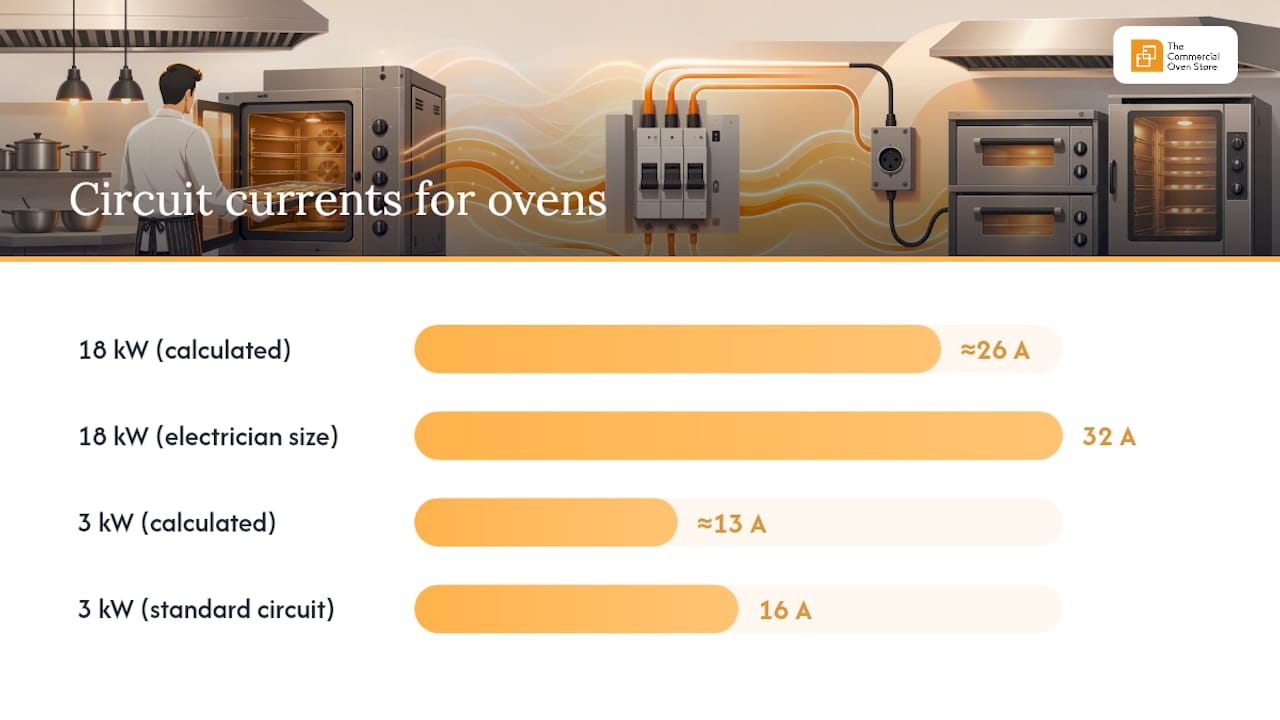
- 18 kW combi oven on 400V three-phase: 18,000 ÷ (1.732 × 400) = approximately 26 A. Your electrician will size the circuit for at least 32 A to allow headroom, then select cable cross-sectional area accordingly.
- 3 kW countertop speed oven on 230V single-phase: 3,000 ÷ 230 = approximately 13 A. A standard 16 A circuit with appropriate cable is usually sufficient.
- Diversity and duty cycle — the nameplate kW is the maximum connected load. In practice, thermostatic control means elements cycle on and off, so a diversity factor may apply. Your electrician decides this; do not apply diversity yourself without their input.
Breaker selection also depends on whether the load is continuous or intermittent. A combi oven running a full lunch service is effectively continuous, which affects both the MCB rating and the cable’s current-carrying capacity calculation.
Pro Tip: Always ask the manufacturer’s technical team for the oven’s maximum demand figure, not just the rated input. Rational and Unox both publish this in their installation manuals, and it is the number your electrician actually needs.
Single-phase or three-phase: which supply do commercial ovens need?
Most medium-to-large commercial ovens require a three-phase 400V supply. Small countertop units are the exception.
- Single-phase 230V (13 A or 16 A): compact speed ovens such as the Merrychef Connex 12 and small countertop fast ovens in the 2–3 kW range. These can connect to a standard radial circuit.
- Three-phase 400V: combi ovens (typically 12–25 kW), full-size convection ovens, and higher-power induction ranges such as the Lincat Phoenix. Hard-wired connections only — no plug sockets.
- DNO uplift risk: if your site runs on a single-phase or undersized three-phase intake, adding a large combi oven may exceed your available capacity. The DNO (your local network operator) must be notified and may need to upgrade the service fuse or meter before work begins.
Plugging a high-power oven into an existing socket circuit is one of the most common and dangerous mistakes in kitchen fit-outs. A 32 A three-phase oven on an undersized circuit will either trip constantly or, worse, overheat cables silently before a fault develops.
Read more about the practical differences in single-phase vs three-phase for commercial ovens.
Circuit design: cable sizing, protective devices, and voltage drop
Cable size and protective device rating must match the calculated current, then be adjusted for grouping, ambient temperature, and installation method. This is where BS 7671 Appendix 4 does the heavy lifting. The A4:2026 amendment added new installation methods 72 and 73 and a new reference method D2 for buried cables, so electricians working from older tables may be using outdated figures.
Key design checks your electrician will perform:
- Current-carrying capacity — selecting the correct installation method from Appendix 4 tables, then applying correction factors for grouping and temperature
- Voltage drop — long cable runs reduce the voltage reaching the oven’s control gear. Manufacturers specify minimum supply voltage; falling below it causes erratic behaviour or faults. Larger conductor cross-sectional area (CSA) is the fix.
- Protective devices — MCBs, RCBOs, or separate RCD + MCB combinations. The BSI briefing on Amendment 3:2024 clarified definitions for bidirectional and unidirectional protective devices, which affects selection for modern inverter-driven equipment.
- RCD protection — practising engineers confirm that 30 mA RCD protection is normally required for three-phase socket outlets in kitchens. Omitting it requires a documented risk assessment, and in a wet catering environment that assessment is rarely accepted.
A single combi oven drawing 12–25 kW represents a substantial current demand. For a 32 A three-phase circuit, a 6 mm² multicore cable is a common starting point, but the actual CSA depends on run length, grouping, and installation method — your electrician calculates this, not the oven supplier.
How to arrange the electrical connection: a step-by-step sequence
Getting from purchase to first cook requires a clear sequence, and skipping steps causes delays.
- Specify — confirm the oven model, kW rating, phase requirement, and site supply details (use the checklist above).
- Load calculation — a registered electrician (NICEIC or equivalent) assesses existing supply capacity and designs the circuit.
- DNO check — if the load calculation shows the existing intake is insufficient, contact your DNO early. Supply upgrades can take 4–12 weeks or longer.
- Landlord and building manager notification — required before any work on the fixed installation; many leases require written consent.
- Installation — cable installation, switchgear, and oven connection by the registered electrician.
- Certification — the installer issues an Electrical Installation Certificate. Where an EICR (Electrical Installation Condition Report) is required for the premises, schedule it at the same time.
- Commissioning — oven powered up, tested, and handed over with documentation.
Documentation to retain:
- Electrical Installation Certificate
- Test records and inspection schedules
- Oven manufacturer’s installation manual
- DNO correspondence if supply was upgraded
For a detailed site-readiness walkthrough, the combi oven installation guide covers physical and electrical preparation in practical terms.
Generators, UPS, and battery backup for commercial ovens
Ovens are high-power devices, and backup power is rarely straightforward.
- Generator sizing — a generator must cover the oven’s peak kW demand plus extraction, refrigeration, and any other simultaneous loads. Staggering start times and using soft-start devices can meaningfully reduce the required generator rating and cost.
- Battery/UPS systems — small UPS units cannot sustain a full-size combi oven for any meaningful period. Battery storage is more relevant for control systems and lighting than for heating elements.
- BS 7671 implications — generating sets used in parallel with the mains supply need appropriate LV switchgear and protective coordination. The A4:2026 amendment’s new Chapter 57 on stationary secondary batteries is relevant if you are integrating battery storage into the site’s electrical system.
Pro Tip: For business continuity planning, temporary genset hire is usually more cost-effective than a permanent standby generator unless you operate a high-volume kitchen where even a two-hour outage causes significant revenue loss.
Common mistakes when specifying oven power
The errors below account for most of the avoidable cost overruns and downtime incidents in kitchen fit-outs.
- Assuming a spare socket will do — a standard 13 A socket cannot safely supply a 6 kW or larger oven. Cables overheat, MCBs trip, and the oven’s warranty may be voided.
- Not notifying the DNO — adding significant load without informing your network operator can breach supply conditions and create liability if a fault occurs.
- Ignoring voltage drop on long runs — a 20-metre cable run that looks fine on paper may drop supply voltage below the oven’s minimum, causing control faults and shortened component life.
- Omitting RCDs without documentation — in a kitchen environment, this is almost never defensible. The risk assessment required to justify omission is a high bar.
- Failing to get landlord consent — discovered after installation, this can mean expensive remedial work or lease disputes.
- Accepting vague quotes — any quote that does not specify BS 7671 compliance, circuit design method, and certification is incomplete.
Only use a registered electrician for commercial oven connections. NICEIC-registered contractors and equivalent competent persons are qualified to design, install, and certify fixed electrical installations to BS 7671. An unregistered installer cannot issue the Electrical Installation Certificate your insurer and landlord will require.
What do supply upgrades and installation actually cost?
Costs vary considerably, but these ranges give you a realistic planning baseline.
- Simple single-phase hard-wire (countertop oven, short run): typically completed within a day or two; labour and materials costs are modest relative to the oven itself.
- Three-phase circuit from existing intake (adequate supply): a few days’ work; cost depends on cable length, containment, and switchgear. Expect several hundred pounds upwards.
- DNO supply upgrade (new or uprated service): this is where costs and timescales escalate. DNO works alone can run to several thousand pounds and take 4–12 weeks or more depending on the network operator and local infrastructure.
- Cost drivers: cable length and type (SWA armoured cable for external or buried runs costs more than internal multicore), trenching or containment, switchgear upgrades, and inspection fees.
Always build contingency into both budget and programme. Remedial work discovered during installation — an undersized intake fuse, an unlabelled sub-board, or a cable route blocked by structure — is common and adds cost and time.
Why getting the electrical supply right upfront saves you money
The case for proper specification is straightforward once you run the numbers in your head. A supply upgrade that costs £3,000–£5,000 upfront sounds significant. But a single week of lost service during a busy period, emergency electrician call-outs, and a replacement control board on a Rational iCombi or Unox combi oven will cost you more than that, and none of it was inevitable.
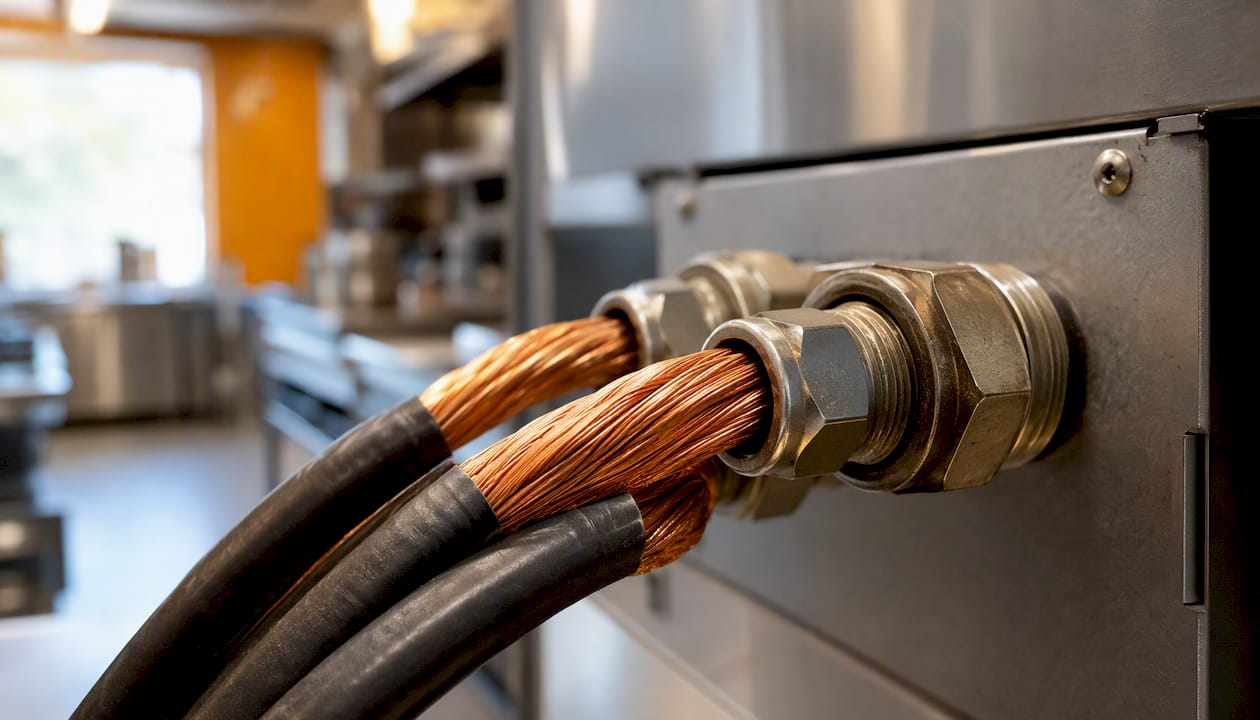
The kitchens that have the most trouble are the ones where someone decided to defer the electrical work and “see how it goes.” It goes badly. Cables sized for a lighter load run warm, insulation degrades faster, and the first sign of a problem is often a fault mid-service rather than a warning.
There is also a less obvious cost: the electrician who has to come back and redo work because the original spec was wrong. Rerouting SWA cable through a fitted kitchen is expensive and disruptive. Getting the load calculation right before the first cable is pulled saves that entirely.
Schedule installation during your quietest trading period. It is obvious advice, but the number of kitchens that book electrical work for a Monday in December is telling.
Thecommercialovenstore makes specification and installation straightforward
Buying the right oven is only half the job. Thecommercialovenstore provides full electrical data sheets for every oven it stocks, so your electrician has the exact figures needed for a load calculation before the unit arrives on site.
Installation packages are available for both single-engineer and two-engineer connections, covering delivery, positioning, and electrical connection by qualified installers. Whether you are commissioning a compact countertop unit or a full-size Rational iCombi Pro, the team can advise on site-readiness requirements and help you avoid the supply surprises that delay projects.
Browse the full range at Thecommercialovenstore and request the electrical data sheet for any model directly from the product page. Your electrician will thank you for it.
Sources
- Requirements for Electrical Installations — BS 7671:2018 Amendment 3:2024 (BSI briefing)
- Restaurant Kitchen & 3‑Phase Oven RCDs - Wiring and the Regulations (IET EngX forum)
- Restaurant kitchen electrical requirements 2026: Complete guide for hotel & commercial projects - Grace Kitchen Equipment
Recommended
- Single phase vs three phase for commercial ovens – thecommercialovenstore.com
- Convection oven for bakery: the UK buyer’s guide – thecommercialovenstore.com
- Best bakery ovens for small UK bakeries: how to choose – thecommercialovenstore.com
- Merrychef Oven Connex 12 SP Standard Power Classic - 13amp single phas – thecommercialovenstore.com