

Running a commercial oven typically costs between £450 and £3,000+ a year once you add energy, planned maintenance and consumables together, though heavy-use bakery combi ovens can run higher. The fastest way to estimate your own figure: multiply the oven’s kW rating by daily hours of use, by your electricity tariff, then adjust for efficiency losses and duty cycle. Add servicing and consumables on top, and you have a realistic annual number, which varies by site.
TL;DR:
- Energy costs vary significantly with oven size and duty cycle, with a high-use bakery combi oven potentially costing up to £14,700 annually.
- Maintaining good insulation, door seals, and calibration can reduce energy waste and extend oven lifespan, saving money over time.
- Proper scheduling of preheat cycles, door discipline, and employing efficient oven modes can cut overall energy consumption without sacrificing output.
- Regular preventive maintenance, costing between £450 and £1,250 annually, prevents costly breakdowns and extends oven service life.
- Upgrading to high-efficiency electric ovens may offer lower total ownership costs compared to gas, especially when factoring in ventilation and compliance requirements.
Table of Contents
- Breaking down commercial oven running costs in the UK
- How to calculate your annual oven running cost
- How can you cut oven running costs without losing output?
- How often should you service a commercial oven, and what does it cost?
- Publisher perspective: how The Commercial Oven Store advises operators
- What actually moves the needle on oven running costs
- Get a running-cost estimate for your kitchen
- Sources
Breaking down commercial oven running costs in the UK
Energy is the biggest line item, but it’s rarely the only one that catches operators out. Four components make up the true cost of ownership: energy, planned maintenance, consumables and labour, and each behaves differently depending on how hard you run the oven.
Start with the nameplate rating, the kW figure stamped on the back or in the manual. A 10kW combi oven doesn’t draw 10kW constantly; it cycles between full power during preheat and recovery, and a lower holding load once it’s up to temperature, varying by cycle. Preheat time matters because it’s the most energy-intensive phase, and an oven with poor insulation or a worn door seal will preheat slower and leak heat throughout service, inflating the real-world draw well above the nameplate figure.
Converting kW to a cost is straightforward once you have the method. Multiply the kW rating by the hours run, which gives you kWh (kilowatt hours), then multiply by your business electricity tariff in pence per kWh. That’s your energy method, before you layer on efficiency adjustments for standby losses and idle time. Our guide to commercial oven power requirements walks through nameplate reading in more detail.
The UK hotel and catering sector spends around £400 million a year on energy, with cooking and heating accounting for over half of that. Equipment running costs commonly make up 4–6% of a food business’s total operating costs.
Beyond energy, four other factors shape your annual bill:
- Planned preventative maintenance (PPM): contracted servicing that catches faults before they become breakdowns.
- Installation and upgrades: electrical supply reinforcement or ventilation changes needed to run higher-spec equipment.
- Consumables: descaling chemicals, water treatment for combi steam generators, and cleaning products.
- Labour: staff time lost to cleaning cycles, manual descaling and downtime during faults.
How to calculate your annual oven running cost
Here’s how that plays out for two realistic UK operators:
- Small café convection oven, 3kW rated, used 5 hours a day, 300 days a year, on a 28p/kWh business tariff: 3 × 5 × 300 × 0.28 = roughly £1,260 a year in energy alone, before servicing and consumables.
- Busy bakery combi oven, 15kW rated, used 10 hours a day, 350 days a year, same tariff: 15 × 10 × 350 × 0.28 = roughly £14,700 a year in energy, reflecting the far heavier duty cycle and higher rated load.
Those figures are estimates built on nameplate ratings and assumed hours, not measured consumption. To refine them, use actual meter readings or submetering on the circuit feeding the oven. This is the only way to catch wasted standby energy or a faulty control board quietly running the appliance hotter than it needs to be, and it usually surfaces problems a nameplate calculation can never show you.
How can you cut oven running costs without losing output?
Most savings come from habits, not hardware. Batch cooking during the busiest preheated window, rather than firing the oven up repeatedly through a shift, cuts the number of energy-hungry preheat cycles you run in a day, which improves efficiency. Preheat discipline matters just as much: starting service before the oven has reached temperature wastes energy recovering heat mid-service, and using the correct cooking mode (dry heat versus combi steam) for the job avoids running steam generation you don’t actually need.
Door discipline is an easy one to overlook. Every time a combi or convection door opens mid-cycle, the oven has to recover lost heat, and that recovery draw is disproportionately expensive compared with steady-state cooking.
On the equipment side, favour ovens with good insulation, auto start/stop functions and efficient combi modes. Modern combi and convection ovens can use meaningfully less energy than older equipment, and the efficiency premium on a new model often pays for itself within a few years in a mid-to-high-use kitchen.
Maintenance also lowers running cost directly:
- Regular descaling prevents scale build-up that forces heating elements to work harder.
- Door gasket checks stop heat leaking out mid-cycle.
- Calibration checks correct temperature drift that causes longer cook times than necessary.
Pro Tip: Ask your servicing engineer to check door seals and calibration at every visit, not just when something breaks. A £20 gasket replacement is far cheaper than months of an oven quietly running 10% hotter than it needs to.
If you’re weighing gas against electric for a refit, total cost of ownership calculations increasingly favour high-efficiency electric equipment once you include ventilation, compliance and carbon costs, though local energy prices and retrofit costs still decide the answer for your specific site.
How often should you service a commercial oven, and what does it cost?
Service frequency should match how hard you run the oven, not a fixed annual date. Recommended intervals are: light use, annually; standard use, twice a year; heavy use, quarterly; and 24/7 operations, monthly or on rolling planned maintenance.
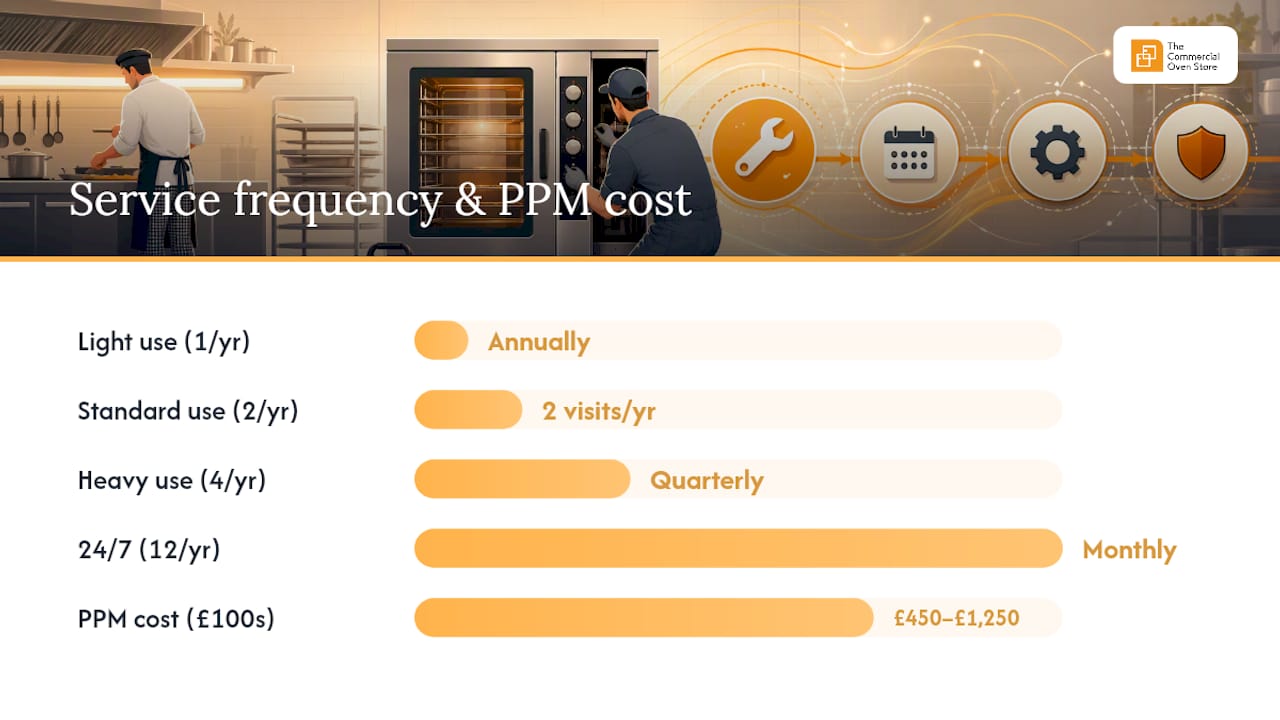
A UK PPM contract typically costs between £450 and £1,250 a year, depending on how many appliances you’re covering, visit frequency and site complexity. Parts are usually charged separately, though contract holders often get discounted rates on them.
Skipping servicing rarely saves money in the long run. Emergency call-outs cost more per visit than a scheduled one, and downtime during a breakdown means lost covers or halted production, often greatly exceeding the servicing fee you tried to avoid. Kitchens that skip planned maintenance also tend to see shorter equipment lifespans, typically about half the duration of those with consistent servicing.
When budgeting, treat PPM as a fixed annual line rather than an occasional expense:
- Get your equipment count and duty level assessed before signing a contract term.
- Ask what’s included per visit versus what triggers an extra charge.
- Check whether the contract protects your warranty terms on newer ovens.
Our maintenance schedule guide sets out what a typical visit covers in more detail.
Publisher perspective: how The Commercial Oven Store advises operators
Industry professionals often work with bakeries, cafés and restaurants across the UK on exactly this calculation, matching oven type and rated output to actual duty rather than to budget alone. Undersizing an oven to save on the sticker price often costs more in energy and servicing over its lifetime than buying correctly the first time.
Installation costs, particularly electrical supply and ventilation, get factored in before purchase, not after delivery. PPM gets recommended from day one rather than retrofitted once something breaks. For operators managing cashflow, flexible financing through iwocaPay spreads the capital cost, which changes the TCO calculation meaningfully for many smaller kitchens.
What actually moves the needle on oven running costs
Most advice on this topic obsesses over the wrong number. Operators fixate on the purchase price of the oven, then ignore the fact that energy, servicing and consumables will cost several times that figure over a ten-year lifespan. The nameplate kW rating gets treated as gospel when duty cycle and insulation quality change real consumption far more than the number on the back panel suggests.
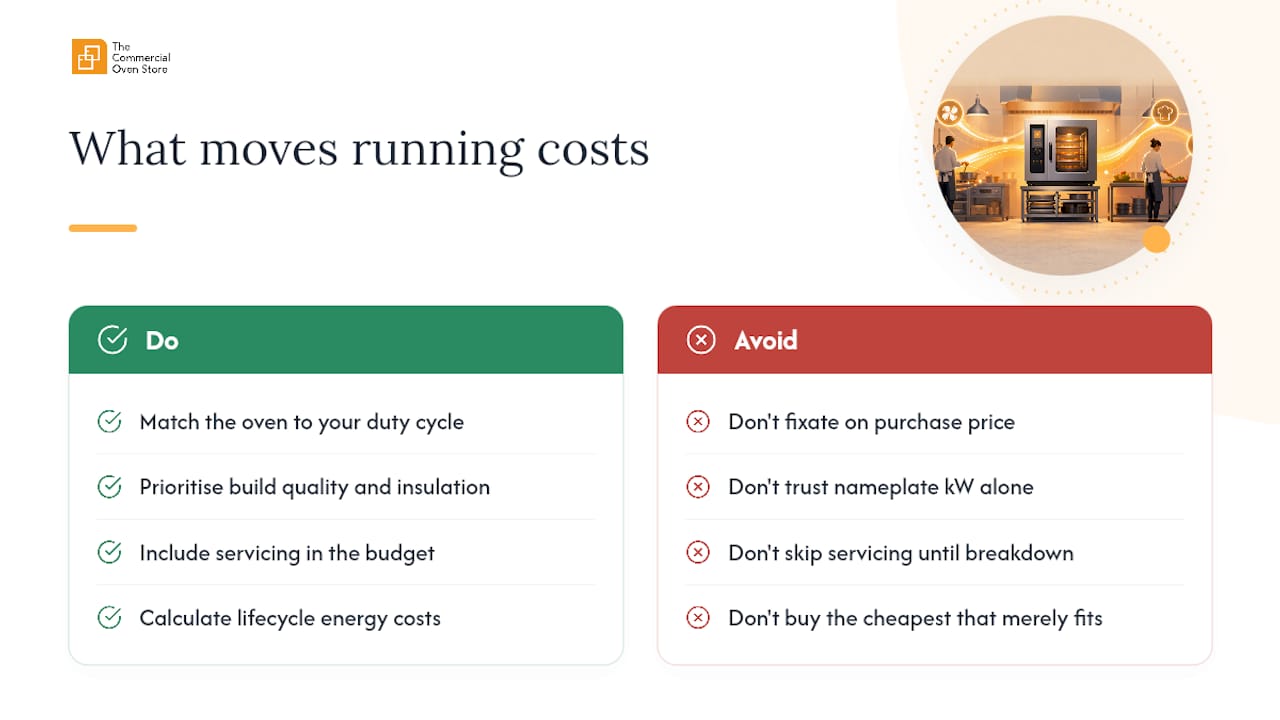
The conventional advice, buy the cheapest oven that fits the space, falls apart the moment you run the maths on a heavy-use kitchen. A £2,000 saving upfront on a poorly insulated oven can vanish within two years of extra energy draw and more frequent breakdowns.
If you take one thing from this guide, prioritise matching the oven’s rated output and build quality to your actual duty cycle before you compare purchase prices. Get servicing into your budget from the outset rather than treating it as an emergency cost. That single decision affects your running costs more than any single “energy saving tip” ever will.
— Simon
Get a running-cost estimate for your kitchen
If you’re weighing up a new oven purchase against your current running costs, professional services can help you work through the sums properly rather than guessing from a brochure spec sheet. These services may include site surveys to assess duty cycle and electrical capacity, oven recommendations matched to your actual output needs, and signposting to PPM providers so servicing is budgeted from day one, not bolted on after a breakdown.
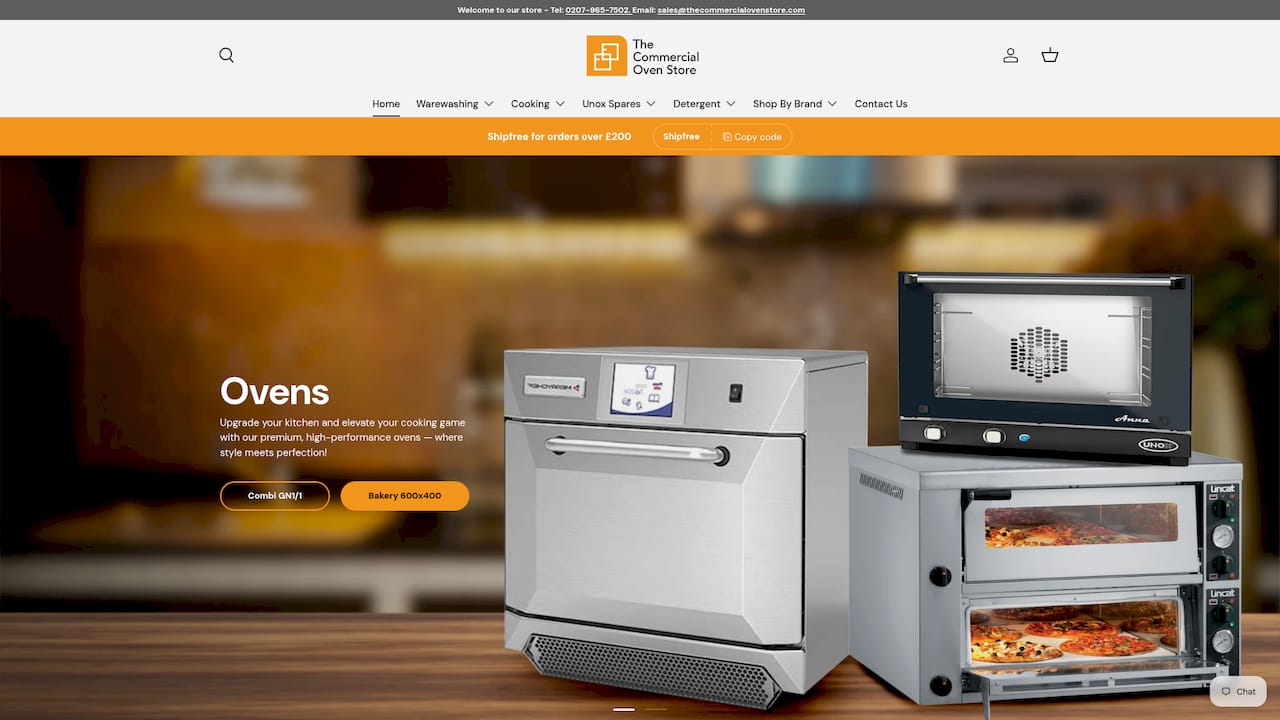
For smaller kitchens comparing energy draw against throughput, the CIBO/S countertop fast oven is worth a look at 2.7kW, while busier sites often need to weigh options like the Lincat Opus 800 electric range against their projected hours of use. Financing through iwocaPay means the capital outlay doesn’t have to compete with your servicing budget in year one. Get in touch through Thecommercialovenstore to request a bespoke running-cost estimate for your kitchen before you commit to a specification.
Sources
- Food that doesn’t cost the earth: energy (London Resilience / sector guidance)
- Power to the people: oven energy efficiency (Bakery Info)
- Commercial Combi Oven Service Interval Guide | Advantage
- Is gas still a viable option in a commercial kitchen? (Grey Simmonds Ltd)