

Whether a tray, rack, or grill fits your combi oven comes down to three things: Gastronorm (GN) size, rail spacing and rack type, and whether you have the right run-in rail or installation kit. Before you order anything, note your exact oven model and either measure the internal rail spacing yourself or pull up the manufacturer’s accessory chart for that model.
TL;DR:
- Confirm the exact GN size, rail spacing, and model specifications before ordering to ensure accessory compatibility for your combi oven.
- Check whether accessories like trays, racks, and accessories require OEM part numbers and verify measurements directly, not just by codes.
- Measure your oven’s internal dimensions and rail spacing yourself to avoid fit issues, especially for load-bearing or microwave-safe accessories.
- Use manufacturer catalogs and specify part numbers when purchasing to prevent costly mismatches and unsafe upgrades.
- Rely on experienced suppliers and their expertise, avoiding third-party parts that aren’t verified for your specific oven model.
Table of Contents
- What determines combi oven accessories compatibility?
- Which combi oven accessories need which fit checks?
- How do you verify accessory compatibility step by step?
- What thecommercialovenstore’s product pages tell you about fit
- Why most accessory mistakes are entirely avoidable
- Get verified accessories and installation from a reliable commercial oven supplier
- Where to check manufacturer accessory data yourself
- Sources
- FAQ
What determines combi oven accessories compatibility?
Two ovens can share a brand name and still take entirely different trays. The real answer to combi oven accessories compatibility sits in a handful of measurable specifications, not the marketing copy on the box.
Gastronorm sizing comes first. The GN system standardises pan footprints, most commonly 1/1 (full size), 2/3, and 2/1 (double width), and every combi cavity is built around one of these formats. But identical GN codes do not guarantee an identical fit. Corner radius and carrier-tray profile vary between manufacturers, and two pans carrying the same GN code can still bind against the cavity or carrier lugs if those radii differ. Always check depth as well as width and length; a 65mm-deep pan behaves very differently under a fan-assisted airflow pattern than a 20mm tray.
Rail spacing and rack type come next. Ovens use fixed hinging rails welded into the cavity or mobile rack systems designed to roll in on a trolley. The gap between rails, typically measured in specific increments set by the manufacturer, dictates which trays, grills, or GN combinations will physically slide in without fouling the shelf above. A hinging-rail oven cannot simply accept a mobile rack’s baskets; the two systems are built for different loading methods entirely.
Material and installation kits matter too.
- Solid metal and enamel accessories are generally safe in convection and combi-steam modes, but manufacturers restrict which pieces are approved for microwave or combination-microwave functions, so never assume a piece safe for one mode is safe for all.
- Non-stick coatings such as TriLax are rated for use up to 300°C, which suits grilling and roasting but rules out some high-heat applications.
- Installation kits change with unit size and hinge orientation (left or right), so a kit ordered for one variant will not always bolt onto another, even within the same model family.
- Stacking kits and stands often carry their own gas or electrical connection requirements that affect physical fit as much as function.
Which combi oven accessories need which fit checks?
Not every accessory carries the same risk of a bad fit. Some checks take thirty seconds; others need a tape measure and the spec sheet open side by side.
- Pans and trays. Match the GN code first, then measure your cavity’s width and depth directly rather than trusting the code alone. Confirm whether the tray needs a carrier or slides straight onto the rail, since carrier-tray requirements catch out a surprising number of first-time buyers.
- Grills, griddles and pizza trays. These accessories usually specify a recommended rail position for even heat distribution. Check the manufacturer’s guidance on preheating and load orientation before you run a full service on day one.
- CombiFry baskets, skewers and superspikes. These have moving or load-bearing parts, so verify the exact part number against your unit size and check clearance around adjacent shelves. A skewer rack that clears a 3-rail oven can jam solid in a 4-rail version of the same range.
- Mobile racks, run-in rails and transport trolleys. Confirm the oven physically has a run-in rail fitted, note its part number, and measure the rail positions against the trolley’s basket spacing. Mobile rack packages typically ship with a specific run-in rail part number tied to unit size, so the trolley and the rail are sold as a matched pair, not interchangeable parts.
- Stands, stacking kits and installation kits. Check stack height clearance and whether the stand needs its own gas or electrical connection, since these details affect physical fit well before you consider capacity.
Pro Tip: Keep a laminated card taped inside a cupboard listing your oven’s model number, GN capacity, and rail spacing. It saves a frantic search through old paperwork every time a new supplier catalogue lands on your desk.
How do you verify accessory compatibility step by step?
A ten-minute check now beats a returned parcel and a wasted delivery slot next week. Run through this before you place any order.
- Record the model, serial number and size class from the nameplate. This single step prevents most compatibility errors, since accessory ranges are built around specific size variants, not just a brand name.
- Measure internal width, depth and rail spacing yourself. Cavity dimensions printed in a brochure can differ slightly from the real installed unit once gaskets and liners are accounted for, so a physical measurement is the only fully reliable check.
- Pull up the manufacturer’s accessory catalogue or technical spec sheet. Search for GN sizes, rail spacing figures, the compatible model list, and any run-in rail requirements. RATIONAL’s accessories brochure and similar documents from other brands organise this exactly by unit size and part number.
- Match the part number, not just the description. Third-party accessories can work well for basic trays and grids, but stick to OEM parts for anything load-bearing, electrically connected, or used in microwave or combination modes, where an approved-parts list genuinely matters for safety.
- Do a safe test fit before the first cook. With the oven powered down, slide the new accessory in and check for rubbing against the cavity walls, restricted airflow around the fan guard, or contact with heating elements. Only once that passes should you run a short trial cook, watching for uneven browning or, in microwave-capable units, any sign of arcing.
What thecommercialovenstore’s product pages tell you about fit
Reading a spec sheet is a skill, and it is one worth building before you buy, not after an accessory arrives and does not fit.
Thecommercialovenstore structures its combi oven and commercial oven listings so that installation kits, GN capacities, and accessory part references sit alongside the core specification, rather than buried in a separate download. This layout helps address common fit questions kitchen managers often have before committing to an order.
On a typical product page, you will find:
- Internal GN capacity stated by size class, so you can cross-check against your existing pan stock before ordering more.
- Installation kit references relevant to that specific unit, including whether hinge orientation changes the part required.
- Links or notes pointing towards accessory ranges that have already been checked against that oven’s rail spacing.
When fit questions are not fully answered by the page itself, installation and expert advice services can assist, and flexible payment options may be available for larger accessory orders.
Why most accessory mistakes are entirely avoidable
The mistakes I see repeated most often are the same three, in almost every kitchen: ordering on GN code alone, ignoring rail spacing because “it’s a standard oven”, and buying non-OEM parts without checking a single part number against the model.
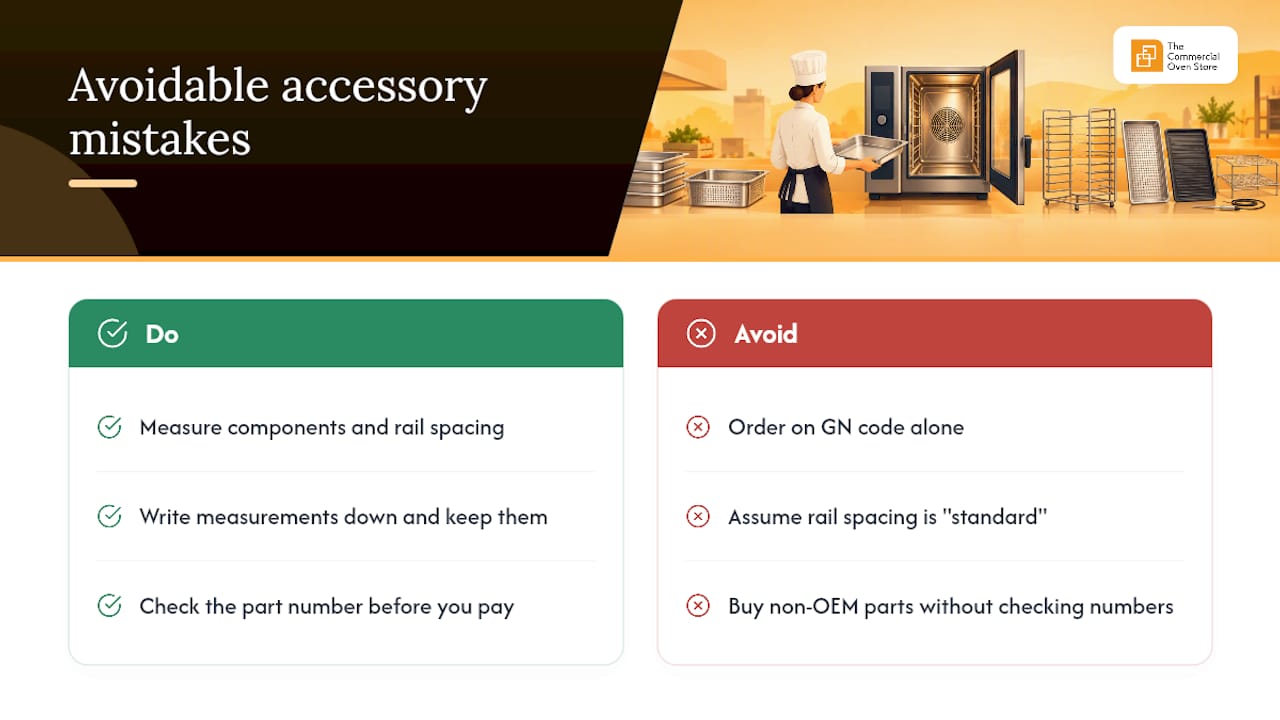
Each one is avoidable, and each one gets expensive fast. A binding tray warps a door seal. A mismatched mobile rack sits unused in a storeroom. None of that shows up on the invoice, but it shows up in downtime.
The single best habit is dull but effective: measure, write it down, and check the part number before you pay for anything.
— Simon
Get verified accessories and installation from a reliable commercial oven supplier
Reliable suppliers can provide accessories checked against specific oven models rather than generic listings that assume every combi oven of a given size behaves the same way.
Avoiding mismatches like wrong GN corner profiles, incorrect rail spacing, or unapproved parts for microwave modes is crucial, and expert advice services are designed to catch these issues before ordering. Measure your oven, note the model number from the nameplate, and get in touch through Thecommercialovenstore for verification on any accessory you are unsure about. Installation kits such as the Unox single unit installation kit can be fitted by the same installation service that supplies the oven, and larger accessory or replacement-unit orders can be spread through iwocaPay rather than paid in one lump. If your current oven is close to the end of its working life, browse the commercial oven range and get advice on a model whose accessory ecosystem matches your kitchen’s actual workflow, not just its floor space.
Where to check manufacturer accessory data yourself
Before ordering third-party parts, cross-reference the official documentation directly:
- Henny Penny’s combi oven accessories page, with downloadable fact sheets for stands, racks, and run-in rail sets.
- RATIONAL’s full unit and accessories catalogue, cross-referencing accessory numbers against installation kit notes.
Always match the exact part number, and measure your unit, before ordering from any third-party supplier.
Sources
FAQ
What are the downsides of a combi oven?
Combi ovens demand more careful accessory planning than a single-function oven, since GN sizing, rail spacing, and rack type all need matching before you buy trays or racks. They also require more maintenance attention, since combi oven cleaning affects both hygiene and accessory longevity over time.
Can you use metal trays in a combination microwave?
Not automatically. Manufacturers approve specific metal and enamel accessories for combination microwave modes, and using an unapproved metal piece in that setting carries a real risk of arcing, so always check the accessory’s approved-mode listing before running it under microwave power.
What are some good accessories for a combi oven?
The essentials are GN pans matched to your cavity size, a mobile rack or run-in rail set if you need trolley loading, and a grill or pizza tray suited to your rail spacing. Installation kits and stands round out the list for anything that needs stacking or repositioning, and Gastronorm sizing is the first thing to nail down.
Can I replace my double oven with a combi oven?
In most professional kitchens, yes, provided the new unit’s footprint and connection requirements suit the space, which is worth checking against a combi oven dimensions guide before ordering. Site readiness, including power and water connections, is covered in detail in a combi oven installation guide.
How much does installation cost at thecommercialovenstore?
Installation pricing is not published as a flat figure, since it depends on the unit and site requirements, so current costs sit on the thecommercialovenstore website alongside the expert advice service that helps confirm what your specific setup needs.