

A sound commercial oven maintenance schedule runs on five cadences: daily checks by the operator, weekly deep cleans by the shift lead, monthly safety inspections by the maintenance manager, quarterly professional reviews, and an annual Gas Safe or certified-engineer service. That structure, applied consistently, is what separates a kitchen that runs smoothly from one that loses a service to an avoidable breakdown.
Structured preventive-maintenance programmes can reduce unplanned downtime events by up to 40%. For a busy UK kitchen, that figure translates directly into retained covers and avoided emergency call-out fees.
Cadence summary:
- Daily (operator/shift lead): visual checks, wipe-downs, door-seal inspection, set-point verification
- Weekly (shift lead): deep clean, gasket re-seat, burner/element and fan inspection
- Monthly (maintenance manager): thermostat and thermocouple checks, lubrication, electrical connections
- Quarterly (maintenance manager + engineer): filter replacement, uniformity checks, log review
- Annual (Gas Safe or certified engineer): full professional service, safety-interlock testing, calibration sign-off
Escalation rule: shut down and call a Gas Safe registered engineer immediately if you detect a gas smell, see flame instability, notice electrical arcing, or find a failed safety interlock. Do not attempt a temporary fix.
Key takeaways
A structured commercial oven maintenance schedule, with daily operator checks, weekly deep cleans, monthly safety inspections, and an annual Gas Safe service, is the single most effective way to prevent unplanned downtime and extend equipment life in a UK commercial kitchen.
| Point | Details |
|---|---|
| Follow the five-cadence schedule | Daily, weekly, monthly, quarterly, and annual tasks each have a named owner and must be completed on time. |
| Gas Safe is non-negotiable | All gas-appliance work beyond cleaning must be carried out by a Gas Safe registered engineer; keep certificates on file. |
| Calibrate sensors weekly | Check temperature sensors against a traceable reference weekly; intervene if any zone drifts beyond ±3°C. |
| Log as-found and as-left readings | A maintenance log with before-and-after readings is your strongest evidence for warranty claims and EHO audits. |
| Stock A-class spares in-house | Door gaskets, igniters and thermocouples should always be on the shelf; their absence turns a minor fault into a full shutdown. |
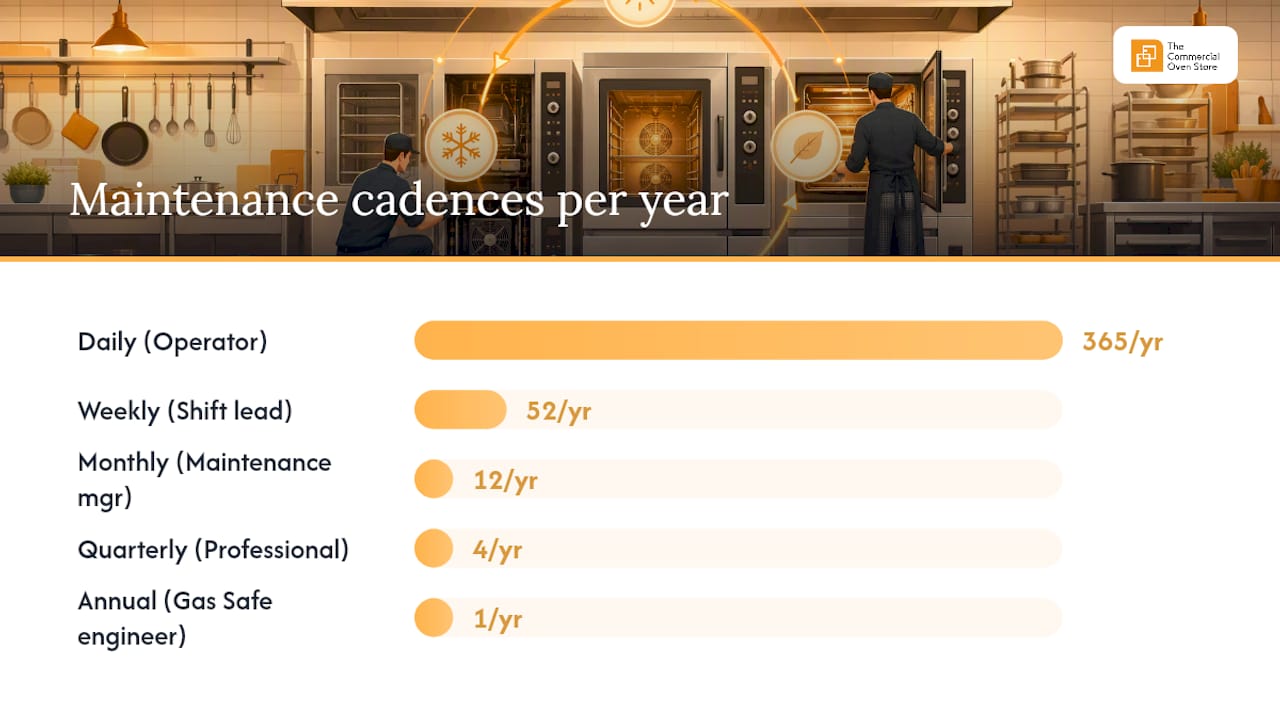
Table of Contents
- What your team should check every single day
- Weekly tasks that go deeper than a wipe-down
- Monthly checks that protect safety and efficiency
- Quarterly, six-month and annual servicing, what needs a professional
- Approved cleaning methods and what to avoid
- How to test temperature accuracy and what tolerances to accept
- Keeping maintenance records that actually hold up
- When to call a professional engineer
- Common faults and safe first checks
- Printable maintenance schedule and checklist
- Where to source spares, engineers and UK support
- The maintenance advice most kitchens ignore until it costs them
- Sources
What your team should check every single day
Daily discipline prevents the grease build-up and early-fault misses that cause most mid-service failures. These checks take under ten minutes per shift and belong to the operator or shift lead.
Pre-shift checks:
- Confirm set-point temperatures match the day’s menu requirements
- Inspect door seals visually for tears, compression loss or food debris lodged in the gasket
- Check ventilation clearances around the oven are unobstructed
- Look for visible water or gas leaks around connections and the base
- Verify controls respond correctly and display no fault codes
End-of-shift cleaning:
- Wipe interior surfaces with a damp cloth while still warm (not hot) to lift grease before it carbonises
- Remove racks and trays; knock off loose debris and wipe down
- Clear the oven floor of food particles and standing liquid
- Wipe door glass inside and out; check the seal again after cleaning
Daily wipe-downs followed by scheduled deep cleans are the baseline standard, and soaking removable racks in warm water with a food-safe degreaser makes the weekly clean significantly faster.
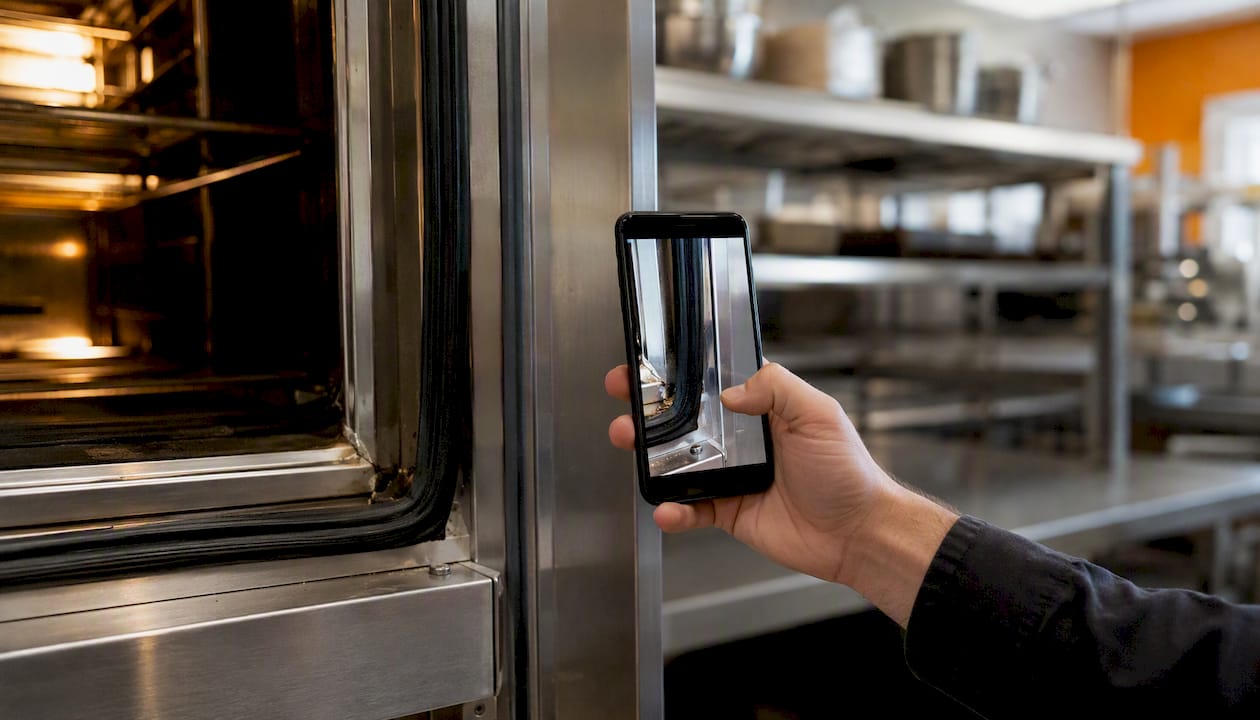
Pro Tip: Take a 30-second phone photo of any visible fault, unusual residue, or damaged component before cleaning it away. A timestamped image is far more useful to an engineer than a verbal description, and it costs nothing.
Weekly tasks that go deeper than a wipe-down
Weekly maintenance requires 30–60 minutes and is best scheduled at a quieter point in the trading week, such as a Monday morning before service. The shift lead should own this.
Interior and filter deep clean:
- Remove all racks, trays and rack guides; soak in an alkaline degreaser solution
- Scrub interior walls, roof and floor with a non-abrasive pad; rinse thoroughly
- Clean or replace grease filters; check combi-oven water filters and drain lines for blockages
- Wipe fan covers and check fan blades for grease accumulation
Mechanical and component inspection:
- Inspect door gaskets for compression, cracking or lifting at the corners; re-seat or flag for replacement
- Check door hinges and handles for play or stiffness
- Inspect burner ports on gas ovens for blockages; check pilot flame colour (should be blue, not yellow)
- Check igniter condition and igniter gap on fuel-fired ovens
- Listen for unusual fan noise or vibration during warm-up
Any item that cannot be resolved with a clean or a re-seat should generate a written maintenance work order before the next service period begins. Do not carry faults forward informally.
Monthly checks that protect safety and efficiency
Monthly tasks are less about cleaning and more about verifying that safety-critical components are performing within tolerance. The maintenance manager should lead these, ideally with the oven taken out of production for a short window.
Component checks:
- Test thermostat accuracy against a calibrated reference thermometer; note as-found readings
- Inspect thermocouples and RTDs for signs of drift, corrosion or physical damage
- Check all electrical connections for looseness, discolouration or corrosion
- Inspect wiring insulation for cracking or heat damage near the oven cavity
- Lubricate door hinges and any moving mechanical parts per the manufacturer’s specification
- Check belt tension on convection fan drives where applicable
- Verify door latch engagement and spring tension
Safety rule: isolate the oven from its power and gas supply before touching any electrical connection or gas fitting. Tag the isolation point with a lock-out/tag-out label. Never carry out improvised repairs on live equipment, and never use a temporary fix on a gas component.
The American Society of Baking’s oven maintenance guidance covers thermocouple and igniter inspection in detail, including flame-sensing device checks and gas-train tightness verification, all of which are relevant monthly items for gas ovens.
Quarterly, six-month and annual servicing, what needs a professional
Some tasks are beyond the scope of in-house staff, either because they require specialist tools, calibrated references, or because UK law requires a Gas Safe registered engineer for gas-related work.
Quarterly (maintenance manager or specialist):
- Replace grease and water filters; inspect duct work for grease accumulation
- Conduct a full burner inspection on gas ovens; clean flame rods and verify gas-train integrity
- Run a multi-point temperature uniformity survey across the oven cavity
- Review the maintenance log for recurring faults or patterns
- Confirm all safety interlocks are functional
Six-monthly (specialist engineer):
- Verify thermostat and sensor calibration against a traceable reference
- Inspect fan motors and bearings; replace worn belts or seals
- Check pressure relief devices and safety cut-offs
- Replace any wearing parts identified in quarterly reviews
Annual (Gas Safe registered engineer for gas appliances; certified engineer for electric):
- Full professional service covering all mechanical, electrical and combustion systems
- Safety-interlock testing to manufacturer specification
- Gas Safe inspection and certification for all gas-fired equipment
- Calibration sign-off and updated service record
- Operator refresher training, as recommended in oven preventive-maintenance guidance
Annual professional servicing is not optional for warranty retention. Regular professional inspections extend oven service life and catch hidden issues that in-house checks miss. The investment is modest against the cost of a mid-service failure or a failed EHO inspection.
Convection ovens typically last 10–15 years; deck ovens can reach 20 years with proper maintenance. That lifespan difference is almost entirely down to whether the annual service actually happens.
Approved cleaning methods and what to avoid
The wrong cleaner can destroy a control panel, degrade a door seal, or leave chemical residue that contaminates food. Use the right product for the right surface.
Do:
- Use manufacturer-approved alkaline degreasers at the stated dilution; follow contact-time instructions before rinsing
- Soak stainless-steel racks in a degreaser solution; use nylon brushes for stubborn deposits
- Rinse all surfaces thoroughly with clean water after chemical application
- Allow the oven to cool fully before applying any cleaning product
- Wear PPE: chemical-resistant gloves, eye protection and an apron
Do not:
- Use abrasive scourers or steel wool on control panels, glass or stainless-steel surfaces
- Spray cleaning chemicals directly into burner ports, igniter assemblies or electrical components
- Immerse any electrical component in water or cleaning solution
- Use domestic oven cleaners not rated for commercial equipment; the caustic concentration is often too high for seals and coatings
Waste disposal: spent degreaser solutions and contaminated rinse water must be disposed of in line with your local authority’s trade-effluent requirements. Do not pour concentrated chemical waste directly into a surface drain without dilution.
Pro Tip: For combi ovens, run the manufacturer’s built-in auto-clean cycle as directed, but do not treat it as a substitute for manual inspection of the drain, water-inlet filter and steam generator. These components need physical checking even when the auto-clean runs correctly.
Practical cleaning technique, including using nylon brushes for grease and soaking removable parts, is well demonstrated in commercial oven cleaning guides and is worth incorporating into operator training sessions.
How to test temperature accuracy and what tolerances to accept
Temperature drift is the most common cause of inconsistent baking results and the easiest fault to catch early with a simple routine.
- Allow the oven to reach its set point and stabilise for at least 15 minutes before testing
- Place a calibrated, traceable reference thermometer at the centre of the oven cavity
- Record the displayed set point and the reference reading simultaneously; note the difference as the as-found deviation
- Repeat at a minimum of three zones (top, centre, bottom) for a uniformity survey
- Record all readings in the maintenance log with the date, asset ID and technician initials
Tolerance guidance: sensors or zones should not deviate more than ±3°C from the reference during routine checks. A structured calibration programme recommends weekly sensor checks and monthly multi-point uniformity surveys, with ±3°C as the intervention threshold. If any zone exceeds this, remove the oven from production and raise a corrective-action work order.
Replace thermocouples or RTDs when drift exceeds the manufacturer’s tolerance or when a multi-point survey shows consistent zone bias. Always document as-found and as-left values so the repair is traceable.
Safety note: never conduct live electrical tests without appropriate isolation and test equipment. If a live-circuit measurement is required, it must be carried out by a competent person under a safe-work procedure.
Keeping maintenance records that actually hold up
A maintenance log is only useful if it contains enough detail to reconstruct what happened, when, and who did it. Thin records fail warranty claims and food-safety audits.
Minimum log fields:
- Date and time of task
- Asset ID or oven serial number
- Task performed (description, not just “cleaned”)
- As-found readings (temperatures, visual condition)
- As-left readings after corrective action
- Operator or engineer initials
- Photographs (reference by filename or attach digitally)
- Corrective actions taken and any parts replaced
- Next scheduled action or follow-up required
Retain maintenance records for a minimum of three years, or longer if your insurer or food-safety plan requires it. Digital records stored in a cloud-based CMMS or a shared drive are preferable to paper logs, which degrade and can be lost. A documented log with as-found and as-left readings is the strongest single piece of evidence for warranty claims and EHO inspections.
When to call a professional engineer
Some faults are not for in-house staff to resolve. Knowing the line between a permissible reset and a mandatory engineer call is a safety requirement, not a preference.
Call an engineer immediately if you observe:
- Any smell of gas around the oven or gas supply line
- Flame instability: lifting, rolling back, or extinguishing repeatedly
- Electrical arcing, burning smells from wiring, or a tripped RCD that resets and trips again
- A failed safety interlock or a fault code the manufacturer’s manual flags as critical
- Persistent temperature drift beyond ±3°C that recalibration does not resolve
- Smoke from inside the oven cavity that is not attributable to food residue
What to prepare before the engineer arrives:
- Isolate the oven from power and gas at the mains
- Clear access to the oven, gas supply and electrical distribution board
- Have the maintenance log, previous service certificates and the manufacturer’s manual ready
- Note the fault code, symptom and time of onset in writing
- Confirm the engineer is Gas Safe registered before they touch any gas component; ask to see their Gas Safe ID card and record the registration number
Keep Gas Safe certificates on file alongside the maintenance log. Your insurer and EHO may ask for them.
Common faults and safe first checks
Not every fault requires an immediate engineer call. Some have safe, reversible first checks that an operator can perform before escalating.
Fault: uneven baking or hot spots
- Check door seal for gaps; a failing gasket causes heat loss and uneven distribution
- Verify fan operation: a slow or seized fan creates dead zones
- Run a temperature uniformity check; if deviation exceeds ±3°C, escalate
Fault: oven not reaching set point
- Confirm power or gas supply is fully on
- Check for a clogged air filter restricting combustion air or convection airflow
- Inspect the thermostat display for fault codes
Fault: burner failure on a gas oven
- Check gas supply pressure at the meter; confirm other gas appliances are working
- Inspect the pilot flame; if absent, attempt one re-ignition per the manufacturer’s procedure
- If the burner fails to light after one attempt, do not retry repeatedly. Isolate and call an engineer.
Fault: unusual noise or vibration
- Identify whether the sound comes from the fan, the door, or the burner assembly
- A rattling rack or tray is trivial; a grinding fan bearing is not
- Grinding, squealing or intermittent clicking from the fan motor requires engineer inspection
Escalation rule: reset and clean are permissible first responses. Anything involving gas components, live electrical work, or a repeated safety-interlock trip requires an engineer.
Printable maintenance schedule and checklist
Use this table as a starting point. Copy it into a spreadsheet, a CMMS such as Maintenance Care or Limble, or print and laminate it for the kitchen wall.
| Task | Cadence | Oven type | Est. time | Role | Priority |
|---|---|---|---|---|---|
| Visual door-seal check | Daily | All | 2 min | Operator | High |
| Set-point verification | Daily | All | 2 min | Operator | High |
| Interior wipe-down | Daily | All | 5 min | Operator | High |
| Rack and tray clean | Daily | All | 5 min | Operator | Medium |
| Deep interior clean | Weekly | All | 30 min | Shift lead | High |
| Gasket inspection/re-seat | Weekly | All | 10 min | Shift lead | High |
| Burner/element inspection | Weekly | Gas/electric | 10 min | Shift lead | High |
| Fan blade check | Weekly | Convection/combi | 5 min | Shift lead | Medium |
| Combi drain and water filter | Weekly | Combi | 10 min | Shift lead | High |
| Thermostat accuracy check | Monthly | All | 15 min | Maint. manager | High |
| Thermocouple/RTD inspection | Monthly | Gas/electric | 10 min | Maint. manager | High |
| Lubrication (hinges, moving parts) | Monthly | All | 10 min | Maint. manager | Medium |
| Electrical connection check | Monthly | All | 15 min | Maint. manager | High |
| Filter replacement | Quarterly | All | 20 min | Maint. manager | High |
| Multi-point uniformity survey | Quarterly | All | 30 min | Maint. manager | High |
| Full burner inspection | Quarterly | Gas | 30 min | Engineer | High |
| Calibration verification | 6-monthly | All | 30–60 minutes | Engineer | High |
| Fan motor and bearing check | 6-monthly | Convection/combi | 30 min | Engineer | Medium |
| Full professional service | Annual | All | 2–4 hrs | Certified engineer | Critical |
| Gas Safe inspection | Annual | Gas | Included | Gas Safe engineer | Critical |
| Safety-interlock test | Annual | All | Included | Certified engineer | Critical |
| Operator refresher training | Annual | All | 2 hrs | Manager/trainer | High |
Oven-type notes:
- Convection ovens: pay particular attention to fan belts and blade condition; see the convection oven buying guide for model-specific notes
- Combi ovens: add weekly water-system checks (descaling, drain inspection, steam-generator condition)
- Deck ovens: inspect stone or steel deck surfaces for cracking monthly; check element continuity annually
- Speed ovens: microwave seals and magnetron condition require specialist annual inspection; see high-speed oven guidance for type-specific pointers
To import into a spreadsheet, copy the table and paste into Google Sheets or Excel; add a “Completed” tick column and a “Notes” column for each row. For a CMMS, use the cadence column to set recurring work-order triggers.
Where to source spares, engineers and UK support
Keeping the right spare parts in-house is the difference between a 20-minute fix and a two-day wait for a courier.
ABC spare-parts prioritisation:
- A-class (stock always): door gaskets, igniter electrodes, thermocouple probes, fuses, and any part the manufacturer flags as a common wear item. These are the parts whose absence stops production.
- B-class (hold one unit): fan belts, door hinges, control-board fuses, and water-inlet valves for combi ovens.
- C-class (order on demand): cosmetic panels, rack guides, and non-critical fasteners.
This ABC approach, drawn from oven maintenance best practice, prevents the scenario where a £4 gasket causes a full-day shutdown because nobody thought to stock it.
Finding certified engineers in the UK:
- Gas Safe Register (gassaferegister.co.uk): search by postcode for registered engineers qualified on commercial catering equipment
- Manufacturer service networks: Rational, Unox and other OEMs maintain UK service networks with factory-trained technicians
- CEDA (Catering Equipment Distributors Association): member companies often offer service contracts alongside equipment supply
For food-safety plan templates and maintenance record frameworks, Navigate Food’s food-safety planning tools offer structured templates that can be adapted for UK kitchens.
Pro Tip: When buying a new oven, ask the supplier whether they offer a service package or can recommend a local certified engineer. Locking in a service relationship at the point of purchase is far easier than finding one urgently after a breakdown.
Thecommercialovenstore stocks commercial ovens from Unox, Rational, and Merrychef, along with compatible accessories including installation kits, oven stands, and trays. The team can advise on model-specific maintenance requirements and help you identify the right spare parts for your equipment.
The maintenance advice most kitchens ignore until it costs them
The conventional wisdom on commercial oven upkeep focuses almost entirely on cleaning frequency. Cleaning matters, but it is the easiest part of the job. The tasks that actually prevent catastrophic failure are the ones that get skipped: sensor calibration, gas-train tightness checks, and the annual professional service.
Most UK kitchens treat the annual service as optional when trading is busy. It is not. A Gas Safe engineer’s annual visit is the only reliable way to catch gas-train deterioration, failing safety interlocks, and thermocouple drift that has been accumulating quietly for months. The cost of that visit is a fraction of a single emergency call-out, let alone the cost of a failed EHO inspection or a kitchen fire.
The other gap is record-keeping. Operators often complete checks but record nothing, which means the maintenance history effectively does not exist. When a warranty claim arises or an insurer asks for evidence of due diligence, a blank log is as damaging as no maintenance at all. The as-found and as-left reading format is not bureaucracy; it is the difference between a successful claim and a rejected one.
Spare-parts strategy is the third overlooked area. Stocking A-class parts costs very little and eliminates the most common cause of extended downtime: waiting for a £6 igniter electrode to arrive. Build the ABC list once, review it annually, and the kitchen will almost never lose a full service day to a minor component failure.
The schedule in this guide is not theoretical. It maps directly to what certified engineers and food-safety auditors expect to see. Apply it, log it, and escalate correctly, and the oven becomes one of the most reliable pieces of kit in the kitchen rather than the most expensive source of stress.
Sources
- Oven Maintenance | American Society of Baking
- Guide to Oven Preventative Maintenance: Helpful Recommendations and Considerations
- Commercial Oven Maintenance Checklist for Bakeries and Food Processors
- The Ultimate Guide to Commercial Oven Maintenance: Keep Your Equipment Running Efficiently | Boh
- How to Clean a Commercial Oven | Burkett Blog
- How Long Do Commercial Ovens Last? - ChefTek LLC
Recommended
- Convection oven for bakery: the UK buyer’s guide – thecommercialovenstore.com
- Combi oven installation: the UK site-readiness guide – thecommercialovenstore.com
- Best bakery ovens for small UK bakeries: how to choose – thecommercialovenstore.com
- Single phase vs three phase for commercial ovens – thecommercialovenstore.com