

If you need a replacement core probe for a combi oven, match the oven’s OEM part number and connector first. Choose an identical OEM probe wherever it’s available; drop to a compatible universal or external USB probe only when the OEM version is out of stock or discontinued. Photograph the connector, confirm the oven’s serial number, and get a supplier to verify fit before you pay. Connector pinout, not colour or cable length, is what actually stops a probe from working.
TL;DR:
- Matching the OEM part number and connector style, verified by serial number and photos, is essential for proper core probe fit and function.
- Compatibility depends more on connector pinout, pin count, and specific specifications than on probe length or cable length alone.
- Using an OEM identical probe guarantees correct calibration and warranty, while universal probes risk inaccurate readings and potential failure.
- Proper probe placement involves handling with gloves, avoiding bone or cavities, and allowing it to reach thicker items above roughly 20 millimeters.
- Suppliers that confirm fit with serial numbers and offer installation help reduce the risks and costs of ordering the wrong probe.
Table of Contents
- Why your combi oven core probe matters more than you think
- Compatibility and the exact specs you must check before ordering
- Choosing the right probe type for your kitchen’s tasks
- How do you fit and use a combi oven core probe safely?
- Diagnosing a faulty probe before you order a replacement
- OEM labelling and what spec sheets tell you
- How professional suppliers reduce the risk of ordering the wrong part
- What actually matters when you’re buying a replacement probe
- Check compatibility or book a probe fitting with us
- Where to check the specs yourself
- Sources
- FAQ
Why your combi oven core probe matters more than you think
Every combi oven with a core probe input uses that reading to control the cook, not just display a number. The firmware watches the sensor and triggers auto-stop when the target core temperature is hit, then can switch into a keeping-warm cycle that reheats food once the core drops by a set margin, roughly 35.6°F below target in some models. That logic runs behind roasting, regeneration, sous-vide work, and long, slow overnight cooks where delta-T programmes hold a fixed gap between chamber and core temperature.
Fit a probe that reads slightly wrong, or one seated loosely in the wrong socket, and the oven still trusts the number. You get undercooked joints pulled early, overcooked batches held too long, and shrinkage that eats into yield. For sites running HACCP checks, a probe giving false readings can mean a batch technically fails its core temperature record even when it was cooked properly, which is a paperwork headache nobody needs during a health inspection.
Compatibility and the exact specs you must check before ordering
Before you order anything, pull the oven’s data plate and cross-reference it against the instructions for use (IFU). Model name alone isn’t reliable. Rational, MKN, and most other manufacturers have run several production revisions under the same model name, and connectors have changed mid-run, which is exactly why dealers commonly ask for a serial number before shipping parts.
Work through these before you place an order:
- Oven model, serial number, and OEM part number taken from the data plate or the manual, not from memory.
- Connector style and pin count (commonly 5 wire, 8 wire, or M16 fastenings) — this is the single biggest cause of a wrong part turning up.
- Probe length and diameter, which affect how well it reaches the core of thick joints or shallow trays.
- Cable length, since a probe that’s a few centimetres short won’t reach the socket cleanly and strains the connector over time.
- Photos of the existing connector and socket, sent to the supplier alongside the serial number, so they can confirm fit rather than guess from a model name.
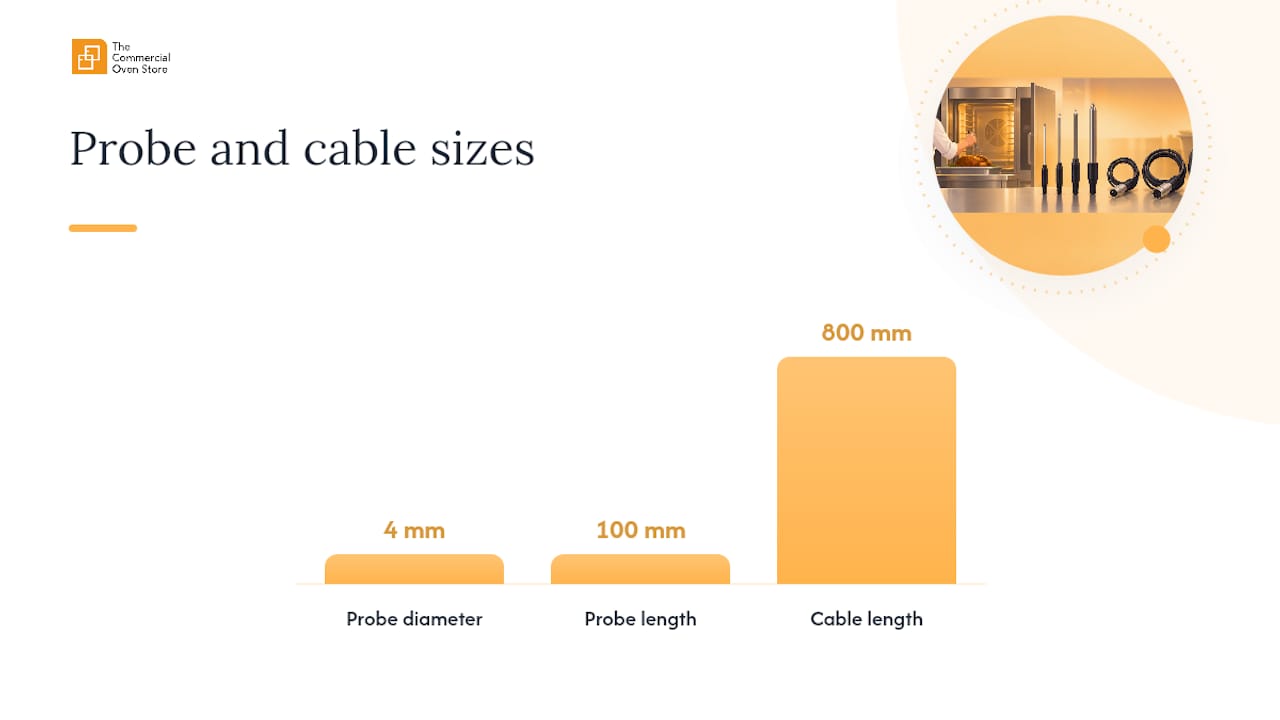
An MKN listing for the FlexiCombi 6.x and 10.x range shows how granular this gets: probe diameter 4 mm, probe length 100 mm, cable length 800 mm, a 5-wire connector with a 1/4-inch fixing thread. Match every one of those fields, not just the headline part number.
Choosing the right probe type for your kitchen’s tasks
Not every kitchen needs the same probe, and picking on price alone tends to cost more later in reordering and downtime.
- OEM identical probe. The safest route when it’s in stock. Pinout, calibration curve, and warranty terms are already matched to your oven, and you avoid the guesswork of a “compatible” listing that turns out not to be.
- Multi-sensor probes. Worth the extra cost for large roasting joints or precision batches, since several sensors along the shaft give a more even read through the thickest part of the product rather than one point.
- External USB or sous-vide probes. These attach externally and are built to monitor vacuum-sealed bags without breaking the seal, which makes them the practical choice for sous-vide work. They’re an accessory alongside your internal probe, though, not a substitute for it.
- Universal replacements. Only sensible when the connector genuinely matches; a universal probe with the wrong pinout is worse than no probe at all.
Pro Tip: If your kitchen runs a lot of mixed batch sizes, ask your supplier about the oven’s “Reinsert” function rather than buying a second probe. It lets you pull the probe from a smaller item once it’s done and reinsert it into a larger piece to carry on the same cook, which keeps production moving without an extra part to maintain.
How do you fit and use a combi oven core probe safely?
Getting a reliable reading is as much about technique as the part itself.
- Cool the probe before use. A probe that’s still hot from the last cook gives a false high reading in cold, raw food; run it under the hand shower first, as most manufacturers recommend.
- Wear protective gloves when handling a probe that’s just come out of the chamber, and insert or remove it on the worktable, not while the tray is already in the oven, to cut the risk of burns.
- Place it centrally in the thickest part of the product. For thin items, angle the probe along the flattest run of meat and use a positioning aid where the manufacturer supplies one; steer clear of bone and cavities in poultry, which read cooler than the surrounding flesh.
- For small or mixed items, start with the smallest piece, pull the probe once that piece is done, then reinsert into a larger one and let the oven’s cooking path continue.
- After the cook, clean the probe, dry it, and return it to its holder. Check the cable and connector pins for wear or corrosion each time, since that’s usually where faults start.
Manuals generally suggest a probe is only worth using on items thicker than roughly 20 mm; anything thinner is better served by a positioning aid or a shorter timed cook. For more on dialling in settings once the probe’s in place, our guide to combi oven programming covers fine-tuning temperature and time together.
Diagnosing a faulty probe before you order a replacement
A handful of symptoms come up again and again on service calls: “probe not detected” on the display, readings that jump around mid-cook, a reading stuck permanently high or low, or obvious damage to the sheath or cable.
Work through it in this order:
- Check the connector is fully seated, not just resting in the socket.
- Swap in a known-good probe if you have a spare, to isolate probe from oven.
- Inspect the cable for kinks, cuts, or corroded pins at the connector end.
- Check the oven’s error code display, since most models flag a probe fault by code rather than a generic alarm.
If the fault clears with a re-seated or cleaned connector, you’ve saved yourself a purchase. If it doesn’t, gather the oven model, serial number, OEM part number if you have it, photos of the connector, and the cable length you need, then send all of it to your supplier in one message rather than back and forth.
OEM labelling and what spec sheets tell you
Short dealer listings pack in more information than they look like they do. The fields to read carefully are the OEM reference or part number, probe diameter and length, cable length, connector type and pin count, the fixing thread size, and the list of compatible models the part actually fits.

Even with all of that matched on paper, expect a supplier to ask for your serial number before despatch. It’s not box-ticking: production revisions within one model line have changed connectors before, so the listing’s compatible-models list is a starting point, not a guarantee. Genuine OEM parts also tend to run longer lead times than generic alternatives, simply because manufacturers batch-produce them to order rather than holding deep stock. That wait buys you a guaranteed fit and a warranty that matches your oven, which a cheaper universal part usually can’t offer.
How professional suppliers reduce the risk of ordering the wrong part
Getting a probe wrong costs a service call and a day of downtime, which is why reputable suppliers check fit against your oven’s serial number before anything ships, rather than relying on a model name alone. That single step catches the mid-production connector changes that trip up a lot of online orders.
Cashflow doesn’t have to be the blocker either. iwocaPay lets you spread the cost of a probe, a full oven, or an installation job rather than paying it all upfront, which matters when a breakdown lands mid-week. Beyond the part itself, Thecommercialovenstore offers expert advice on spec matching and an installation service, so a replacement probe gets fitted correctly first time rather than left half-seated and throwing false readings a week later.
What actually matters when you’re buying a replacement probe
Most advice on this topic focuses on brand comparisons: Rational versus MKN, which is faster, which is cheaper. That’s the wrong starting question. The part that actually determines whether your replacement works is the connector pinout, and almost nobody checks it thoroughly enough before ordering.
Conventional wisdom treats probe length and cable length as the main variables to match, because they’re the easiest numbers to read off a listing. In practice, those are secondary. A probe with the right length and the wrong pin count is dead on arrival; a probe with the wrong length but the right connector can often still be made to work with care in placement. If you only have time to verify one thing, verify the connector and pin count against your oven’s serial number, not the tape measure.
The other habit worth dropping is treating a universal probe as a like-for-like swap for an OEM part. It rarely is. Calibration curves differ between manufacturers, and a universal probe reading two or three degrees off across a service could be the difference between a joint that’s safely cooked and one that fails a core temperature check. Where the OEM part is available, buy it. Where it isn’t, get the supplier to confirm the calibration match in writing, not just the physical fit.
— Simon
Check compatibility or book a probe fitting with us
Ordering the wrong probe twice costs more than getting it checked once, and some suppliers help kitchens to avoid costly downtime by confirming fit before shipping parts. Providing your oven model and serial number along with a photo of the connector allows them to confirm compatibility before anything ships.
Alongside probe supply, we offer a full installation service so the replacement gets fitted and tested properly, and iwocaPay if you’d rather spread the cost of a probe, a full oven, or an installation job than pay it all in one go. If you’re weighing up a full oven replacement rather than a probe, our commercial ovens range is worth a look while you’re in touch. Call, email, or use the contact form on Thecommercialovenstore with your oven details, and we’ll get back to you with a fit check and, where you need it, a fitting date.
Where to check the specs yourself
- Rational iCombi Pro manual — probe safety notes, USB sous-vide probe guidance, and placement instructions.
- BKI combi oven manual — auto-stop and keeping-warm behaviour explained by an OEM.
- MKN OEM part listing — example of full spec fields for a genuine replacement.
- Rational spare part listing — shows how UK dealers present part numbers and connector details.
Always check your own oven’s data plate and IFU against these before ordering, since revisions can differ even within one model name.
Sources
- IFU_20.046_RATIONAL_Original instructions_iCombi Pro_Table Units_en-US
- Combi-Oven model manual (BKI)
- MKN OEM 10013578 Core Temperature Probe for FlexiCombi 6.x, 10.x
- RATIONAL ICOMBI 40.06.808P combi steam oven meat temperature core probe
FAQ
What’s the difference between an OEM and a universal core probe?
An OEM probe is built by the oven’s manufacturer to match its exact calibration curve, connector, and pinout. A universal probe can physically fit the same socket but may read slightly differently, so it’s a fallback option only when the OEM part isn’t available.
How do I know which connector my combi oven uses?
Check the oven’s data plate for the model and serial number, then compare that against the IFU or ask your supplier to confirm from a photo of the connector. Pin count and connector style, commonly 5 wire or 8 wire, decide fit far more than probe length or cable length do.
Can I use an external USB probe instead of the internal core probe?
External USB probes work well for sous-vide, since they can monitor a vacuum-sealed bag without breaking the seal. They’re an accessory for that specific task, though, not a replacement for the oven’s built-in probe input.
How do I check my probe is reading accurately?
Compare its reading against a known-good calibrated thermometer in the same product, ideally at more than one temperature point. A probe that reads consistently a few degrees off, or one flagged by the oven’s own error codes, is due for replacement rather than recalibration.
Do suppliers supply and fit replacement core probes?
Thecommercialovenstore can verify probe compatibility against your oven’s serial number and supply the correct part, alongside an installation service to fit it properly. Current pricing and availability are listed on Thecommercialovenstore, and iwocaPay is available if you’d rather spread the cost.