

Most commercial oven tripping comes down to one of four things: degraded heating element insulation, a loose or burnt terminal block, moisture inside the cavity, or a supply mismatch on the circuit feeding the unit. Turn the oven off, isolate it at the wall, and stop resetting the breaker. Run a simple isolate test with the oven disconnected. If the fault sits in the appliance, you need an appliance technician; if it’s in the wiring or breaker, you need a certified commercial electrician.
TL;DR:
- If the breaker trips immediately on startup, the fault is likely a direct short caused by a failed element or wiring touching the oven’s chassis.
- When trips occur after a few minutes or at higher temperatures, insulation breakdown or loose terminal connections are probable causes.
- A circuit that trips even with the oven unplugged indicates a wiring, breaker, or supply issue outside the appliance itself.
- Testing functions individually and inspecting terminal blocks and wiring for damage during low-heat dry-out can identify moisture ingress or faulty components.
- Mismatch between oven capacity and circuit supply, or an overly sensitive RCD, can cause trips without a genuine fault, requiring proper power matching or professional assessment.
Table of Contents
- What your oven’s trip pattern is telling you
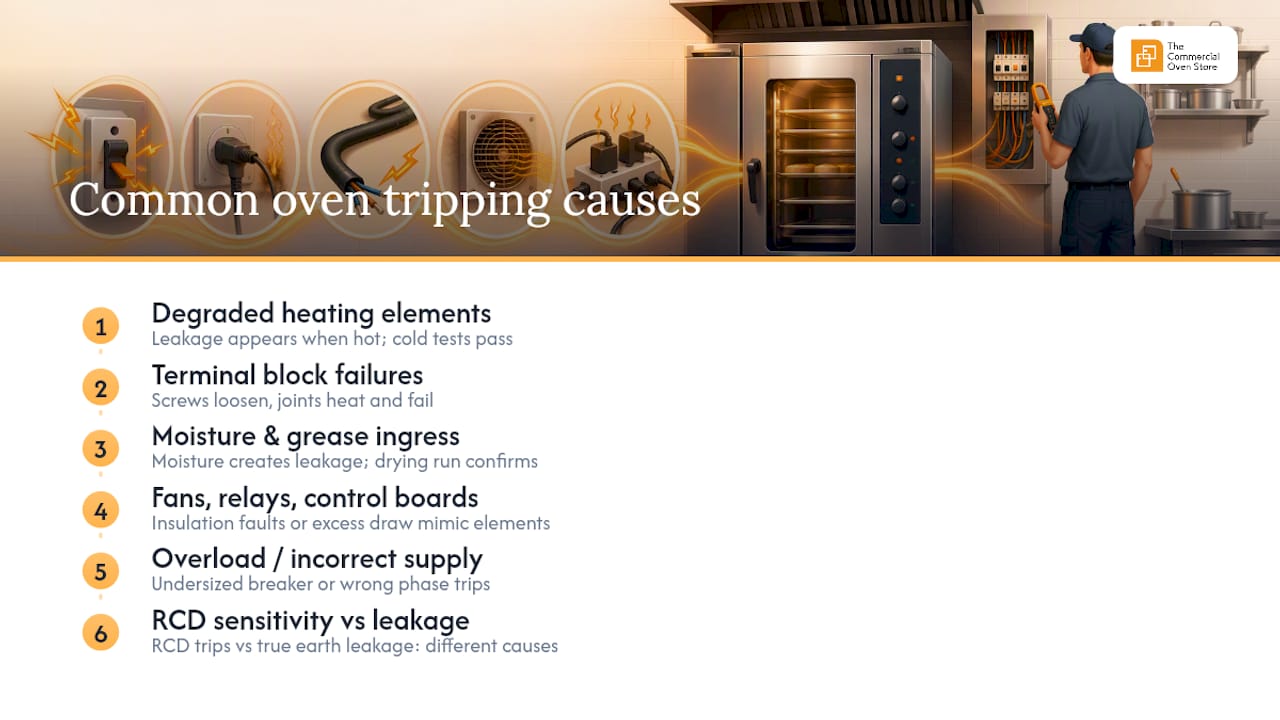
- Why commercial ovens actually trip: the six usual suspects
- How to safely check a tripping oven before calling anyone
- Appliance technician or electrician: who actually fixes this?
- Maintenance that actually cuts down on trips
- Where to get further help with power sizing and installation
- An editorial take on troubleshooting commercial oven trips
- Sources
What your oven’s trip pattern is telling you
The timing of the trip is the single best clue you have before anyone opens a panel. Commercial kitchens rarely get the luxury of a slow diagnosis, so reading the pattern correctly saves a wasted call-out.
An oven that trips the instant you switch it on almost always has a direct short to earth. That’s usually a failed element touching the casing, or a wiring fault that’s been building for a while and finally made contact. This kind of immediate trip on start-up is one of the most diagnostically useful symptoms in the whole troubleshooting process, because it rules out slow, heat-related causes straight away.
A trip that only happens a few minutes in, or once the oven reaches temperature, points somewhere else entirely. That delay is the signature of insulation breaking down under thermal expansion, or a terminal connection heating up and losing contact quality as the load rises.
- Trips instantly on power-up: hard short, likely a failed element or damaged wiring touching the chassis.
- Trips after a few minutes or at higher heat: element insulation leakage, or loose terminals heating under load.
- Trips only on one function (grill, fan, or a specific zone): the fault sits in that circuit or its element, not the whole unit.
- Trips intermittently, with no clear pattern: loose connections, moisture migrating through the cavity, or a failing relay.
- Circuit trips even with the oven unplugged: the fault isn’t the oven at all. Look at the breaker, RCD, or building wiring.
That last pattern matters more than any other, because it changes who you call. If the breaker or RCD trips with nothing plugged into it, you’re no longer dealing with an appliance issue.
Why commercial ovens actually trip: the six usual suspects
Six mechanisms account for the overwhelming majority of tripping calls in commercial kitchens. Knowing which one you’re dealing with narrows the fix before a technician even arrives.
Degraded heating elements. As an element heats, it expands slightly, and if the internal insulation has developed micro-cracks, current starts leaking to earth exactly when it’s hottest. This is why an oven can test fine cold and trip reliably once it’s up to temperature. Heating element failure is the single most frequent cause of tripping in ovens over five years old, and a fault that only shows up hot is one of the most commonly missed causes in a rushed diagnosis, because a resistance check done cold can pass while the real fault only appears under thermal load.
Terminal block and connection failures. Every thermal cycle, the wiring inside an oven expands and contracts. Over hundreds of cycles, screw terminals work loose, lugs corrode, and resistance at the joint climbs. Technicians frequently find scorched or blackened terminal blocks on ovens that trip specifically after preheat or during a long bake, because that’s exactly when the loosened joint gets hot enough to fail.
Moisture and grease ingress. An oven left idle for a week, or one that’s just been through an aggressive steam clean, can trip repeatedly until it’s genuinely dry inside. Moisture creates a leakage path across components that would otherwise test perfectly. A controlled low-heat drying run often confirms this as the cause on its own, without any parts needing replacement.
Fan motors, relays and control boards. These components can develop their own insulation faults or draw excess current as they age, tripping the circuit in ways that look identical to an element fault until someone isolates the circuit properly.
Overload and incorrect supply. Commercial ovens are rated for specific circuits, and large units are frequently incompatible with a standard single-phase domestic-style supply. If a unit is installed on an undersized breaker, or with an unsuitable phase configuration, it can trip under load despite the oven being in good condition.
An oversensitive RCD versus genuine leakage. Not every trip is a fault. Occasionally an RCD trips on overcurrent while a breaker trips purely on earth leakage, and separating those two failure modes early tells you whether you’re chasing a load problem or a genuine leakage path.
How to safely check a tripping oven before calling anyone
Work through this sequence in order. Each step either clears a possibility or narrows where the fault sits, and none of the first four steps require anything beyond a torch and common sense.
- Isolate the oven completely. Switch it off, then isolate it at the wall or local isolator. Do not attempt any of the following steps with the unit live.
- Stop resetting the breaker repeatedly. If it trips again immediately, that’s not a fluke. A breaker or GFCI that won’t stay reset is a professional’s definitive sign of a persistent ground fault, not something to keep flicking back on.
- Run the isolate test. Disconnect the oven entirely from the circuit, then reset the breaker on its own. If it holds with the oven disconnected, the fault is in the appliance. If it trips anyway with nothing connected, the fault is in the wiring, the breaker itself, or the switchboard.
- Test functions individually, where the oven design allows it. Run the fan alone, then the grill, then bake, to see whether the trip follows one specific circuit rather than the whole unit.
- Inspect visually while cold. Look for scorch marks around the terminal block, discoloured or brittle wiring insulation, pooled grease near elements, or any dampness in the cavity.
- Leave insulation resistance testing to a qualified tester. A megger test on the elements and supply cable is the definitive way to confirm insulation breakdown, and checking for current leakage this way is the standard diagnostic step for intermittent trips triggered by heat or specific cycles. Continuity checks with a multimeter and a look at the breaker’s trip curve against the oven’s actual current draw round out a proper professional diagnosis.
Pro Tip: Keep a written log every time the oven trips: the time, which function was running, and how long it had been on. Three or four entries usually reveal the pattern faster than any single inspection does.
Stop immediately and call a professional if you smell burning, see any sparking, or the breaker refuses to reset after one attempt. None of those are DIY situations, regardless of how confident you feel with a screwdriver.
Appliance technician or electrician: who actually fixes this?
Getting the right tradesperson out first time saves a repeat call-out fee and a second day of downtime. The split is straightforward once you know which side of the plug the fault sits on.
An appliance technician handles anything inside the oven itself: elements, internal wiring, terminal blocks, fan motors, relays, and control boards. An electrician handles the breaker, the RCD, the circuit wiring back to the distribution board, and anything to do with supply phase or capacity. If your isolate test showed the circuit trips even with the oven unplugged, you need the electrician, not the appliance side.
Check whether the oven is still under manufacturer warranty before booking an independent repair. If it is, manufacturer support will generally insist on a professional diagnosis rather than any attempt to bypass the safety device yourself, and using their own network can protect the warranty.
Whoever you call, give them this upfront:
- When the trip happens (instantly, after a few minutes, or only on one function).
- Whether the breaker trips with the oven disconnected.
- The type of protection device: MCB, RCD, or RCBO.
- The oven’s model and power rating.
- Any recent cleaning cycles, repairs, or idle periods before the fault started.
If there’s any smell of burning or a breaker that won’t hold, treat it as urgent and get someone out the same day rather than waiting for a scheduled slot.
Maintenance that actually cuts down on trips
Most tripping faults don’t appear overnight. They build over months of thermal cycling, idle periods, and cleaning cycles, which means a handful of scheduled habits catch problems long before they cause a shutdown.
- Book element inspections on a fixed schedule, and plan replacements proactively on ovens over five years old rather than waiting for failure.
- After any long idle period or a steam or self-clean cycle, run the oven at low heat for 15 to 20 minutes to dry out residual moisture before full use.
- Have terminal block connections checked and torqued during every scheduled service visit, not just when a fault appears.
- Confirm the circuit is genuinely dedicated to the oven, and that the phase allocation matches the unit’s requirements, at installation and again during any kitchen refit.
- Log every trip event rather than dismissing it. A trip is a diagnostic marker, not an inconvenience to reset away.
Pro Tip: If you’re refitting or repositioning kitchen equipment, poor cable routing and proximity to steam sources are a common hidden cause of moisture-related trips. Getting placement right at installation avoids most of it.
Where to get further help with power sizing and installation
A large share of tripping calls Thecommercialovenstore hears about trace back to a mismatch between the oven and the circuit it’s sitting on, not a fault with the appliance itself. Our guide on commercial oven power requirements covers the dedicated circuit and phase rules that many kitchens get wrong at installation, and the companion piece on single-phase versus three-phase supply explains why a unit built for one won’t run safely on the other.
Simon, who covers technical buying guidance for Thecommercialovenstore, put this piece together drawing on field electrician practice and the supply-matching issues that come up repeatedly when kitchens choose and install commercial ovens. If a diagnosis points to a unit that’s simply undersized or mismatched for its circuit, our team can advise on correctly rated replacements and installation planning, and flexible payment through iwocaPay is available for kitchens replacing equipment sooner than planned.
An editorial take on troubleshooting commercial oven trips
The advice most kitchens get is backwards. It treats a trip as an annoyance to reset past, when it’s actually the most useful diagnostic signal the oven gives you for free. Every reset without an isolate test throws that information away.
The conventional wisdom overrates parts-swapping and underrates the fifteen minutes it takes to disconnect the oven and test the circuit alone. That single step tells you, immediately, whether you’re paying for an appliance technician or an electrician, and it costs nothing but patience. Too many call-outs get booked to the wrong trade because nobody ran that test first.
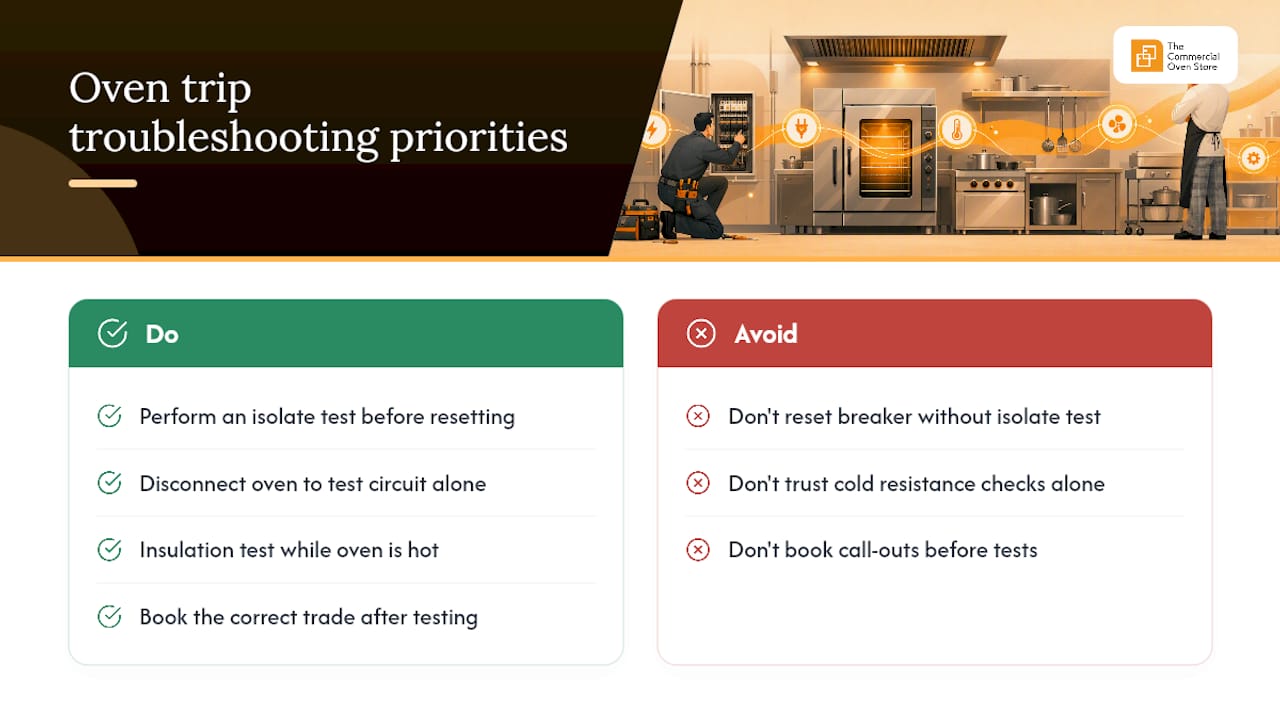
What the evidence actually supports is treating heat-dependent faults with more suspicion than they usually get. A cold resistance check can pass cleanly on an element that’s about to fail hot, which means “it tested fine” is often not the reassurance operators think it is. If a trip only happens once the oven’s up to temperature, insist on an insulation test under those conditions before anyone declares the unit sound.
Prioritise the isolate test, distrust a cold pass on a heat-triggered fault, and never let a breaker get reset more than once.
— Simon
Sources
- What causes ovens to trip electrics and how to prevent it
- Electrolux support article: oven blows/trips fuses