

You need ducted extraction to outside that meets Approved Document F minimums; a recirculating hood on its own does not comply. Domestic kitchens need at least a 30 l/s intermittent extract fan next to the hob or a 60 l/s cooker hood, plus background ventilation. Commercial kitchens add DW/172 canopy design and a BS 6173 interlock, and any gas work must go through a Gas Safe registered engineer.
TL;DR:
- Domestic kitchens must have a ducted external extractor with at least 30 l/s for intermittent fans or 60 l/s for cooker hoods; recirculating hoods do not meet Part F requirements.
- Commercial kitchen ventilation must comply with DW/172 and BS 6173 standards, including properly sized canopies, grease filtration, and gas interlocks for safety.
- Accurate measurement and documentation of airflow rates, commissioning tests, and maintenance records are essential for legal compliance and inspection readiness.
- Professional installation requires Gas Safe registration for gas work, proper commissioning, and proof that the interlock system functions correctly before use.
- Proper planning, including specifying, testing, and recording performance data, is more critical than choosing hardware alone to avoid costly non-compliance issues.
Table of Contents
- Which laws and official documents govern oven and kitchen ventilation
- The extraction numbers you actually need to hit
- Commercial kitchens: canopy design, interlocks and make-up air
- Compliance checklist: specify, test and record
- Maintenance, fire safety and who’s responsible
- Who to hire and what to check before you pay
- Practical notes from Thecommercialovenstore
- Why the paperwork matters more than the hardware
- Sources
- FAQ
Which laws and official documents govern oven and kitchen ventilation
Three documents do the real work here, and they rarely get read together, which is where most confusion starts.
Approved Document F covers requirement F1, the means of ventilation for a dwelling. It sets out extract ventilation for wet rooms including kitchens, whole-dwelling background ventilation, and purge ventilation for clearing pollutants quickly after cooking or decorating. The current edition also flags transitional arrangements, so check which version applies if your build straddles an update date.
Approved Document J deals with combustion appliances and fuel storage, including flue design and carbon monoxide risk from any gas or solid fuel appliance in the kitchen. It works alongside Part F rather than instead of it: Part F clears cooking moisture and odour, Part J makes sure combustion gases have a safe route out.
Gas safety law sits outside the Building Regulations entirely. Under the Gas Safety (Installation and Use) Regulations 1998, any gas appliance must be installed by a Gas Safe registered engineer, and adequate ventilation is a legal precondition for safe operation, not an optional extra.
- Approved Document F: kitchen extract, background vents, purge ventilation
- Approved Document J: flues, combustion safety, carbon monoxide
- Gas Safety Regulations 1998: installer competence and ventilation adequacy for gas appliances
The extraction numbers you actually need to hit
Part F gives you two workable routes for a kitchen extract, and picking the wrong one is the single most common domestic mistake.
- Intermittent extract fan positioned adjacent to the hob: minimum 30 l/s
- Cooker hood: minimum 60 l/s in intermittent operation
- Background ventilation: trickle vents sized to an equivalent area set out in the Part F tables, plus whole-dwelling supply of at least 0.3 l/s per m² of floor area
- Purge ventilation: enough operable window or equivalent to achieve four air changes per hour when you need to clear the air fast
Pro Tip: A recirculating hood filters grease and odour through a carbon filter and blows the air straight back into the room. It never removes moisture, so it does not satisfy Part F’s core objective no matter how expensive the unit is.
Hood mounting height matters too: too high and capture efficiency collapses, too low and it becomes a hazard over a hot hob. If your kitchen has no external wall nearby, ducting to outside is still the requirement, not a convenience you can skip because the run is awkward.
Commercial kitchens: canopy design, interlocks and make-up air
Domestic rules stop applying the moment you’re running a catering operation, and the technical bar rises sharply. HSE’s CAIS10 information sheet points operators towards two industry documents that do the heavy lifting: DW/172, the specification for kitchen ventilation systems, and BS 6173, which governs gas-fired catering appliance installation.
- DW/172 sets canopy sizing, grease filtration standards and discharge guidance, with grease filter performance tested against LPS 1263
- BS 6173 requires an air-proving interlock that stops gas appliances firing if extraction fails or isn’t running
- Make-up air has to match what the canopy extracts, or the kitchen depressurises and pulls combustion gases back in through the nearest gap
- Discharge points need to sit clear of fresh-air intakes, windows and public walkways to avoid re-entrainment or nuisance complaints
Pro Tip: Never let a canopy get specified after the appliance line-up is fixed. Extraction volume, discharge routing and make-up air all depend on total heat load, and retrofitting a canopy to an existing kitchen almost always costs more than getting the design brief right first. A competent ventilation designer should be commissioning and signing off performance figures, not just installing to a catalogue spec.
Compliance checklist: specify, test and record
Getting this right on paper matters as much as getting it right on site, because building control and environmental health officers both want evidence, not assurances.
- Before installation, confirm extract rate, duct route, external termination point, make-up air strategy and interlock requirements in writing with your installer.
- At commissioning, request measured airflow figures in l/s, a smoke or capture test at the hood face, and noise readings if the kitchen is near living or working space.
- Get a signed commissioning report that states the measured performance against the design figures, not just a “works fine” sign-off.
- Retain documentation long after installation: manufacturer instructions, the commissioning certificate, Gas Safe certification for any gas work, and a maintenance schedule.
- Notify building control for kitchen extensions, new gas appliance installs, or any change that alters the ventilation strategy. Most straightforward like-for-like hood replacements don’t need notification, but a new build or a knocked-through kitchen almost always triggers a full Part F check.
| What to collect | Why it matters |
|---|---|
| Measured extract rate (l/s) | Proves the installed system meets Part F minima, not just the spec sheet |
| Commissioning report | Written evidence for building control or an EHO inspection |
| Gas Safe certificate | Legal requirement for any gas appliance work |
| Maintenance schedule | Shows ongoing compliance, not just day-one compliance |
Maintenance, fire safety and who’s responsible
A perfectly designed system that nobody cleans stops being compliant fairly quickly. Grease accumulation in canopy filters and ductwork is a recognised fire hazard, and inspectors treat a neglected system as a live risk, not a paperwork issue.
- Canopy filters need regular cleaning on a schedule matched to cooking volume, not a fixed calendar date
- Ductwork needs periodic professional cleaning, and the system needs inspection access points that let engineers actually reach it
- Kitchen managers should keep dated maintenance and inspection records, since these are what an EHO or insurer asks for after an incident
- Daily checks by kitchen staff, filters clear, hood running, no unusual noise, catch problems before they become fire risks
Pro Tip: Write the cleaning frequency into your food safety management documentation, not just a separate maintenance file. If a fire inspector or EHO asks who’s accountable, “it’s in our HACCP paperwork” answers the question instantly. Under workplace and food hygiene rules, that responsibility sits with the employer or premises owner, never with whichever member of staff happened to notice the grease last.
Who to hire and what to check before you pay
Credentials matter more here than almost anywhere else in a kitchen fit-out, because a badly interlocked system is a safety failure waiting to happen.
- Insist on Gas Safe registration for any engineer touching a gas appliance, and ask to see the certificate and scope of work before they start
- Choose ventilation contractors who can demonstrate DW/172 experience and air-balancing competence, not just duct installation
- Ask for commissioning sheets showing actual measured airflow, not a manufacturer’s theoretical figure
- Demand documented proof the interlock works, gas should not fire without extraction running
- Bring in a building services engineer for anything beyond a straightforward single-appliance swap
Practical notes from Thecommercialovenstore
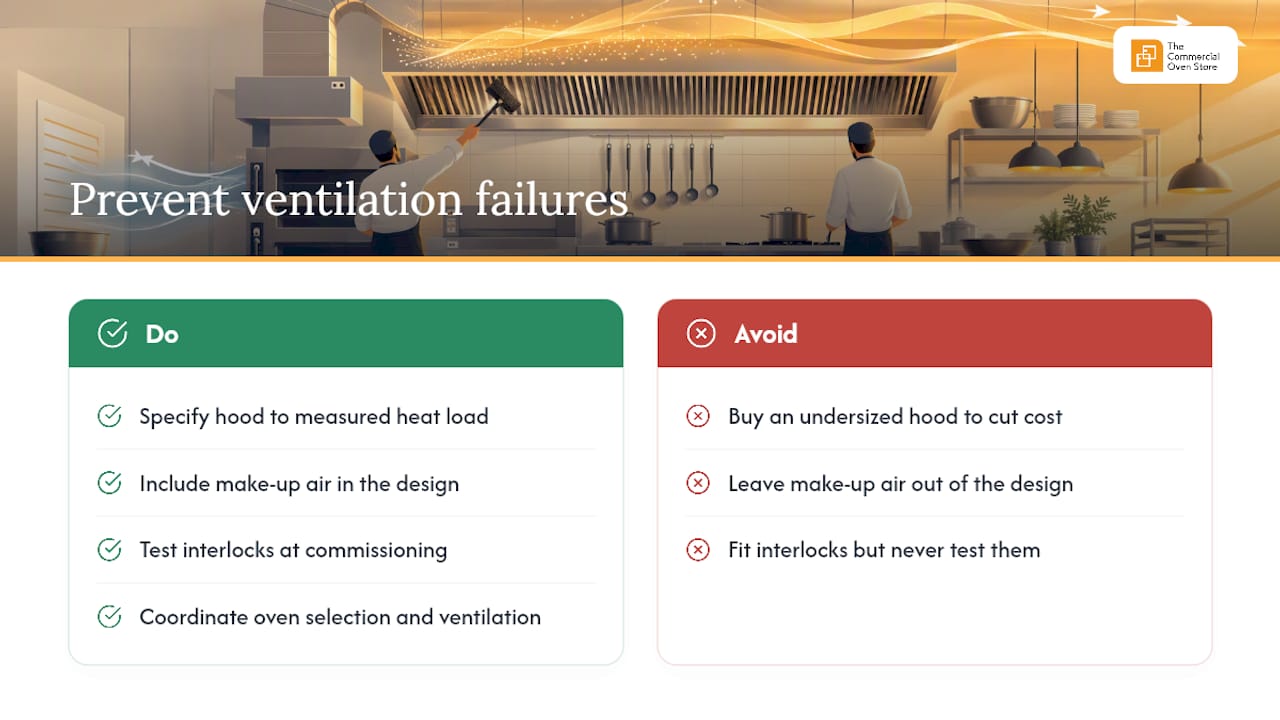
Most ventilation failures we see on commercial installs trace back to three things: an undersized hood bought to match a budget rather than a heat load, make-up air left out of the design entirely, and interlocks fitted but never actually tested at commissioning. All three are avoidable with a proper specification stage.
Getting oven selection and ventilation planning right together saves a second, expensive conversation later. Thecommercialovenstore’s installation service and expert advice exist for exactly that reason, matching an appliance to a kitchen’s real extraction capacity before the order goes in, not after. Compatible installation kits can also simplify the physical fit between oven and existing ductwork on tighter refurbishments.
Why the paperwork matters more than the hardware
The technical detail in Part F and DW/172 is not the hard part. Extract rates, duct sizes and canopy dimensions are all published numbers that any competent installer can hit. What actually causes non-compliance, in my reading of how enforcement plays out, is a documentation gap: nobody commissioned the system properly, nobody kept the certificate, and nobody can prove the interlock ever worked.
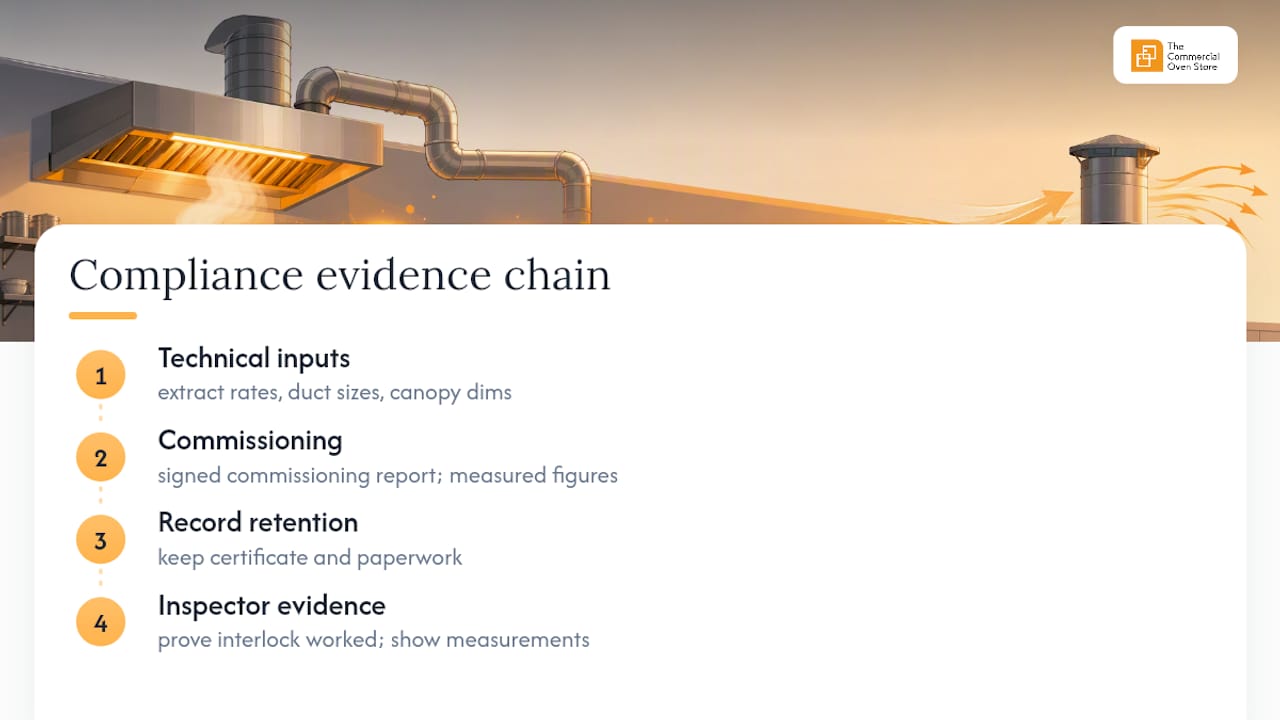
Conventional advice tends to focus entirely on picking the right hood or fan. The harder 20%, and the part building control and EHOs actually check, is whether you can produce a signed commissioning report with real measured figures. Homeowners rarely get asked for one until they sell or extend. Commercial operators get asked constantly, often after something has already gone wrong.
If you take one thing from this, prioritise the paper trail as highly as the airflow. A correctly sized system with no commissioning record is, in the eyes of an inspector, indistinguishable from an incorrectly sized one.
— Simon
Sources
FAQ
What are the rules for air vents for gas hobs and ovens in the UK?
Approved Document F requires a minimum 30 l/s intermittent extract fan next to the hob, or a 60 l/s cooker hood, backed by trickle-vent background ventilation. Any gas appliance also needs adequate ventilation under the Gas Safety Regulations 1998 to prevent carbon monoxide build-up.
What are the legal ventilation requirements for a UK kitchen?
Domestic kitchens must meet Approved Document F’s extract, background and purge ventilation standards, while combustion appliances also fall under Approved Document J for flue and carbon monoxide safety. Commercial kitchens add DW/172 and BS 6173 standards on top of these baseline rules.
Is an extractor fan a legal requirement in a UK kitchen?
Yes, functionally. Building Regulations require either an intermittent extract fan rated at 30 l/s or a cooker hood rated at 60 l/s in any new or altered kitchen, so some form of mechanical extraction is effectively mandatory.
What British Standards apply to kitchen ventilation?
BS 6173 governs the installation of gas-fired catering appliances and requires an air-proving interlock between ventilation and gas supply. DW/172 is the trade specification covering canopy sizing, grease filtration and ductwork design in commercial settings.
Does a recirculating cooker hood meet Part F requirements?
No. A recirculating hood removes grease and odour through a filter but sends the air straight back into the room, so it never removes moisture. Part F’s ventilation objective requires ducted extraction to outside for compliance in most kitchens.