

Most commercial ovens need a hardwired, dedicated circuit rather than a plug. The exception is a small category of countertop or speed ovens that manufacturers explicitly configure for 13A single-phase plug use. If you’re unsure which category your oven falls into, plan for a hardwired supply. It’s the safer default and avoids compliance, insurance and warranty headaches down the line.
TL;DR:
- A hardwired supply supports higher power loads, three-phase configurations, and ensures compliance, insurance, and warranty protections in commercial kitchens.
- Most ovens over 3kW require dedicated circuits, with larger models often needing three-phase power and careful load balancing to reduce voltage drop.
- Proper site preparation, including confirming supply capacity and coordinating with electricians before delivery, prevents delays and costly upgrades.
- Using adapters or plugging in high-power ovens without verifying the nameplate ratings can pose fire risks and void warranties.
- Switching from a plug-in to a hardwired oven involves running a new circuit and scheduling electrical work ahead of oven replacement to avoid operational downtime.
Table of Contents
- Plug vs hardwired oven: weighing the pros and cons
- What UK electrical standards actually require
- Reading the nameplate: when plug, single-phase or three-phase applies
- Getting your site ready before delivery day
- Why the wrong supply choice creates real risk
- Moving from a plugged-in oven to a hardwired setup
- Maintenance and troubleshooting: what actually differs
- Why we default to hardwired unless the nameplate says otherwise
- Get your electrical spec confirmed before you order
- Sources
Plug vs hardwired oven: weighing the pros and cons
The plug vs hardwired oven decision comes down to power draw, not preference. A plug offers speed and flexibility. A hardwired circuit offers headroom and compliance certainty. Here’s how they actually stack up against each other in a working kitchen.
When a plug genuinely works:
- You’re running a low-power countertop speed oven, typically rated well under 3kW, that the manufacturer has explicitly built for 13A single-phase use.
- You need to install fast, perhaps in a pop-up kitchen, food truck prep area, or a unit awaiting a full electrical fit-out.
- The equipment might move between sites or get relocated within the kitchen as layouts change.
Where plugs fall short:
- A standard 13A socket caps you at roughly 3kW continuous draw. Push a heavier appliance through it, or double up with an adapter, and you’re inviting overload.
- Plug-in setups rarely scale. Add a second oven or a bigger model later and you’re straight back to rewiring.
- Menu growth is the silent killer here: what fits on a plug today often doesn’t fit in twelve months.
Hardwired circuits, by contrast, support higher continuous loads, allow three-phase distribution for larger combi and deck ovens, and satisfy insurers and inspectors who expect fixed appliances to be fixed-wired.
Pro Tip: Never assume a plug is fine because the oven “looks small.” Check the nameplate current rating against your socket’s rated capacity before you plug anything in.
What UK electrical standards actually require
BS 7671:2018+A3:2024, the current edition of the IET Wiring Regulations, sets the technical benchmark that UK electricians work to. Installations that follow it are treated by the Health and Safety Executive as evidence of meeting the Electricity at Work Regulations 1989, which is the legislation that actually carries legal weight.
In practice, this standard drives several decisions your electrician will make before an oven ever gets switched on.
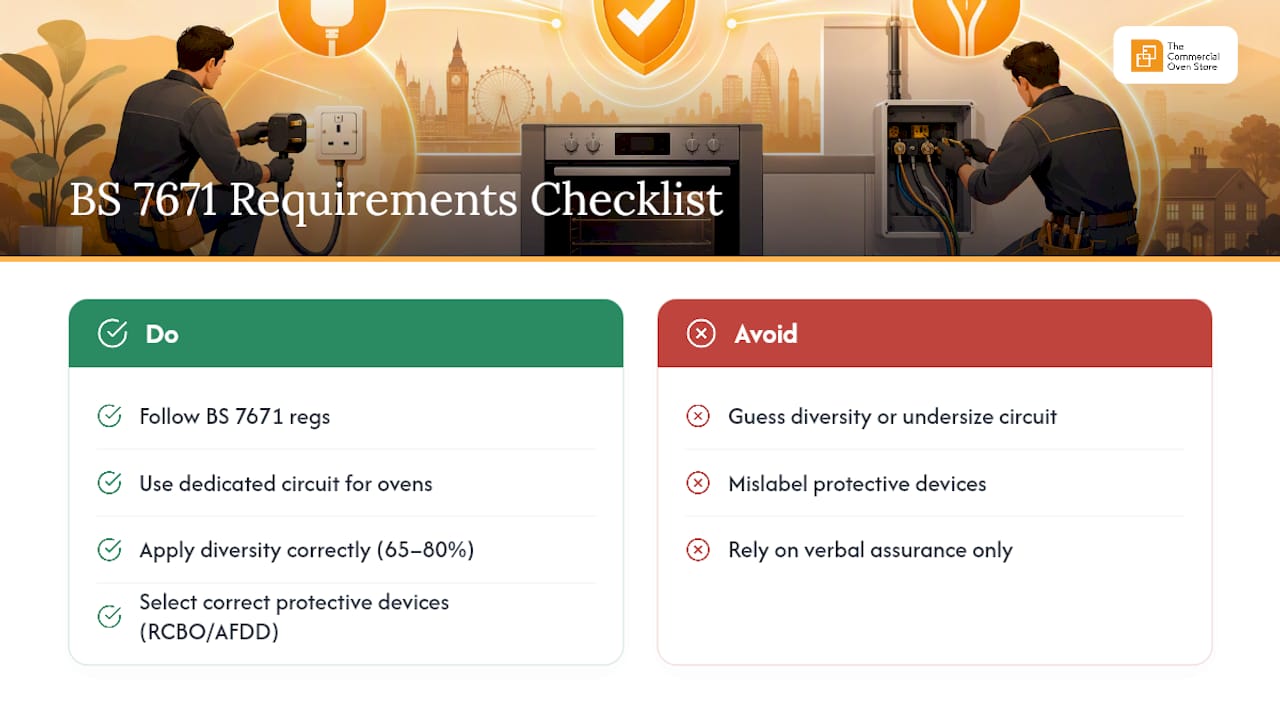
High-current cookers and ovens are generally expected to sit on their own dedicated circuit, sized and protected to minimise the risk of fire, electric shock and burns. Diversity factors, sometimes reducing calculated load to 65 to 80% of total nameplate demand, still have to be applied correctly rather than guessed.
That last point matters more than it sounds. Get the diversity calculation wrong and you either undersize a circuit dangerously or oversize it needlessly, wasting money on cable and switchgear you didn’t need.
Protective device selection also comes into it. RCBOs and, increasingly, AFDDs need correct labelling for unidirectional or bidirectional use, and getting that wrong can trip nuisance faults or miss genuine ones. None of this is optional extra care. It’s the baseline that determines whether your installation is legal, insurable and covered under warranty. A qualified electrician working to current oven power requirements should issue a signed certificate confirming the circuit meets these rules, not just a verbal assurance that “it’ll be fine.”
Reading the nameplate: when plug, single-phase or three-phase applies
Every oven nameplate tells you exactly what it needs. Ignore it and you’re guessing. Read it properly and the plug vs hardwired oven question mostly answers itself.
As a rough guide:
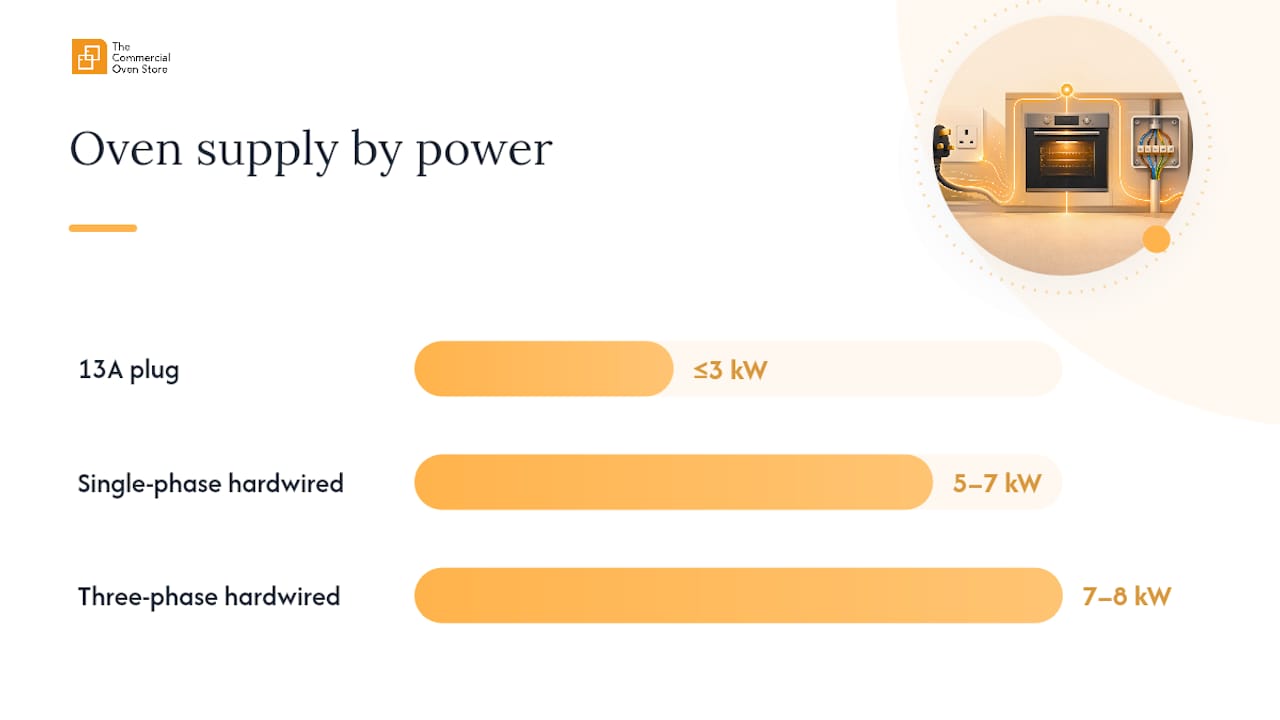
- Under roughly 3kW, single-phase: small countertop speed ovens sometimes ship in a genuine 13A plug configuration. The Merrychef E2S Standard Power Classic is a documented example, available specifically as a 13A single-phase model for this use case.
- Roughly 5 to 7kW, single-phase hardwired: small to mid combi ovens generally sit here, needing a dedicated circuit even though they’re still single-phase.
- Above roughly 7 to 8kW, or 10-tray combi format: this is where three-phase supply becomes the norm rather than the exception. Larger Bakerlux-style ovens, such as six-tray and ten-tray models, typically fall into this bracket and need higher supply capacity from the outset.
Three-phase isn’t just about raw power ceilings. Balancing heavy continuous loads across three phases keeps cable sizes down and reduces voltage drop compared with trying to push the same energy through a single-phase feed, which is one reason larger kitchens standardise on it even when a single-phase alternative technically exists on paper.
Here’s the trap: the same oven model can sometimes be ordered in different supply configurations. One buyer gets a 13A plug variant, another gets a three-phase hardwired version of what looks like an identical box. Before you order, confirm voltage, current rating in amps, phase count and any installation notes directly against the spec sheet, not against what a similar-looking model needed last time. Compare options using a single-phase versus three-phase breakdown if you’re weighing up which configuration suits your kitchen’s growth plans.
Getting your site ready before delivery day
Electrical readiness has to happen before the oven arrives, not after the driver’s already unloading it. Skip this sequence and you’re either paying for an emergency electrician callout or storing an oven you can’t switch on.
Before you order:
- Confirm the exact electrical configuration with your supplier in writing, including phase count and current rating.
- Request the technical spec sheet and installation drawing rather than relying on a product photo or generic description.
- Check spare ways and available phases at your existing distribution board, ideally with your electrician present.
Budget and timeline realities: electrician labour and a new dedicated circuit are usually the quickest part of the job. Distribution board upgrades add time and cost if spare capacity doesn’t exist. The real variable is a three-phase supply upgrade from your network operator, which can run from a few thousand pounds into the tens of thousands depending on local capacity, and take weeks to months to complete. Building in that lead time early avoids a finished kitchen sitting idle while you wait for the grid connection.
On site, your electrician handles: load calculation against existing circuits, correct cable sizing and routing, RCD or RCBO selection, circuit labelling, and final commissioning with BS 7671 certification.
Pro Tip: Loop your dealer, electrician and landlord or building inspector into the same conversation early. Schedule delivery only once the electrician confirms the circuit is live and tested, not “should be fine by then.”
Guidance on placement and access is worth reading alongside this checklist, since where an oven sits often dictates cable routing distance and cost.
Why the wrong supply choice creates real risk
Getting the plug vs hardwired oven decision wrong doesn’t just risk a tripped breaker. It creates fire hazards, voids warranties and can hand an insurer a legitimate reason to deny a claim.
- Adapters that up-rate a socket, such as forcing extra current through a connector never designed for it, are a well-documented cause of dangerous overloads, and insurance assessors actively look for this kind of misuse after any incident.
- Many manufacturers state hardwiring as a condition of warranty for anything above their smallest models. Deviate from the installation manual and you may find the warranty simply doesn’t apply when something fails.
- RCD or GFCI-style protection is expected on most kitchen circuits, but the specific type needs to be coordinated with manufacturer guidance. Some electronic control boards are prone to nuisance tripping on the wrong RCD type.
- Keep the installer’s certificate, dated nameplate photographs and full commissioning paperwork together. If an inspector, insurer or landlord ever asks for proof of compliant installation, this is what settles the question in minutes rather than weeks.
None of this is paperwork for its own sake. It’s the evidence trail that protects you if something ever does go wrong.
Moving from a plugged-in oven to a hardwired setup
Outgrowing a plug-in oven is common, and the transition is more straightforward than most operators expect if you sequence it properly.
Start with a load calculation on the new oven’s actual nameplate rating rather than assuming it slots into the existing circuit. Most upgrades from a 13A plug to a hardwired supply involve running a new dedicated circuit back to the distribution board, since the original socket circuit was never sized or protected for the new load. This usually means new cable, a new protective device sized for that specific current, and in some cases a board with a free way to accept it.
Timing matters here. Book the electrical work before the replacement oven arrives, not concurrently. A kitchen with a half-finished circuit and a new oven sitting in its packaging is a common and entirely avoidable delay.
If the upgrade pushes total kitchen load close to or above your existing supply capacity, this is the point where a three-phase conversation with your network operator needs to start, given the lead times involved. It’s worth raising with your electrician even if the immediate oven swap doesn’t strictly need it, since a kitchen expanding its equipment once tends to expand it again.
Keep the old plug-in oven’s nameplate and any commissioning documents for the new circuit. If you sell or relocate the old unit, the buyer will want to know exactly what supply it needs, and you’ll want your new installation’s paperwork on file regardless.
Maintenance and troubleshooting: what actually differs
Plug-in and hardwired ovens fail differently, and knowing which category you’re dealing with changes how fast a fault gets fixed.
A plug-in oven that trips or stops working often has a simpler first diagnostic step: check the socket, check the plug fuse, check for a tripped RCD on that circuit. Staff can sometimes rule out the obvious causes before an electrician is even called, because the connection point is accessible and visible.
Hardwired ovens remove that first-line troubleshooting option. There’s no plug to swap or fuse to inspect by eye, so a fault almost always means calling a qualified electrician to isolate the circuit safely and test it properly. This isn’t a downside so much as a trade-off: the same fixed connection that prevents accidental disconnection or overload also means diagnosis needs a professional from the outset.
Routine maintenance differs too. Plug-in units are easier to isolate for cleaning or servicing since you can simply unplug them. Hardwired ovens need isolation at the local switch or distribution board, which means staff need to know exactly which circuit and switch corresponds to which appliance, particularly in kitchens running several ovens off different circuits.
Whichever setup you run, build a simple habit: label the isolation point clearly, log any fault and its resolution, and keep the installer’s contact details posted near the board. It saves confusion during a genuine emergency, when nobody wants to be tracing cables to find the right switch.
Why we default to hardwired unless the nameplate says otherwise
Our starting position at Thecommercialovenstore is simple: unless you’re buying a small countertop speed oven that the manufacturer has explicitly configured and certified for 13A plug use, plan on hardwiring it. That’s not caution for caution’s sake. It reflects how commercial kitchens actually evolve, menus expand, equipment gets added, and today’s comfortable margin on a plug circuit becomes tomorrow’s overload risk.
The one piece of advice worth repeating to every kitchen manager: never assume based on size or looks. Validate the nameplate rating against the supply, confirm it with a qualified electrician, and get it in writing before delivery day.
Thecommercialovenstore specialises in commercial ovens from established manufacturers, offers flexible payment through iwocaPay, and provides direct advice on site readiness before you commit to an order. Request a spec sheet, ask about supply configuration, and book a pre-delivery check rather than discovering the answer after the van’s already outside.
— Simon
Get your electrical spec confirmed before you order
Thecommercialovenstore takes the guesswork out of matching an oven to your existing supply, something a generic equipment listing simply can’t do. Rather than choosing blind and finding out during installation that you need three-phase work you hadn’t budgeted for, our team checks the nameplate and supply requirements against your site before you commit.
Browse the full oven range to compare single-phase and three-phase models side by side, or look at the Merrychef E2S 13A single-phase if a compact, plug-capable speed oven suits your counter space. For growing kitchens stepping up to a six-tray or ten-tray Bakerlux, we’ll talk you through the supply upgrade before you order, not after. iwocaPay is available to spread the cost of the oven and any accessories you need alongside it. Get in touch to request a site survey or a written electrical spec for the model you’re considering, and know exactly what your electrician needs to do before it arrives.
Sources
- BS 7671:2018 Amendment 3:2024 (BSI brochure)
- BS 7671 key changes and implications — Total Skills guide
- Restaurant electrical, gas, plumbing & vent specs (operator guide) — Kitchnry