

Every UK restaurant kitchen needs six equipment categories covered before opening day: cooking, refrigeration, food preparation, warewashing, storage, and fire/ventilation safety. The single rule that decides how much of each you buy is simple. Size everything to your covers and your menu, staying conservative on consumables and generous on the equipment that would stall service if it failed. Get that sequencing right and the rest of this restaurant equipment checklist for UK kitchens becomes a matter of detail, not guesswork.
TL;DR:
- Equipment should be sized according to the kitchen’s peak 90-minute service workload, not average daily covers, to ensure smooth operation.
- Refrigeration units must be energy-efficient, with sufficient capacity for at least a week’s frozen and several days’ chilled stock, to prevent stock loss and inspection failures.
- Fire safety includes correctly sized extraction hoods, wet chemical suppression systems, and appropriate fire extinguishers over fryers and high-temperature cooklines.
- Advancing planning on power supply and ventilation before purchase reduces costly retrofits and project delays, especially for larger combi ovens and induction ranges.
- Operating a HACCP-compliant system with digital temperature logging and disciplined stock rotation simplifies inspections and prevents food safety failures.
Table of Contents
- Cooking equipment: ovens, ranges, fryers, grills and speciality ovens
- Refrigeration and freezing: what to buy and how to size
- Food preparation equipment and essential smallwares
- Warewashing, cleaning and hygiene kit
- Storage and shelving: keep stock organised and compliant
- Front-of-house and service equipment
- Consumables, disposables and packaging checklist
- Technology and systems: POS, inventory and ordering
- Safety, ventilation and fire protection essentials
- Buying considerations: sizing, power and energy in UK kitchens
- Compliance and HACCP basics for UK operators
- Maintenance, service plans and budgeting for lifecycle costs
- Publisher expertise: practical tips from The Commercial Oven Store
- Launch checklist: day one and first 90 days
- How The Commercial Oven Store can help with ovens and installation
- Sources
- FAQ
Cooking equipment: ovens, ranges, fryers, grills and speciality ovens
Your cookline is the one part of a commercial kitchen essentials list you cannot retrofit cheaply, so get the core decision right before anything else. A combi oven (steam plus convection) suits menus that swing between roasting, steaming, and reheating. A straight convection oven is the workhorse for bakeries and cafés running consistent batch bakes. Stone-deck and pizza ovens earn their space only if pizza or flatbread is a genuine menu pillar, not a side dish.
Ranges and hobs need sizing to throughput, not floor space. A four-burner range copes with a 40-cover café; a busy 80 to 120-cover restaurant kitchen typically needs six to eight burners plus a griddle or char section to avoid bottlenecking at peak service. Gas ranges still dominate UK professional kitchens for responsiveness, but induction is gaining ground where landlords restrict gas installation or where energy costs matter more than upfront kit price.
Fryers and griddles bring their own extraction and fire-safety implications, covered in more detail later, but the buying decision itself hinges on volume: a single-basket fryer rated for light snack service will not survive a fish and chip rush.
Core cooking-line items to plan for:
- Combi or convection oven, sized to batch volume and menu variety
- Range or hob with burner count matched to simultaneous dish counts
- Fryer(s), rated by oil capacity against peak-hour fried item volume
- Griddle or char-grill for high-turnover proteins and breakfast service
- Speciality items (pizza deck, sous-vide bath, blast oven) only where the menu justifies them
Smaller kitchens with tight capital should stage purchases. Buy the combi oven and range first, since these carry the widest menu range, then add speciality equipment like a pizza deck or sous-vide setup once volume proves it out. A complete guide to commercial convection ovens is worth reading before committing capital, particularly if you’re choosing between combi and straight convection models.
Refrigeration and freezing: what to buy and how to size
Refrigeration failure is the fastest way to lose stock, cancel covers, and fail an inspection in the same afternoon, so this category deserves more budget scrutiny than most owners give it. A reach-in fridge suits low to mid-volume kitchens; undercounter units free up cookline space for mise en place; walk-in coldrooms only make financial sense once storage needs exceed roughly 15 to 20 cubic metres of chilled goods.
Blast chillers are not optional for any kitchen doing batch cooking, sous-vide, or cook-chill service, because they bring food through the temperature danger zone fast enough to meet Food Standards Agency safety expectations. If your menu depends on prepping ahead of service, a blast chiller belongs on the day-one order, not the “nice to have later” list.
Sizing storage volume against menu and par levels beats guessing. A rough starting formula: multiply your average daily covers by expected portion weight per cover, then hold two to three days of chilled stock and up to a week of frozen stock, depending on delivery frequency.
Pro Tip: Run the numbers on running costs, not just purchase price. A fridge with a stronger energy rating on the official UK energy label guidance can cost several hundred pounds more upfront but claw that back within two or three years through lower electricity draw, especially on units that run continuously.
Categories to plan for:
- Reach-in or undercounter fridges, sized to daily chilled stock volume
- Freezer capacity for at least a week of frozen goods, depending on delivery schedule
- Blast chiller if the menu includes any batch cooking or cook-chill process
- Display fridges only where front-of-house merchandising demands them
Food preparation equipment and essential smallwares
Prep equipment decides how many covers your kitchen team can turn out per hour without buckling under prep-list pressure. A stand mixer earns its place in any kitchen doing scratch bread, batters, or sauces; a food processor speeds vegetable prep and purées; a slicer is worth the investment the moment deli meats, cheese, or consistent vegetable cuts become a daily task rather than an occasional one.
Choose mixer and processor capacity against your busiest single prep session, not your average day. A 20-litre mixer bowl that copes with Tuesday’s bread order will choke on a Saturday banquet prep list.
Smallwares are the unglamorous half of any restaurant supply checklist, and they’re the items new operators most often underbudget. Order these before opening day:
- Stock pots, sauté pans, and roasting trays in a range of sizes
- A full knife set per station, plus honing steels
- Tongs, spatulas, ladles, and whisks in sufficient quantity to avoid mid-service scrambles
- Colour-coded chopping boards for allergen and cross-contamination control
- Digital probe thermometers for temperature checks at every station
Allergen hygiene deserves its own line item. Colour-coded boards (typically red for raw meat, blue for raw fish, yellow for cooked meat, green for salad, and so on) are now standard practice across UK kitchens and make HACCP compliance far easier to demonstrate during inspection. On par levels, order enough smallwares to run two full services without a mid-shift wash cycle, then adjust once you’ve watched a week of real turnover.
Warewashing, cleaning and hygiene kit
Dishwasher choice affects staffing and layout more than most owners expect, so match the machine to your actual plate-turn speed rather than your kitchen’s floor plan. Glasswashers suit bar-led venues with light crockery needs. Undercounter dishwashers handle 30 to 40 covers comfortably. Hood-type machines with a 90-second cycle are the standard choice once you’re running above roughly 60 covers, because anything slower creates a bottleneck at the pass.
A three-compartment sink for washing, rinsing, and sanitising remains a baseline requirement in most UK commercial kitchens, alongside a dedicated hand-wash basin separate from food-prep sinks. Chemical sanitiser, dishwasher detergent, and rinse aid all need a supplier account set up before opening, not sourced in a panic during week one.
- Commercial dishwasher (glass, undercounter, or hood type, matched to covers)
- Three-compartment sink plus separate hand-wash basin
- Sanitising chemicals, detergent, and rinse aid on a standing order
- Rubber gloves, aprons, and other PPE for warewashing staff
Storage and shelving: keep stock organised and compliant
Stainless-steel racking wins over timber or painted shelving in every commercial kitchen, because it resists corrosion, cleans easily, and satisfies inspectors on sight. Keep all dry stock and ingredient bins off the floor. This is both a pest-prevention measure and a near-universal requirement under food hygiene guidance.
- Stainless-steel shelving units for dry storage and walk-in coldrooms
- Sealed ingredient bins for flour, sugar, and other bulk dry goods
- Clear labelling with product name, opening date, and use-by date on every container
- A FIFO (first in, first out) rotation system applied consistently, not just when stock is tight
Front-of-house and service equipment
Service style dictates your tableware and holding equipment more than any other single factor. A fine-dining room needs full crockery sets and heated plate storage; a fast-casual counter needs stackable trays and disposable-friendly holding units instead.
- Crockery, cutlery, and glassware matched to cover count plus a 20% breakage buffer
- A POS system with order-routing to the kitchen, sized to table count and menu complexity
- Hot-holding cabinets and a pass counter positioned to keep plated food at safe serving temperature
- Trolleys or runners’ stations if your dining room spans more than one level or room
Hot-holding equipment in particular affects cookline timing. A pass that’s too small forces chefs to plate late, which cascades into slow table turns during a busy Friday service.
Consumables, disposables and packaging checklist
Packaging is where new operators most often either overstock and waste capital or understock and run out mid-service. Container sizing depends heavily on cuisine: soup and curry need leakproof round tubs, burgers and sandwiches need clamshells or wrap, and salads need tall-sided containers that survive a delivery bag.
A practical first-month approach:
- Estimate projected daily orders from your covers forecast and delivery platform plans
- Order roughly 1.5 times that daily figure as your opening stock, covering unexpected demand spikes without tying up cash in excess inventory
- Track actual burn rate in week one and adjust the next order accordingly, rather than committing to a large opening bulk order
Pro Tip: Resist the urge to bulk-buy packaging before you have real sales data. Background guidance on early-stage consumable planning consistently points the same way: measure actual consumption for the first month, then set par levels from real numbers rather than a guess.
UK guidance on single-use plastics continues to tighten, and many operators are shifting toward compostable or recyclable packaging ahead of any further restriction, partly for compliance and partly because customers increasingly expect it.
Technology and systems: POS, inventory and ordering
Your technology stack needs to match transaction volume, not ambition. A single-till POS system suits a 30-cover café; a multi-terminal system with kitchen display screens becomes worthwhile once you’re running split service across a bar and dining room.
- POS system with menu modifiers, table management, and integration to your accounting software
- Inventory tracking software or a disciplined manual system to manage par levels and trigger supplier reorders
- Reliable Wi-Fi and enough power sockets near the pass and till points, checked before fit-out, not after
Inventory tracking matters more than most first-time owners assume. Without it, par levels drift, and drift is exactly what causes the 2am “we’re out of chicken” phone call.
Safety, ventilation and fire protection essentials
Extraction design drives your cookline layout more than any single equipment choice, because a hood that’s undersized for your fryer and griddle combination will fail an inspection regardless of how good the ovens are. Get your ventilation contractor and your equipment supplier talking to each other before you commit to a floor plan, since retrofitting extraction after installation is far costlier than planning it upfront.
HSE catering guidance covers ventilation, manual handling, and general kitchen risk in detail, and it’s worth reading before you finalise cookline layout. Fire suppression is not optional over any fryer or high-heat cookline: a wet chemical suppression system in the hood, paired with a Class F extinguisher rated for cooking oil fires, is the baseline UK standard.
- Extraction hood sized correctly for fryer, griddle, and oven output
- Wet chemical fire suppression system integrated into the extraction hood
- Class F fire extinguisher positioned within reach of the cookline
- Non-slip flooring or mats at every wet-work station
- First-aid kit and burn treatment supplies stocked and checked monthly
Buying considerations: sizing, power and energy in UK kitchens
Translating a menu into equipment capacity starts with covers, not intuition. A rough rule that holds up across most casual and mid-market restaurants: plan oven and range capacity for your busiest 90-minute service window, not your average hourly cover count, since that peak is what actually determines whether food comes out on time.
Power and gas supply checks belong early in the process, ideally before you sign a lease. A three-phase electricity supply is often required for larger combi ovens and induction ranges, and retrofitting it into an older building can add real cost and weeks of delay. A guide to commercial oven power requirements covers what to check with your landlord or electrician before ordering equipment.
Ventilation costs frequently turn a seemingly affordable oven into an expensive project once ducting and hood work are factored in. One UK café case study found ventilation surprises adding £3,000 to £8,000 to a project when extract requirements weren’t checked before the equipment order was placed.
- Estimate capacity from peak-hour covers, not daily averages
- Confirm three-phase power availability before ordering heavy cookline equipment
- Get an extraction quote before finalising oven or fryer choice
- Compare running costs using energy labelling data, not just sticker price
Pro Tip: Ask your equipment supplier for the kilowatt draw of every major appliance before you finalise your electrical plan. It’s far cheaper to upsize a consumer unit during first fit than to discover a shortfall after the ovens arrive.
Compliance and HACCP basics for UK operators
Every UK food business must operate a food safety management system based on HACCP principles, and the Food Standards Agency publishes free templates through its Safer Food, Better Business pack that most small and medium kitchens use as their starting framework. HACCP in practice means identifying where food safety could fail (delivery, storage, cooking, cooling, service) and recording the checks that prevent it.
Equipment choice can make this easier or harder. Ovens and fridges with built-in temperature logging remove a layer of manual record-keeping and give inspectors a clear digital trail. Easy-clean stainless surfaces, rounded corners, and sealed joints all reduce the time your team spends on deep cleans and the risk of a failed hygiene rating.
- Keep HACCP records current and accessible, not filed away after the first month
- Use equipment with built-in temperature logging where budget allows
- Label all stock with dates and rotate stock visibly
- Keep supplier delivery notes and temperature checks on file for inspection
Inspection readiness is mostly about documentation discipline rather than dramatic equipment upgrades. A kitchen with tidy, current HACCP records and clearly labelled stock will usually outscore a better-equipped kitchen with sloppy paperwork.
Maintenance, service plans and budgeting for lifecycle costs
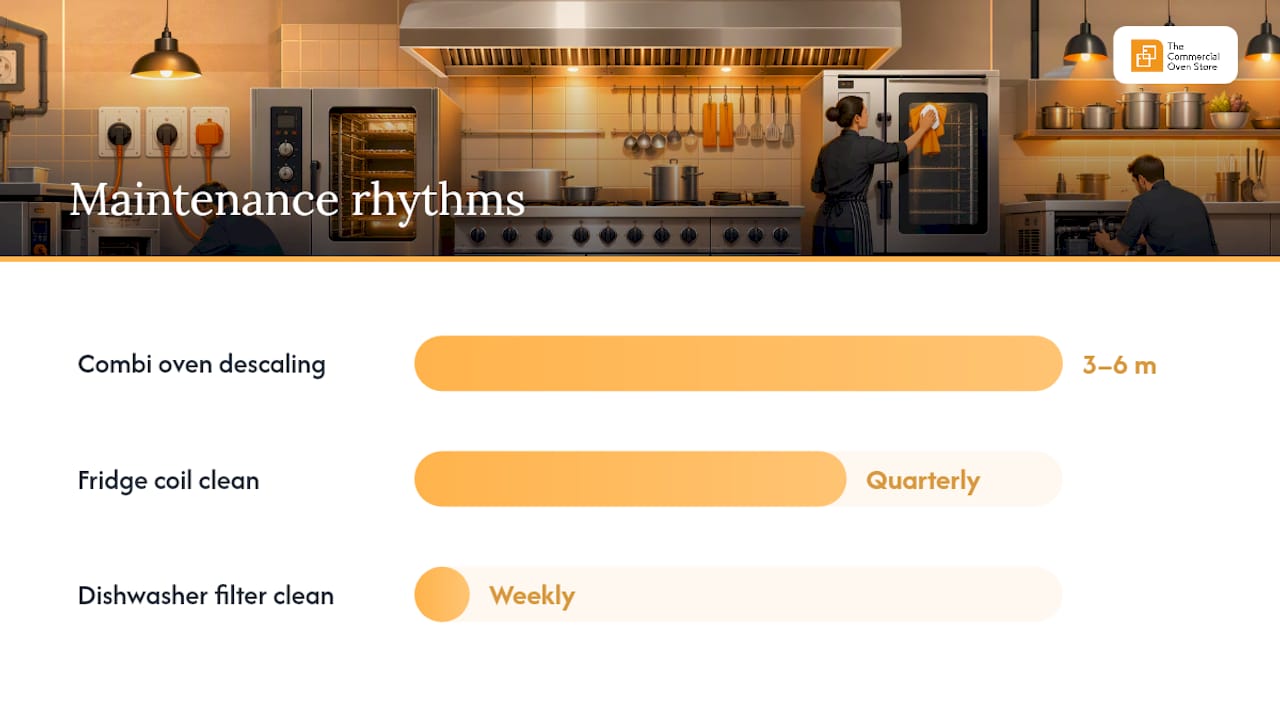
Ovens, fridges, and dishwashers all have different maintenance rhythms, and treating them the same is how equipment fails mid-service. Combi ovens typically need descaling and seal checks every three to six months depending on water hardness; fridges need condenser coil cleaning roughly quarterly; dishwashers need detergent line checks and filter cleans weekly.
Budget for a service contract on your highest-value equipment rather than relying purely on manufacturer warranty, since most warranties cover parts but not the callout labour that adds up over a machine’s lifespan. A commercial oven maintenance schedule is worth setting up in your diary the week equipment arrives, not the week it breaks down.
Pro Tip: Do a full commissioning check at delivery, not just a visual inspection. Run every burner, check every fridge thermostat, and cycle the dishwasher through a full wash before the installer leaves, so any fault is covered under installation warranty rather than discovered on your first busy Saturday.
- Commission every appliance fully at handover, including a live test cycle
- Set calendar reminders for descaling, coil cleaning, and filter checks
- Budget 1 to 3% of equipment value annually for servicing and minor repairs
- Keep a spares fund for high-wear items like door seals and igniters
Publisher expertise: practical tips from The Commercial Oven Store
Thecommercialovenstore supplies combi, convection, and speed ovens from Unox, Rational, and Merrychef, alongside the accessories, stands, and grids that turn a bare oven into a working cookline station. Most UK menus map onto one of three oven types: a combi oven for kitchens juggling roasting, steaming, and regeneration; a convection oven for bakery-heavy or batch-cooking operations; and a speed oven where counter space and quick turnaround matter more than batch size.
Capital outlay is usually the biggest hurdle for new operators, which is why flexible payment through iwocaPay is worth exploring before ruling out a higher-spec oven on price alone. Spreading the cost can make the difference between buying equipment that fits today’s covers and equipment that still fits in three years.
- Match oven category to menu type before comparing brands or price
- Check power and ventilation requirements against your kitchen’s existing supply
- Use financing to access higher-capacity equipment without straining opening capital
- Book installation and commissioning as part of the purchase, not as an afterthought
A guide to commercial oven placement covers siting and layout considerations worth reading alongside your ventilation contractor’s quote.
Launch checklist: day one and first 90 days
Order your cookline, refrigeration, and warewashing first. Everything else, from smallwares to front-of-house tech, can arrive in the weeks leading up to opening, while speciality items like blast chillers or pizza decks can wait until week two or three if capital is tight.
In my view, the biggest mistake new operators make isn’t under-ordering equipment. It’s skipping the covers simulation before opening night. Run a full mock service at expected peak volume in the week before launch, and you’ll find the bottleneck (usually the fryer or the pass) while you can still fix it. Track consumable burn rates daily for the first month and adjust par levels from real numbers, not launch-week guesses. Book your first oven and dishwasher service before month three; equipment under heavy new-kitchen strain fails earlier than manufacturers admit.
— Simon
How The Commercial Oven Store can help with ovens and installation
Once your cooking-line specification is settled, the next step is matching it to real equipment rather than a catalogue guess. Commercial oven suppliers typically stock combi, convection, and speed ovens from brands like Unox, Rational, and Merrychef, plus stands, grids, and installation accessories that help get a unit from delivery bay to working station without needing multiple suppliers.
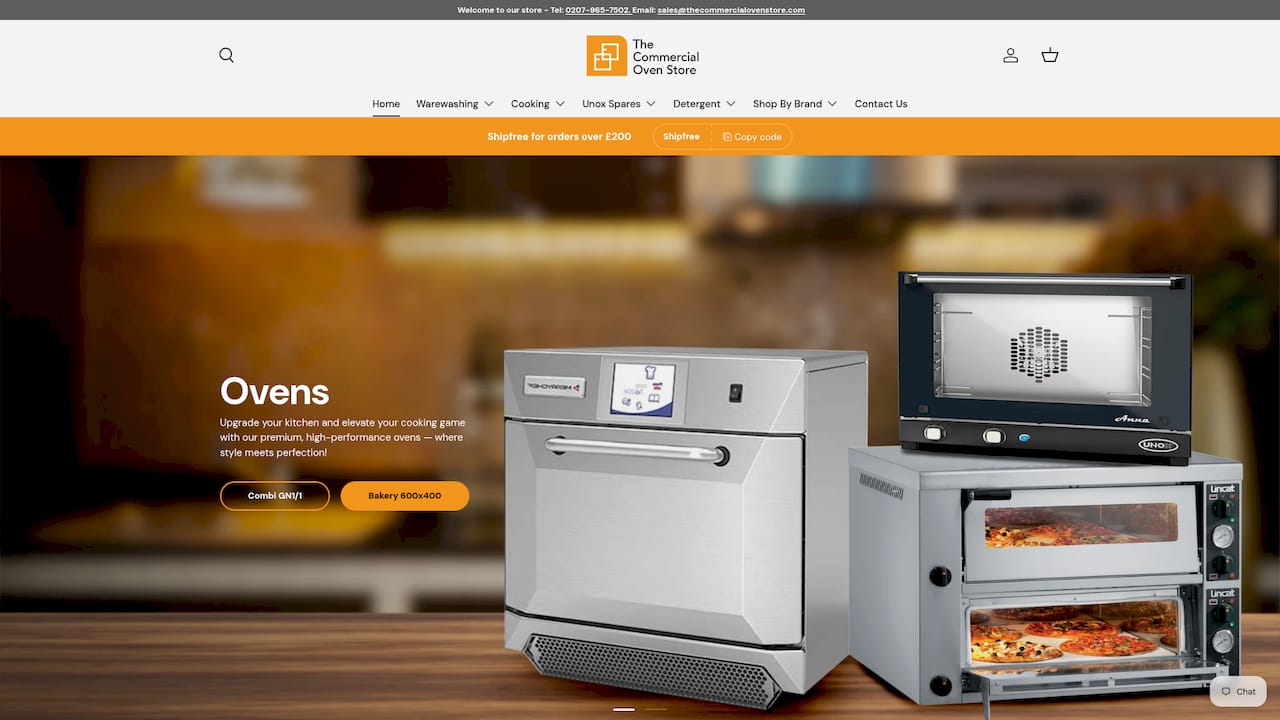
Before requesting a quote, have your kitchen layout, available power supply, and expected covers count ready. This is the information that decides whether a compact model like the XB693 Bakerlux manual oven suits you better than a higher-capacity option like the Unox Bakerlux SHOP.Pro Master Arianna.Matic. Where capital is the constraint rather than the specification, financing options may let you spread the cost of a higher-capacity oven instead of settling for a smaller unit that might need replacing within a few years. Explore the full oven and accessory range and compare specifications side by side, or get in touch to talk through commissioning and installation before you commit to a model.
Sources
- HSE — Catering
- Food Standards Agency
- EU/Energy labelling guidance (official PDF)
- SafetyCulture — restaurant inventory checklist
FAQ
What equipment does every restaurant need?
Every UK restaurant needs cooking equipment (oven, range, fryer), refrigeration and freezing, food preparation tools, a commercial dishwasher and sink setup, stainless storage shelving, and fire suppression with an extraction hood.
What is the rule for sizing equipment to a menu?
Size cooking and refrigeration capacity to your busiest 90-minute service window rather than your daily average, and keep consumable stock conservative in the first month while you measure real burn rates.
What are 20 essential kitchen tools and equipment?
A starter list covers a combi or convection oven, range, fryer, griddle, fridge and freezer, blast chiller, mixer, food processor, slicer, three-compartment sink, dishwasher, stainless shelving, knives, pots and pans, tongs, ladles, colour-coded boards, probe thermometers, extraction hood, and a fire suppression system.
What are the legal requirements for a commercial kitchen in the UK?
UK kitchens must operate a HACCP-based food safety system as required by the Food Standards Agency, maintain safe ventilation and equipment practices under HSE guidance, and hold fire suppression appropriate to any high-heat cooking equipment.