

No UK law says a care home must use one particular type of oven. What the rules require is that the oven is suitable for the job, safely installed, ventilated, maintained, and used by trained staff within a food-safety system. This guide sets out each of those requirements, shows where England, Wales, Scotland and Northern Ireland differ, and explains how to turn the rules into an oven choice for your kitchen.
TL;DR
- There is no mandated oven type. The Care Quality Commission (CQC) in England expects equipment to be clean, suitable for its purpose, maintained and properly used.
- Your kitchen must be registered as a food business and run under a written food-safety management system.
- Gas and electrical installation, ventilation and extraction are legal safety matters. Use competent, registered installers and keep the certificates.
- Fire risk assessment must cover the kitchen: grease build-up, extraction cleaning, isolation switches and unattended cooking are the usual weak points.
- Staff need role-based food-hygiene training, and probe checks of 70°C for 2 minutes (or an equivalent) are the standard for cooked food.
Table of Contents
- What the rules actually ask of a care home oven
- Four nations, four regulators
- Food business registration and your food-safety system
- Temperatures and procedures staff must follow
- Installation: gas, electric and ventilation
- Fire precautions around the oven
- Cleaning, maintenance and training
- Choosing the right oven for a care home kitchen
- Our perspective
- Find the right oven for your care home kitchen
- FAQ
- Sources
What the rules actually ask of a care home oven
The law works at the level of outcomes. In England, CQC’s guidance on Regulation 15 on premises and equipment says equipment must be clean, suitable for its intended purpose, maintained and properly used. Providers are expected to carry out regular health and safety risk assessments, follow manufacturer instructions, keep cleaning schedules and train the staff who operate the equipment.
In practice, an inspector looking at your kitchen will want to see:
- An oven that matches what you cook and how many residents you feed.
- Evidence it was installed correctly (gas and electrical certificates, ventilation checks).
- A maintenance and cleaning record.
- Trained staff who know the temperatures and procedures.
- A risk assessment that names the oven and the kitchen as a fire risk and explains the controls.
Everything below is a way of producing that evidence.
Four nations, four regulators
The oven rules are largely the same across the UK because food hygiene, gas safety, electrical safety and workplace ventilation sit in UK-wide or near-identical law. What changes is who inspects you and which guidance document they point to.
| Nation | Care regulator | Fire safety framework |
|---|---|---|
| England | CQC | Regulatory Reform (Fire Safety) Order 2005 |
| Wales | Care Inspectorate Wales | Regulatory Reform (Fire Safety) Order 2005 |
| Scotland | Care Inspectorate | Fire (Scotland) Act 2005 and Fire Safety (Scotland) Regulations 2006 |
| Northern Ireland | RQIA | Northern Ireland fire safety guidance for residential care |
The regulator names come from a summary of care home regulation across the UK, and the Scottish fire legislation is described in this overview of care home fire safety law. If you operate homes in more than one nation, keep one kitchen standard that satisfies the strictest guidance, then check each regulator’s own document for local detail.
Food business registration and your food-safety system
A care home kitchen is a food business. Guidance for Welsh care homes says homes must register with the local authority’s Environmental Health Department and have a written food-safety management system that identifies hazards and their controls. The same guidance notes that Safer Food Better Business (SFBB) with its residential-care supplement can suit small residential homes, but is not suitable for larger residential or nursing homes, which need a fuller HACCP-based system.
Your oven sits inside that system. The hazards are undercooking, unsafe reheating and unsafe hot-holding. The controls are the temperatures and checks below. If you want a plain-language read on how food quality standards and safety management fit together, this piece on food quality standards for smarter dining is a good companion.
The Food Standards Agency also publishes SFBB material specifically for residential care, including a pack for mini-kitchens. It says mini-kitchens and food-storage areas belong in the cleaning schedule, and that equipment and food-contact surfaces should be cleaned and disinfected. That matters if your home has unit kitchenettes with small ovens as well as a main kitchen.

Temperatures and procedures staff must follow
The FSA’s guidance on cooking food safely gives the figures your oven needs to deliver and your staff need to check:
- Cooking: follow the recipe or packet instructions, then check the centre with a clean probe. 70°C for 2 minutes is the standard. 75°C for 30 seconds or 80°C for 6 seconds are accepted alternatives.
- Reheating: reheating means cooking again, not warming. Food must be steaming hot throughout and may be reheated only once.
- Hot-holding: keep food at 63°C or above. Food may be held below 63°C for up to 2 hours, then must be cooled as quickly as possible to 8°C or below, or thrown away.
These numbers shape the oven choice. A kitchen that cooks batches for a lunchtime service and holds them for several wards needs reliable holding, accurate core-temperature control and an oven that recovers quickly when the door is opened. Probe records go into your food-safety diary, so make them part of the daily routine rather than something done before an inspection.
Installation: gas, electric and ventilation
Gas
HSE’s guidance on gas systems in commercial premises covers appliances and flues, natural gas and LPG. Installers must use suitable, sound fittings, support and protect them properly, and test gas tightness after any work that could affect it. Use a Gas Safe registered engineer, and keep the paperwork.
Electric
Electrical installations, including additions and alterations, are covered by BS 7671:2018+A3:2024. A new combi or convection oven is an alteration to your installation, so the supply, protection and isolation have to be designed and verified by a competent electrician. Our guide to commercial oven power requirements in the UK explains how to check your supply before you order.
Certificates
If you are registering a new care home with CQC, the application must include current gas and electrical safety certificates issued within 12 months of the application. An electricity-only building does not need a gas certificate for that application. For existing homes, keeping these certificates current is the simplest way to show the equipment is safe.
Ventilation and extraction
HSE’s catering ventilation guidance requires effective and suitable ventilation. For cooking appliances, a canopy hood should be properly sized, sit close to each fume- or heat-producing appliance, and extract adequately without fumes spilling into the room. HSE also says the design should consider the cooking load, the number of appliances, kitchen layout, staffing, cleaning and maintenance.
This is where care home kitchens most often get caught out, because a new, larger oven can change the load on a system designed for older equipment. Two of our guides go deeper: UK oven ventilation rules and compliance steps and whether combi ovens need extraction or a ventless hood is enough. For on-site checks before installation day, see common combi oven installation failures and our guide to oven placement.
Fire precautions around the oven
Fire risk assessment is a legal requirement where fire-safety law applies. The Scottish Government’s practical fire safety guidance for care homes says the assessment must be specific to the individual home, not generic, and must consider the occupants, activities, ignition sources, consequences and management arrangements. The same guidance names inadequate cleaning, grease build-up in kitchen extraction equipment and disabled safety features or cut-outs as causes that raise the likelihood of fire. It says competent people should regularly maintain and clean cooking equipment and plant.
For Northern Ireland, a residential care fire safety guide is more specific about kitchens:
- Larger catering kitchens should have automatic fire suppression over the cooking range.
- Smaller premises should have a suitable extinguisher and a fire blanket.
- Deep-fat equipment should have thermostatic temperature control.
- Cooking equipment must never be left unattended.
- Extractor ducting, grease traps and filters should be cleaned and maintained regularly.
- Gas and electricity isolation switches, and a switch for the extractor fan, should be near an exit.
Those points are good practice in every nation, so write them into your own risk assessment wherever your home is.
Cleaning, maintenance and training
HSE’s maintenance priorities for catering are simple and worth printing for the kitchen wall: set up safe cleaning methods, take particular care with cleaning chemicals, train and supervise staff, check equipment routinely for wear, damage and leaks, and arrange planned maintenance and safety-critical repairs through competent people.
A workable schedule looks like this:
| Frequency | Task |
|---|---|
| Daily | Clean the cavity, door seals and glass after service. Wipe control panels. Record probe checks. |
| Weekly | Clean filters and check door seals and hinges. Look for leaks onto the floor. Test any visible safety features. |
| Monthly | Inspect extraction hoods and grease filters. Check isolation switches work. Review the cleaning log. |
| Annually or as the manufacturer states | Planned service by a competent engineer. Gas and electrical safety checks. |
The frequencies are our suggested starting point, not a legal timetable. Your manufacturer’s instructions and your risk assessment set the final schedule, and CQC guidance expects maintenance in line with legislation, manufacturer instructions and your own procedures. Our commercial oven maintenance schedule gives a fuller version.
Training
Welsh Government care home guidance expects food handlers to be trained according to their role. Handlers of open high-risk food and supervisors are generally expected to complete recognised food-hygiene training within 3 months. Kitchen managers, chefs and cooks are advised to take Level 3 training, with refreshers at least every 3 years (guidance). Also train everyone who touches the oven on its controls, its cleaning chemicals and what to do if something goes wrong.

Choosing the right oven for a care home kitchen
Because the law asks for “suitable for its intended purpose”, the choice starts with your menu and your numbers. These are the questions we ask first:
- How many meals, in how many services? A 20-bed home cooking one hot meal a day has different needs from a 70-bed nursing home with breakfast, lunch, tea and special diets.
- What do you cook? Roasts, casseroles, steamed fish, pureed and fortified dishes, baking and regenerating cook-chill meals all lean on different oven functions.
- How much space and what supply do you have? Gas or three-phase electric, floor space, and the existing extraction decide which models are realistic.
- Who will use it? Rotating staff and agency cooks benefit from simple programmes and clear, repeatable results.
A rough guide by type:
| Oven type | Suits |
|---|---|
| Convection | Baking, roasting and general cooking in smaller homes and unit kitchens. Simple to use. |
| Combi | Larger kitchens that roast, steam, regenerate and hold in one unit. Programmable for consistent results across shifts. |
| Speed oven | Quick regeneration and small-batch cooking, such as snacks or late meals, where space is limited. |
Our guide to three site checks that decide your catering oven fit covers space, power and ventilation in more detail. If you need the same practical approach for another institutional setting, our school kitchen oven requirements guide follows the same logic.
Our perspective
We speak to catering managers who have inherited a kitchen and an oven that nobody quite trusts. The usual story is not a lack of rules. It is that the oven, the extraction and the cleaning routine were never planned together.
Our view is that a care home should choose the oven last, after the menu, the supply and the ventilation are clear, and then choose one that makes the safe routine the easy routine. Programmable cooking, repeatable core temperatures and easy-to-clean cavities help a rotating team deliver the same result at every service. That is why we stock combi, convection and speed ovens from makers such as Rational, Unox and Merrychef, and why we talk through the kitchen with you before you buy.
Installation is part of compliance too. An oven that is correctly connected, ventilated and signed off is one you can show an inspector with confidence.
Simon
Find the right oven for your care home kitchen
We supply commercial ovens to professional kitchens, along with compatible accessories, installation and expert advice. If you are replacing an oven or fitting out a new kitchen, our team can help you match a model to your menu, supply and extraction. Flexible payment and lease finance are available, so equipment does not have to be bought outright.
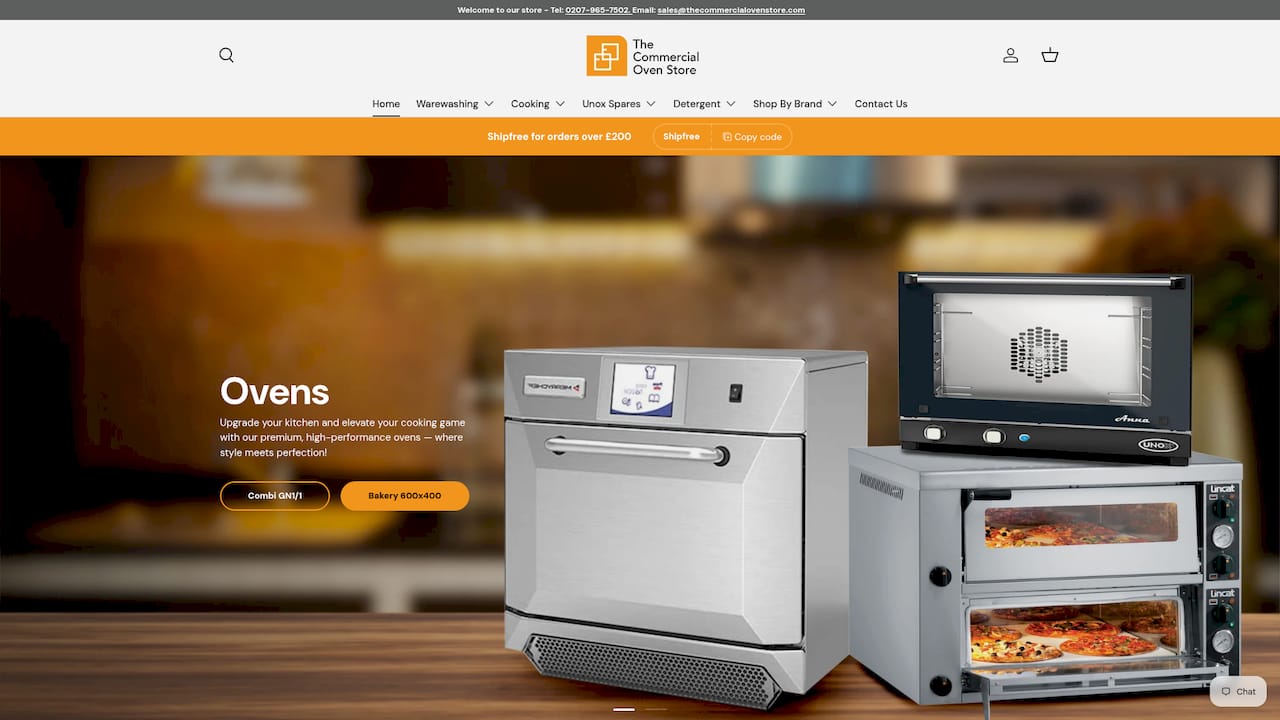
Browse our commercial ovens, look at convection ovens, or talk to us about installation and advice.
FAQ
Does a care home need a special type of oven?
No. UK rules do not name an oven type. In England, CQC expects equipment to be suitable for its intended purpose, properly maintained and used correctly. Pick the oven that fits your menu, meal numbers and kitchen, then document the risk assessment and maintenance.
Do care home kitchens need to be registered?
Yes. A care home kitchen is a food business and must register with the local authority’s Environmental Health Department. It also needs a written food-safety management system. Small residential homes may use SFBB with the residential-care supplement, but larger and nursing homes need a fuller system.
What temperature must food reach in the oven?
The FSA standard is a core temperature of 70°C for 2 minutes, checked with a clean probe. 75°C for 30 seconds and 80°C for 6 seconds are equivalent. Reheated food must be steaming hot throughout and reheated only once.
Do I need extraction over a care home oven?
HSE requires effective and suitable ventilation in catering kitchens, and the right solution depends on the oven type and the cooking load. Have the extraction assessed by a competent ventilation engineer before installing a new oven, particularly if it is larger or more powerful than the one it replaces.
How often should care home oven extraction be cleaned?
There is no single figure for every kitchen. Scottish Government guidance says competent people should clean and maintain extraction regularly, because grease build-up raises fire risk. Set the interval in your fire risk assessment and your manufacturer’s instructions, and record each clean.
Sources
- CQC Regulation 15: Premises and equipment
- CQC gas and electrical safety certificates
- Welsh Government: food hygiene and safety in care homes for older people
- FSA: Safer Food Better Business for residential care, mini-kitchens
- GOV.UK: Cooking food safely
- HSE: Gas systems in commercial premises
- HSE: Ventilation in catering
- HSE: Maintenance priorities in catering
- BS 7671:2018+A3:2024 Requirements for Electrical Installations
- Scottish Government: Practical fire safety guidance for care homes
- Northern Ireland fire safety guide for residential care premises
- Care home regulations across the UK
- Care home fire safety and the RRFSO
- Food quality standards for smarter dining