

A good catering trailer oven setup comes down to five decisions made in the right order: the oven that suits your menu, the fuel or power you can actually supply, where it sits relative to the axle, how it is ventilated, and how it is fixed down for the road. Get those right before you buy and the rest is fitting. Get them wrong and you face a trailer that sways on the A-road, a generator that trips mid-service, or an inspection you fail.
This guide is for UK traders fitting an oven into a trailer, from a first-time festival stall to an established street-food operation. It covers choosing the oven, fuel, layout, ventilation, securing, legal registration and daily checks.
TL;DR
- Choose the oven from your menu and your peak-hour throughput first, then check that your generator, hook-up or LPG supply can run it.
- Put the heaviest items over or next to the axles, and check the oven’s weight against the trailer’s rating and axle loads.
- Every gas appliance needs adequate ventilation, and the oven must sit fully under the extraction canopy where one is fitted.
- Fasten the oven down for travel, check cylinders, pipework, vents and flues daily, and have the gas installation inspected by a Gas Safe engineer at least once a year.
- Register your food business with your local authority at least 28 days before you start trading.
Table of Contents
- Start with the menu, not the oven
- LPG or electric: decide on the supply you can guarantee
- Where the oven goes: layout and weight
- Ventilation, heat and clearances
- Securing the oven for the road
- Legal requirements for a trailer oven
- Daily setup and shutdown routine
- Three site checks before you buy
- Get the right oven for your trailer
- FAQ
- Sources
Start with the menu, not the oven
The most common mistake is picking an oven because it looks right in a catalogue, then discovering it cannot hold your Saturday-night queue. Work backwards from what you serve.
Ask three questions:
- What is the peak hour? Count the portions you need to produce in your busiest 60 minutes. That sets the capacity you need, measured in trays or shelves, not in litres.
- How fast does the food have to come out? A trailer at a festival has a customer standing at the hatch. Food that takes 25 minutes to bake has to be batch-cooked and held, which changes your workflow and your space.
- How many different things do you cook at once? A single-product menu such as jacket potatoes or pies suits a simple convection oven. A mixed menu of roasted, baked, regenerated and finished items points towards a combination oven or a fast oven.
The three oven types that fit most trailers
Convection ovens circulate hot air, bake evenly and are the workhorse for pastries, pies, bread, roasted vegetables and traybakes. They are simple to operate, which matters when different staff work different events. Our convection oven range includes compact countertop models, such as the Lincat Convector CO133T Touch, listed at 3.0 kW with a 610 mm width, which is a footprint a trailer bench can often take.
Speed ovens combine hot air with microwave or other fast-heating technology so food finishes in minutes rather than a quarter of an hour. They suit toasties, bake-and-serve items, pre-prepared dishes and anything finished to order. Dimensions matter enormously in a trailer, so record them carefully; our guide to speed oven dimensions lists the six measurements to take.
Combination ovens add steam, so they roast, steam, bake and regenerate in one unit and let a small kitchen produce a wide menu. They draw serious electrical load, so they suit trailers with a robust hook-up or a properly sized generator. Browse the Rational iCombi Pro 10-1/1 if you are weighing a combination oven for a larger unit.
If you are unsure which type fits your menu, our guide to matching a menu to a food truck oven walks through power bands and speed, and the wider commercial oven buying guide covers capacity and tray sizes.

LPG or electric: decide on the supply you can guarantee
The fuel choice is usually made for you by where you trade.
Electric ovens are clean, controllable and need no gas certificate for the oven itself. Their limit is the supply. Many festivals and markets offer a metered hook-up with a stated capacity per pitch, and if you rely on a generator, every appliance on the trailer adds to the load. Add up the kilowatt rating on each data plate (oven, fridge, urn, lighting, card reader) and compare the total with your supply, leaving headroom for start-up surges. Do not guess. A 3 kW oven is a very different proposition from a 4.8 kW one, such as the Lincat Convector Touch CO235T, once the fridge and lights are running too.
LPG ovens free you from the generator and suit off-grid pitches, but they bring the full weight of gas regulation into your trailer: cylinder storage, regulators, hoses, ventilation and annual inspection, covered below.
A practical rule many traders follow is to pick the fuel that matches your most frequent pitch type, then check that your less frequent pitches can accommodate it before you commit. Ask event organisers what supply they give and what they allow, because some restrict gas or cap electrical load.
Where the oven goes: layout and weight
A trailer is a small kitchen on one axle or two, and an oven is one of the densest objects in it. Placement affects both how the kitchen works and how the trailer tows.
Weight first
Heavy commercial ovens should be positioned directly over or adjacent to the trailer’s axles, to keep the load balanced and avoid sway at speed, according to one trailer-builder’s guidance on oven weight and layout. The same source advises checking the oven’s weight against the trailer’s rating and axle loads. Do the sum before you buy: oven weight plus stand, plus the water, gas cylinders, stock and equipment you will carry, against the plated payload.
If you are unsure, ask the trailer builder or manufacturer to calculate the weight distribution. A concentrated vertical mass such as a tall oven is exactly what specialist builders are used to assessing.
Then workflow
Good layouts follow the food: raw storage and prep at one end, cooking in the middle, finishing and serving at the hatch. Place the oven so staff can load it without crossing the serving line, and so the door opens without hitting a wall, a fridge or a colleague. Leave the clearances the manufacturer states for the model, and never assume that a gap which looks big enough is adequate.
Space is the other constraint. Stacking or under-counter configurations are common ways to keep bench space free, as trailer layout guidance notes. A compact oven on a purpose-made stand often beats a larger unit that swallows your prep surface.
| Layout question | What to check |
|---|---|
| Is the oven over or next to the axle? | Compare weight with axle loads and trailer rating |
| Can the door open fully? | Measure door swing, not just the body |
| Is the oven fully under the canopy? | Extraction should cover the whole footprint |
| Can staff reach controls and trays safely? | Check height and standing position |
| Is there manufacturer clearance on all sides? | Read the installation manual for your model |
Our installer-written article on commercial oven placement goes deeper on clearances and measuring a site, and the principles carry over to a trailer.
Ventilation, heat and clearances
A hot, enclosed trailer is unforgiving. Ventilation is both a comfort matter and a safety one.
For gas appliances, the Calor guidance for mobile caterers says ovens need adequate ventilation for their type, ideally a properly designed flue, plus a canopy or extractor hood where appropriate (Calor’s LPG guidance for mobile catering).
If mechanical ventilation is fitted to a gas kitchen, the HSE says the gas supply should be interlocked with it so that a ventilation failure shuts off the gas, and manual bypasses of the interlock are not acceptable (HSE Catering Information Sheet No 23). Do not switch off or bridge an interlock to get through a busy service.
Canopy sizing matters too. The trailer-builder guidance above suggests that hot-cooking equipment should sit entirely beneath the hood, typically with around six inches of overhang beyond the equipment’s footprint, to capture smoke, heat and grease. Treat that as a design starting point and confirm the exact requirement with your builder and your local fire authority.
Electric combination ovens still produce steam and heat that need to go somewhere. Our guides explain the UK oven ventilation rules and whether combi ovens need extraction or a ventless hood. For a Rational combi, the manufacturer-matched Rational exhaust hood is one accessory to consider.
Securing the oven for the road
An oven that stays put in the car park can still move when you brake on a roundabout. The Calor guidance says ovens must be securely fastened or supported. In practice:
- Bolt or strap the oven to a fixed stand or the bench, using fixings rated for the load.
- Use a stand designed for the oven’s footprint and weight rather than improvising with a table.
- If an appliance holding hot liquids has to be moved, the HSE sheet calls for lockable castors. If you use castors, lock them and add a tie-down for travel; our guide to oven stands with casters covers the fit checks.
- Remove loose trays and grids and stow them separately, so they cannot slide into the glass or the controls.
- Secure the door with a catch if the model allows.
Check fixings after your first few journeys, because vibration loosens bolts that felt tight on day one.
Legal requirements for a trailer oven
Gas
LPG installations in mobile catering should be installed and inspected by a competent Gas Safe registered engineer. The Calor guidance recommends a visual check of cylinders, pipework, appliances, vents and flues every day, and an inspection of the installation by a Gas Safe installer at least annually. Keep the certificate with the trailer, because event organisers and local authority officers often ask to see it.

Food business registration
In England, Wales and Northern Ireland you must register your food business with your local authority at least 28 days before you start trading, according to the Food Standards Agency’s start-up guidance. Scotland has its own arrangements, so check with your local council there.
The same page explains that mobile caterers need a food safety management system based on HACCP principles, such as Safer Food Better Business. Putting your oven’s cooking and holding temperatures in writing is part of that. If you want to see how other operators structure their food hygiene management systems and allergen information for takeaway food, that page shows one approach from Belgium, where the rules differ from the UK’s.
Fire and electrical
Ask your local fire authority about venting and extraction for your specific layout. Electrical work, whether a hook-up inlet, consumer unit or generator connection, should be done by a qualified electrician, and portable appliances are best tested as part of your regular safety routine.
Daily setup and shutdown routine
A short routine catches most faults before a customer does.
- Before opening: inspect cylinders, pipework, vents and flues. Check the oven is level and the canopy or extractor is working. Confirm the interlock behaves correctly.
- Pre-heat early: a trailer oven on a cold morning needs longer than you expect, particularly if it also has to reach temperature on a limited supply.
- During service: keep the area around the oven clear, and load trays at a steady rhythm to avoid cold spots.
- At close: switch off at the controls, turn off cylinders, let the oven cool and clean it according to the manufacturer’s instructions.
- Before travel: lock castors, strap the oven, stow trays and grids, and close the gas supply.
Proper cleaning also protects your investment. If you use a combination oven, the right detergents and descaling products keep it performing; we stock detergent and warewashing products alongside the ovens.
Three site checks before you buy
Before ordering, measure and confirm three things. First, can the trailer’s payload and axle position take the oven and its stand? Second, can your supply, whether hook-up, generator or LPG, run it on your busiest day? Third, does the ventilation arrangement fit the oven you are choosing? Our guide to three site checks for catering oven fit covers this process in a kitchen setting, and the same logic applies to a trailer.
Our perspective
Most trailer traders come to us with a model in mind and a supply problem they have not noticed yet. We would rather start with the pitch. How much power can you count on, how much weight can the trailer carry, and what will you cook at 1pm on a Saturday?
Our view is that a trailer oven should be chosen for repeatable results and speed at the hatch. A well-matched convection or speed oven that does its job every service is worth more than an oversized unit that strains your generator. When the menu needs steam and flexibility, a combination oven from a manufacturer such as Rational earns its place, provided the power and ventilation are planned from day one.
We sell genuine ovens from Unox, Rational and Merrychef, and we talk through the fit with you before you order: dimensions, supply and accessories such as stands, grids and trays. That is the point of our expert advice, so you get the oven that suits your trailer the first time.
Simon
Get the right oven for your trailer
We supply convection, combination and speed ovens, plus stands, trays, grids and installation kits, to UK food businesses, and our team can talk you through which model suits your trailer and menu. Flexible payment options, including iwocaPay, can help spread the cost of your equipment.
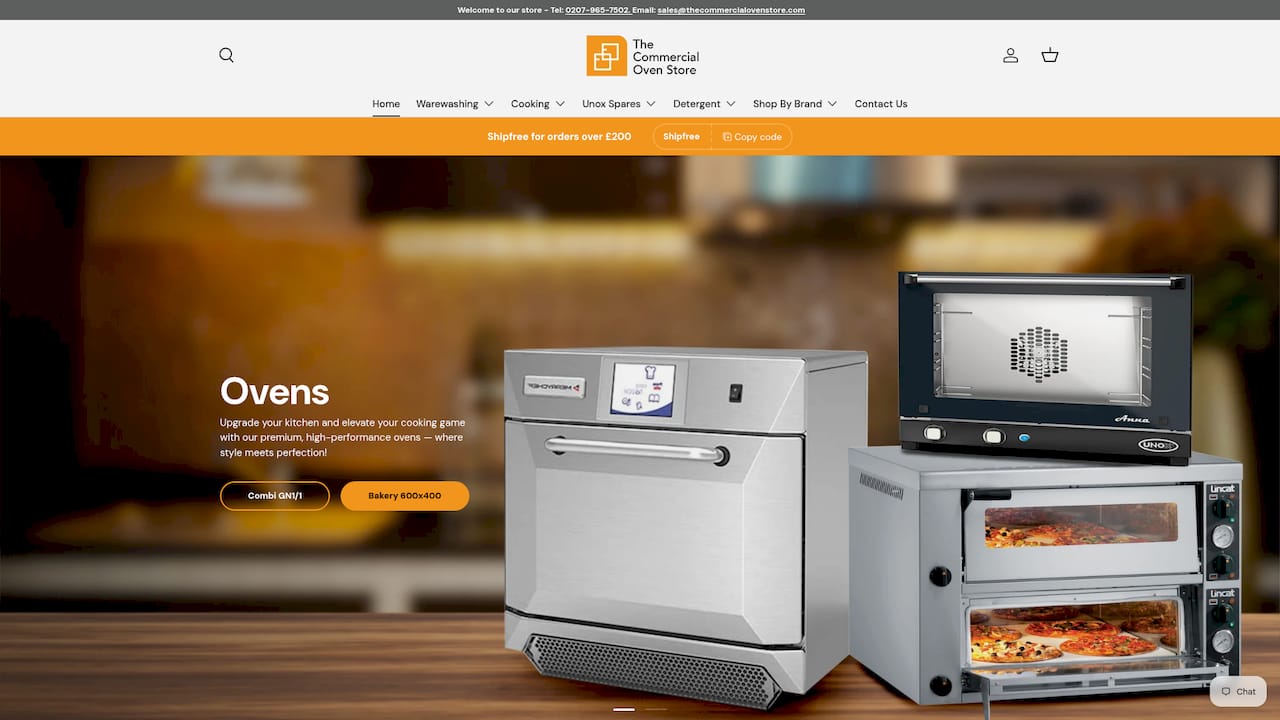
Browse our commercial ovens, or contact us through The Commercial Oven Store for expert advice and installation support.
FAQ
Can I fit a combi oven in a catering trailer?
Yes, if the trailer can take its weight and your supply can run it. A combination oven needs a robust electrical supply, sensible placement over or near the axle and suitable extraction. Plan these with your trailer builder before you buy.
Is an LPG or electric oven better for a trailer?
It depends on where you trade. Electric suits pitches with a reliable hook-up or a properly sized generator, while LPG suits off-grid pitches but brings annual Gas Safe inspection and ventilation requirements. Choose the one that matches most of your bookings.
How often does a trailer gas installation need inspecting?
The Calor guidance for mobile caterers recommends a Gas Safe installer inspect it at least annually, with a visual daily check of cylinders, pipework, appliances, vents and flues. Keep the certificate with the trailer.
When do I need to register my mobile food business?
In England, Wales and Northern Ireland, at least 28 days before you begin trading, with the local authority where your trailer is based. Scottish traders should check with their local council.
Sources
- Catering Information Sheet No 23: Gas safety in catering (HSE)
- Guidelines for the Safe Use of LPG in Mobile Catering (Calor)
- Getting ready to start your food business (Food Standards Agency)
- Pizza Food Truck or Trailer: Oven, Weight and Layout
- Custom Food Trailer Interior Layout