

For most independent restaurants a 10-pan combi oven is the practical sweet spot. Cafés and food trucks usually manage well on a 6-pan model, while banqueting suites and central production kitchens need 20-pan or roll-in units. Before you fix on a capacity, confirm three things: your power and gas supply, your water and drain provision, and the door swing or footprint the space allows. If any of those are uncertain, two smaller ovens working in parallel often beat one large one.
TL;DR:
- Most restaurants will find a 10-pan combi oven suitable, but capacity should align with utility availability and space constraints.
- Steam generation method (boiler or injection) impacts recovery speed and overhead costs, especially for larger units with heavy steaming loads.
- Utility preparation, including correct electrical phase, gas line size, and water filtration, is critical to avoid delays or damage during installation.
- For high-volume or multi-program kitchens, pairing two smaller ovens can outperform one large oven in flexibility and uptime.
- Control complexity should match menu needs; manual controls suit simple menus, while touchscreen systems benefit high-volume, multi-program operations.
Table of Contents
- What is a combi oven, and how is capacity measured?
- How does a combi oven work, and why does steam generation affect capacity?
- Capacity tiers compared: 6-pan, 10-pan, 20-pan and roll-in
- Sizing your kitchen for the oven: footprint, clearance and workflow
- What power, gas and water do you need before ordering?
- Which control level does your kitchen actually need?
- How much does capacity affect running costs?
- What cleaning and maintenance should you budget for?
- Where to check site readiness before you order
- What to ask a supplier before you compare quotes
- Why redundancy often beats one big oven
- How a specialist commercial oven supplier gets your capacity order right first time
- Sources
- FAQ
What is a combi oven, and how is capacity measured?
A combi oven combines convection heat with injected or generated steam, letting one cabinet roast, steam, bake, and regenerate without swapping equipment. Capacity is not measured in litres, as it would be for a domestic appliance. It is measured in Gastronorm pan slots.
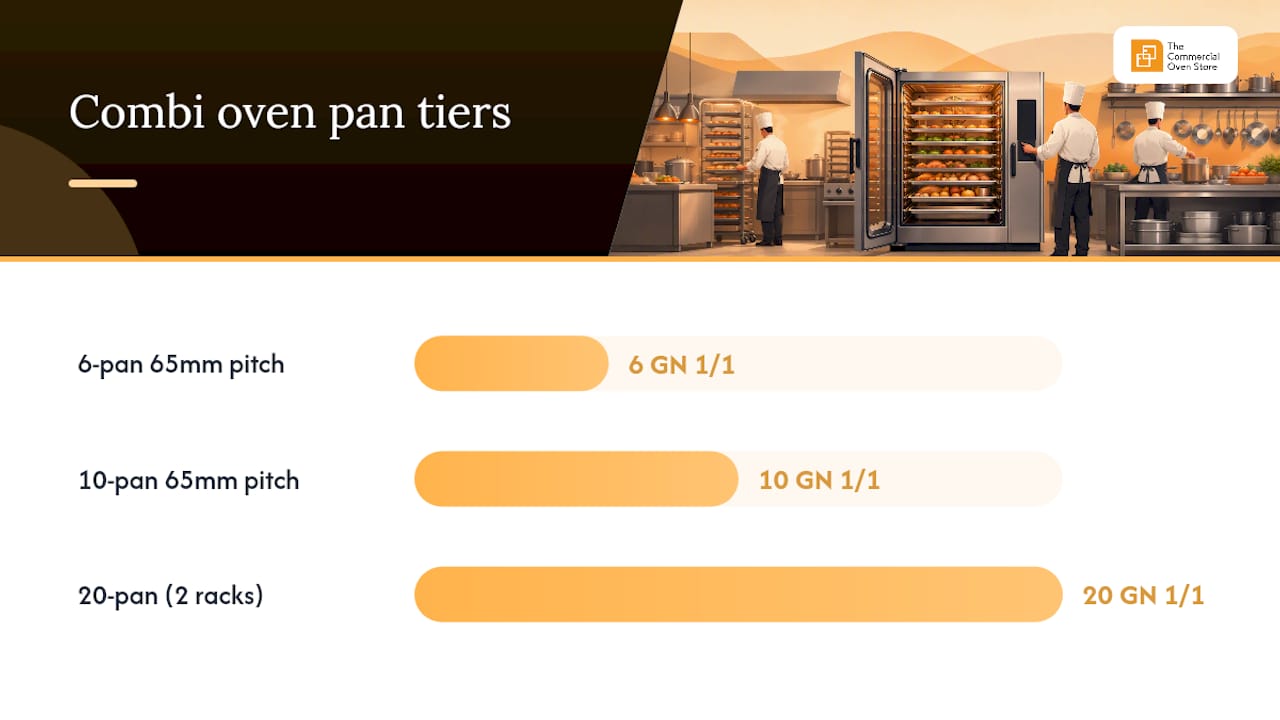
The industry standard is the GN 1/1 pan, measuring 530 by 325mm. Every commercial combi spec sheet counts capacity by how many GN 1/1 pans, or their half-size and two-thirds equivalents, fit on the internal racking. A “6-pan” oven holds six GN 1/1 trays at roughly 65mm pitch; a “10-pan” holds ten; a “20-pan” holds twenty, usually across two racks or a full roll-in trolley.
You will also see 600 by 400mm pans referenced, particularly on European bakery-focused units and some Unox models designed around baking trays rather than gastronomy trays. These are a separate standard, not interchangeable with GN sizing, so check which system a spec sheet is quoting before you compare two ovens on pan count alone. Half-size GN 1/2 pans double your dish variety per rack at the cost of raw volume, which matters for à la carte kitchens running multiple small batches rather than one big braise.
Manufacturer guides also reference GN pan-slot measurement when listing compact or household-adjacent units, though anything genuinely built for commercial duty will sit within the 6, 10, or 20-pan tiers this guide focuses on. Get comfortable with GN terminology early. Every capacity conversation from here on assumes you know what a “pan” means on a spec sheet.
How does a combi oven work, and why does steam generation affect capacity?
Every combi oven runs three core modes: convection (dry heat with fan circulation), steam (humidity-controlled cooking below or at 100°C), and combination mode, which blends both with variable humidity control. The mode you use most dictates how hard the steam system works, and that system is where capacity and duty cycle actually collide.
There are two ways a combi generates steam. Boiler models heat a reservoir of water to produce dense, fast-recovering steam, useful when you are loading and reloading pans back to back during service. Injection (boilerless) models spray water directly onto a heating element or fan, which is cheaper to buy and simpler to service but recovers more slowly under sustained, heavy steaming loads.
This matters more as pan count rises. A 6-pan café oven running mostly bake and reheat cycles will rarely notice injection’s slower recovery, because the demand on the steam system is light and intermittent. A 10-pan or 20-pan unit running back-to-back steaming for banquet vegetables, fish, or rice will feel it, because every reload resets the humidity and temperature the boiler or injector has to re-establish. Boiler models recover steam faster and produce denser steam but cost more upfront and need treated water, which pushes the real-world cost comparison beyond the sticker price.
The practical rule: match steam generation method to how continuously you steam, not to how big the oven is. A 10-pan injection unit doing light, spaced-out service might outperform a boiler model on cost without sacrificing much throughput. A 20-pan unit running continuous banquet service almost always justifies the boiler premium, because slow recovery on a large rack means the whole batch waits on the slowest tray.
Usable throughput per pan also depends on load density. Densely packed trays of small cuts cook faster and more evenly than a few large joints spread thin, because steam and hot air need contact area to work. Heavier, denser loads (whole birds, large roasting joints) slow recovery and effectively reduce how many “true” service cycles a pan delivers per hour, regardless of the oven’s rated capacity.
Capacity tiers compared: 6-pan, 10-pan, 20-pan and roll-in
Combi ovens split into three workhorse tiers, plus a fourth roll-in category for the busiest kitchens. Each tier maps to a fairly predictable service volume, though menu complexity shifts the numbers more than most buyers expect.
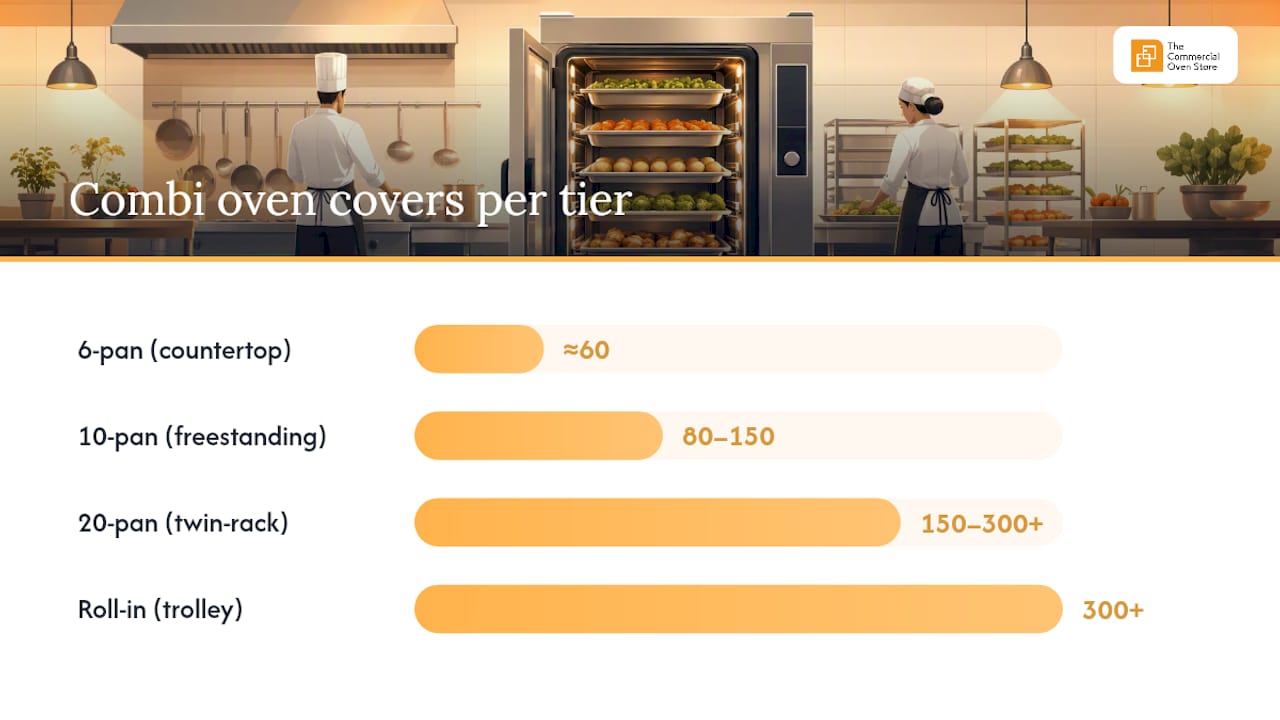
- 6-pan (countertop): Typically fits on a worktop or low stand, drawing single-phase power in most electric models. Suits cafés, food trucks, small prep kitchens, and satellite service points running up to about sixty covers a session.
- 10-pan (freestanding, floor-standing): The default choice for most independent restaurants, gastropubs, and mid-sized hotel kitchens. Handles broadly between eighty and one hundred fifty covers per service depending on menu style, and usually needs three-phase electrical supply if electric, or a properly sized gas line and flue if gas-fired.
- 20-pan (floor-standing, twin-rack): Built for high-volume, multi-section kitchens, central production units, and larger hotel or contract catering operations. Comfortably covers between one hundred fifty and over three hundred covers a service, but demands a serious utilities allocation and a larger floor footprint with full service access on at least one side.
- Roll-in (trolley-loaded): Effectively a 20-pan or larger capacity delivered via a wheeled trolley that rolls the entire rack into the cabinet. Common in banqueting, hospital catering, and central production kitchens producing large batches for later distribution or reheat-and-serve service.
The covers-per-pan rule of thumb that most buyers use is roughly one GN 1/1 pan per 8 to 15 covers, with the lower end for complex à la carte menus needing frequent small batches, and the higher end for simpler batch-cooked menus where one pan serves many portions before reloading. A busy curry house running large batch trays of one or two dishes might stretch a 6-pan oven to serve 90 covers, while a tasting-menu restaurant with a dozen small-plate items might need a 10-pan just to cover 70.
When the numbers sit near a tier boundary, or when you run distinctly separate programmes (bread proving alongside protein roasting, say), pairing two smaller units often makes more sense than buying one larger one. This is sometimes called parallel redundancy: two mid-sized combis instead of one large roll-in let you run two different programmes simultaneously and keep service running if one unit needs servicing. It costs more in footprint and installation complexity, but it removes the single point of failure that a lone 20-pan unit represents during a fully booked Saturday night. Our guide to matching oven size to kitchen type covers this trade-off in more depth if you are sitting between tiers.
Sizing your kitchen for the oven: footprint, clearance and workflow
Getting the pan count right is only half the job. An oven that fits the covers count but not the kitchen is a wasted order, and clearance mistakes are one of the most common reasons installations get delayed on delivery day.
- Measure the actual footprint, not just the floor space. Take the oven’s stated width, depth, and height from the spec sheet, then add manufacturer-specified side and rear clearance, usually 50 to 150mm depending on the model and whether it is gas or electric.
- Check door swing against your walkway. A combi door opening outward needs its own arc of clear space, and on a 10-pan or 20-pan unit that arc can eat a metre of floor that looks empty on a plan but is not usable once the door is open mid-service.
- Confirm trolley clearance for roll-in models. A roll-in cabinet needs a straight, level run to load the trolley, plus enough turning space in front to manoeuvre it, which is easy to miss on a tight kitchen plan drawn before the oven was selected.
- Allow full-height access for servicing. Engineers need to reach the back and sides for maintenance, so treat clearance as a permanent requirement, not a one-off installation gap you can close up afterwards.
- Map the workflow around the oven, not the other way round. Where prep stations, plating benches, and pass-through points sit relative to the oven affects how efficiently pans move in and out during service, particularly on multi-section kitchens running several dishes at once.
Detailed dimension tables for each capacity class, including door clearance notes specific to common models, are laid out in our combi oven dimensions guide, which is worth checking against your kitchen plan before you commit to a tier.
If your kitchen runs genuinely separate cooking programmes, say, banquet production upstairs and à la carte downstairs, or a bakery line running alongside protein cookery, pairing two smaller ovens across those workflows usually beats trying to schedule both through one large unit. It costs more floor space overall, but it removes the scheduling conflict entirely.
What power, gas and water do you need before ordering?
Utility mismatches cause more delayed installs than any other single issue, and most of them are avoidable with a proper site survey before the oven arrives. This is the checklist worth working through with your electrician or gas engineer, not after delivery.
- Electrical supply by tier: 6-pan countertop electric units often run on single-phase supply, while 10-pan and 20-pan floor-standing electric models typically require three-phase power at 380 to 415 volts. Confirm the exact voltage and frequency on the spec sheet against your site’s actual supply, because mismatched voltage or frequency prevents correct operation and can void the warranty outright.
- Gas line sizing and flue: Gas-fired 10-pan units commonly sit in a moderate BTU range that needs a correctly sized gas line, not just any existing connection, plus a dedicated flue or extraction hood rated for the appliance’s output.
- Water hardness and filtration: Boiler models are especially sensitive to hard water, which causes scale build-up inside the reservoir and shortens service intervals. Manufacturers specify hardness limits, and filtration sized to those limits is not optional if you want the warranty to hold.
- Drain routing and material: Combi ovens discharge hot condensate and cleaning waste, so drain piping needs heat-tolerant material and a gradient that actually clears the discharge rather than pooling near the base.
Electric units are generally simpler to certify and install in a building without existing gas service, while gas is usually chosen where running costs are the priority or where the electrical panel cannot support the extra load a 10-pan or 20-pan electric unit demands.
Pro Tip: Get your water tested for hardness before you choose between boiler and injection models, not after. A hardness reading that looks fine on paper can still shorten a boiler’s service life if the filtration sizing is wrong for your local supply.
Our water hardness guide for combi ovens walks through filtration sizing in more detail, and the drain requirements page covers the plumbing specifics most site surveys miss on the first pass.
Which control level does your kitchen actually need?
Control sophistication should match menu complexity and compliance needs, not budget headroom alone. Buying more automation than your operation uses just adds servicing cost for features nobody touches.
Manual controls, dial-based temperature and time settings, suit simple menus with a handful of repeated dishes, typically found on 6-pan units in cafés or small operations where one or two people run the kitchen. Semi-programmable controls store a set number of favourite programmes, letting staff select a saved recipe rather than dialling in settings from scratch every time, which suits most 10-pan restaurant kitchens running a fixed core menu with regular specials.
Full touchscreen controls, with recipe libraries, multi-stage cooking programmes, and networked management, earn their cost on 20-pan and roll-in units running complex or high-volume menus across multiple sections or sites. These units typically include HACCP data logging, automatically recording cooking temperatures and times for food safety compliance, which matters more as covers and audit exposure increase. Multi-site operators also gain from remote management, letting a central kitchen team push programme updates or monitor performance across several locations without visiting each one.
The trade-off is servicing complexity. A basic manual-control 6-pan unit is straightforward for a local engineer to repair with commonly stocked parts. A networked touchscreen 20-pan unit may need a manufacturer-trained technician and longer lead times for specific electronic components, which is worth weighing against how much the automation genuinely saves your kitchen day to day.
How much does capacity affect running costs?
Energy draw scales with pan count, but not in a straight line, because duty cycle and steam method both shift the real-world number more than capacity alone.
Electric units draw power constantly during heat-up and steam generation, with typical draw rising from a few kilowatts on a 6-pan countertop unit to considerably more on a 20-pan floor-standing model. Gas units generally cost less to run per hour once installed correctly, because gas tariffs typically undercut electricity per unit of heat delivered. That gap narrows if your kitchen’s duty cycle is light, since gas units still need pilot and standing losses even between cooks.
Boiler systems cost more to run than injection systems under light-to-moderate steaming duty, because maintaining a heated water reservoir uses energy even when you are not actively steaming. Under heavy, continuous steaming, that gap shrinks or reverses, because injection systems working flat out to keep pace with reload after reload waste more energy fighting recovery lag than a boiler spends on standby heat.
A simple way to estimate your running cost: multiply the oven’s rated power draw by your realistic daily duty cycle (hours actually cooking, not hours switched on), then apply your local electricity or gas tariff. A 10-pan electric unit drawing 15kW running four active hours a day at a typical commercial tariff gives you a rough daily energy cost you can then multiply across a working month. It will not be exact, but it is close enough to compare two spec sheets honestly before you order either one.
Some energy efficiency and incentive registries list qualifying commercial kitchen equipment, worth a quick check if your installation might be eligible for an efficiency scheme before you finalise a model.
What cleaning and maintenance should you budget for?
Cleaning regime and capacity tier are closely linked, because bigger ovens generate more grease and scale, and cost more in lost service time if cleaning takes too long between sittings.
Automatic clean-in-place (CIP) systems run a set detergent cycle overnight or between services, using dosed detergent and a fixed water volume with no operator standing over it. Manual clean-down needs a staff member scrubbing racks and interior surfaces by hand, taking longer and depending heavily on how thoroughly it is actually done each time. Automatic CIP with detergent dosing reduces operator time substantially and keeps a reliable record for HACCP purposes, which matters more as throughput and audit exposure rise on 10-pan and 20-pan units.
Common wear parts across all tiers include door seals and gaskets, which degrade faster on higher-throughput ovens due to more frequent opening and closing, and steam system components, which need more frequent descaling on boiler models in hard-water areas. A 6-pan unit running light café service might need a service check once or twice a year; a 20-pan unit in continuous production use often needs quarterly attention to stay reliable through peak periods.
For uptime, a service contract covering scheduled maintenance and priority callouts is worth the cost on any 10-pan or 20-pan unit carrying real service volume, and keeping a spare gasket kit on site avoids losing a full day to a seal failure that a five-minute swap would fix. Where budget allows, pairing units, as covered earlier, gives you a working oven even while the other is down for scheduled servicing.
Where to check site readiness before you order
Getting a combi oven ordered, delivered, and then discovering it will not fit, connect, or run properly is the single most common and most avoidable failure in commercial kitchen procurement. A short pre-order checklist catches almost all of it.
- Confirm your electrical panel has spare capacity for the oven’s dedicated circuit, checked against the exact voltage and phase on the spec sheet, not assumed from what looks similar in the kitchen already.
- Size the gas line correctly if going gas-fired, and confirm flue or extraction capacity matches the appliance rating rather than an existing hood sized for older equipment.
- Route the drain before delivery day, using heat-tolerant piping with a gradient that actually clears discharge, checked against the drain requirements for combi ovens.
- Test water hardness and size filtration accordingly, especially for boiler models, before the unit arrives rather than after scale build-up becomes a service issue.
- Measure door swing, trolley clearance and service access against the final kitchen layout, not an early floor plan drawn before the oven model was chosen.
The most common on-site failure modes are voltage mismatches, undersized gas lines, and drains that were routed for a domestic appliance rather than a commercial one discharging hot condensate. Professional installation, and finance options that let you budget for installation alongside the oven itself, reduce this risk considerably, because a proper site survey catches these issues before delivery day rather than during it.
Pro Tip: Book your site survey before you finalise the oven model, not after. A survey that flags a three-phase supply limitation might change which tier you can realistically install without an expensive electrical upgrade.
Full step-by-step planning detail for UK sites is covered in our combi oven installation requirements guide and our broader site-readiness guide, both worth working through with whoever is managing your install.
What to ask a supplier before you compare quotes
A spec sheet only tells you part of the story, so ask suppliers the same set of questions across every quote you gather, regardless of brand.
Confirm the exact pan layout and whether it is GN 1/1 or a bakery-tray standard, the voltage and phase requirement, and the manufacturer’s stated steam recovery time under load, not just at idle. Ask what the CIP cycle actually uses in water and detergent per run, what the warranty covers versus what counts as wear and tear, and what the realistic lead time is for spare parts, particularly door seals and steam system components.
On installation, ask who commissions the unit on site, whether that includes water hardness testing, and whether the quote includes the drain and electrical work or only the appliance itself. To validate a manufacturer’s performance claims, ask for the actual test conditions behind any recovery-time or throughput figure quoted, since those numbers usually assume ideal load density that a busy real kitchen rarely matches exactly.
Why redundancy often beats one big oven
The industry default is to size for peak covers and buy the biggest single unit that fits the budget, especially if offering popular items like seitan döner which demand consistent high-volume production. That is not always the smarter call.
A single 20-pan roll-in gives you enormous batch capacity, but it is also a single point of failure. If a door seal fails or the boiler needs descaling mid-service, your entire hot-food output stops. Two 10-pan units running in parallel cost more in floor space and installation complexity, particularly around shared electrical and drain services, but they let you run two different programmes at once and keep cooking if one unit goes down for maintenance.
This trade-off shows up most clearly in kitchens running genuinely separate operations, banquet production alongside à la carte, or a bakery line beside protein cookery. Two mid-sized ovens simply suit that split better than one large one ever could, and the resilience is worth the extra install cost for any kitchen where a dead oven mid-service is not an option.
— Simon
How a specialist commercial oven supplier gets your capacity order right first time
Getting capacity, utilities, and footprint right on paper is one thing. Getting the right oven actually delivered, installed, and running on your first service is another, and that is where most kitchens lose time and money on this decision. Specialist suppliers give you direct access to genuine ovens from manufacturers including Unox and Rational, backed by expert advice from a team that will talk through your covers count, utilities, and site constraints before you commit to a tier.
That advice matters most when you are sitting between a 10-pan and a paired-unit setup, or unsure whether your existing electrical supply can take a three-phase floor-standing model. Professional installation services are often available to handle the technical side properly, and flexible payment options can sometimes help spread the cost of the oven and its installation rather than absorbing it all at once. Browse the full range of commercial ovens, including combi ovens sized across every tier covered in this guide, or get in touch with your covers count, utility details, and kitchen dimensions ready, and the team will help you land on the right capacity before you order.
Sources
- Commercial Combi Oven Buying Guide 2026: Types, Sizes, Prices & How to Choose - Grace Kitchen Equipment
- Combi Oven Buying Guide - FoodServiceNerd
- Combi oven buying guide - KitchenCompare
FAQ
What are the downsides of a combi oven?
Combi ovens need more careful installation than a standard convection oven, since boiler models require treated water and most 10-pan or larger units need three-phase power. They also demand more disciplined cleaning to protect the steam system, and higher-tech touchscreen models can need specialist servicing for electronic faults.
How much oven capacity do I need?
Estimate roughly one GN 1/1 pan per 8 to 15 covers depending on menu complexity, then match that to a 6-pan, 10-pan, or 20-pan tier. Complex à la carte menus need more pans per cover than simple batch-cooked menus using large trays of one or two dishes.
Is a 60L oven big enough?
Domestic-style litre capacity does not translate directly to commercial GN pan counts, so it is not a reliable comparison for a professional kitchen. A small commercial 6-pan unit, sized by GN 1/1 pans rather than litres, is the closer commercial equivalent for a café or small kitchen serving up to around 60 covers a session.
What is the typical combi oven capacity for a restaurant?
Most independent restaurants run a 10-pan floor-standing model, handling roughly 80 to 150 covers per service. Larger or banquet-style operations typically move up to 20-pan or roll-in units for volumes above that range.
Should I choose one large oven or two smaller ones?
Two smaller combis running in parallel give you simultaneous programme flexibility and reduce the risk of losing all hot-food output to a single fault. It costs more in footprint and installation, so it suits kitchens running genuinely separate menus or those that cannot tolerate any downtime during service.