

A commercial oven rarely arrives the week you order it. Published guidance for UK kitchen projects puts standard catering equipment at roughly 3 to 6 weeks, and the oven then needs delivering, positioning, connecting and commissioning before it earns anything. The sound way to plan is to treat lead time as four separate clocks (order confirmation, production or stock, delivery, installation) and to get each one in writing before you pay a deposit. We sell and install commercial ovens for UK bakeries, cafes, restaurants and caterers, and our team can walk you through those four clocks for the model you are considering.
TL;DR
- Standard commercial catering equipment typically carries a 3 to 6 week lead time, according to a 2026 UK fit-out guide. Bespoke steel work takes 4 to 8 weeks.
- A manufacturer’s published production period (for example 35 working days for combi orders from one German maker, quoted in 2021) is only one part of the total.
- Allow separate time for installation and commissioning, and book your electrician, plumber and ventilation engineer against the delivery date, not after it.
- Delivery dates are usually estimates. Ask for the date in writing and ask what happens if it slips.
- Order only once your layout and utilities are signed off, because late or changed orders cause most programme overruns.
Table of Contents
- What “lead time” actually means for a commercial oven
- How long does delivery take in practice?
- In stock, back-ordered or made to order
- What stretches a commercial oven delivery
- How much time to allow for installation and commissioning
- What to confirm with your supplier before you order
- Are delivery dates a promise?
- A realistic timeline for a single oven
- Reducing the risk of delay
- Our view on lead times
- Where to start
- FAQ
- Sources
What “lead time” actually means for a commercial oven
When a kitchen owner asks how long an oven takes, they usually mean “when can I cook on it?” A supplier usually means something narrower: the time between a confirmed order and the oven leaving the warehouse or factory. Those are very different numbers, and confusing them is the commonest reason a new oven misses a launch date.
Break it into four parts:
- Order to release. Time for the order to be confirmed, payment or finance to be agreed and the oven to be allocated or scheduled for production.
- Stock or production. Zero if a unit is already in a UK warehouse. Weeks if it has to be built or shipped in.
- Delivery. Transport to your door, including any restrictions on access, kerbside-only drop-offs and the need for a pallet truck or lifting help.
- Installation and commissioning. Positioning, connecting power, water and drainage, checking the oven operates, and training your staff.
Only the first three are “lead time” in the supplier’s sense. The fourth belongs to your calendar, and it depends on trades you must book yourself or have arranged for you.
How long does delivery take in practice?
There is no single UK figure, and any page that promises one is simplifying. What we can anchor to are two published reference points.
The first is a July 2026 guide for UK kitchen fit-outs, which states that standard commercial catering equipment typically has a 3 to 6 week lead time, while bespoke stainless steel fabrication needs 4 to 8 weeks from design approval to delivery. Ovens are normally standard equipment, so the 3 to 6 week range is the more relevant one. It is a planning norm for fit-out projects, not a promise from any one supplier.
The second is a manufacturer example. In a November 2021 Catering Insight feature, the UK and Ireland regional vice president of the German combi manufacturer MKN said the company kept a production period of 35 working days for all combi orders, with its logistics partner delivering to the UK within 5 working days. That is about eight working weeks from production start to the UK, and it dates from the supply-chain pressures of 2021. Treat it as an illustration of how production and transport add up, not as today’s figure for any brand.

The practical lesson: ask for the production or stock position and the transport time as two separate numbers, then add them.
In stock, back-ordered or made to order
The same oven can have three very different timelines depending on where it sits in the supply chain. Use these as questions to ask, because the answer for a given model changes week to week.
| Status | What it usually means | What to ask |
|---|---|---|
| In stock | The unit is held in the UK and can be dispatched once the order is confirmed | Is this exact model and voltage in stock, and will it be allocated to my order today? |
| On back-order | The unit is not held, but more are expected from the manufacturer | What is the confirmed arrival date from the manufacturer, and is it a firm slot or an estimate? |
| Made to order | The unit is built after you order, often with a fixed production window | How many working days is production, and when does the clock start: order, payment or sign-off? |
Two details trip people up. First, the clock may not start at order but at deposit or at approval of the specification. Second, the variant matters: single-phase or three-phase, gas or electric, a particular tray size or a stand included. A model can be available in one configuration and weeks away in another.
What stretches a commercial oven delivery
Most delays are not dramatic. They are small frictions that stack up. These are the ones to plan around.
- Ordering late. The Zigaflow guide calls late ordering the most common cause of programme overruns on fit-out projects. If your oven is on the critical path to opening, it should be one of the first things ordered.
- Ordering before the layout is final. The same guide warns that ordering ahead of a signed-off layout risks buying to a scheme that later changes. If the oven then has to be swapped, you may lose time and money.
- The wrong electrical or water specification. A three-phase oven in a single-phase kitchen is a commissioning delay, not a delivery one, but you feel it just the same. Our UK combi oven installation guide explains what a site needs in place.
- Access. Narrow doors, stairs, tight lanes or a first-floor kitchen change how the oven is delivered and who needs to be there.
- Ventilation and extraction. If the oven adds heat or steam load, the ventilation engineer’s schedule can become your real deadline. See our note on checking UK ventilation before buying a combi oven.
- Seasonal demand. Carriers fill up before Christmas, and kitchens refit in the quiet weeks after summer or in January. Ordering in those windows means competing for the same slots.
- Finance and paperwork. A payment plan or lease that is not approved when you order can hold up release. Sort it before you commit to a date.
How much time to allow for installation and commissioning
Delivery is not the finish line. Positioning a combi oven, connecting power and water, running the first cycles and training the team all take time, and they depend on other trades being on site.

A useful real-world benchmark comes from a 2024 case study of a hotel kitchen rebuild by an installation contractor, in which new Rational iCombi Classic ovens and other equipment took four days to install, with one day dedicated to commissioning once water and power were connected, and a further day to power up the kitchen a month later. That was a whole-kitchen rebuild, so a single oven in a ready site will normally need less. It does show that commissioning is a distinct step that needs water and power live.
Plan for it like this:
- Book the electrician, plumber and, where needed, the Gas Safe engineer and ventilation engineer against the delivery date. The Zigaflow guide recommends confirming those sub-contractor bookings against programme dates.
- Leave a buffer between delivery and your opening or menu launch. A few working days is sensible for one oven on a prepared site, and longer if the room is still a building site.
- Gas appliances must be installed by a Gas Safe registered engineer. Check the engineer’s registration on the Gas Safe Register before work starts.
Our installation service is there to take the coordination off your hands, and our guide on preventing four common on-site failures in UK combi installations lists what usually goes wrong on the day.
What to confirm with your supplier before you order
A lead time is only as good as the written confirmation behind it. Before paying a deposit, get answers to these, ideally in the order confirmation itself.
- Exact model, variant and voltage. Matching the electrical supply to the oven is the foundation. Our guide to three site checks for catering oven fit covers it.
- Stock status. In stock, arriving soon or made to order, as in the table above.
- Stock and capacity checks. A Retigo UK director told Catering Insight in 2021 that her company checks stock availability and production capacity before quoting realistic delivery dates. That is the standard to expect from any supplier: a date based on checked stock, not a hope.
- When the clock starts. Order, payment, deposit or specification sign-off.
- Delivery terms. Kerbside or placed in position, who unloads, what notice the carrier gives and what happens if nobody is on site.
- Whether the date is an estimate or guaranteed. More on that below.
- Installation slots. Whether installation is included, who does it and how soon after delivery it can happen.
- Payment and finance timing. When payment is taken and when a finance agreement needs to be approved.
Write the answers down. If a supplier’s date is only given verbally, you have nothing to point to when it slips.
Are delivery dates a promise?
Usually not. Trade terms commonly treat delivery dates as estimates. One UK trade supplier’s published terms and conditions state that any delivery times or dates are estimates unless the customer pays an agreed charge for guaranteed delivery. The same terms allow the customer to cancel in writing if delivery is not made within a reasonable time, provided the goods have not been dispatched or specifically obtained for the order. Terms differ from supplier to supplier, so read the ones attached to your order.
For a business buyer, that means two things. If an opening date depends on the oven, ask whether a guaranteed delivery date is available and what it costs. And if a delay is already happening, read the cancellation and delay clauses before you decide anything.
If a delivery is running late:
- Ask for the new date in writing, with the reason (production, carrier, stock).
- Check whether your contract’s delivery clause makes the date an estimate or a commitment.
- Tell your installers straight away so they can move their slots, rather than turning up to an empty site.
- If the delay is serious, take advice from a solicitor or your trade body on your rights under the contract and the law on goods sold in the course of business. Do not rely on consumer rights, which are written for individuals rather than trading businesses.
A realistic timeline for a single oven
Here is an illustrative plan for one combi or convection oven going into a kitchen that is already trading. The figures use the 3 to 6 week norm for standard equipment, and they are a planning example, not a quote.
| Week | What happens |
|---|---|
| Week 0 | Confirm site survey, power, water, drainage and ventilation. Choose the model. Agree payment or finance |
| Week 1 | Place the order once the layout is signed off. Get the delivery estimate in writing |
| Weeks 1 to 6 | Allow for stock allocation or production and transport (the 3 to 6 week norm) |
| Week before delivery | Confirm the delivery slot, clear access, and book electrician, plumber and ventilation engineer |
| Delivery week | Position the oven, connect services, commission it and train staff |
| Week after | First full service runs with the new oven, with the old equipment kept as a fallback if possible |
If you are replacing an existing oven, keep it running until the new one is commissioned. A delivery that slips by two weeks is an inconvenience. A kitchen with no oven for two weeks is a lost fortnight of trading.
Reducing the risk of delay
You cannot control a factory, but you can control the parts of the timeline that belong to you.
- Decide capacity early. Choosing a unit that is too small or too large is the commonest reason for a late swap. Our guides on sizing combi oven capacity by trays, kilograms and meals and on avoiding installation delays through the right capacity help you settle it before ordering.
- Survey the site before you order. Measure doorways, check the electrical supply and find where water and drainage will come from.
- Order before you need to. Aim to place the oven order as soon as the layout is signed off, not once the rest of the kitchen is ready.
- Line up the trades. Arrange installers while the oven is in transit, not after it arrives.
- Think about plug-in options. Some combi ovens are designed to be easier to site. Our guide to site-ready plug-in combi ovens explains what that means for water and power.
- Sort finance up front. Flexible payment and leasing should be agreed before you set a date.
Our view on lead times
Most of the lead-time trouble we see described by kitchen owners comes from the same place: the oven was treated as a purchase, when it is really a small project. A date on an order confirmation is only one piece of it.
Our advice is to settle the oven’s specification, its power and water needs and the finance before anything is ordered, and to talk the whole job through with someone who handles ovens for a living. That is why we pair every range of Rational, Unox and Merrychef ovens with expert advice and an installation service, so the question you ask is “when will I be cooking?” and not just “when does it ship?”
Flexible payment through iwocaPay and lease finance mean the cash decision need not hold back the technical one. Choose the right oven first, get the dates in writing, and plan the trades around them.
Simon
Where to start
If you are comparing models, begin with the commercial ovens range, or go straight to combi ovens, convection ovens or bakery ovens if you already know the type. We stock Unox, Rational and Merrychef ovens, plus accessories such as installation kits, stands, grids and trays, and our team can advise on the right model for your kitchen and arrange installation. Flexible payment through iwocaPay and lease finance are available.
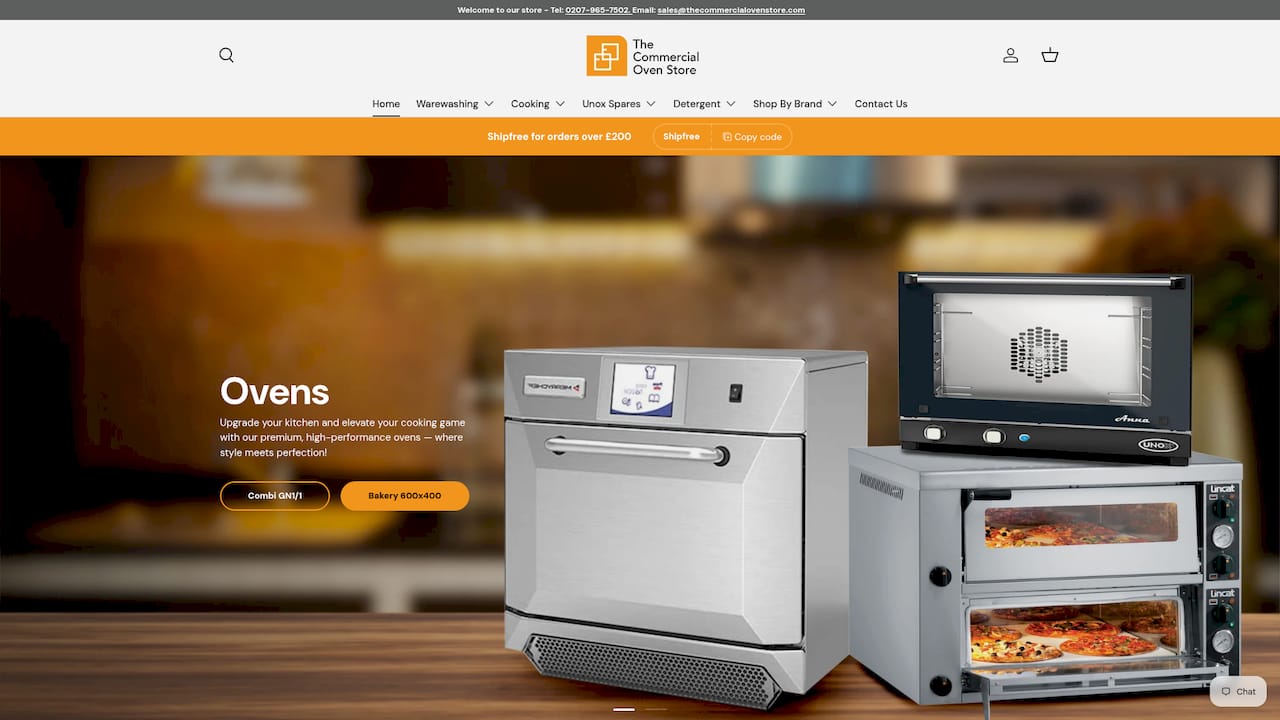
Tell us the menu, the covers per service and the utilities you have, and we will help you match the oven to the room before you order, which is the quickest way to take avoidable delay out of the schedule. You can reach us through the Commercial Oven Store.
FAQ
How long does a commercial oven take to be delivered in the UK?
For standard commercial catering equipment, a 2026 UK fit-out guide gives a typical lead time of 3 to 6 weeks. The exact figure depends on the brand, the model and whether it is held in stock. Ask your supplier for the date for your exact variant, in writing.
Does the lead time include installation?
No. Lead time normally covers the period up to delivery. Installation and commissioning come afterwards and depend on your electrician, plumber and, for gas, a Gas Safe engineer being available. Book them against the delivery date.
Is a quoted delivery date guaranteed?
Often it is not. Some trade terms treat dates as estimates unless a guaranteed delivery charge is paid. Check the terms on your order and ask whether a guaranteed slot is available if your opening depends on it.
When should I order if I am opening a new kitchen?
As soon as the layout is signed off and the utilities are confirmed. Late ordering is the most common cause of programme overruns on fit-outs. Ordering before sign-off risks buying equipment you later have to change.
Can I spread the cost while I wait for delivery?
Yes. We offer flexible payment through iwocaPay and lease finance on our ovens. Agree the arrangement before you fix a delivery date so that payment does not hold up release.
Sources
- How to Quote and Run a Commercial Kitchen Fit-Out (Zigaflow)
- IN DEPTH: A combi odyssey (Catering Insight)
- The Feathers Hotel’s Commercial Kitchen Rebuild case study
- Terms and Conditions of Trading (Alltrade)
- Gas Safe Register